What Kind of Fish Have I Caught?

Now What Am I Going to Do?  by Sheila Maloney

Why did I decide to write a mystery? Let me see.

I was living half way up a mountain, suffering from a serious lack of sensory deprivation. I was surrounded by extraordinary beauty and bored out of my skull. I had read every mystery available in the Kern County Library down the hill. I couldn’t afford anymore Kindle e-books. And I wasn’t aware of digital loans. I could watch TV only if I crashed in somebody else’s living room. Internet connection could be found only at a cafe, which still wasn’t licensed to serve. Anything. Besides the connection was so slow, it took hours just to buffer.

So not a serious writer. Not driven. Just bored.

On the other hand, I had built my long life around narrative, survived by it, studied it, taught it, got withdrawal if I ran out of it. So why not?

My friends in the mountain village, fearing for my mental health, brainstormed the underlying idea – eco-terrorism. Well meaning ecologists driven over the line by ideology. Or not. Three and a half years and eight rewrites later, back home in Toronto, I published Hour of the Hawk, independently as an e-book and POD (print on demand) on Amazon.

Six months later, 300 e-books have been downloaded. Free e-books. Twenty five paperbacks have been sold, 20 to the author, the others to her friends.

So marketing?

David Gaughran who generously shares his experience in independent publishing, helped me – virtually – to publish my first book, a memoir of childhood, Never Tell with his free book, Let’s Get Digital in 2012. Now I turned to his book Amazon Decoded for finer points on accessing Amazon’s best seller’s lists and his newest Strangers into Superfans. Reading and rereading, I slowly began to refine my idea of my ideal reader.

OMG!

She was a cozy mystery reader!

➤ COZY: One of the ironic strengths of this subgenre is the fact that, by creating a world in which violence is rare, a bloody act resonates far more viscerally than it would in a more urban or disordered setting. READER EXPECTATION:
A unique and engaging protagonist: Father Brown, Miss Marple, Kinsey Millhone. The crime should be clever, requiring ingenuity or even brilliance on the hero’s part to solve. Secondary characters can be coarse, but never the hero—or the author. Justice triumphs in the end, and the world returns to its original tranquility.
Writer’s Digest Oct, 2015

A world where violence is rare -Bear Mountain Place, a remote village in Southern California – check
a unique and engaging protagonist –  Joanna, a 78-yr-old who has trouble recognizing faces, Clara, an 85-yr-old who has trouble seeing and hearing, set out to solve the mystery -check
a clever, ingenious even brilliant resolution by the protagonistadd visionary – check
Justice triumphs, order is restored – of course, with two such sleuths on the case – check

So what’s the problem?

In order to find my narrative voice, I had a number of portraits taken and this is what my narrator looked like. (Phillipa C., Dundas W. Toronto)

Not cozy. Smart-mouthed. Occasionally profane. Prone to black thoughts. Convinced of Samuel Beckett’s rule, ‘Despair young and never look back’.

Gaughran told me to look at “Also Boughts’. (In my case, the term ‘bought’ has to be used loosely.) These included several cozy series including the Cupcake Series, (cozy mysteries often include recipes), several historical mysteries like Mona Lisa’s Secret by Phil Phillips, the Undertaker Series (sounds promising) and Everett by Jennifer Buff, a dark psychological suspense novel.

Oh, come on, Joyce, you did include a detailed description of a birthday dinner preparation in Hour of the Hawk. And it’s true  Clara has six cats, named Jazz, Poirot, Tennison, Sherlock and Columbo. It’s also true that Joanna, who is living with her, is allergic to cats and endures a sequence of 27 sneezes early in the book.

You, Joyce, are a terrible snob. Like most English Majors. Look how long it took you to lower yourself to reading mysteries. You were 67 when your friend Anna said she was reading Donna Leone’s Detective Brunetti series set in Venice. (A lot of Italian cooking there) Only then did you admit a reader could not live by Booker Prize alone. Since then you have devoured P.D. James, Ruth Rendall/Barbara Vine, Elizabeth George, Peter Robinson, Ian Rankin, all of the Scandanavian mysteries – even Jo Nesbo, as well as Icelandic, Michael Connelly, Lee Child. Etc. Now you have had to branch out to espionage novels. You have had repeated escapes from truly awful cliched books, some of which you actually undertook to review. Get over yourself. Admit you wrote a cozy mystery.

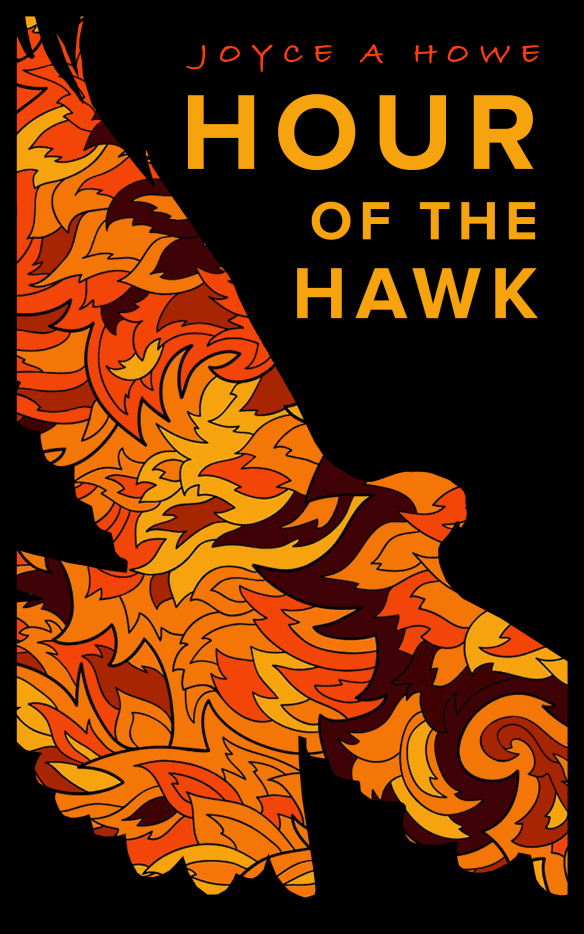
“Can I still keep the cover? (Jeremy Von Caulert, BLack Sunset) I love the cover. I’ll have to rewrite the blurbs. Okay, Okay, but only if I can call it a cozy mystery, plus.”

Hour of the Hawk  Chapter One: Too Many Bears

The bear came down from the mountain in late afternoon. She wasn’t hungry. She had eaten well, but she was missing the cub.

She turned at the bottom along the well-worn path, picking up the scent of honey in the distance, and closer up, traces of many other bears, including the cub. The cub was old enough to manage on her own now. There would be a new cub in winter. She was almost there when another darker smell stopped her in her tracks. Blood. Bear blood. She took it in. Not just any bear blood, her cub’s blood.

The man got home from work early. He was the boss. He could leave when he wanted. This bear thing had him all upset. All he had wanted to do was help his fellow creatures. They were hungry and starving in this four-year drought.

To continue reading sample https://www.facebook.com/joyce.howe.75
joycehowe.com


‘Am I in your book?” – The Worst Kind of Thief

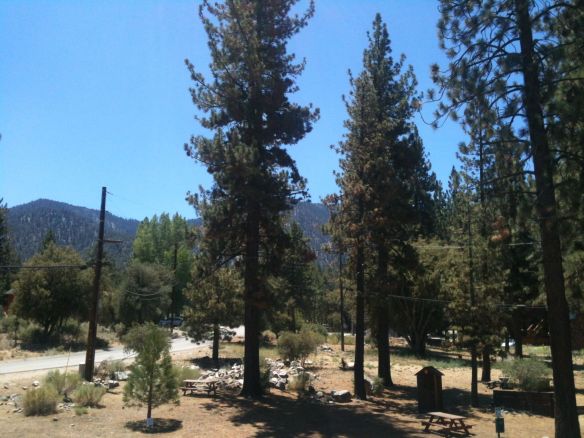
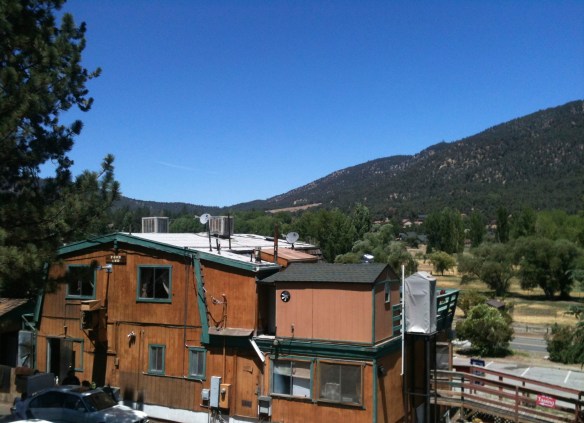
The mountain village of PMC in Kern County California, which served as the prototype for Bear Mountain Place.

Awake, I lack imagination. Asleep, I dream whole new worlds. Unfortunately, I do my writing awake. And so, I identify with Sheryl Crowe’s ‘worst kind of thief’.

In her song, The Book, Sheryl Crowe (from her 1996 self-titled album) sings that she read the book and discovered she knew that girl in it ‘a little too well’. She’ll always remember three days in Rome. She got “written down, sliced around, passed down among strangers’ hands”. She ‘laid her heart out, laid her soul down’. She learned that ‘the love you once made/can’t be undone’. ‘Will I get revenge?’ Well yes. By writing this song.

I longed to find proof that this was autobiographical. It seems too heartfelt to be fiction. But I didn’t.

Why do I care? I “carry a pen and a paper” and “no words I waste”.

I started writing my mystery Hour of the Hawk, when I spent several months in a California mountain village waiting out a family problem. My amateur detectives are two elderly women who set about finding out who is terrifying the town with acts of ecological terrorism, which steadily grow more deadly. I modeled one of them on a friend.

Clara was a disarming little old lady, cute, with flashing blue eyes and a lovely smile.  She had a great schtick. She could seem charmingly helpless-a girl just out in the world, or alternately, a slightly confused elder. The first week she was in Bear Mountain Place, a woman stuck $10 in her purse and told her to buy herself a decent meal.
“Why did she do that?” Clara asked me.
“Generosity,” I said. “But next time tell her you need $20 for a decent meal up here.”

I shamelessly stole other identities as well. Two of these people read the manuscript, and, although they both offered advice, neither objected to the theft. ‘Clara’ still had not read the book when I published it as an e-book on Amazon. Since she didn’t have a tablet, she still couldn’t. Then in February, I published Hour of the Hawk through Amazon’s Print on Demand. Now she could read it.

I’m such a coward that I tried the indirect approach. None of her close relatives would hazard a guess about how she’d react. Fictional Clara is hard of hearing and sight, so much so that the villain of the piece – or one of them at any rate – is able to sneak past here while she is watching television. Real Clara has had her vision corrected, but has also fore-sworn her hearing aids on the grounds that elderly fingers can’t handle tiny, tiny batteries. Would my friend resent these handicaps being used for humor?

The other amateur sleuth, Joanna Hunter, can’t recognize faces, a disability I am familiar with.

So I found my courage and wrote Clara a long letter, explaining my concern and enclosing a sample or two.

Then Jesus, the cable guy, arrived.
His card read Jesus Morales, Direct T.V. He pronounced it for me, Hesus.
“Hesus, Hesus,” I kept repeating to myself. I wasn’t used to Jesus as an ordinary name. I wasn’t used to Hispanic accents. I could understand Chinese or West Indian accents, and, of course, South Asian, but not Spanish.
He wasn’t used to Canadian accents. He didn’t understand ‘rooof’, so I had to say ‘ruf’. We kept asking each other to repeat. I held the record. I just didn’t get Hesus.
“Sit down. Why don’t you sit down?” Reg/Doug called to me.
Clara could tear herself away from them only for a moment. “Joanna can show you whatever you need,” she told Hesus.
He turned on the new 70-inch television set. It hung on the wall in front of the couch where Clara and her company sat. We were all jammed into a ten-foot wide space, crowded with unpacked boxes. When the sound came on, Clara cried out, “I’ll never be able to hear that.” So Jesus turned the volume up and up, until Clara was satisfied. The screen told us the volume was 87. Then she and the ‘boys’ resumed shouting.
Jesus showed me his work sheet, and began to ask questions. A bald guy on the screen was yelling about the shoddy workmanship on a renovation. Jesus was shouting questions at me. The boys and Clara were splitting their sides at some long ago anecdote. I grabbed the remote control, and turned down the volume.
“It says one box here,” said Jesus.
“No, no. We were promised two,” I said. “There’s another set in a bedroom. Colin talked to the company several times. There are to be two boxes.”
Then I moved Jesus over near the utility room, so I had access to the landline.
“Oh, Jesus-with a J-God, I’m going to lose my mind,” I thought.
Once I’d got hold of Colin, I handed the handset to Jesus, and locked myself in my bathroom.
It didn’t work. I had to come back out into the din. Jesus called.
When I came out, he assured me everything was all right now. The bedroom set was working as well. I dragged Clara away from the boys, explained what had been done, and asked her to sign her name. Suddenly, she decided she should take charge, and began to ask questions that had been answered an hour ago. Jesus tended to mutter in his thick accent.
“Do I have two boxes? Colin said I would get two boxes.” She went into my bedroom and came out. “There’s just this tiny thing in there, no real box.”
Jesus began to reassure her that both sets worked, independently of each other
“You’ll have to speak louder,” I told him.
He started shouting. I searched frantically for the remote control, found it at last on top of a pile of boxes and pushed mute. I gestured at the boys who were laughing with each other. Now there were only two voices shouting.

It took a week for the letter to escape the confines of Canada Post and the U.S. Mail and end up being released into Clara’s California post office box. Yes, she wanted to read it, I heard. A mutual friend handed her a print copy. I waited for her verdict.

“I’m so flattered,” she said when she called.

I have started writing the second Joanna Hunter mystery and Clara, who will soon be 90, will be part of it.

joycehowe.com

The e-book version of Hour of the Hawk is free to download on Mother’s Day May 13/18 and May 14/18. If you decide to read it, please leave a review on Amazon. The print edition is also for sale.


Leonard and I

Leonard and I were both born in Canada’s province of Quebec. He arrived, in this incarnation, on the autumn equinox of 1934, in the well-to-do Montreal suburb of Westmount. He was almost 2 when I was born in poverty in the wooded hills of the Eastern Townships.

He said he was “the little Jew who wrote the Bible”. Jesus was the only Jew I met until I was 12. He wrote me love songs, although we never met. He never did bring “my groceries in”. If I didn’t drag them in myself, an athletic mathematician did, a man quite unlike Leonard. Since loving me mandated at least tolerating poetry, Mr. Math learned to. He even wrote me a poem once, and was willing enough to go to Greece because Leonard had made me love it from afar.

Leonard, with a poet’s intuition, passed in his sleep after a fall on the night of Nov. 7th, the day before Donald Trump was elected president of Leonard’s adopted country. He had proclaimed earlier that “Democracy was coming to the USA”. I’m not saying he was wrong, just that his prediction may have been more complicated than it seemed.

Besides being born Quebec-ers (although not Quebecois), we shared an enduring depression. Leonard indicated later he had defeated it by becoming a Zen monk for five years. Kudos to him. My own excursion into Taoism did not prove as efficacious. I hope that Buddhism enabled him not to rage against the slings and arrows of outrageous fortune: the loss of his wealth to a larcenous business manager, the necessity to start touring again in his 70’s, the ‘unbearable’ pain of leukemia, and the inevitable losses of old age.

Personally, I am bitching mad at old age. I don’t have unbearable pain or a deadly disease (so far as I know). Of course, I don’t have Leonard’s companions either. He said the ladies had been very kind to him in his old age. Recently, two of the major problems in my immediate family have been resolved, I have published my mystery Hour of the Hawk, (joycehowe.com) I have a secure if modest income and a warm, safe place to live.The problem is that being pissed off actually makes my health problems worse.

I had a grandmother who lived to be 96, but apparently I learned nothing from her role model.

So I put in my earbuds and listen to Back on Boogie Street – not his own song but Sharon Robinson’s; he sings backup. I’m still on Booogie St. Got to market this book. Got to keep my head straight. Got to drag the groceries up to my tower of .. whatever. Coming up to 82, could l have my Nanny’s long-lived genes? Then I listen to ‘Hallelujah’. https://www.youtube.com/watch?v=hEWqDE20O3U
https://www.youtube.com/watch?v=YrLk4vdY28Q

Youth and beauty and ecstasy are not lost. They are there, ingrained, embedded, as alive in me as any mournful loss.

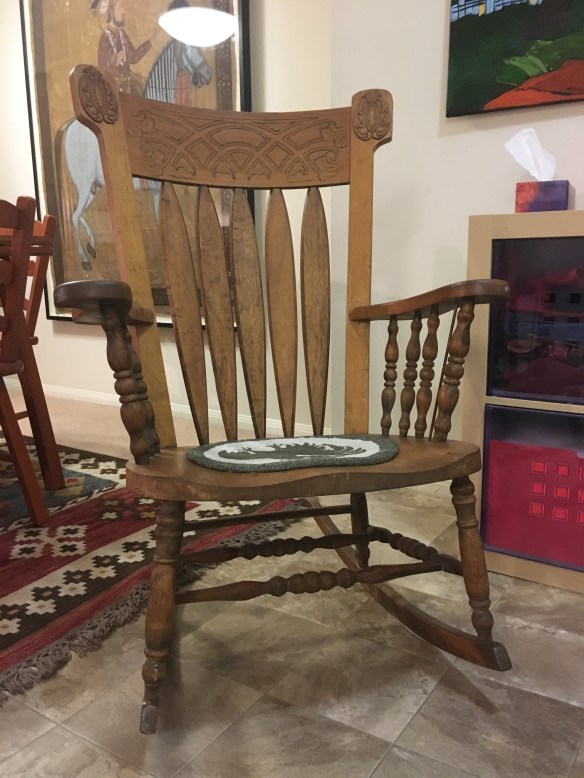
The Crying Chair

This is the crying chair. It sits in my entrance way on a tiled floor. Good rocking there and tissues at the ready.

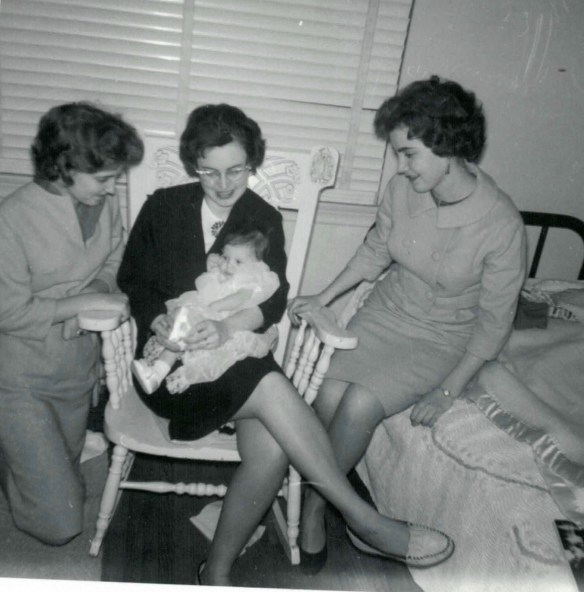
I saw it first at Christmas 1960 when I dragged my extremely pregnant body upstairs to my mother-in-law’s attic. She was storing it for a friend, but I could have it to rock the baby, temporary loan.

It was cream colored then. At some point, my husband painted it antique green. (When was the era of antiquing?) During a desperate teachers’ strike, our house became the place for coffee break. Deep winter. Constant arguing. Months of poverty. My two children unschooled as well, of course. To avoid insanity, I carried it down to the basement and stripped the paint off and oiled it. I loved the chair. It saved me.

I rocked my large self in it through most of a dark January 1961. When she arrived, my daughter, like her mother before her, cried. If she had cried for Canada, she would have won the gold. My father slept with his foot out of bed rocking my cradle. I rocked her in the big, comfortable chair.

Her brother arrived a year later. By then his sister was noshing on pureed food, so her colic had cleared up. Anyway her real live doll-brother made her so happy, she didn’t need to cry. He, in turn, was fascinated by her -his own non-stop performance artist/teacher, and calm by nature. Still I rocked them both before bed and at teething time, one on each knee, singing every song I knew including ‘House of the Rising Sun”

Some nights, however, I cried as I sang. Their father taught day school, night school, took night courses and tutored on Sunday. We had dinner together. That was it. A quiet, tasteful time, full of conversation. No. Two babies who needed to be fed while Daddy tried to sort out the evening lesson plan.

I had studied English & Philosophy and Drama. I was the only female survival in the Logic class by third year. I had two years of teaching English under my belt as well as teacher training. I had subdued 50 hormone-ridden grade 10s in a classroom with 48 seats. Now I was washing six dozen cloth diapers twice a week.

I started reciting Shakespeare as I bathed the kids together in the big tub.

Eventually, my husband intervened. “What would you do right now, if you could do anything?” he asked. “Put on my navy suit,” I said. “Where would you go?” he asked. “Cedarbrae Collegiate,” I replied. “You want to go back to teaching,” he said.

How could I? It was 1963. My job was to nurture these priceless babies. It just wasn’t done. But before we got up from the grey card table that functioned as our dining surface, we had the plans underway. We would hire a nanna, carefully vetted. I would get a job easily. Populations were booming and my clever husband could stop working all the time. My terror and relief could be soothed only by more rocking those bigger and bigger babies.

The rocking chair went with us to a new house. We were now making almost $12,000 together. It was an ideal place for growing children, a hill, with a flagpole and a martin house, wilderness, gardens, fences and eventually a pool. There were parks galore and a very high cliff above Lake Ontario for risking young lives. Not that we worried. They had bicycles. They had each other.

The rocking chair sat in the corner of the rec room beside the sliding door and in front of the fireplace, which any of the four of us could choose to light. Nanna kept it swept free of ashes.

Then the crying chair came back into its own. I was the one in it. It was 2 a.m., where was my husband?

The chair and I set out on our travels. Sans the others. We moved to Heyworth Ave., to Main St., to Fishleigh Dr., to the town of Zephyr, to Mississauga, to Evans Ave., to Stephen Dr. and back to Mississauga. I can picture where my chair sat in each of these places. All except 3 had my name on the deed. One had my sister’s and two I signed leases for. A good deal of rocking and crying went on in those 40 years.

Meanwhile my ex-husband had lost his much younger wife to cancer. He had been diagnosed with stage 4 cancer the same year, 2010. We welcomed him back into the family at Easter 2012. (“Should of stuck with the old girls,” my sister greeted him cheerily.

He and I had lunch last week. A two hour lunch tires out this 82-yr-old retired teacher, but he seemed to want to come to my 14th floor suburban apartment. We did have to talk over a few details concerning his estate. There have been no bad tests recently but…

I pointed out the crying chair. This sent him into a reflective mood. He always cried easily-just maybe not over me. Intimations of mortality can bring that on. He regretted our son had not continued his painting and sculpting. I thought that a youthful art career is like a teen-aged rock band. Most people grow out of it.

Hubby, for example had chosen math and physics, over art. Even got to work with a nuclear reactor. (Is that significant?)

Anyway, grief is always the same, not so much about loss as the f-ups that we regret.

So the chair waits invitingly, inevitably.

Feel free to drop by and cry until you’re done.


Kindle and the Red Top-Down (The Hawk flies again)

So the red top-down went missing. It wasn’t as if I could call the police. Not that I had left the keys in the ignition. The trouble was it was an imaginary 1963 red MGB. I found it  myself in the word document titled Hour of the Hawk v.8 for Vellum, put it back where it belonged between Chpt. 4 “Too Many Kids” and “The Sitter” which had got promoted to Chpt. 5. O.K. done!

But no!!! One hundred and four people had already downloaded my mystery Hour of the Hawk. (joycehowe.com) Without that clue-filled chapter, they wouldn’t understand the vision of the car at the bottom of the cliff. They wouldn’t understand why Xiao Yu ended up in a mental ward. They wouldn’t understand why Joanna Hunter’s life was in danger. They would think I was a terrible writer or that they were stupid.

Both J. and M. went for the latter. Thank God, C. who had listened to me talking about the plot, said, “Do you describe the flood?” OMG. Of course I do. Where was it?

That was Sunday, Dec. 31.

I don’t want you to think I did all this calmly and quietly. I could barely remember how to turn the computer on, and I wasted a good deal of time staring at the Kindle upload page, which I could not now comprehend. I felt as if I had never seen it before.

I shook of course. I had a dry mouth. My fingers blundered.

Well, that’s what got the red MGB lost in the first place. As I went through the Vellum version the umpteenth check, I saw the heading “Chapter Five”. It didn’t need to be there. Right below it was “5. The Red Top-Down”. I went to the tools and clicked “hide in book”. The tool did its job all too well. I didn’t. I didn’t do one more sweep as I should have.

At first, a KIndle employee, K, working late on Sun, New Year’s Eve, answered reassuringly, saying they would review the change and if it was a serious error, they would forward a link to buyers so they could get the chapter.

Serious, yes, serious! I shot back.

On New Year’s Day, I bought new versions for 5 friends I knew had downloaded it. Kindle wouldn’t let them “buy” the book twice. Somehow I managed to get myself and my sister, Georgia, the updated version. I e-mailed the chapter to the others.

The terrible thing was, except for C., they hadn’t missed it.

Then I waited. Not quietly. I sent Kindle ever more hysterical e-mails. A. responded with increasing empathy. Once she used the word ‘noble’. No, strictly venal. But it was up to K and the Star Chamber that would examine the book for quality.

It was a quantity problem, I replied.

Publishing a book, like giving birth, is a jarring experience. What was once a comforting inner presence is now out there in the world causing problems. I cried at any and all TV shows. Talk about baby blues.

Finally last night, I lost it. I wrote an e-mail lamenting my destroyed reputation and subsequent breakdown. I felt as if I were praying to an absent God. But still I was careful.  You don’t want to piss God off too much. Then I went to bed and read Fire and Fury – on KIndle.

This morning, dear heaven, I got an e-mail. I had passed the audition. Word would go out to all 104 readers telling them how to get a new version.

Vellum is a formatting program, recommended by Joanna Penn in her blog. “Why I changed from Scrivener to Vellum.” It formats your book in about 10 seconds in 8 different formats, including Print On Demand. It’s way too easy to use. See above.

Oh, my children used to call our green 1963 MGB the top-down.


Canadian Cold Front Moving Nowhere

Our cold water pipe froze. Water pipes are freezing across Canada. People are trying to thaw them with blow torches. Houses are catching fire. Fire hose water is freezing as it hits the air.

When I say “our”, I mean the residents of the 15 storey building I live in. Holy suddenly-cold-shower, Batman! Holy no-water at all!

“Can’t they prevent that?” my sister Georgia demands.

“Personally, I have never had any luck with preventing it,” I reply.

So, yes, I have had pipes freeze, but not in December, not at Christmas. The end of January, yes or the middle of a bad February. Not when my festive duds are lying ready for a freshly showered me.

I have a rule. Stay in until supplies run out. If the wind-chill is -30 C. (-22 F) make do. If it’s only -20 (-5 F) go for it. It’s -20 right now. I really do need to get to a store.

The wind is rattling my windows here on the 14th floor and moaning in under the door to the hall. I wear a woolen tuque when I go down for my newspaper. A heavy hoodie goes without saying.

One day last week, Toronto was colder than the North Pole. Ottawa, was the coldest capital city on earth that day. New Year’s Eve was basically cancelled, although some hardy soul lit the fireworks anyway.

Still never confuse weather with climate, as Georgia told me just now. She lives 3 lights west of me. We’ll get together again around Easter.

(I know I’m a softie. It gets down to -40C on the prairies. I put it down to history. Some of my ancestors came over to the Plymouth Colony on the Hopewell in 1634. The Mayflower arrived in 1621. I should be hardier. But I grew up in a farm house with one wood stove and snow drifts inside the windows.)


Excerpt from the beginning of Hour of the Hawk: joycehowe.com

The whole thing started at breakfast.Sitting at the table, I could see the cyclists on the bike path, and people walking their dogs. My laptop was lying to my left, waiting for me as I strip-mined the newspaper for information. It was the beginning of May. The maple trees lining the road had a green mist.

Spring north of Lake Ontario is a little taste of heaven. We sigh and let go of the winter scowls that warded off frostbite. We lift our faces to the long lost sun. For however brief an interlude, it is warm. It isn’t freezing like the Arctic or sweltering like a Florida bayou.

Who’s your Psychopomp?

SAMSUNG DIGITAL CAMERA

As for qualifications, I have camped on the south shore of the Gulf of Corinth at the mouth of the River Styx and crossed it several times. So have all the other residents of Akratas. No that won’t do. (The Ancient Greeks believed that Charon, the boatman ferried them across the River Styx to the Underworld. They were buried with coins on their eyelids to pay him for his service.)

As a child, I was shut in boxes. Maybe that was my early training.

At a certain point in my life, the recently dead started turning up, usually sitting in a chair in the corner of my bedroom. Just sitting. Never talking. Or in my dreams, they phoned me, never saying anything sensible and never answering questions. My father’s spirit persistently offers advice such as ‘Buy lottery tickets’. He was a villain on earth, but he has spent 30 years on the other side and seems to be a reformed being. He even shows up at hospital bedsides to comfort those he once harmed. So they tell me.

Somewhere along the line, my family started to assume that I was a conductor of the dead, a psychopomp. They didn’t use that word of course. It is not a role I aspire to. At the moment, for example, I have a recurring image of a man who has passed over, but doesn’t believe in the afterlife. He is huddled in a fetal position with his ears covered, pretending he is not conscious. I repeat the 23rd Psalm to comfort him and, alternately, offer to give him a swift kick.

I’m not religious at this point, but I remembered that comforting song of David, and thought it might help – Josh, let’s call him Josh. If you feel inclined, you could join me in your own way, encouraging him to “Wake up! Wake up! It’s not so bad. You really are forgiven.”

When I uploaded my e-book, Hour of the Hawk, Amazon called ‘psychopomp’ a spelling error. An aberration, a delusion, perhaps, but not a spelling error.

Creating my main character, Joanna Hunter, I saddled her with that ‘ability’ as well as a conscience which speaks to her in her great aunt’s voice, admonishing her to fulfill her duty.

Her first duty is to attend to Tom Braddock who has been mauled to death, in his own backyard, by an angry bear. Well, of course an ‘angry bear’. He would hardly have been killed by a grateful, happy bear, even though he did persist in feeding his bear friends honey in a tire swing. And the bear had good reason for being angry, although not necessarily at Tom.

There are other deaths. It’s a murder mystery after all. But those Departed have enough imagination to manage on their own.

As you will, no doubt, when the time comes. Just be sure to cure yourself of the idea there is a hell. Pretty sure we are doing our stint there, right here on earth. Like my father we may have much to learn in the afterlife, but as a school it’s much more like Play Mountain Place than the boarding school Prince Charles attended. It seems to me, the afterlife can be whatever you think it is. With night school courses in empathy.

For heaven’s sake, don’t call on me to guide you.

To purchase Hour of the Hawk as an e-book go to joycehowe.com. It will be available as a paperback from Amazon in January 2018.


Should You Hunt a Doppleganger?: Redhill’s Bellevue Square

Trinity Bellwoods, the model for Bellevue Square

In Michael Redhill’s Bellevue Square, Jean Mason decides to track down her double/look-alike/doppleganger. One of the customers at her bookstore reports he has just seen Jean with shorter hair and in different clothes in Toronto’s Kensington Market. He reacts violently when she denies it, and, eventually is found hanging in his apartment. He’s not the only one who sees the double and ends up dead.

Jean sets out on a quest to find this other woman, who’s name is apparently Ingrid Fox, and who, it turns out, is a mystery writer.

I felt almost uniquely qualified to understand this book. (Not quite unique because my reading partner, Georgia, has the same sort of qualification.)

I can intentionally look at my image in a mirror, but if I inadvertently catch a glimpse of myself, I have to avert my eyes instantly because that’s not me I’m seeing. If I keep looking, I zone out or become dissociated. It’s as if the image is hypnotizing me. And, yes, I have had therapy. I have discovered hidden parts of me, particularly one – D, who led a life I didn’t remember. Not a very fun-filled one. A sober cult-ish life devoted to foretelling the future and trying to keep other cult-ish people out of trouble. With pretty much zero success! Knowing the future apparently does not change behavior.

Once I discovered D’s existence, I still had a long way to go before we got integrated enough that I stopped getting up in the middle of the night and putting on robes.

One thing I always knew was that I couldn’t just get rid of her. I had been assured that I was not psychotic -at great expense- but I always sensed that I could become mad if I tried to cut off D. or any of her lesser sisters.

Jean has a somewhat different problem, autoscopy. Something is wrong with her brain, somewhere between the temporal lobe and the ear. (There are several people with damaged brains in the story, oddly in the same area.) This disease causes sufferers to externalize their self-image.

In an effort to achieve integration (my interpretation), Jean begins neglecting her bookshop, her two sons and her ex-policeman (or actual police chief) husband Ian to search for Ingrid. She does this by sitting in a park, Bellevue Square, where Ingrid has been sighted. There she relates to the park’s habituées – eccentric, drug-addled, mad but lucid and just plain mad.

But she doesn’t find Ingrid. Not until the end of Part 1, when Katarina, who sells pupusas in Kensington Market and was the second person to report the doppleganger is shot. Jean is the main suspect. Only then does she spot Ingrid crossing the park. As she follows, Jean wonders if Ingrid is “the harbinger of her death”.

Then we discover Jean is actually a university lecturer who has vanished from her classes, and her husband, Ian, seems to have a problem with her owning a bookstore.

Things get weird. Jean has a mirror experience: she sees herself but she’s not in the room. While she gets closer to Ingrid -entering her home and making a gorilla sandwich for Ingrid’s daughter, and discovering Ingrid has a boo-boo in her head – she gets farther from herself. Finally, she ends up in a hospital bed, coming out of unconsciousness.

My reading partner, Georgia, said initially that she must be too stupid to understand the book. Then as we talked, she hypothesized that everyone besides Jean was really Jean. Even Jimmie, whom she breaks out of CAMH, the mental health clinic, and who goes with her on a long hazardous flight to a northern woods. There he seems to abandon her and she finds herself more than ever lost.

Obviously, the book is about identity and fluid identity at that. Jean is following breadcrumbs in a quest for herself. Does she succeed? Maybe the next book in this three part series Modern Ghosts will tell us.

I am a little worried about Michael Redhill, considering what happens to Inge Ash Wolfe in the novel, since that is his pseudonym when he writes mysteries. Maybe he just integrated Inge and Michael and all will be well with one author identity.

Bellevue Square must mean something. It won the Giller prize of $100,000. Perhaps Georgia, D and I aren’t up to the job after all.

Full Disclosure: Initially, I published Never Tell, my e-memoir, under the pseudonym of Joyce Hood, as I did this blog. I have reverted to Joyce Howe, now that all the cult-ish types are either gone or toothless.

Coming soon to an Amazon near you Hour of the Hawk, a mystery by Joyce Howe


Where Did You Go Joe Dimagio?

Have you had the experience of meeting someone after years apart and feeling that no time has passed. You start up your friendship right where you left off, all those years ago. Me too.

I went away a year ago. Part of the reason can be found in my last post. I was about to lose my decade-long home. The other reason can be found in my Dec. 15, 2015 post, Getting the Hawk off the Ground. The picture said it all. I had to rewrite my mystery, Hour of the Hawk.

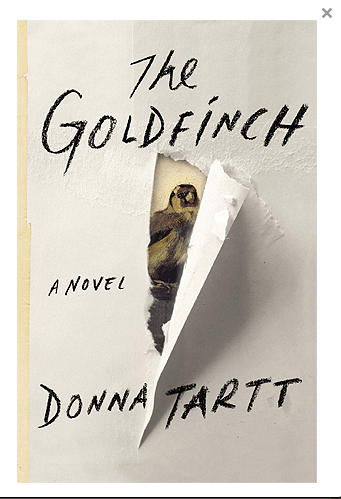
I last posted in Sept. 2016 – A Gold Finch This Morning. I had just finished reading Donna Tartt’s book The Goldfinch, and had been greatly heartened by her description of terrible depression, my own default setting. It had made me laugh, horrible though it was: it was so dead on.

“This was a plunge encompassing sorrow and revulsion far beyond the personal: a sick, drenching nausea at all humanity and human endeavor from the dawn of time.” (863/1427- on my iPad). Theo goes on to enumerate all the futile actions we indulge in -playing, working, having babies, redecorating, reading restaurant reviews…

Happily, I can report I am not homeless, although I am writing this in my favorite Starbucks. My resourceful sister took me in hand, announcing that I needed to live near her and her daughter because of my advancing age. Any day now, apparently, I will need a zimmer frame and a tag pinned to my coat, giving my address and saying, “If found, please return.”

Georgia lives in Mississauga, a suburb west of Toronto. I had lived there 15 years before. As a young married woman, I had lived in Scarborough an eastern suburb. I had already done my time in suburbs

But Toronto rents for a one-bedroom were $900 to $1000 more than I was paying for my two-bedroom, rent-controlled home. In Mississauga, we found a one-bedroom on the 14th floor for only $500 more. The library, recreation center, pool and park were one long block away. And I could count on invites to dinner every week.

So I moved, got rooked by the movers, lost things – some didn’t make it onto the truck, some unpacked by others- I had to get niece to come back and find the battery box, and just generally lost my mind. Getting groceries from my car and up to my eerie flummoxed me. Ditto doing laundry on the ground floor. My muscles took turns seizing up. I discovered that reading in bed not only helped with that, but had the additional benefit of a floor to ceiling window on life in the burbs: a major thorough fare, two schools, parkland, a community of houses and the front door of the building.

I hated it. Of course I did. I could see all the way to Lake Ontario and, on a clear day, half way across. I wasn’t God. Why would I want to do that?

I wanted my green old neighborhood with the crazy Polish woman next door, who persisted in thinking that I understood her rapid Polish, and had the ability to influence my landlord. I missed the maples and the deer that lived in the oak savannah next to the river. I missed the kids on the other side of my house. I missed the “girls” upstairs. I could hear all 4 of them in my place.

In the new place I had a wood burning fireplace. I had a gym on the penthouse floor and a sauna. In the brief summer I had an outdoor pool. I got to go to house parties where beautiful African Canadian and Muslim children softened my heart. I was in a minority. Let’s just say that Donald Trump would not approve. Even the province of Quebec in my own country would look askance, although we have no burkas, just a lot of very colorful hijabs and African prints. The West Indians and Haitians fill the halls with lilting English and distinctly un-Canadian French. And, of course, I got to go to dinner two blocks away.

Well, okay.

I got the place in order eventually, sat down at my desk in front on another floor to ceiling window, and pulled up version 7 of Hour of the Hawk. It was as usual, completely silent in my tower. And warm. Did I say warm? Those windows face south

Version 8 coming up.

Next post: Getting the Hawk off the Ground 2017.


A Goldfinch This Morning

goldfinch

MAY TRIGGER DEPRESSIVES.

https://www.theguardian.com/books/2013/oct/17/goldfinch-donna-tartt-review

I borrowed an e-book version of Donna’s Tartt’s The Goldfinch from the library. (Still pretty amazed I figured out how to do that, but a rent crisis made it necessary.) This morning, I arrived at 870/1427. In this passage, the protagonist Theo Decker, who suffered a terrible loss when he was 14, as well as a remarkable, if dodgy, gain, is now 26. He decides to wean himself off his drugs of choice, Oxycontin 80s, et al. These enable him to carry on a successful life, whereas alcohol, his father’s drug, or heroin would not. So he says. (This does not reflect the views of the writer who has trouble with 100 mgs of Sertraline.) The physical withdrawal is bad enough, but after that comes the DEPRESSION.

“This was a plunge encompassing sorrow and revulsion far beyond the personal: a sick, drenching nausea at all humanity and human endeavor from the dawn of time.” (863/1427- on my iPad). Theo goes on to enumerate all the futile actions we indulge in -playing, working, having babies, redecorating, reading restaurant reviews…

Elsewhere I have confessed to a black sense of humour. I embrace Beckett’s advice to a young writer, “despair young and never look back.” except I tend to apply it to life in general. So these few pages cheered me up and made me laugh.

My 80 yr-old-body had hobbled out of bed this morning with full awareness that today more strangers would file through my apartment. Eventually, one of them would buy the triplex. Very likely, they would then evict me. My place is the only unit renovated. The only available apartments are $200-800 more than mine. (We’re having a really big real estate boom in Toronto.) I try to remember that “in my father’s house there are many mansions”, but getting into those seems too radical altogether.

So I’ve been ruminating on divorce, recession, illness, housing bubbles that burst, and those that haven’t yet. But this despondent passage in Donna Tartt’s book was so beautifully written that I didn’t care.

Goldfinches, especially painted ones, do not have voices like nightingales or mockingbirds. They twitter as they swoop, parentheses of bright flashing light.