 The woods are lovely, dark and deep. (Robert Frost – Stopping by Woods) (In a valley in the Sierras, just across the Kern County line from Los Angeles County; otherwise Shangri La.)
More to come.

The woods are lovely, dark and deep. (Robert Frost – Stopping by Woods) (In a valley in the Sierras, just across the Kern County line from Los Angeles County; otherwise Shangri La.)
More to come.

Not taken at 6:30 am on a Monday!
Toronto Pearson Airport 6:30 a.m, a Monday. The septuagenarian hobbit is about to learn a lot.
Lesson 1: The physics of a rolling object 1.0.. The new large roller suitcase isn’t as easy to roll as they claim. The carry-on rolls better. The bigger problem is how to co-ordinate two rolling bags.
Lesson 2: Times change 1.0. I’m already checked in on-line. I’ve already paid for my checked bag. What the –? I have to print my own baggage tags. Do the check-in kiosks do that? The very tall man in front of me, who hasn’t checked in yet – how old school- assures me they do. Then an attendant, one of a rare breed, identifies me as old. Helps me flatten my passport, sticks the baggage tag on, scans it and send me off to find the E entrance.
Lesson 3: The physics of rolling objects 2.0. Should have got a push trolley. E is half a kilometer away. The big bag weighs at least 23 kilograms.
Lesson 4: Patience 1.0. There are at least 1000 people in the U.S. customs hall. They are all ahead of me.
Lesson 5: How to Queue. By spreading my feet and doing a high sit into my hips, I can keep from fainting in the dense, winding line. Tearing off the coat, scarf and tam I have worn against Toronto weather helps as well, as does chatting to the people behind and in front.
Lesson 6: Times Change 2.0. Eventually, I arrive at another kiosk which also wants to read my passport and again, I have to flatten it with both hands. Then on to the next line with a real human being at the end.
Lesson 7: Times change 3.0. American Customs and Immigration officers have mellowed. In 2002, I was almost denied entry. I had family in the U.S. and it was felt I was going to stay. I bit my tongue and did not say, “As if.” I said that if I did, I would lose all my benefits. She let me through. Today I am asked if I am having a good day.
Lesson 8: Patience 2.0. At the security check, I am behind an older couple and their adult son. (They are probably younger than me.) Totally emptying his pockets is too much for the old guy. He thinks that’s an imposition. His wife puts her smart pumps in the bin. The next thing I hear is, “I have to take my shoes off too.” He steps through the metal detector which sounds its alarm. The officer tells him to step back. He is told to go through his pockets again. He is wearing cargo pants. He fishes out a wad of paper. He steps through again and again. Same result. I stand waiting for my turn. The officer uses the wand which squawks many times. I want to shout,” He has metal knee replacements.” I don’t. Dad is moved over to stand on a black square, facing the wall. Mom is stood on a second square beside him. A female officer joins the fray and both desperadoes are carefully patted down. Nothing. I pass through the metal detector. Dad is standing at the conveyor built, which is standing still. “My money’s in there,” he cries. Mine too, Dad. A second invigilator arrives. Much study ensues. Son has moved Dad back to sit in a chair. Mom stands beside him. “My shoes,” cries Dad as the belt starts moving. “Dad’s shoes,” Mom cries. “Get Dad’s shoes!” I pick them up and turn to Son, saying,”Dad’s shoes.” As I reassemble myself and claim all the valuables I have in the world, I hear, “Flashlight. It was a flashlight.” Right, can’t have seen many of those before.
Lesson 9: Perspective. The tall, rangy West Indian guy who lifts my checked bag onto the belt, makes up a special song to wish me on my way.
Lesson 10: Patience 3.0. The line at Starbucks is 20 passengers, 4 pilots long.
Lesson 11: How to count. My gate is F34. I set off on the moving sidewalks, pulling the carry-on bag. Near the end, it occurs to me that F34 is not going to come after F80. The moving sidewalk says, “Do not enter”. I need to hurry. It is boarding time. I begin to trot back – “boats beating against the current” (F. Scott Fitzgerald), but I am working up a good sweat, so it isn’t all bad.
Lesson 12: Self-worth. I am finally seated in 18D. A woman is in 18F at the window. She gets to see the Grand Canyon . I get to pee. We are both praying no one will claim 18E. He is the last person to board. He is 6’4″ with the weight to go with it. As he folds himself into his seat, he says, “I tried to switch to an aisle seat but couldn’t.” And can’t now, I observe to myself. Age before beauty.

Are you the 13,000 visitor? Look on the home page. There is a counter there on the right.
And thank you all so much for your encouragement.
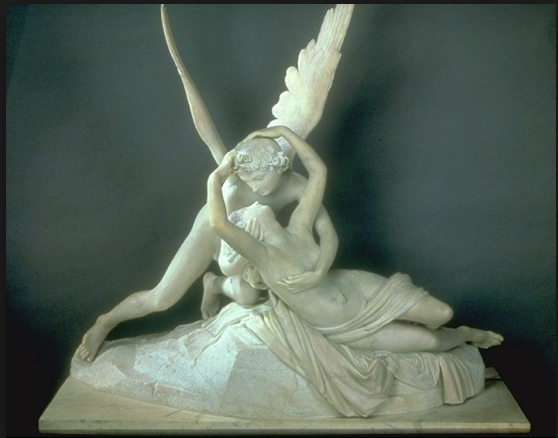 (The myth of Psyche and Eros, the god of love, is found in the Roman Apuleius’s novel Metamorphoses or The Golden Ass, about 150 CE. The myth was retold by C S Lewis in his novel Til We Have Faces, 1956, written in conjunction with his wife Joy Davidson. In the story, Eros forbade his love Psyche to look upon his face.)
Becoming Psyche (an interim stage) (2011)
Fathomless grief has washed me clean,
Dissolved the clenching that
I once called me.
I have courted this relief, but
Now, emptied of all I was,
I cry out against the loss,
Not helplessly begging some god
To fill the void, but
Asking, rather, to know that I am already full.
Let me see you, I pray.
Be clearly present,
Be presently clear.
Show your reflection in this empty glass,
Give voice to silence,
Share this solitary bed.
Grief has wrought this marriage
To the soul,
But Eros has forbidden me
To look upon his face.
Being Pysche (2014)
The signs were someone else’s
-so I thought-
the Chinese talisman she drew, the tiny owl,
Minerva’s messenger.
Then Hades lured her down,
lost Proserpine,
into his underworld.
No chance of spring.
I forgot to seek the face of God
I sought her face instead.
Yet she returned; spring rose
and looking up I saw
my own face in a glass, no longer empty.
“I love you and I trust you.”
For days the words went with me.
Then one dawn,
I heard a singing in my head,
A man’s voice, full of longing.
“The water is wide and I can’t swim over.”
Two such longings bridge an ocean.
All day, it sang, until I fell in love.
Lying down to sleep,
flashes of brilliant gold
above my eyes.
Gift of the underworld-
the god of love has shown his face.
Joyce A Hood
(All the mythological references can be found on-line.)
 As a septuagenarian hobbit (a stay-at-home 70-something), I board a plane the way I get into an Athens taxi: I accept my death. After that I can relax.
I leave the pseudo-leather folder containing my will and insurance policies out on my desk. Clearly labelled.
When I was a mere 50-something hobbit, I actually flew to the other place. Very instructive. https://115journals.com/2012/07/20/i-dream-of-etherica-life-changing-dream-2/
My eastern medical adviser says this idea results from liver heat. General Liver is trying to help my weak, damp digestion by going into battle. The fire rises to my head and produces scarey images.
My western medical adviser prescribes Lorazepam. Which I carry on my body in case I have to slid down the escape exit without my purse.
I have given up wine with airline breakfast. Too dehydrating.
Last time this hobbit went on an adventure it was Christmas season and I flew to Belgium. See https://115journals.com/2013/11/28/the-septuagenarian-hobbit/ and posts following. There I contended with the confusion of three languages and found myself embraced by mon frère and his many friends. Turned out I was so Europianized by my three week stay that I found it hard to adjust back. https://115journals.com/2014/01/05/the-septuagenarian-hobbit-gets-a-parking-lesson/
This time there will be no language problem. Well almost none, although Los Angeles is near the top of the list of large Spanish-speaking cities.
I am due to arrive on Cinco de Mayo, a day of celebration. So nice of people to party on my birthday. For indeed it is. After this, I’ll have only one more septuagenarian birthday. Figure it out.
So what to do? Shall we immediately set out for the mountain fastness where Julia now lives. Not a chance. Let’s round up a little party of our own, hit that place in Culver City and crash at someone’s house when we are partied out.
I don’t travel for the love of travel. I travel for love.
 At Easter brunch, I learned that a 15 lb, 3-month-old baby is too heavy for these ancient arms. I learned that a grade 3-er doesn’t read cursive writing, except her name, which she can proudly sign. I learned that a 30 year-old is baffled by the expression “ham it up” and others, which astonished elders then trotted out to further bafflement. I learned that this same young man can solve a computer problem that I have struggled over for at least an hour in a split second. I relearned that even the grade 3-er spends half her time face down to her device – a tablet, as did those 20 and 30 with their smart phones.
I already knew that my 19-year-old grandson, who was having Easter brunch across the continent, had a problem telling time on a non-digital clock and my 28-year-old grandson prefers to print rather than write. Although he must have also more or less mastered his signature – to be a doctor. That can be blamed on the “hippie” school he went to in Los Angeles. I have heard about an 18-year-old who went to apply for his passport and couldn’t sign his name. There is an ad posted in my doctor’s office for private lessons in cursive writing. My sister, Georgia says that curriculum is so demanding these days that teachers can’t give much time to practice, although cursive is still taught in the school she knows best.
In the spirit of cultural exchange, I recalled to a 20-something, my progress from straight pen and ink well to fountain pen. She knew about fountain pens, but had never much considered there was a time before the ball point pen or biro as the Brits say. She had never heard about the dastardly male-child practice of dipping the braids of the girl in the desk in front into his inkwell. She obviously had never been chosen for the momentous task of filling the ink wells. She had missed the joys of ink splatters and blotting paper. I inevitably got marked down for messy writing. We were allowed fountain pens eventually and I got one when I graduated from grade 8. And lost it in early grade 9.
The computer whizz recalled that first they had to write their essays in cursive and then they were forbidden to. In fact, even I experienced the shift to typed-only essays in my night school courses, a major pain since I had deliberately not taken typing so that my father couldn’t make me quit school to work in an office. In addition, school secretaries no longer typed material for teachers – cost cutting started in the 70s. The typewriter with corrective ribbon -an IBM Selectric- came along to save me. I could barely lift it. I learned to type one-handed, 3-fingered, quite fast, as I am doing now – while looking at the keys. My first Apple desk top computer in 1992 was a dream come true, of course no corrective ribbon, but “delete” and “undo” and “copy” and “paste”.
The conversation at brunch moved to the study of key board/ typing skills. Mostly, it doesn’t seem to be happening. It is assumed that one way or another kids have those skills once they get to high school. So much for QWERTY. The little finger may become vestigial.
The 50-year-olds watched cartoons from the thirties as children and learned old-fashioned expressions then or from Andy Rooney pictures. The 30-year-olds are more apt to have learned expressions from Rooney Mara, whose tattooed girl had computer chops they can admire.
My own colloquial history, alas, goes back to the 19th century. My grandparents were born at the end of it, and dragged their parents’ language from mid-century in to my early life in the late 30s. One internet citing traces “ham it up” to a mid 19th century touring theatre group in the U.S. led by a man named Ham, and given, I suppose, to exaggerated gestures and bombast. (The 19th century means 1800 to 1899, by the way.)
Sorry if that note is offensive, but yesterday I told someone that one of my grandsons is in California, the other in Massachusetts and she asked if they were far apart.
Earlier I remarked to a friend about the beautiful robin song we could hear and she said, “Is that a robin? I don’t know bird calls.”
What is the world …… etc?
It’s Earth Day. It wasn’t called that in 1949. It was called Arbour Day and we were herded outside with rakes and other implements of mutual destruction to clean up the school yard and we were jolly well expected to know the birds we heard there and the trees we raked under and the bushes and even the bloody weeds.
Okay. Times change. Catch up girl.
I dislike the way the French police their language. The number of French words in use – so quick research tells me is about 43,000. Samuel Johnson’s 2 volume English dictionary of 1755 had about the same number -of English words. Today’s Complete Oxford Dictionary, 20 volumes, has over 200,000 and some estimates put the number of English words even higher. The amazing thing about our language – you are reading this in it after all, so it’s ours- is its adaptability. We accommodate change and even embrace it. (I do still bristle at “grow our business”, having the old idea that you can grow carrots but not businesses.)
True, for over 30 years, I was in the business of holding the line on grammatical structure. I had that mandate, but I didn’t like it much. I saw that sentence fragments could be the best way for students to express an idea, for example. I red-penned errors that made a sentence incomprehensible, but I may have let down standards otherwise.
Talking to Georgia, I said wealth distribution is changing so that a small percentage of people -1%?- have most of it and I think there is a similar disparity between the percentage of people who read and those who don’t, between the intellectual and the non-idea people. Of course they are not at all the same group. In fact, apart from Conrad Black, the 1% and the readers seem exclusive of each other. (I know, really, me bad, as the kids now say. Dumbed down from my bad. Even dumbness can be dumbed down.)
I failed to transmit my knowledge and love of the King James Bible and the Anglican liturgy to my children. I made a stab at it by giving my bar mitsva-ed grandson the King James Bible and he used it as a literary resource. The younger one eats up marketing books. He believes strongly in the necessity of being cultured, but his definition differs from mine. He seems to mean “becoming fully human”.
Looking at my past, I see that apparently, I don’t want to set our culture in stone but I am uneasy with the rapid change I observe. I suspect that my uneasiness comes from the fact that I am cut off from what is replacing it, out of touch, a relic of a bygone age. Except at Easter brunch.
If you want to chuckle, try this.

I am re-posting this from last year. Of course Easter was not early this year, but given the weather we are still having, those Easter clothes of yesteryear would be too cold.
I love Easter as a time of rebirth, a resurrection of life. When I was a child, there was always a new outfit, hand-sewn and often cut down and reworked from other garments, new white shoes and a new hat, usually white straw with flowers, chilly to wear when Easter was early as it was this year -2013. To me, it was an unparalleled celebration of light, a miracle – like finding the horse radish root pushing green up out of the newly thawed soil.
In those days, I hadn’t heard about the Easter bunny. He didn’t come to the hills where my family farmed hardscrabble soil. But the hens had started laying eggs again by then and they were served in abundance on Easter Sunday breakfast. It wasn’t unheard of for a farmer like my father to polish off a dozen when he came in from milking and before we all set off for church.
Once we moved to town there were still new clothes at Easter and our growing family might even present itself at church, but that was a special occasion. I would have been the only family member who went for all the Sundays in Lent and right the way through, I would have been looking forward to the exuberance of Easter Sunday.
My love for the Anglican liturgy in the Book of Common Prayer and the King James Bible were enough to keep my child self coming back for more.
This Easter Sunday, I revisited some of that poetry as I drove north to Barrie, Ontario for brunch. I fired up my iPhone and listened to the second part of Handel’s “Messiah”, beginning just before the “Hallelujah Chorus”. Handel took the passages from the Bible and set them to his stirring music. One of my favourite pieces is the soprano aira, “I know that my redeemer liveth”, (Job XIX, 25-26) which ends with “And tho’ worms destroy this body, yet in my flesh shall I see God”. The remaining songs are taken from Psalms and the writings of the Apostle Paul, mostly the 1st Epistle to the Corinthians.
I have been lucky in my religious education. I listened to the beautiful King James Bible being read aloud in church and at my grandmother’s, daily in the latter case. I went to church religiously: I sang in the children’s choir. And the university I went to was affiliated with the Baptist Church still when I attended it. Not my church and at the time, I was not happy with the mandatory religious studies, but it gave me a ‘grown-up’ perspective on the New Testament, especially on Paul.
As I listened to “The Messiah” – and drove northward, I remembered reading Tim Harpur’s book The Pagan Christ at Easter in 2004 and I got to thinking about Paul’s letters to the early Christian church. The Apostle’s letters are actually the earliest writings in the New Testament and are “virtually” silent “on the whole subject of a historical Jesus of Nazareth” (Harpur, 166). Paul’s writing predates the earliest gospel, that of Mark, by about 20 years. First Corinthians probably dates from 55 A.D. “Paul was a mystic and he knew only the mystical ‘Christos’, Christ not ‘after the flesh’ but after the spirit. As he says, ‘The Lord is that spirit’.” (Harpur, 172) Paul does not talk about Jesus Christ as a personal saviour, in other words, he talks about redemption through the Christ within. It was the next generation of writers, working from an oral tradition, who wrote about a historical Jesus who died 70 years before.
Harpur, like other scholars before him, noted the similarity between the story of Jesus and the stories of other divine sons of God like the Egyptian, Horus. He concluded, after much research and soul searching, that the Gospel stories were “true myths” but not meant to be taken literally. This was not an easy conclusion for him to come to. It had unsettled him badly at first, but ultimately, it lent depth to his faith. It meant that he as an individual was responsible for his own salvation, the Bible having shown the way. Jesus Christ had to be born in the cave of his own heart. The stone had to be rolled away from the tomb of his own deadness, the oblivion of being incarnated in flesh, so that the Christ within would be resurrected and true spiritual consciousness be attained.
By the time I read The Pagan Christ, I did not find the idea surprising. I had worked my way around to a similar position reading Buddhist and Taoist writing. It seems to me that all religions come around to that idea. The 13th century Sufi poet, Rumi, speaks of the ecstatic union with the Friend as a sort of drunken abandon. My Aunt Mae dwelt in great joy with her best buddy Jesus. You could hear her singing His praises as you walked up to her isolated, tiny house. I do not doubt that she saw heaven on earth.
At such festivals, I find myself reworking meaning, sorting out the literal from the metaphorical. But in the end, I do not doubt that “my redeemer liveth… and in my flesh shall I see God”
On a less serious note: this year, 2014, the local Jehovah Witnesses invited me to a memorial for the death of Jesus Christ. That’s what I call a zinger.
April 15, 2014 in Winterfell – sorry -Toronto




 Click on pictures to enlarge to full screen.

Once again this post is for people who have already read Eleanor Catton’s The Luminaries.
See also https://115journals.com/2014/04/05/deconstructing-the-luminaries-a-timeline/
Those who have not yet read the novel, see https://115journals.com/2014/03/27/the-luminaries-eleanor-cattons-booker-prize-winning-novel/
In this post, I will examine what happened to the fortune in gold (£4000 or about $300,000 in today’s money).
pre 1865 – Crosbie Wells discovers gold while prospecting in the highland gold field of Dunstan and stashes it, without smelting it or going through the mandatory registration with a bank; he stashes it in his wife Lydia’s safe in Dunedin
Lydia and Francis Carver steal the gold dust/nuggets and Crosbie’s papers; Lydia sews the gold into the seams of 5 dresses; having established the practise of shipping of trunks of dresses to Melbourne to be fashionably altered in Lauderback’s name, they pack the 5 dresses with the gold in them in a trunk (since Lauderback was having an affair with Lydia, this seems reasonable)
May 12, 1865 – in Dunedin, Francis Carver, using the name Wells, hires Emory Staines to watch the trunk one afternoon (labelled with Lauderback’s name, it is due to be shipped on the Godspeed; at night Crosbie Wells flees for his life and is told about the trunk Carver is shipping in Lauderback’s name and diverts it from the Godspeed to the Titania; seriously wounded by Wells, Carver misses the departure of the Godspeed and does not know the trunk has gone missing;
June 14, 1865 – Carver takes over the Godspeed when it returns to port and sails it to Hokitika
June 18, 1865 – Hokitika – Staines tells Crosbie Wells about guarding a trunk for a man who used the name Wells; using Crosbie Wells’ birth certificate as identification, Carver places an ad in the paper to try to find the trunk;
July 28, 1865 – Hokitika – Anna buys a trunk full of dresses sold by the salvagers of the wreck of the Titania and begins to wear all but the orange one, while plying her new trade as prostitute;
pre Sept – Clinch, Anna’s landlord discovers the gold sewn into the dresses and assumes Anna knows about it; Anna thinks the weight is caused by lead inserts that are meant to hold the skirt down; when Clinch checks the dresses, he mistakes the lead Ah Quee has used to replace the gold for the gold itself and goes on assuming Anna knows about it;
Sept 20, 1865 – Ah Quee who has discovered the gold sewn into Anna’s dresses, removes the last of it while she lies in a drugged stupor; he smelts all the gold and stamps it with the name of the mine he is indentured at, ‘Aurora’; he hands it over to the mine’s owner Staines: Staines ‘steals’ it, thus not registering the find or paying half of it to his partner Carver or Ah Quee, his stipend; Staines buries the fortune on Maori land;
Oct 11, 1865 – Anna tells Crosbie’s story to Staines; during an altercation with Carver, Anna suffers a blow that leads to the loss of her unborn child; she blames Carver and says it was his child; outraged and knowing the child was Wells’, Staines asks Crosbie to draw up a deed of gift giving Anna half the buried fortune but passes out from drink before he signs it;
Having learned from Staines about his buried fortune and realizing it is actually his, Wells finds it buried on Maori land and takes it home where he hides it in his kitchen (the gold is now restored to its rightful owner but it is stamped Aurora so cannot be spent;
Jan 14, 1866 – wearing her orange dress Anna visits Staines and later takes opium, passes out on the road and is arrested for attempted suicide; Crosbie Wells dies from an overdose caused when Carver put opium in his drink; Carver finds the gold stash and attempts to burn the unsigned deed of gift; he then sends word to Lydia to come to claim it as Wells’ widow;
Jan 15, 1866 – Anna finds the gold in the orange dress and she and Gascoigne get her bailed out; they remove the gold and hide it under Gascoigne’s bed; Clinch buys Crosbie’s estate; Nillsen discovers the gold in Crosbie’s house; £400 is paid to Nillsen as finder and £30 to Frost, the banker who splurges it all away;
alerted by Balfour’s questions, Frost remember that Crosbie’s hoard was originally stamped Aurora – since resmelted – and tells Mannering that Crosbie had stolen it
Jan 17, 1866 – Clinch pressures Anna to pay him her rent, (he still thinks she has access to the gold in her dresses, but she can’t even get access to the gold under Gascoigne’s bed); as a result Anna falls back into Lydia’s grasp for Lydia has arrived to claim her husband’s fortune;
Feb 18, 1866 – Shepard, the gaol governor has blackmailed Nillsen into loaning him the £400 to get started on building the gaol before Lauderback can be elected and build roads instead; now this has come out and Shepard publishes the idea that it was a gift from Nillsen;
Mar 20, 1866 – Anna forges Staines signature on the gift of deed that Devlin, the clegryman, has shown her; (he found the unburned document in Crosbie’s stove);
April 27, 1866 – Moody, defense lawyer, proves that Anna is illiterate and could not have forged Staines’ signature; the gold is awarded to Staines, but he ends up paying out half of it to Lydia, now Carver’s widow, as well as legal fees, money to buy Anna out of Mannering’s control, a bonus to Ah Quee and Frost’s £30, but Staines, ever the optimist doesn’t care. He gets nine months hard labour and Anna at the end of it.
Once again please leave a comment so I can correct errors or add omissions.


