Thank You Anger, Thank You Rage VV

https://www.google.com/search?client=firefox-b-d&q=Elanis+Morissette+Thank+oyo

It is Thanksgiving again. I say again because we Canucks had one 7 weeks ago. Some of us, however, have a foot in that other country and so we have two.

Then today talking to my American daughter long distance, I fell to thinking about how family members trigger each other. Holidays bring this out in the best of families, although a casual conversation can do the job just as well. I had just had one of those and we were analyzing it. How could I have handled it better, we wondered. Possibly, I could simply have acknowledged to the trigger-er that I had been triggered. Then I wouldn’t have got that great come-back in, I mused.

At that moment, I came face to face with my anger.

It’s been several hours since then and I have had time to see some of its dimensions, although mostly they vanish into the distance only hinting at the monolithic scale of my rage. There are sound reasons for harboring such a monster. If it were purely personal I might even be able to let it go, but the abuse which engendered it was visited on those I loved as well, vulnerable small people that try as I might I could not protect.

Years of therapy have not actually made a dent in it, although I have pretended that it did and mostly packed it away.

I read once that Thich Nhat Hanh, the Vietnamese monk who had a dreadful war to teach him rage, said that we have to honour our anger.

That seems more sensible than the idea that we somehow have to get rid of it. Mosh plans, pounding pillows, clobbering punching bags, all they accomplish is fatigue enough to make you too tired to care. And they seem to establish the habit of expression. For me at least.

My anger is too great to let loose.

I can’t imagine the anger of the Jews who escaped to NYC, leaving all their relatives to die in the camps or the surviving Bosnians whose loved ones were butchered and thrown in rivers or any of the other genocide survivors. Or the anger of slaves, past and present.

Even the anger of those who helplessly watch what looks like the demise of democracy is hard to get the measure of, or the rage of those who see the life on earth in peril and idiots denying same.

Of course we can use our anger as an impetus to constructive action, but the supply is surplus to needs. So then what?

The Vietnamese monk tells me that if I see the suffering that motivates my enemy, my anger will dissolve. A long range strategy perhaps. I’m a slow learner.

Meanwhile, thank you anger. You are mine. You are valid and reasonable. You are inextricably part of me. Sit with me here on this stormy night as Thanksgiving dawns again.

I undertake not to use you to harm others and, by honouring you, I know I render you less harmful to my self.


Winter Came: aging in a cold climate

From The Double Game by Dan Fesperman

He (Bruzek) handed it back. Then, with a grimace and a groan, he worked himself into a more upright position.

“Please help me to stand. I would feel much more comfortable speaking to you from behind my desk.”

I took his arm and helped him across the room to a ladder-back chair behind a huge mahogany desk. Behind it was a wall of bookshelves, stuffed full and leaning slightly, as if they might fall at any moment.
p 313 in my overdrive program on my ipad.

I had to recline as Vlacek Bruzek was doing when Bill Cage wound his way up through the antiquarian book store in Prague to ask him questions about spy couriers during the cold war.

I had to recline and pick up Fesperman’s book because I was exhausted. It was 11 a.m. and I was exhausted because the superintendent had called to tell me to move my car for the snow plow. The older woman -only in her late 60s next to my car – was trying in vain to defrost her windows and clear the 8 inches of snow. Fortunately, I had done that the day before and had by now recovered from that exertion.

It’s worth noting that I am so old this woman is solicitous of me.

Twenty minutes later, I had to put on my boots, my furry aviator’s hat and my -30C hooded coat and go back down to relocate my Corolla. (Full disclosure the windchill was only -15, but old bodies are cold bodies.)

That was it. I was barely able to make Masala chai before I had to rest.

I never expected to grow old. Too many close calls and a mother who passed at 58. But here I am, not yet old old. Yes, it’s a thing. In less than 2 more years I will be 85 and old old. My grandmother lived to be 96, so I guess I have to follow a new paradigm.

I suppose I should remind you that if you are lucky, you too will get there. If you’re already there, you know the truth that Leonard Cohen said, ‘You can’t reveal to the innocent youth.’ Part of that truth seems to be that for every half hour of effort it is necessary to rest 30 minutes. I mean I had to go down 13 floors in an elevator, walk 50 yards, get into my car and drive it to Visitors’ parking. How can that be exhausting?

Our bodies all age differently, of course, so perhaps yours is/will be different. If your mind can’t accept that resting routine, you have to numb it down with – preferably -‘stupid’ TV. HGTV works for me, but recently my Bell TV service has been down more than up, so I turned to Fesperson’s books. These are smart books by the way. Whereas I can’t use CNN to rest with, I can use complicated books with good mysteries.

I don’t have many old friends.One, my ex-husband, Blake, passed last March as I have documented in previous blogs. https://115journals.com/2019/03/20/blake-no-more/ My sister Georgia is 6-years younger and just beginning to feel the effort/rest effect. Another friend who is 91 has recently changed dramatically, developing an edge. She was always able to keep me believing she was charming and sweet and cared deeply for me and my loved ones. Then in one single angry outburst laid waste to that idea. Blake had also become irascible in his last days, We all forgave him as we sat beside his bed of pain. Until we had to deal with the twenty years of neglect of home and finances he left behind.

Apparently, we should all assume that our brains are de-myolinating as we age and expect dementia. I’ve got Lion’s Mane mushrooms in capsule on order. fungi.com

An older real estate collapse you don’t even remember in 1995 bumped me out of home ownership. Three years ago, my landlord sold the triplex where I lived on the ground floor in a Toronto neighbourhood I had come to love. Rent increases made it necessary for me to get out of town and at my sister’s encouragement I moved to an apartment in Mississauga. It is warm – often equatorial, even in winter, well-maintained -although the elevators can be chancey, and safe – interlopers are scared of our Shanti in the front office. First responders will be able to stretcher me out and down.

At Blake’s three-story townhouse in Cabbagetown, they had to carry him bodily down the twisty, narrow stairs. He never did get set up with a hospital bed and a potty on the first floor.

So that’s been dealt with. The fact that I really am not a suburb lover can’t matter now. Anyway I am learning to love the sky in all its moods and the distant glimpse of Lake Ontario and the Niagara Escarpment where the clouds are different.

According to my mandatory driver assessments, I am able to drive. That could change or it could gradually dawn on me that spending over $500 a month on a car is too much what with the pressure of rent increases and Bell increases. Grocery delivery, Uber and patience may win out.

It’s new territory and Tennyson’s Ulysses has advised me to “To strive, to seek, to find and not to yield” https://www.poetryfoundation.org/poems/45392/ulysses


The Cure for PTSD Terror: you’re soaking in it

This post may trigger PTSD sufferers.

In our search for mental health care, we once sat in a Kern County, California, mental health clinic listening to a psychologist exclaim that our patient could not have PTSD because she had never served in the army.

In fact she had been conscripted at birth as all the rest of the family had, and our sergeant major was a bat-shit crazy man, known initially as daddy and later as grandfather. His sadist attacks were so traumatizing that we dared not reveal them even had we been able to remember. So it was that the patient had been repeatedly taken back to that house of torture by her mother, the author of this blog.

(To be fair, mother could not recall that her own life had almost ended when the b-s crazy man raped her as a child. And she has spent the last 30 years since b-s crazy man died and she did remember, in profound guilt and grief. But enough of personal angst.)

Suffice to say Dad could have given the North Koreans or even the CIA lessons in torture or a 2.0 course in mind control. He himself had rather an unpleasant death, which I describe at the end of my e-memoir, Never Tell, recovered memories of a daughter of the Temple Mater. joycehowe.com

That’s the back story as to why the patient developed suicidal impulses and then intractable insomnia. For most of her life, she was able to repress the trauma, going so far as to contend that the rest of us experienced it, but she didn’t. This was lucky, because by then we had put in years of dealing with it, worn out therapists and come to realize that terrifying as it is, the past is dead and gone.

As, by the way, were quite a few people outside the family, who encountered our very own psychopath. And, no, a million dollar police investigation, involving three police forces couldn’t prove that.

How to deal with such insomnia? Even the strongest drugs couldn’t put her to sleep for long. In one 5 day hospital stay, five other drugs were tried. The fifth one precipitated a heart attack. So we cast about for other methods.

Finally last April, I concluded she couldn’t sleep because she was afraid to dream.

At one point, she fled to Toronto and her loving mother’s arms. I would sit at her bedside until she fell asleep, sometimes for 90 minutes. It is a moving experience to sit in the dark beside someone you love as she does her best to sleep. Going to sleep for her isn’t easy, but it is easier than staying asleep. I wasn’t up to being there at 4 a.m. when she usually comes wide awake. Or 3 am or 2 am. Sometimes she doesn’t sleep at all, just lies in a semi-conscious state, which surprisingly can generate bad dreams.

While I was studying the NICABM (National Institute for the Clinical Application of Behavioral Medicine) Treating Trauma Master Series , I came across the idea that therapists don’t do their clients any favours by trying to make them feel safe. That is a technique that Grandad and hosts of his fellow abusers use. Trying to make the trauma survivor relax is an immediate trigger – they want to run a mile.

Our patient came at the idea from a totally different angle. She watched a terrifying movie, went to bed late and slept like a baby.

We reached the conclusion that, instead of avoiding fear, she (we in fact) had to soak in it – like that Palmolive dish detergent commercial years ago where the woman is in the nail salon -“You’re soaking in it”. https://www.youtube.com/watch?v=_bEkq7JCbik

We are in the research phase. Our patient has spent the last several months reading about psychopathic serial killers and watching shows like The Mindhunters. The Mindhunters interview serial murders in prison in order to understand them. Patient reports that the single scariest scene so far was one in which the woman on the mindhunter team was at home in her apartment at night wearing only a long  man’s shirts and pouring herself a glass of wine at the kitchen counter. She was at the left of the shot. The right side showed the rest of the kitchen and hall, an empty floor. An absolutely terrifying space. Into which something could suddenly come. I myself found the next scene where she goes down to the building’s laundry – still dressed only in the shirt – and while the washer starts, hears a cat meowing outside the open basement window and decides to feed it her leftover tuna. I will not divulge what eventually comes through that window.

Who says recovering from PTSD can’t be fun?

I’ve always hated Hallowe’en and horror shows, but now I begin to see their value. We can’t evade our terror. It may be buried, but it’s there, so we might as well face it, embrace it as far as possible. We don’t need to defy it. We can acknowledge it and even say this is what made me who I am. We can say, ‘I have been to the edge of death more than once, but I can still permit myself to sleep’. At least six hours most nights.

And of course, we can refuse to put ourselves in real life situations with people that scare us.

See also https://115journals.com/2013/10/18/the-cure-for-pain/


Janet and the Still Face: attachment theory

Janet was my mother-in-law. I knew her for 26 years from my 16th year to my 42nd. She passed on the same year that my marriage to her son ended. By then, she was 73 and suffering from advanced dementia. The Durant family reconstituted itself for a brief graveside ceremony in a Scarborough cemetery, 41 years ago, on a cold autumn day.

The central mystery of Janet was not why she had to rein in her dislike of me. Blake was her only child. I was beneath him. The central mystery was how could she send that child, age 5, across the Atlantic Ocean through the German u-boat fleet, for what turned out to be 5 years with a foster family in Canada.

Yes, the Nazis had bombed Middlesbrough. Yes, little Blake had watched an airman crash to his doom. Yes, she expected Hitler to land any minute and turn Blake into a junior brown shirt and steal his soul. Yes, it could be seen as an act of self-sacrifice. But I was never convinced. Or to put it another way, I could not imagine doing that even when I was 16. I had a 5-year-old brother. Once I had my own children, I was even more baffled.

Yet I admired the Jewish parents who put their children on a Kinder Train to the British Isles. And I reminded myself that I had not felt the terror of the English people in those early, unprepared days.

Then I fell heir to Janet’s diaries.

They were tiny little books, often labelled “gentleman’s diary”. They stretched from the 1920s to the early 70s, I think. I’m not sure because I threw them all away. Why did I perform such an act of desecration. It wasn’t because they were mostly a record of the weather on any given day or brief notes of meeting so and so for a film. It was because I looked up what she wrote on the day my daughter, her first grandchild, was born. Sandwiched between the weather and a note that she met Mable for lunch was a line that Blake had phoned to say that Joyce had had a girl. After she finished the entry, she went back and penciled in “proud grandparents” between the lines. The birth of my son, a year later, the only person who still carries on the family name, was even more innocuous.

The next thing I knew the tiny books, along with most of Blake’s photos, had vanished down the garbage chute.

I am already custodian of 146 large, thick, extremely detailed journals of my life and the Durant family’s. They may look as if they are written in ink, but they feel as if they were written in blood and tears. So sorry, Janet, no shelf space.

“Avoidant attachment” said my daughter, Janet’s first grandchild.

We had both, along with other family members been studying NICABM’s (National Institute for the Clinical Application of Behavioral Medicine) Treating Trauma Series. Watching the video sessions and reading the transcripts, I began to see that today’s psychiatric theory sees personality development as inter-personal rather than individualistic and based on needs and drives as Freud and his heirs did. The key to mental health, this theory postulates, depends on secure attachment. An infant finds that her needs are answered by a responsive caretaker, who picks her up, attends to her needs and soothes her upset. In this way, the child learns how to self regulate and withstand stress.

Alternately, the caretaker, like my own mother, could respond with ‘What do you want now?’ I had colic. My tummy hurt. I cried. All the time. My father, who gets no other accolades for parenting, was the one who soothed me down, sleeping with his foot out of bed to rock my cradle whenever I started stirring awake. He also beamed at me like a lunatic, talked baby talk and generally didn’t take my hysteria seriously. That is how I came to experience ambivalent attachment.

There were other mothers in our small northern Appalachian community. Some, like my Aunt Mae were champions at secure attachment. My mother’s cousin Maude was another. Either one could take me off my mother’s hands and calm me down.

Experiments show that a mother with avoidant attachment may actually pick her baby up as often as a mother with secure attachment, but not in the same way. Instead of smiling and speaking in a reassuring way, the mother may have a still face. https://www.youtube.com/watch?v=apzXGEbZht0  This short video shows how the baby deregulates quickly in the face of that stony response. And quickly compensates when mom comes back to life.

No doubt my mother eventually moved on to ambivalent attachment once my colic improved as colic usually does as the baby matures. Sometimes she would engage and show warmth, but then again, she would be absent and distant. She had her own issues, even excluding the fact she was married to a psychopath, a baby-loving psychopath, but a scary dude nonetheless. (I can clearly remember being in her arms and hearing him threaten to murder her pa and her ma if she carried out her threat to go back to live with them.)

An upset baby for whatever reason – wet, hungry, in pain, scared, lonely – who is picked up and comforted, learns to regulate herself, to soothe herself and move back to equilibrium.

A young child with secure attachment can tolerate her mother’s absence, even though she will still react on her mom’s return in a way that indicates she was upset.

A baby with an attachment avoidant mother will eventually give up seeking consolation and will become a child who avoids attachment. No point crying. No point acting cute. Don’t need anyone anyway.

How surprised I was to discover I had married such a person! Here I thought we had a firmly bonded marriage and family. We shared a profession and even a workplace. We went on long car trips together, four people in a tiny car all over Europe. We sailed a 29-foot sailboat through hell and high water. Then suddenly, he was spending nights in someone else’s bed. He had cared enough to act as though he was attached to his two children, until he couldn’t. That fall, his mother – the founder of the feast – passed on.

I found a few pictures of her mother as I went through her son’s collection, a grim-faced English woman and no doubt there was another earlier grim-faced grandma. My own mother had a mother who hadn’t had great mothering even before her mother died young.

I had motherhood thrust upon me at an early age, by which I mean seven or eight. My first sibling needed a friendly face when I was that age. By the time, the second and third siblings arrived, I was getting the hang of it. Smile, sing, talk silly, get them the heck out of the kitchen when hell broke loose and it wasn’t clear which parent would survive. I had had that hill community and attached mothering from other mothers to draw on, but we had moved to town by the time the other three arrived. All they had was me. Oddly, they turned out well and one of them stayed married.

Blake was an only child in an industrial city with one grim grandma and another poverty-stricken grandmother with seven sons. Then he saw an airman crash to his death and got sent through Nazi u-boats to live with strangers.

Just before he died, he told me he was lucky to have had the love of good women. I did not say that there were certainly a lot of them. His choices went downhill as he aged and his last lady struck me as problematic for many reasons, not least of which was that she  slept on the couch for five years. Avoidant attachment.

We keep repeating those old patterns.



I Am Writing This For You

I am writing this for you, not for everyone, for you. I want you to know this.

I have been grieving for a very long time. I have been wracked by loss and fear, gripped by nameless terror, in utter despair. I grieved for the death of one man and the loss of another.

I sought to comfort myself by repeating the 23rd Psalm. David found protection and peace and plenty under the Shepherd’s watchful eye.

I mourned tall, thin, dark men who turned their faces and went utterly away taking all music, poetry and joy.

Then it came to me again as it had years before as I turned north off the Rosedale Valley Road. In the midst of despair. I am still in love. The shadow of what I love is gone. The one I truly love remains.

He is here.

(Mostly he and thoroughly, inevitably here.)

The poet king, the lyre player, the one who bends to wrap his cloak around Ruth on the threshing floor, the one who stays up all night talking on the roof, the far-see-er, the one who burns, the one who easily laughs, the one whose love annhilates.

No wonder I can’t find the space to be or a way to live my life. He’s hogging the room. He takes it all. He doesn’t share. We are one or I am nothing. We are one and I am nothing. Consumed by love.

Craig Mazin’s Chernobyl: a personal response

Reactor 4, Chernobyl, under its protective sarcophagus

“With every lie we tell, we incur a debt to the truth. Sooner or later that debt will be paid.”

These lines are spoken by Valery Legasov, in Craig Mazin’s five-part series Chernobyl. Legasov was the nuclear scientist, who was instrumental in saving the world from the nuclear holocaust that the meltdown of reactor 4 on April 26, 1986 could have been. In doing so, he exposed himself to doses of radiation that would have eventually proven fatal if he had not killed himself on the second anniversary of the disaster. He left behind an oral account, which circulated among scientists and revealed the lies that caused the explosion and the ensuing coverup.

As it turned out penny-pinching, ambition and fear of humiliation were the root causes, but none of these would have endangered Europe or cost so many lives – as many as 100,000 – if not for the lies.

We are living in an age of lies. As of the end of April 2019, Trump is reported to have lied over 10,000 times . His staunch supporters don’t care. Even now, that Fox News is beginning to admit the fact, they don’t care. This week, he has denied knowing E. Jean Carroll, who writes that he sexually assaulted her in a dressing room at Bergdorf Goodman, even though a picture has been published showing them talking together.

Hitler followed Joseph Goebbel’s advice that if you told a big enough lie often enough, everyone would believe it. Thus he was able to resettle six million Jews.

I remember. But that may be because I am so old that I was alive while he was doing it. A friend of mine, who is even older, on the other hand, does not. Or only partly. She voted for Trump, but may be having slight second thoughts now, at least about his sexually morality. Still, what does sexual morality have to do with GDP?

I also remember learning from George Orwell’s 1984 that it is possible to hold two contradictory ideas to be true at the same time. This he called doublethink, a key principle of government in Oceana.

I was glad to discover there was a name for that kind of thinking. Doublethink was the default mode of the Family. My family – lower case – belonged to the Family. In the great tradition of other arch Families like the Mafia, we were more or less owned by the Family and stepped out of line at our peril. And no, we didn’t live in a walled off commune, we lived where everybody else did. We were indistinguishable. We didn’t wear red robes – except at night, but only if we were high up on the hierarchy. Initially, the goals of the Family were quite admirable. Or at least, some of its members, most of them women, believed in a higher purpose and even eventual enlightenment. Unfortunately, others believed that children were sexual beings and that kidnapping and murder were justifiable instruments of order.

Our father, who had been nurtured in the bosom of this cult, turned out to be a sociopath of considerable stature, who helped himself to cult power for status and extra cash. His alliance with the actual Mafia was helpful in both regards. He was a dab hand at body disposal and much worse criminal mayhem, seemingly unhindered by empathy. He was considerably ahead of the CIA or even the KGB when it came to torture techniques and he practiced on his children and grandchildren.

So why did I keep returning to the family home for family celebrations, thus enabling such abuse.

In my day to day life, I carried around the idea of my family as respectable, hardworking and honest. A little raucous, noisy, prone to shouting matches, but fundamentally good, even God-fearing. We didn’t even speed or run red lights. We became teachers. We served the community.

And because…

My father had threatened the life of one of my children and offered convincing evidence that it was no idle threat. And, of course, he had violently abused me to the point of near-death.

Terror initiates trauma, a feeling of helplessness -“There’s nothing I can do. I’m done for.” The connections in the brain get ‘messed up’. Adrenaline and cortisol release into the body. Adrenaline helps to formulate memories, but cortisol prevents the integration of them because the hippocampus  responds to cortisol by shutting down. And the hippocampus is the part of the brain that links ‘separated areas of implicit memory” and integrates experience. The wires are down between the the conscious and the unconscious. (Quotes from NICABM “Treating Trauma Master Series, session 1, The Neurobiology of Trauma.)

Traumatic memory gets locked there as Dr. Ford said at Kavanaugh’s Supreme Court hearing: “Indelible in the hippocampus is the laughter”.

After my father died, flashes of memory and dreams began to release these bits, along with the original terror. My sister and I both had to stop teaching for several months. I shook visibly, which wasn’t a good look at the front of a classroom. We went to lawyers, psychologists and the police. We learned that it was not a crime to witness a crime. We learned that none of our allegations could be proved. We learned that telling the truth could cost financially and socially. We learned that our family was split into truth-tellers and deniers.

And that was that.

But no. As time went on, other hippocampuses flashed information into higher brains and other people, who had stood aside from our truth, found themselves dragged into it by their own dysfunctioning minds, their own despair and rage.

We had a rule. Don’t tell until the other person remembers. But after a certain number of close calls, we broke even that rule. It turned out to be a good thing.

If you can ever say that letting a person understand the hidden horror in her past is a good thing. It’s not as if we can replace the graphite tips of the control rods in the brain or replace the AZ 5 emergency shutdown device. The Soviets eventually did both.

So that is what I’ve learned about the truth. I can’t even swear to its exact nature. I know only that it cannot be denied. It catches up to you and its interest rates are astronomical.

On the other hand, partial though it may be, it heals like love.


Blake in the Bardo

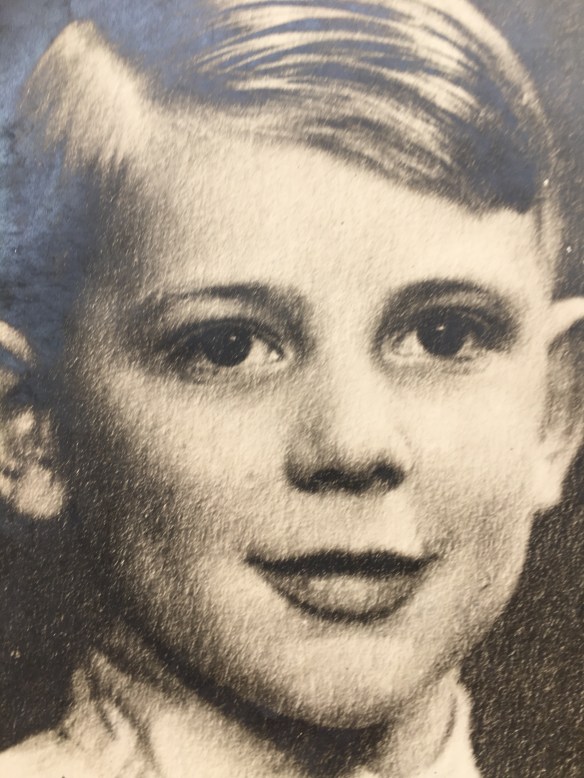
Blake as Child #2

Lincoln in the Bardo, a novel by George Saunders has popularized the bardo concept. Lincoln, having been shot to death, spends a single night -spirit-wise – in the graveyard where his son is buried, to the consternation of its ghostly residents.

Eastern religions believe that the soul sojourns in the bardo for 49 days before moving on.

Blake left his body in the middle of March. Initially, and even before his actual last breath, he traveled about a bit, principally to my sister’s home, his ex-sister-in-law’s, where he had attended family parties, including one for his 80th birthday. He always had an eye for my pretty younger sister. See https://115journals.com/2019/03/24/grieving-for-blake-a-ghostly-affair/ and https://115journals.com/2019/03/20/blake-no-more/

He has settled down since then. He doesn’t flit about alarming the living or causing them to throw pillows. He has even given up peering solemnly over my shoulder while I try to sort out his affairs. Possibly, this is because I curse him roundly for not filing a tax return since 2016 or paying Canada Revenue what he owed.

Or maybe he has slunk away because I now owe our mutual bank nearly $9000, borrowed to cover all the expenses that I am not permitted to pay for from the estate until it is settled. I am permitted to use estate money to pay for insurance, the interest on Blake’s line of credit -to the same, rule-making bank, and Ford Credit. I plan to outfox the latter by buying out the contract. More dollars I do not have, but – hey, I’m a great credit risk.

So while I trudge from office to office -bank, real estate, lawyer, post office – clasping his death certificate, his notarized will and my ID, Blake seems to be settling down to bardo instruction. His mentors appear to be small children, mostly boys. Blake was evacuated from England to Canada at the age of 5 to get him out of the way of Hitler’s bombers. His ship was in a convoy, protected by Corvettes, a cargo of British gold at his ship’s secret centre. An earlier shipload of such children had been torpedoed with great loss of young lives. My sister Georgia believes that it is these children who are teaching Blake. I opt, as well, for children who traveled with Blake and survived as he did, but have now passed on. I include my colleague Michael who hung himself one July morning when he was supposed to be doing a group presentation with me at the Ontario College of Education.

These children were orphans of the war, despite the tender care of their Canadian foster parents.

So, Blake sits with the children. In his heart, he was always five years old, always longing to be back on the water, in the water, under the water, always unable to trust his family.

He’s still got a good few days to spend in the bardo, at least until my birthday in early May.

I can’t speak of him in the past tense yet.

But alas, we do speak of him in anger.

First, there was the problem of Alice. I defied the heirs by not pitching her out of the house at once, saying it was too cruel to show up with two cops and a locksmith and tell her to go. (TO HER OWN APARTMENT WHICH BLAKE HAD PAID TO STAND EMPTY FOR 6 YEARS) Of course, I did end up on the front porch with two cops and a locksmith after a decent interval, coaxing her to at least give us access to his papers. Surely, she wanted our co-operation and, for example, his ashes. “I don’t want his ashes,” she snarled. Heads whipped back. Sympathies changed. Documents were handed through a tiny opening between the steel door and the frame. She promised to leave by Sunday midnight. On Monday, with the same patient locksmith, we entered to an impossibly dirty, foul smelling house, but one that no longer looked like a hoarder’s paradise.

Eventually, I collected Blake’s ashes – very heavy, that boy, in spite of how skeletal he had become. Eventually, I passed his earthly remains – in a roundabout way – to Alice. He loved Alice. I tried to honour that.

I thought I was too old at 83 to lift and sort and get soaked to the skin ferrying stuff to Value Village, to battle Toronto rush hour traffic to his downtown house. So, you could say that Blake has taught me that I’m stronger and smarter that I thought I was.

We work in the house without heat – to save money. I wear a winter jacket that used to be off-while. “Is that all from Blake’s house?” asks our son Daniel. “No, I reply, sarcastically. I like wearing filthy clothes.” And I stick my head back in the beautiful fridge, bought on the hottest day last summer, and absolutely never wiped out since. There are swaths of red, sugary spills and orange spills and crusty clear ones. It looks as if they opened the fridge door, stood back several paces and flung uncovered liquid concoctions in for storage.

“Why are you doing this?” Georgia yells, as she wrestles the shelves and crispers out.

“Because….” I yell back. I am kneeling on ceramic tile. My knees are crying. My back is crying. Because, I think, I cannot let the world know what my Blake had sunk to.

He was ill. He was depressed. He was afraid. He had found a perfect woman, one who couldn’t bear to be touched, one who was young and ill-informed and opinionated, -“Are the Beatles dead?” she once inquired. – one who argued and railed and shouted and shut us out of his life for years, who abused us as we tried to clean his room before his grandsons came to say farewell.

But he loved her.

Oh, Bardo Boys….


Grieving for Blake: a ghostly affair

Persistent readers know that I have been documenting the demise of my ex-husband Blake here at 115journals. I’ve told of his remarkable 8-year survival with stage 4 prostate cancer, and lately his decline as he began to lose his grip on his perch. He passed away last Monday.

We have been divorced for forty years. We were married for only nineteen. We had two children, who are themselves middle-aged now. To protect their interests, I agreed to act as his executor. I knew it was a bad idea, but I wasn’t aware that I would be chief mourner and ghost-whisperer as well.

When it comes to Kubler-Ross’s  seven stages of grief, I’m a rapid cycler.

Saturday, I set up a little altar in the loving spirit of letting him go, or to be precise, getting him to go. He had turned up in Georgia’s bedroom at 5:20 a.m. in his hospital gown, trailing his blue hospital blanket, confused but vividly Blake. A few days later, Georgia’s daughter jumped off the floor and screamed as something brushed past her in a doorway. Admonitions to go to the light, to go find Leyla, his second wife, fell on deaf protoplasm, as did a final plea to go find his pet Sheba Inu.

In my place, his presence was more diffuse and business-like. He has left me to file several years of income tax, as well as deal with Alice, his resident gold-digger. On Saturday, that seemed charmingly chivalrous, so I set up an auxiliary shrine on the dining room table. As a Taoist, I keep a family shrine with pictures of my people, past and present, Kwan Yin, the Mother, Buddha and candles. I put a picture of 23-year-old Blake in his graduation gown, his obit, a book of Rumi poetry, a dozen tea-coloured roses, incense, Kwan Yin, Buddha and lit bees wax candles. It was the Saturday after his passing, the day we would have had his funeral if he hadn’t opted out of such ritual. I read him Tennyson:

Sunset and evening star
and one clear call for me
May there be no moaning of the bar
When I put out to sea.

Then I got on with my own taxes.

In the evening, I sat down to finish watching The Girl on the Train on Netflix. I had read the book some time ago, and, although I had forgotten it mostly, I knew I hated all three neurotic women and especially the drunken protagonist, who just wouldn’t let up on her ex’s new wife and may have killed her neighbour. About an hour later, my mood had swung from loving a farewell to dear Blake, to get back here: I’ll kill you myself. For my lovely Blake was every bit as good at gas-lighting as Tom, the husband in the story. We – ex-wife, daughter and step-daughter – had compared notes at dinner one February night when the family had travelled from near and far to say goodbye to papa. And he wasn’t beyond blackening each of our names to the others. Then, of course, there was the question of Alice, his latest triumph, 45-years younger, who wouldn’t let us in to see him without a hissy fit, and who had been helping him work his way through the home equity line of credit at a good fast clip.

I repurposed the altar in the name of love and told Blake to get lost.

So here I am, middle of the night, suddenly awake and sobbing with grief. I knew him longer than anyone still extant. I may have loved him best. I certainly hated him best.

He’s gone. I can’t call him up to lament about one ‘child’ or the other. I can’t depend on his caring as much as me. And no, I can’t tell Blake – whatever – anymore.

He believed death was the absolute end. There was nothing after.

In that case, settle down, Boy.


Blake No More

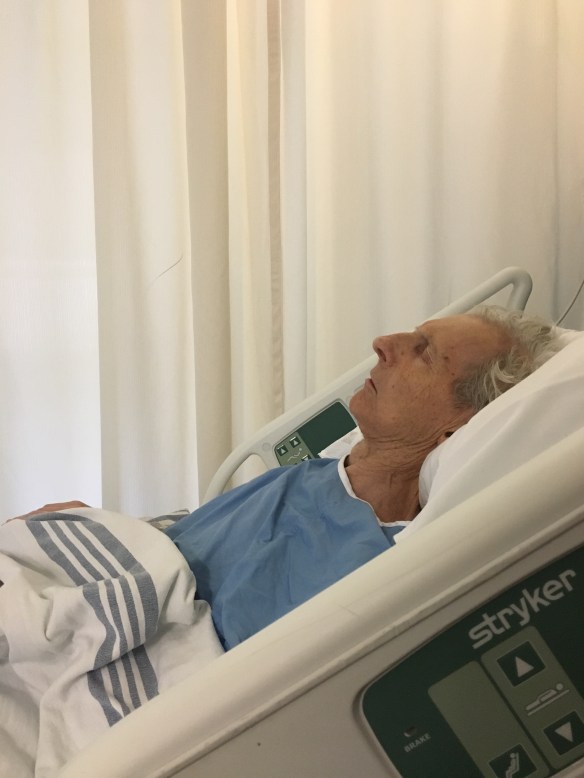
Blake 2 days before he fell off his perch

Sunset and evening star
And one clear call for me
Let there be no moaning off the bar
When I set out to sea.

Tennyson

Blake’s last day was devoted to breathing. Three, sometimes four, of us sat beside his bed listening to his breath. We told Blake stories. We laughed quietly. How amazingly, infuriatingly complicated this man had been. How persistent he was even now in spite of agonizing pain that fentanyl and morphine could not entirely subdue, in spite of his failing mind and his inability to communicate.

The nurses came often to keep him comfortable. The doctor came to talk to us. The Salvation Army Chaplain stood quietly with us. We took turns going out to eat. We told more stories.

Blake’s breathing changed. There were long pauses when we thought the worst – or the best depending on your point of view. As the light began to fade over Bloor and Church, there was one last breath. We waited. We nodded to each other. We put comforting hands on his body. We wept silently. After a while one of us went for the nurse.

6:45, Monday, March 19, 2019

There was a glorious red sunset as I rode westward home.

Other posts about Blake and his relentless efforts not to fall off his perch are available at 115journals.com


Blake on his Sad Height #2

And you, my father, there on your sad height
Curse, bless me now with your fierce tears, I pray
Do not go gentle into that good night.
Rage, rage against the dying of the light.

Dylan Thomas

Here I continue the story of my ex-husband Blake’s fall off his perch. See 115journals.com for previous episodes.

Alice just called. Should Blake have blood thinner shots?

I am known as the Alice whisperer now. Like Blake, I am old enough to be her grand parent, so what the hey. The younger members of the family are more familiar with being the target of Alice’s angry shouts to get out of her house and leave Blake alone. That would actually be Blake’s house of course. But that chapter’s over and done with.

After Alice broke Blake out of Toronto Western Hospital, things went downhill on the home nursing front. Mercifully, I was left out of the loop at 1 a.m. when, once again medics trundled Blake down the narrow stairs from his third floor bedroom, and took him to Mount Sinai Hospital.

Alice just called again now. The doctor says Blake’s hemoglobin is so low, blood thinner may cause a bleed. So no.

Yet another day of sitting beside his bed and talking to the palliative care resident, the palliative care doctor, the nurse, the pharmacist, the social worker, the resident internist, not to mention the diaper changing crew and the meal shleppers. Hard enough to answer questions without Alice asking complicated meds questions of the social worker or hospice questions of the pharmacist. Always Blake was consulted on decisions. Did he want to continue treatment with Zolodex. No, he didn’t. Two interviews later, by a different expert, well, yes, why not. He’d been taking it all along after all.

Daniel and I are silently shrieking, “Stop. Stop. It’s over.” Alice is buying even the smallest unit of survival time.

The Zytiga costs $4,600 a month, but all Blake has to pay is $600 for one last bottle before the drug insurance runs out. I have no luck contradicting that decision. Alice has POA. (Yes, I had to look it up – power of attorney.) She gets to make decisions.

Alice takes it hard when the resident explains that a hospice makes the patient comfortable, but does not treat the underlying disease. By the end of the day, news arrives that Blake will be moved to the hospice unit of Sally Ann’s Toronto Grace in the morning. He is there now and that is where Alice has been calling from.

It took me the usual 2 hours to get back out of the city. I was so shattered, I took a short cut which turned into a long, long cut. At home, I showered, brushed teeth, gargled and made plans to burn my clothes. Then I fell into the unconsciousness of sleep at 6 p.m. Spending a day trying to keep Alice from messing things up and countering her rude cracks at the staff has that effect.

But Blake!

He is completely changed. He doesn’t care who helps him sort out Mr. Peepee and the handheld urinal. I say, “Good boy” and he’s satisfied. He snoozes and wakes up to ask questions. “David’s Savings Time?” “Air bubble?” Some I can’t decipher. “I need to borrow a lot of money,” he announces. “Why?” “To solve this problem.” We skip the obvious. The problem will be solved soon enough. “You just got your pension cheques,” I say. “I’ve paid your property tax,” says Alice, “and you still have $80,000 free in your line of credit.” But he has actually read the family’s mind. We thought we would need to pay for private hospice care. “I can hear phones ringing and somebody saying, ‘I’ll transfer your call’.” The nursing station is far enough away that I certainly can’t. I feel sorry for the young man in the next bed who is recovering from orthopedic surgery. How hard this must be to overhear.

Blake is listening when the best news of the day comes. His prognosis is down from 6 months to 3, and that is why he got a hospice bed.

I rub his feet. I touch his forehead. I do not allow myself to grieve. I can do that once I get out onto the Queen E. where the freeway traffic thins and all the way up Erin Mills.

Once I got rested, I felt how sacred it was. He looks like one of those elongated saints beside a Gothic Cathedral door. He has lost all his angry edge that made the last six weeks so hard. There is nothing left of the womanizing misogynist that wrecked lives. The essential Blake is there, just shining through.