The Immense Heart and Mr Death

rumi quoteBlake turned 80, the first one in the family to do so, so Rob, who was visiting from Brussels and Georgia threw a small dinner party. The food was amazing – baked breaded shrimp with mango and chutney, salmon Provençal en croute, lobster ravioli, champagne – rose, for a change- lots of white wine and chocolate cake.  It was a laugh fest from beginning to end. Blake, an only child and war refugee, found himself teased by my siblings and knew he was family.

Then we said goodbye.

Rob, who was going home the next day, followed Blake and I out the door in his sock feet, despite the cold. He gave me a last hug and turned away. He might as well have spoken out loud. I heard his thought. We might not meet again.

For a while, his fear was based on the fact that I am 11 years older and had had cancer twice. Now that I have been cancer free for 13 years, he himself has melanoma. His doctor was not happy that he postponed treatment of an excised patch to come to see us. Meanwhile Blake is perking alone nicely with the latest prostate cancer drugs, free as it turns out, part of a study. He had just returned from a Caribbean cruise and was happier than he had ever been.

Grandpa Munn routinely bade us goodbye by declaring mournfully that he would probably be gone by the time we made the long trip back. Eventually, many years later, this turned out to be true.

My mother died after a 7-year bout with ovarian cancer, a few years afterwards. She had been horribly ill and deserved a break from it and her psychotic husband. I expected her spirit would show up in my house the way my other dead people did, even my father-in-law. When she didn’t do so, I fell into a deep depression and suffered what I call an existential breakdown, complete with hospitalization. I recovered, but for many years, I saw death as the grim reaper and my advancing age as his harbinger. Either there was no life after death or my mother didn’t love me.

This fear was so great that I tended to drop friendships with older people. Unfortunately, my son, Daniel, seems to have caught it. The older people he has dropped are his father, Blake, and me.

Eventually, after Blake and I divorced, I had a run-in with suicidal ideation. It wasn’t really about death, just a deep desire to stop hurting. A momentary vision of the future where I would be needed, the Suicide Help Line and the Salvation Army pulled me through.

Getting cancer settled the question once and for all. I definitely did not want to stop living in my body, no matter what.

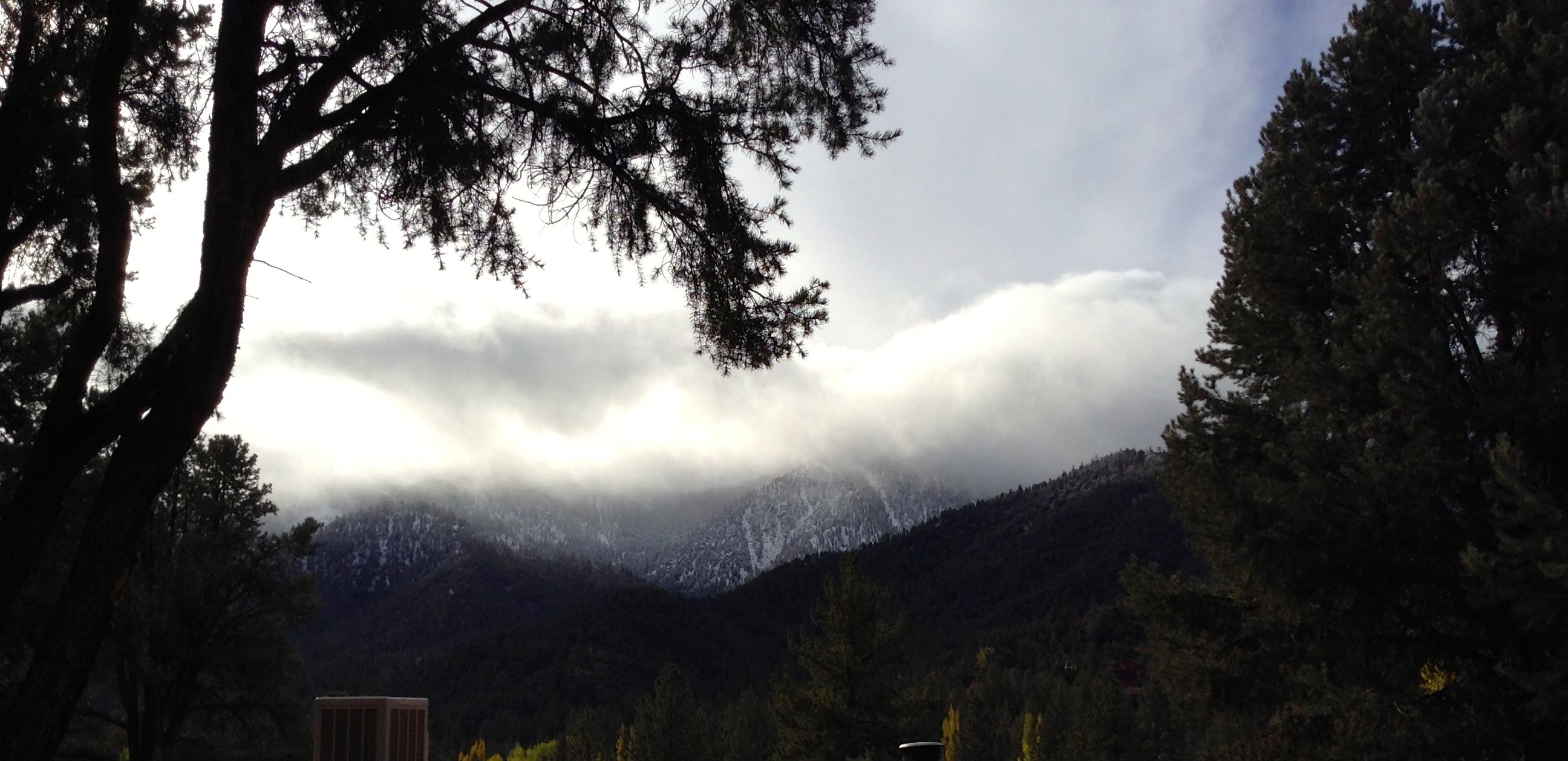
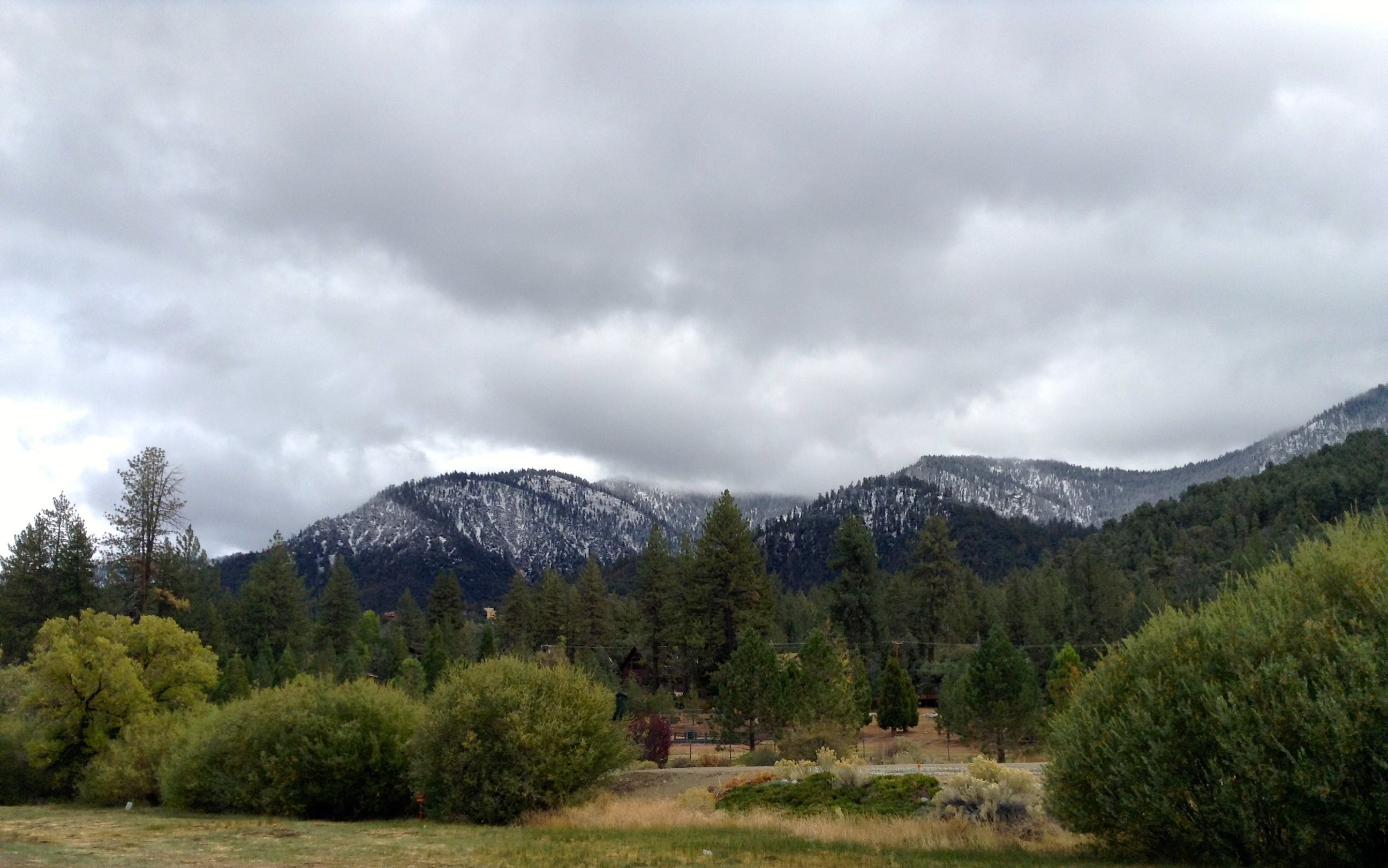
This spring, I walked into my daughter’s new home in the Sierra Mountains and clearly heard my mother say, “This is nice.” So she shows up now, 38 years later. What the….?

She hung around, apparently swooping over the pines in the company of her 43 year-old grandson who had just passed on. He seemed to be 3 now, the age at which she first knew him, and quite happy to be flying loop-de-loops with her.

I was going to write this post anyway, but then Rob called me in tears this morning at 5 a.m. He had returned to Brussels to discover that his young friend, Julian, had died of an asthma attack.

I wrote last December about Julian, whom Rob was coaching in life skills, like controlling his temper and wearing his teeth. Julian had been left to institutional care, pretty much abandoned by his parents. He did his wash at Rob’s house, carried up wood for the fireplace, helped decorate the Christmas tree and showed up at awkward times. Rob had taken back a sweat shirt for him with “Toronto Alumna” written on it. My niece’s really but new and we figured Julian wouldn’t get that it was a girl’s. What was he to do with it, Rob asked me.

I am bowled over by how we four siblings, children of an extremely abusive home, all of whom nearly died at one point from that abuse, turned out to be so concerned with the welfare of others. We learn to give what we need, apparently, and Rob was a good “father” to Julian.

I don’t think of passing on in terms of Mr. Death, anymore. (Well, not for the moment anyway. Get me in a hospital room, I may revert.)

At present, it seems more like an approaching holiday, like Christmas feels ten days before, something glorious approaching. A very old priest I knew told me he felt like an excited kid about to start school. The old pictures of heaven are totally irrelevant to me. “Heaven” is just dwelling in love and being without a physical body will mean no opposition by space and time, more opportunity to look after loved ones. Sure growth happens in the body, but we can take our achievement with us.

I got over the angst of farewell by sitting down to begin writing a book I had in mind. We are keeping busy. Death will have to interrupt us.

As a family, we are scattered across two continents. Some of us don’t even speak. Yet we found each other across time and space. We have a long history with each other. We came together because of our long term love for those two outrageously dysfunctional people who were our parents. I think we saved them from what the church would call damnation. Not everyone agrees with me, but I feel my father’s help these days.

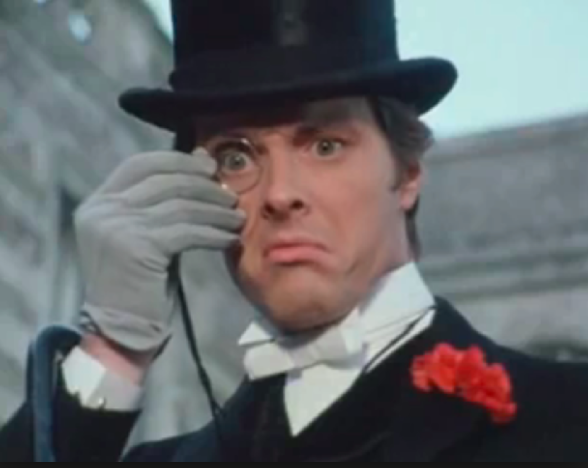
No force, not even that guy in the black top hat and tails is powerful enough to overcome love. It holds the stars in place.
MrDEath

A Series of Unfortunate Events

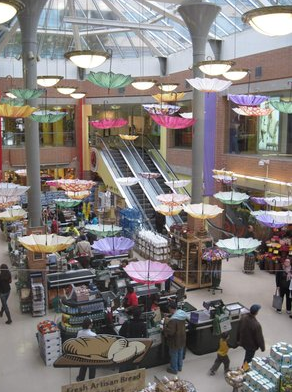
whole foodsIt started with tow trucks. We could see their lights flashing sideways above the cabs as we drove north towards Queen’s Park on University Ave.

“It’s somebody important,” said Rob, who is used to Obama shutting down Brussels.

“Funny vehicles,” I observed, but no, it was about a hundred tow trucks protesting, by driving very slowly around Queen’s Park Circle. Protesting what, I wondered, too few accidents?

We inched along. Even my loquacious brother fell silent. I named the buildings on our right. The one on the left, pinkly Victorian, was the provincial legislature. Oddly, the members were not outside being impressed by the tow truck parade.

Finally, I was able to get into the right lane and speed by the circling trucks. (Why do they have tinted windows, anyway?)

I parked in the Whole Foods underground parking at Hazelton Lanes. All the stores except it were under construction, indeed half of Hazelton Lanes. The city is getting ready for the Pan Am games next summer. It is unlivable now and will be unlivable then.

We decided to eat at the Whole Foods deli, choosing food from the steam tables. Rob joked his way through the line for the cash register, managing to choose the only clerk with a sense of humour, Chun. We found a table and Rob wolfed down his “Layered” meal – salad on top, hot food on the bottom. I was much slower.

I was in the restroom when the fire bell started ringing. We all ignored it and went on with what we were doing. Then the alarm got hysterical and there were shouts of “Evacuate.” As I returned to our table, I saw Rob dump my half finished lunch in a trash bin.

We walked in single file through a corridor under construction for a long time. Then we walked up stopped escalators and emerged into cold air.

“We’ll just walk to the theatre,” I said to Rob.

“What about your car?” Rob asked.

“You think it’s going to burn?” I saw Chun and went over to ask him if he knew anything.

“Probably false alarm,” he shrugged. “Don’t know.”

As we headed for the street, the alarm stopped ringing and people began streaming back inside.

I was a bit turned around when I found we were spewed out up a north/south street instead of on east/west Yorkville, but I got us turned south and then east past the park with the enormous dome of rock from the Canadian Shield, carefully cut up like jigsaw pieces and reassembled a hundred miles south in the city’s centre for our viewing pleasure.

It was only a few blocks to the Varsity Theatre in the Manulife Centre, but I had forgotten about Rob’s knees, well about his right one anyway. His left knee joint was plastic, worked well and didn’t pain him. The right one was still bone on bone. He limped on that side and it hurt so much that it encompassed both legs in his mind. At Bay St. we caught the diagonal walk signal. That felt too exposed to him and my worldly European brother protested. Eager cars confronted us on four sides as we two lone figures crossed to the diagonally opposite corner.

Rob rested his knees at a coffee shop while I hurried through Indigo book store buying calenders for Christmas. I was carrying my fur hat in my hand, it being too hot to wear.

Inside the movie theatre I waited at the bar while he bought popcorn, resting my things on it.

We were on time, which meant we watched  half an hour of commercials before we even got to the previews. Finally, Interstellar started at ear numbing volume. Immediately I saw that it seems to have been filmed near Bakersfield, CA, my summer stomping ground. Where else would they have found vast corn fields, dust and mountains?

We were there because a guy who worked for Rob as an electrician had done the lighting. I decided privately than despite Matthew McConaughey, it was a dog of a movie. About 1 1/4 hours in, McConaughey and two other members of his space crew were trying to decide whether to go down to Miller, a planet that might save the human race by providing a home now that earth was done for. It was about then that I missed my fur hat.

“Let’s go find it,” Rob whispered.

“It’s okay. I’ll wait,” I whispered back.

Various terrible things happened on Miller in the 3 1/2 hours they spent there. When they arrived back at their space ship, the guy they had left in charge was 23 years older. Rob and I turned and looked at each other, picked up our things and rose as one to leave.

It reminded me of a news item I had heard about Japan sending a space ship zooming toward an asteroid six years away. My immediate response was, “How could they have so little respect for human life?” Then of course I realized the ship was unmanned. The old Kamikazi prejudice had reared its head.

In this case, I couldn’t stay and contemplate the poor guy’s wasted life, waiting 23 years for his ship-mates to return.

I was sure I had left my hat at the book store check-out, but I stopped at the bar to ask if it was there. One young woman disappeared behind the bar, while three others stood looking after her. About five minutes later, the watching tableau unchanged, the first one emerged with my hat.

We hobbled back to Whole Foods, which was back in business. I bought a few things, which came to $68, thus reinforcing the Whole Paycheck idea. But, hey, I got $2.50 off my parking bill.

At the  machine, Rob started pouring coins into the slot. I tried to stop him because I was pretty sure he didn’t have $22.50 in coin, despite Canada’s strange coin system. I had to get cross, inviting him to stop by using an emphatic short word followed by a preposition. I put in a $20 and invited him to top it up.

Since we had forgotten our cloth bags, we loaded the items into a bag in the car and got the cart out of the way of traffic, more or less. I went to start the car. Where was that expensive paid parking stub. I searched my purse, my pockets, the car floor.

Oh, God, another $25 or more,” I moaned

“Get out of the car,” Rob ordered. And I did.

I stood beside the door. There lying at my feet was the parking stub.

Now I could blame Rob’s hyperactive, discombobulating energy, but a few days before when he wasn’t around, I had gone through the car wash at my local gas station. I pulled over into a bay to wipe the car, creating a bigger and bigger pile of wet paper towel. I opened the trunk, got out the windshield washer and topped it up. I carried the towels to the garbage can, got into the car and found I did not have the car keys. What to do? I searched my purse, my pockets, the car floor, the trunk, under the hood, under the car. I dumped all the nice garbage out and pawed through every last bit. No keys. I did it all again. I was the only one on the lot. It had been half an hour. Finally I walked over to the shop.

“I’ve lost my car keys,” I said.

The clerk raised his hand. From his index finger hung the keys.

When I left for California in early June, I was a well organized person. I always read several reviews before I wasted money on a movie. I always knew when some moron or other had organized a slowdown protest. I always put my keys in the same pocket of my purse. The parking stub went beside the credit card until it was paid and then it joined the keys. Both got taken out once I was at the car. If I took my hat off, I always stuffed it in the sleeve of my coat. Now after 5 months high on a mountain, I can’t organize myself out a door.

No point in talking to Rob about it. That was a normal way of life for him. I decided to tell Blake, my ex-husband, as we drove back from his 80th birthday party. Too late I realized how wrong that was. Blake has spent a small fortune on taxis after shutting his keys in his car, yet again.

“People says it’s age,” he said, “but I’ve always been like that. Well you know.”

Ah yes, the time he packed our passports in a suitcase and had to climb on top of a Moroccan bus to get them, the time he ran the family car out of gas miles from nowhere on a throughway…..

I’ve always been like that too, I guess, but I wound myself so tight it didn’t show. Darn those relaxing mountains!

The Great Loneliness

Churchill called it the Black Dog

Churchill called it the Black Dog

The great loneliness fell upon me without warning.

True it was Saturday night, the loneliest night of the week, according to Sammy Cahn. True I had just watched Piper’s boyfriend break up with her on the phone, after dissing many of her fellow inmates on NPR and telling her who actually turned her in. True Jamie Fraser,s cousin, Simon, had just died of a musket wound, but Jamie had gone to the British lines under a flag of truce to bid him goodbye in Gaelic. Still it was very sad. I hadn’t spoken to another human being all day. I had phoned but everyone was out. The sky had been heavily overcast when I opened the curtains at 8:30, there was ten minutes of sunshine around noon, but at 3 p.m., I closed them against the gloom.

I shut off the iPad and An Echo in the Bone. I disappeared the TV and sat down on the couch. Winter loomed, months of lost light and cold, days of being shut in by ice and snow. I didn’t even get to my impending mortality before one of the women upstairs broke down, crying “it’s not funny”. I got up to get a glass of water and dropped one of my favourite glasses onto a pyrex bake dish soaking in the sink, smashing it into seven sharp pieces. As I put the wrapped shards into the garbage, the other upstairs resident drove away.

Right, you can feel the great loneliness even if you have a spouse. I knew that. I had felt that lonely before my husband left.

You can feel it in the midst of your family. When I first found myself suddenly on Pine Mountain, I would sit in bed with the curtains open, watching the steep wooded slope, the moon waning above. I was longing for home and the familiar, my no-view first floor flat. If I had known that the family emergency would keep me on the mountain for five months… I didn’t and I fell asleep before the loneliness got well established.

Usually, the year end holidays keep it at bay at least until mid January. You can armour yourself against it even then. I can usually con myself that winter is manageable until a month later, at which time I begin to snivel and consider throwing myself down in a tantrum, but unobserved tantrums are over-rated.

This particular bout of great loneliness follows upon the great good fellowship of family achievement. Four of us together handled a serious illness and a traumatic change in an elder’s life. Elder even than me, which is very elder indeed. In the last five weeks, we broke through to a relaxed and healing companionship. We were going to live after all.

Then I had to come home. Not only did I need to come home. They needed me to. Marriages go better without mother and elders need to feel self-sufficient.

My brother rushed from Brussels to help me make the transition from sunlight and altitude to gloom and sea level. He took one look at me, declared I was not destroyed by my ordeal as he expected. He didn’t actually have to save my life this time. If I had gone to Brussels, as I did last Christmas, I would have been his chief concern, feted by his many friends and his family. Here he has to be shared. This weekend is someone else’s turn.

I used to think I could fight the great loneliness by sheer willpower, by talk therapy, journaling, acupuncture and long walks, identify the aberrant mental attitude and contradict it. Stick up post-its with affirmations on the bathroom mirror. It was exhausting. Now I take psychotropic drugs.

But it’s a long game. I am old enough to know just how long.

Sure, I need to feel needed, as Orange is the New Black has just assured me and for the present, I am not. I wasn’t needed for years, but I’m glad I persisted until I was. Lives depended on it. So here I am again, under-needed and sulking about it.

In fact, old bodies need to rest at this time of year, so home needs to turn into a cave for long sleeps. It is a time to turn away from the outer darkness to the light within.

Having said that I see that the moon is full.

full moonmtn


Welcome to Bangor: Thanksgiving 2014

Bangor International Airport without snow

Bangor International Airport without snow

“We won’t get home for Thanksgiving,” said the woman beside him.

“It’s not Thanksgiving,” said Rob.

“You’re Canadian,” she guessed. “It’s Thanksgiving here.” They were sitting in an unheated room in a hangar at the Bangor airport. Their empty plane sat in the runway, its chute deployed. She had studied the group and sized my truck driving brother as the likeliest.

“Let’s rent a car,” she said. “We can drive me to Ithaca and you can go on to Toronto.”

He paused. “It’s getting dark. It’s snowing. I don’t know you and besides, I’ve seen that movie.” Which of course reduced him to laughter.

He withdrew to a quiet corner and called me on his Belgian mobile phone. “First, they said we were running out of fuel,” he told me, “but as we landed the whole plane started shaking. “I knew I was going to die. I thought I should hold the hand of the woman across the aisle, but she was too ugly. Then I thought, I’m here at the bulk head next to business class. I’m likely the only who will survive. Shoot, I thought.” They hit the ground. “Now,” he said to himself. Then they hit again and with a terrible whining, grinding and howling came to a stop.

The chute deployed.

“Ladies and gentlemen, please keep your seats.” People were struggling desperately to get up and out. They had been told the plane was out of fuel. “There is a problem with the door,” the captain admitted.

Mayhem erupted.”I could have died,” was the universal cry. “I almost died.”

Me too, thought Rob. You’re not the only one here. You didn’t die. We didn’t fall out over the Atlantic. We are on a lucky flight!

Turned out once the door was opened that there was a problem getting the steps up to meet it, but that had been resolved and now Rob sat on a cold cement floor, his winter coat and boots safe in his checked luggage, catching laryngitis and talking to me.

Four hours later,  little had changed, except he had gone out for a smoke and set off all manner of alarms on his way back from the hardware in his joints. He was patted down, wand-ed and dog-sniffed, a hair raising experience given what he had smoked the night before. The promised plane from Philly had not arrived, would arrive despite the snow in half an hour, would not arrive if it snowed six more inches. But snow plows ground up and down the single runway, keeping it open. Finally, snow in Philly would prevent the plane’s departure from that city.

By now, he had called me four times and I was at Georgia’s place which is nearer the airport. “They’re sending us to a hotel,” he said.

“Yes, I can see it right next to the airport,” I said. I could also see the U.S. Airways flight status on another screen. The path led from Brussels to Philly, but the little plane was stuck in Bangor, Maine. “Don’t forget your meds,” I said.

“Oh, thank you, thank you,”he said.

“You put your meds in your checked luggage?” Oh he was rattled.”It’s okay, Rob. You’re safe now. You’re going to stay in a cozy snow-bound hotel.” Family history tends to send us off the deep end in urgent situations.

He made out all right of course. He spent the evening in the bar ordering rounds of drinks for everyone there and talking.

Two younger women told him of the way, troops are welcomed back at the airport. They are never greeted by “Welcome home” or “Welcome to the United States” that way lies emotional breakdown and mass chaos. They are greeted simply, “”Welcome to Bangor.”

At closing, his credit card wouldn’t swipe. No chip readers there. So the wealthy Belgian couple paid his bill and refused compensation next day, “Are you trying to insult me?”

I woke up in the guest bedroom to hear my phone ringing. The plane from Philly would arrive in Bangor, momentarily, read an hour and a half. His flight back north would be at 4:30 on Air Canada and he would arrive in YYZ at 6:06.”Wherever that is,” he said.

Then there was silence for 4 hours. I understood that. No worries. At 3:45, just as I was about to call him, he called me. The flight was delayed until 5:30 and he was going back to Brussels.

“Have you eaten lately?” I demanded.

Well no.

“Go. Eat. Have a drink. Relax. You’re almost here.”

“Okay,” he said. I was his big sister after all.

At 7:30 Georgia and I were on the road to YYZ, Pearson International Airport, trying to catch the right lane in the dark and snow. She insisted on driving her new car.

“Am I going to have to put you in the back seat?” she demanded.

I could have driven, but I was too tense to be driven.

“The car is dark blue,” I tell him on my cell phone.

“I don’t care what colour it is, just so long as it picks me up. I’m waiting at P,” he says.

There is no P of course, so I duck out of the car at C and run him down. He’s still clad in just a cotton sweater. We run for the car, half hugging. Georgia springs out to load the big bag, even though we are blocking a thru lane.

Our celebration dinner is smoked salmon pasta, thrice-cooked of necessity by niece/daughter. There are 5 of us, together at last.

“You are here,” I say in wonder, “And my daughter is still alive.”

(This apparent non-sequitor is explained in previous posts.)

Saving a Life: losing a friend

jim and IMon Frère et moi en Bruxelle

I feel like Dante after his epic journey through hell, purgatory and paradise. True I got to see the face of Grace and then to return home. But I’ve been spoiled. The paradise bit was full of light and love and joy. Once I got there, I was able to lift my eyes and love the pine-clad mountains and the pure light and air again. Home in TO sees a couple of hours daylight under gloomy skies. Something is always falling from the sky and the streets are slick with decaying leaves.

That’s not the worst of it. Two of the people I had counted on to welcome me home, to rejoice in our triumph and to console me for our ordeal are no-shows.

One is my son, whose sister’s life was just saved and who is on her way to being able to live a reasonably good life, if not to being cured. What we accomplished, in spite of MediCal and general incompetence, was a miracle, something to be celebrated. But this half of the family in Toronto is hived off into individual units. It begrudgingly pulls itself together for a funeral, if the relative is close enough, not apparently, for a good, boozy party of celebration.

The other is my friend, Sophie. Sophie is given to observing that she is glad she had cats instead of children, particularly since mine are so troublesome. What can anyone say to that? A cat can’t be Shakespeare. No, but listen, those children are unique and beautiful creations. They have made themselves who they are over decades. They have made many people’s lives better for knowing them. I don’t say any of that to her. I sympathize when an elderly cat has to be put down, as if it were an actual person. I inquire about the surviving feline, which drags its hind quarters.

In the midst of the worst or hellish part, Sophie suggested on the phone that it would be better for our patient if we let her go. A slip of the tongue I thought. But then she discovered that I had taken psychotropic drugs to survive the ordeal. “I wouldn’t speak to you, if I’d known,” she said. I’m still taking them of course. She has read a stupid book that maintains they don’t actually work and, despite her education, she believes it.

So she hasn’t called me back and that makes me sad.

Tomorrow, my brother, Rob, arrives from Brussels. “I thought I needed to come and cheer  you up and help you get back to your life,” he told me on the phone. I will pick him up at terminal 3 and take him to Georgia’s, where we will all have a sleep-over, along with two of my nieces. He will call me his little sister, even though I am older and make me laugh. The two of us have a reputation in Brussels for our comic routine. All we have to do is be in the same room and we’re off.

On Thursday, back on the mountain in Kern County, California, my son-in-law will turn chef again and make Thanksgiving dinner. Besides his recovering wife, my erstwhile house-mate Clara, my grandson Leo, his father -that would be an ex- and a friend will be there to raise a glass in glad thanksgiving that she lived, that she is thriving, that some doctors really are brilliant, that faith and dogged persistence and the odd temper tantrum can save a life.

PMC


A Change Would Do You Good

https://www.youtube.com/watch?v=Ikjmz_SlGh
Cheryl Crow’s song of the same name
black &white wallI flew back to Toronto on Monday and met my sister Georgia for dinner on Wednesday. I ordered Guinness. She had never known me to order beer. I felt like saying, “It’s not beer. It’s Guinness.” She had not expected that change, but she liked my new hair cut.

Blake, my ex-husband, took me out for dinner Friday. He made no comment when I ordered Honker’s Ale from Goose Island, but he did tell me I looked younger. True, I was tanned from 150 days of sun at 5,500 ft in California, where darkness and silence led me to sleep 10 or 11 hours a night. And I had spent hours sitting beside our patient reading while someone else made dinner. The last seven weeks as recovery proceeded were particularly relaxing.

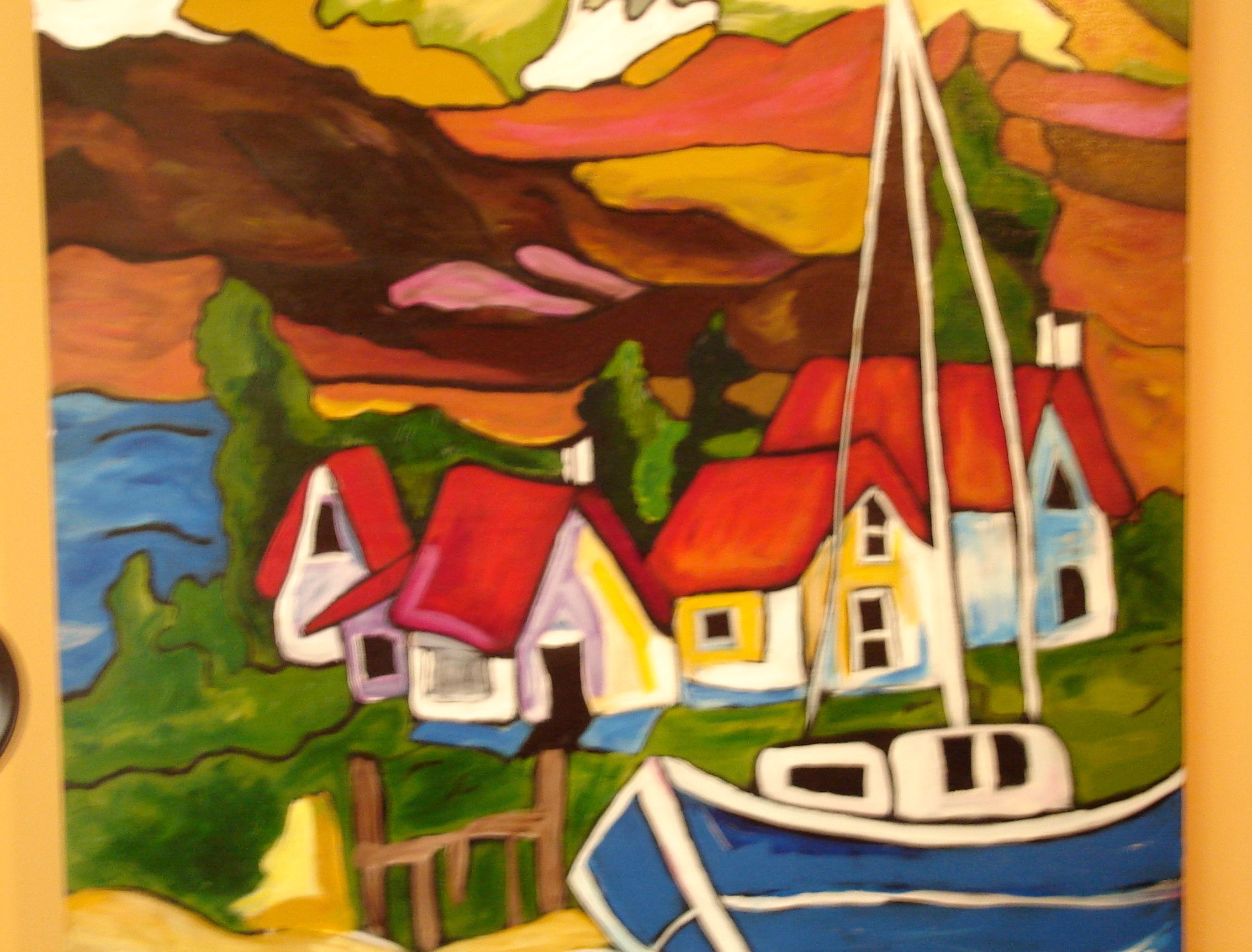
On Friday, I decided that I hated my minimalist decor and began hanging all the pictures in storage, including a wall devoted to the family and another of Georgia’s colorful paintings of houses. This means that I am giving up on feng shui. I’m not supposed to have red, a  fire element, in my living room during the year of the horse. Georgia’s paintings are full of red. Besides feng shui wasn’t doing  any good. My year has had a deal of bad luck. Our patient had also used feng shui which did not protect her from recession, loss or extremely grave illness. Be that as it may, I prefer now to be creative and bask in the warmth of family fire.

Roberta's wallAt my desk, I rounded up all the receipts I have assiduously saved my entire life and trashed them. I have lived altogether too carefully. During the five months I was away, I didn’t get my mail, of course. I didn’t even listen to the messages on my land line until a month before I left and I couldn’t receive calls because my cell phone got no reception. There was absolutely nothing in the mail or in the messages that was important. Well, there was a thank you note for funeral flowers, pretty much a dead issue.

During my mountain sojourn, I talked about the cold as fall drew on and I adapted to cabins heated in the old way by wood or more modern pellet stoves, both of which meant cold mornings. I have hated being cold all my life. For years, I have included the weather at the top of my daily journal entries. Now I have stopped. At first, I glanced at the thermometer outside my kitchen window. But I’ve stopped doing that as well. I assume that for the foreseeable future it will be below freezing. Snow, ice and wind will be apparent when I open the curtains. What difference does it make? I am going to wear thermal underwear, a heavy sweater, a sheepskin hat and a long down coat whenever I go out. I don’t need to hear a forecaster scaring me silly.

Georgia and her friend, the people upstairs, Blake, my brother on the line from Belgium and others who have called have eased me back into life in Toronto. Not everyone has answered my “I’m-home call”. I am sad, but by their deeds, ye shall etc.

So out of a traumatic and potentially tragic situation, has come new life. As Aunt Mae would say, “Ain’t that grand?”


Home After Five Months Away

Georgia's idea of homeGeorgia’s idea of home

http://www.poets.org/poetsorg/poem/home-after-three-months-away

My title is taken from Robert Lowell’s poem, Home After Three Months Away in which he observes his toddler daughter and himself after his stay in a psychiatric hospital. His central image is one of shrunken dried out toast, hung as bird feed by the tyrannical ex-nurse. I like the title, but my own experience is quite different. I wasn’t in re-hab. I wasn’t even a patient, but I returned after a long absence to find myself much changed and for the better.

I was surprised by change, rather than dried out sameness. Wow, I have a new kitchen tap. I have new phones. True I had bought them, but I had forgotten. I stood for a long time, trying to figure out where I kept my mugs. I knew where they were in both houses in Pine Mountain Club, California. Now, logically, where would they be in my house. I took a chance they were near the glasses and there they were. What did I used to use to carry dirty clothes to the laundry room. Not a basket. I know I used something; otherwise socks escape all the way down stairs. Ahhh, a plastic bin, stored in the closet.

I came into the apartment to be met by heat and the sound of electric fans. It was very hot. “I turned on all your air filters,” Georgia had told me on the phone. That puzzled me. I have only one. She had turned on that and two small heaters that I had been using on cold spring days, once the furnace was turned off.

There were vegetables, bread and cookies in the fridge. I could actually have a chicken sandwich for dinner. All of the clocks except the one on the PVR were an hour out. The audio unit was doing a light show – the power had gone out.

But the place was dust free, it had been aired and the sheets changed. The mail had been sorted and discreetly placed so I could ignore it. The one letter that might cause me angst, opened and summarized for me. An old friend still didn’t want to speak to me, but Revenue Canada had given me back $200. Armed with this information, I ignore it.

True, I also met my terror at receiving the call that led me to leap on a plane to L.A. reassured it that all was well and moved on.

I ran the water filter a few minutes and had a long drink of familiar water to quell the dehydration of the flight home.

I called Georgia to anchor myself in Toronto and then I called Pine Mountain Club because I needed to extend my long-distance love connection and get the latest medical report.

I vowed in early June that I absolutely would not leave until I felt our patient was stable and unlikely to relapse. I vowed it fiercely. I put up with major inconveniences, like living two months in a hotel and two more with Clara. I put up with no car, no internet and no phone of my own. I found ways to cope – a hot wire, Skype and a golf cart. I put up with the occasional hint that now it was time to leave. I was adamant. When I decided to leave, I booked three weeks in advance. Even that three weeks showed significant health improvement.

Phone calls over, I went out to discover my almost new car was full of gas and it started right up. I drove to my favourite restaurant, where the dining room was closed. At 9:30????? (Oh right, I’m back in Kansas.) The bar was open, so I ordered a dark beer and the most expensive item on the menu, lobster jambalaya. I pulled out my iPad, turned on night vision and dived back into the 6th Outlander book, Snow and Ashes.

I was home after five months away, a more solid and whole person, an easier person to be. I knew when I left that our patient was better and so was I. Two heal faster than one.

Fare Well; look thy last on all things lovely

sunset over mtnshttp://www.poetry-archive.com/m/fare_well.html

In his poem Fare Well, Walter de La Mare advices us “To look our last on all thing lovely/Every hour”

Since that all things thou wouldst praise
Beauty took from those who loved them
in other days
De La Mare is telling us to really see the beauty of our world because death will take it from us. Not sure that I agree with that idea, but the line came back to me as I contemplated leaving a beautiful place to return to a more mundane one.So I have been imprinting the beauty of this mountain valley all day. The golden aspens and poplars over the golf course, the evergreen slopes, the rocky peaks below which snow still lingers, the sharp outline of green against the clear blue sky.I prefer to think that beauty, like love, goes with us across the great divide and maybe even as far as Toronto.

IMG_0003Toronto: near the Brickworks

Going Home: leaving the Centre of the World

mountain 3Air Canada has generously allowed me to change the return date of my $1700 ticket for an additional $210 and I am returning to Toronto -in the comfort of the economy class cabin- on Monday. (As constant readers know, serious illness here in California kept me five months instead of two weeks.) The ticket was bought two hours before I flew down, ergo the high price. Yes, I paid for insurance, which refused to pay out because I knew there was an emergency when I left, and extra for luggage. I intend to thwart the airline of an additional $75 for a second bag by mailing my summer clothes.

Having dealt with that business, I have moved on to emotional impact.

First of all, I have to leave paradise, what I called Shangri-La in May posts, when I first visited and which I later called the Centre of the World, as the Chumash tribe does.

I have talked about the 3 year long drought, bears prowling the village, wildfire on the mountain and early snow. There is potential for large animals on the winding mountain roads as well as ice. There are signs that say,, “Expect to use chains at any time”, amusing enough when the temperature is 100 degrees F. but in  dead earnest. I haven’t mentioned that our ultra-friendly village sits in a valley shaped by the San Andreas Fault.

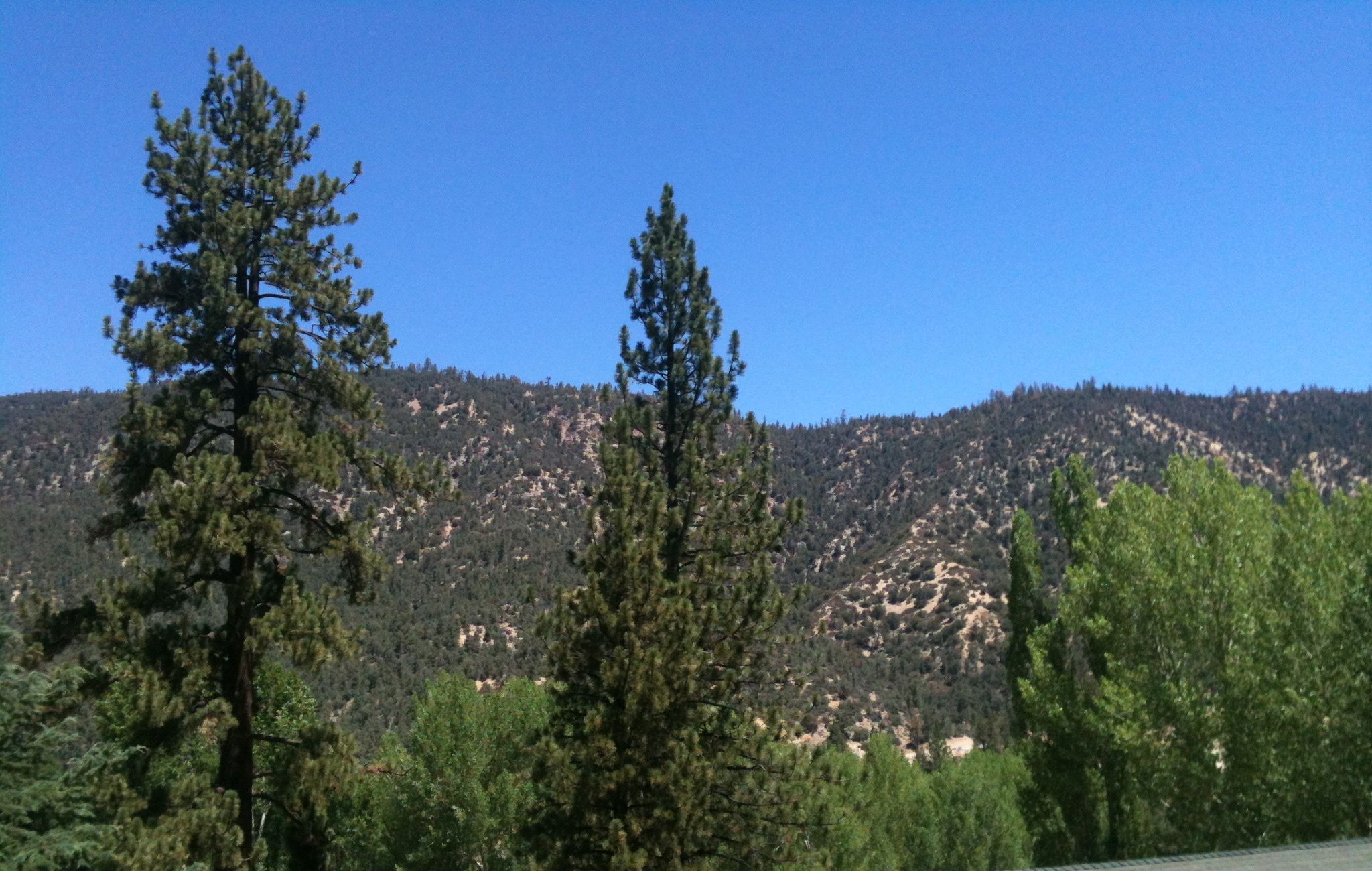
But I have also talked about the clear mostly silent skies , blue by day and unbelievably star-filled by night. There are no street lights and there is an ordinance against light pollution. Trees, mostly pine, climb the 8500 ft. peak of Mt. Pinos as well as the lesser slopes of the San Emigdio Mountain range and their breathing purifies the air. Here at 5500 ft. the aspens and poplars are florescent yellow now. The house in the pines is under a steep slope above a pond. House and pond are darkening by 4:45.

When snow fell on Hallowe’en, flocks of birds came down from the mountains. One morning there were many Brown Thrasers and others looking for food on the ground. The Stellers Jays, which amused me in May, flit back and forth between the trees, entertaining Clara and me when we drink our morning tea on the deck of my other, hillside  home. Woodpeckers search for grubs, head down on a pine tree. One jay likes to land on the deck rail and stare at the open door as if waiting for breakfast. But feeding a bird is inviting a bear. A hawk sat in a tall tree at the house in the pines this morning. Yesterday, the family golfer saw an immature condor. His first clue that it was an enormous bird was the slowness of its wings.

There is a horse trail that runs 3 miles down to an immense pine, over 20 ft around and 600 to 1000 years old. There are many other hiking trails. The Chumash Wilderness is accessible only by an ancient trail, which the firefighters had to use to get to the fire and crush out the spots the helicoptered water didn’t hit.

Our patient can do the 6 1/2 mile hike to the big tree. I cannot.

There are other amazing things about this place, for example, I can leave here in my fur-hooded jacket in near freezing temperatures and drive to Bakersfield where it is 90 degrees -altitude and an hour’s driving – north.

Not a bad place to find yourself marooned!

Then I will be leaving behind the close companionship that developed in the family as we struggled with a potentially fatal illness. At first we were united by grief and fear and general angst and now by joy that we have found a way to manage the disease. Our patient no longer needs constant care, even though she is still recovering.

Then there is the actual arrival home to deal with, walking in the door of my home. I confess I am afraid of that. I am told that since no one has lived there for 5 months, the dust will be only a light film not the greasier stuff that cooking and shedding skin cells produces. I did ask my sister to make my bed. I leapt out of it on June 4th when I got the phone call and started booking my ticket and throwing stuff into a suitcase. It’s as if I feel that the place is going to reprimand me for neglecting it.

I visualize it, the pictures on the walls, most of them painted by friends, except for the large photograph of the Seine by night, the Fiestaware cups on the sideboard, the bright rugs, the big rocking chair, so I will be familiar with it.

I have made about 55 trips to Southern California, two of them for several month’s stay and I always find the adjustment back to a long distance relationship with my family here difficult for a few days, not to mention adapting to Toronto, a colder place in every sense of the word.

This time, however, I will be taking back a different self, one more confident in support that transcends earthly connections, comforting as they have proved to be. I have the beauty and peace of this place securely memorized. I will have the memory of sitting alone, tearing a baguette for croutons, and suddenly feeling that I really was at the centre of life, at the centre of what Greek legend calls Eros.


The Hallowed Eve of All Saints Day at the Centre of the World

snow cloud mountain(Hallowe’en is the evening before All Saints Day, the day those in heaven are remembered. All Souls Day, Nov. 2 is the day to pray for all the dead, in heaven or not.)

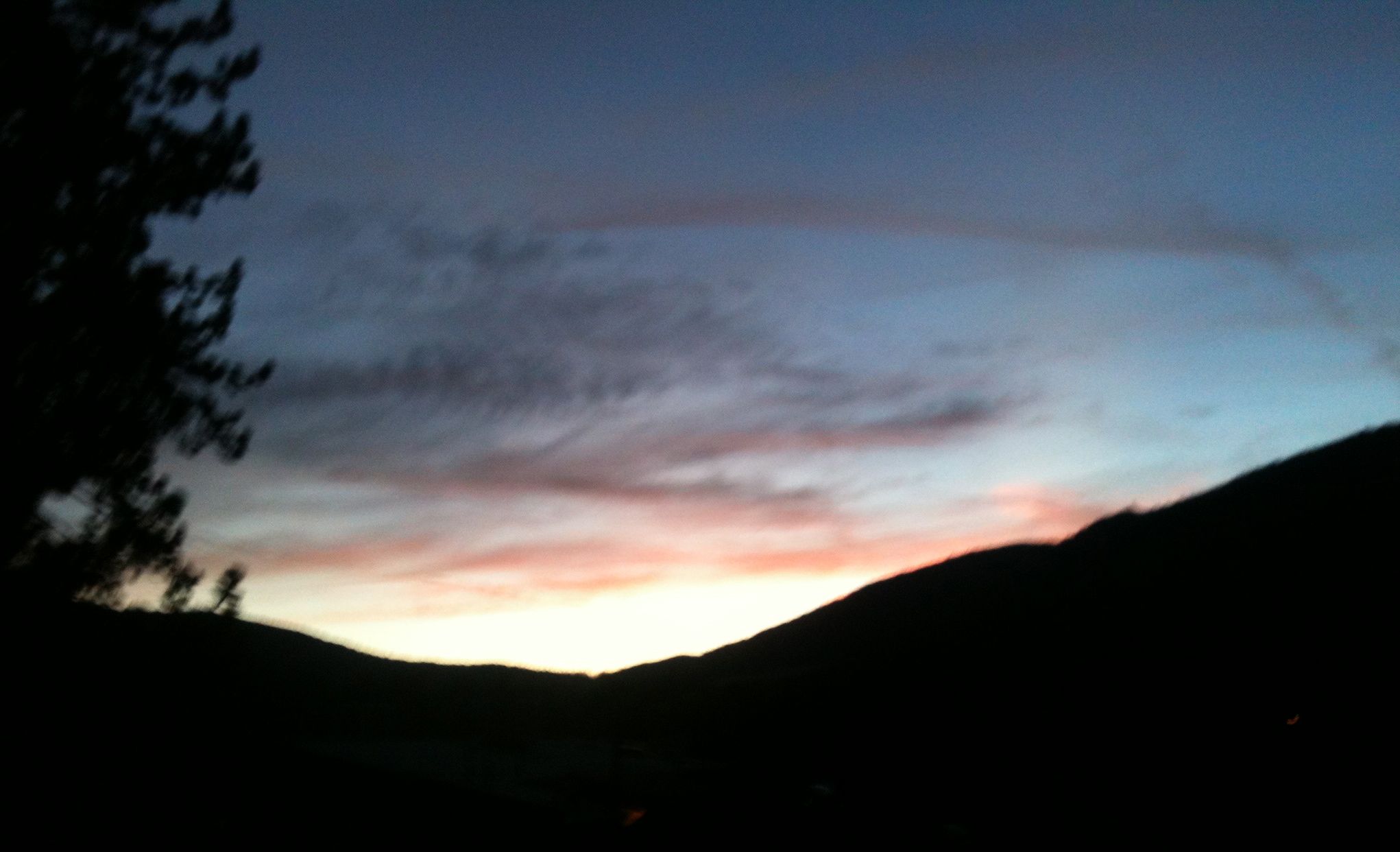
Darkness fell suddenly at the house in the pines. I sprang up from the dinner table.

“it’s okay,” I said. “It will be lighter when I get out of the woods.”

I flung my various bags onto the golf cart and sped away – at 10 miles an hour. I turned right to where the daylight should be. The  aspens were florescent yellow against the grey sky, but the sun had gone and the mountains on either side loomed ominously. Over rocky Mount Pinos, a rack of black cloud hung and over the San Emigdio Mountains, grey and black cumulus promised a storm.

I hit the dusty trail on the edge of the golf course where I usually go very slowly, but the night-on-bald-mountain atmosphere made me forget. At the paved school bus stop, I passed a couple with two children on their way to the Hallowe’en party at the club house and waved. Now I had to hit the dark streets again.

It’s perfectly legal to drive a golf cart on the village streets because this is a private village, but not entirely advisable to drive an unlighted one after dark. Well, at least, my cart was white. I wouldn’t be making the trip on Saturday and by Sunday, Standard time would solve the problem.

One hundred percent chance of rain by 11 p.m. We had been talking about it all day. Apart from a downpour in July, it hadn’t rained a drop here in drought stricken Centre of the World (according to Chumash legend) for 6 months.

As I fell asleep deep thunder began to roll in from the west. Eventually, I heard what was either a high wind in the trees or rain. Too tired to care. Two very close and very loud thunder claps tried to wake me without success.

I woke up late, after 9 a.m.

“That wasn’t much rain,” said Clara, my house mate, as she stepped out on the porch. “Look,” she cried. “Snow.”

Sure enough the highest range of mountains was  covered with snow.

snow(Okay, you knew all along. The time change means it gets dark an hour earlier.)