Bulletin from Shangri-la # 4: spirits

trees outside windowWhen I first walk into the house in the pines, I hear my mother say, “It’s beautiful!” My mother passed on in 1976, but this is the first I’ve heard from her. My grandparents, even my father-in-law and certainly my father when his time came, showed up in the days after they moved on. Not my mother. Absolute silence. So profound, that I had an existential breakdown. Now here she is- or seems to be- celebrating the tiny, jewel of house in Sierra mountains.

Of course she would be here, if anywhere, because the mountains and the pines are like her birthplace in Hereford, Quebec. And we are here, her daughter and her grand-daughter and full of joy to be together. It is the week of Mother’s Day and Julia’s mother-in-law is due to arrive as well.

We speculate that my mother has been lost in the timelessness of that other place, a purgatory of her own making, and only now has found a beacon to guide her out.

In the days that follow, her spirit seems to be doing loop-de-loops in the blue sky above the mountains. All the other mothers in our line, Janet and Jenny and Gladys, come into our thoughts as they often do, but only Lila is delirious.

She is not the only spirit there.

Besides being thin, the air is bone dry in this drought. Near the front door, a humidifier sends a jet of mist into the air. Out of the corner of my eye, I see it as a dancing water sprite.

The floors are local stone, patterned like rugs. Every step feels rooted in their strangely old, slumbering consciousness. There is a small cairn of rocks near the entry and California jade and other semi-precious stones on the desk and tables. The fireplace and massive hearth of red brick fills one whole wall. The cathedral ceiling is rafterred and wooden. A wall of sliding doors looks out on the woods. Below a lake peeks through the trees.

This is a Taoist household with altars to the ancestors and the family, but there is also a stone Buddha sitting below the bookcases. A path of beige floor stones leads up to him. One morning when I am making tea, I catch a glimpse of a figure standing in front of Buddha, the figure of a monk in a brownish robe. When I turn, he gives me what can only be called a stink eye. I hurry away. Julia tells me there is a Zen monastery nearby.

Enough proves to be enough one night as I get into bed, I have a picture of an army of brownies – no not that kind- tiny beings wearing red hats and overalls going about some work under the trees. I saw such creatures when I was a child when my father took me fishing in the trout stream that ran down through the woods. They scared me with their intensity. I always understood the Seven Dwarfs on a visceral level.

In the fields, as a child, I saw fairies – blue and pink and gold- or once in a while, a towering angel. I preferred them.

Happy ghosts, water sprites, meditating monks, nature spirits, but I don’t have to cry like Macbeth, “No more sights!” I move over to the boxcar house and don’t even see dead miners. https://115journals.com/2014/05/15/bulletin-from-shangri-la-the-boxcar-house/


Septuagenarian Hobbit -another adventure

cinco de mayoAs a septuagenarian hobbit (a stay-at-home 70-something), I board a plane the way I get into an Athens taxi: I accept my death. After that I can relax.

I leave the pseudo-leather folder containing my will and insurance policies out on my desk. Clearly labelled.

When I was a mere 50-something hobbit, I actually flew to the other place. Very instructive. https://115journals.com/2012/07/20/i-dream-of-etherica-life-changing-dream-2/

My eastern medical adviser says this idea results from liver heat. General Liver is trying to help my weak, damp digestion by going into battle. The fire rises to my head and produces scarey images.

My western medical adviser prescribes Lorazepam. Which I carry on my body in case I have to slid down the escape exit without my purse.

I have given up wine with airline breakfast. Too dehydrating.

Last time this hobbit went on an adventure it was Christmas season and I flew to Belgium. See https://115journals.com/2013/11/28/the-septuagenarian-hobbit/ and posts following. There I contended with the confusion of three languages and found myself embraced by mon frère and his many friends. Turned out I was so Europianized by my three week stay that I found it hard to adjust back. https://115journals.com/2014/01/05/the-septuagenarian-hobbit-gets-a-parking-lesson/

This time there will be no language problem. Well almost none, although Los Angeles is near the top of the list of large Spanish-speaking cities.

I am due to arrive on Cinco de Mayo, a day of celebration. So nice of people to party on my birthday. For indeed it is. After this, I’ll have only one more septuagenarian birthday. Figure it out.

So what to do? Shall we immediately set out for the mountain fastness where Julia now lives. Not a chance. Let’s round up a little party of our own, hit that place in Culver City and crash at someone’s house when we are partied out.

I don’t travel for the love of travel. I travel for love.


What I Learned At Easter Brunch: the times they are a-changing

IBM SelectricAt Easter brunch, I learned that a 15 lb, 3-month-old baby is too heavy for these ancient arms. I learned that a grade 3-er doesn’t read cursive writing, except her name, which she can proudly sign. I learned that a 30 year-old is baffled by the expression “ham it up” and others, which astonished elders then trotted out to further bafflement. I learned that this same young man can solve a computer problem that I have struggled over for at least an hour in a split second. I relearned that even the grade 3-er spends half her time face down to her device – a tablet, as did those 20 and 30 with their smart phones.

I already knew that my 19-year-old grandson, who was having Easter brunch across the continent, had a problem telling time on a non-digital clock and my 28-year-old grandson prefers to print rather than write. Although he must have also more or less mastered his signature – to be a doctor. That can be blamed on the “hippie” school he went to in Los Angeles. I have heard about an 18-year-old who went to apply for his passport and couldn’t sign his name. There is an ad posted in my doctor’s office for private lessons in cursive writing. My sister, Georgia says that curriculum is so demanding these days that teachers can’t give much time to practice, although cursive is still taught in the school she knows best.

In the spirit of cultural exchange, I recalled to a 20-something, my progress from straight pen and ink well to fountain pen. She knew about fountain pens, but had never much considered there was a time before the ball point pen or biro as the Brits say. She had never heard about the dastardly male-child practice of dipping the braids of the girl in the desk in front into his inkwell. She obviously had never been chosen for the momentous task of filling the ink wells. She had missed the joys of ink splatters and blotting paper. I inevitably got marked down for messy writing. We were allowed fountain pens eventually and I got one when I graduated from grade 8. And lost it in early grade 9.

The computer whizz recalled that first they had to write their essays in cursive and then they were forbidden to. In fact, even I experienced the shift to typed-only essays in my night school courses, a major pain since I had deliberately not taken typing so that my father couldn’t make me quit school to work in an office. In addition, school secretaries no longer typed material for teachers – cost cutting started in the 70s. The typewriter with corrective ribbon -an IBM Selectric- came along to save me. I could barely lift it.  I learned to type one-handed, 3-fingered, quite fast, as I am doing now – while looking at the keys. My first Apple desk top computer in 1992 was a dream come true, of course no corrective ribbon, but “delete” and “undo” and “copy” and “paste”.

The conversation at brunch moved to the study of key board/ typing skills. Mostly, it doesn’t seem to be happening. It is assumed that one way or another kids have those skills once they get to high school. So much for QWERTY. The little finger may become vestigial.

The 50-year-olds watched cartoons from the thirties as children and learned old-fashioned expressions then or from Andy Rooney pictures. The 30-year-olds are more apt to have learned expressions from Rooney Mara, whose tattooed girl had computer chops they can admire.

My own colloquial history, alas, goes back to the 19th century. My grandparents were born at the end of it, and dragged their parents’ language from mid-century in to my early life in the late 30s. One internet citing traces “ham it up” to a mid 19th century touring theatre group in the U.S. led by a man named Ham, and given, I suppose, to exaggerated gestures and bombast. (The 19th century means 1800 to 1899, by the way.)

Sorry if that note is offensive, but yesterday I told someone that one of my grandsons is in California, the other in Massachusetts and she asked if they were far apart.

Earlier I remarked to a friend about the beautiful robin song we could hear and she said, “Is that a robin? I don’t know bird calls.”

What is the world …… etc?

It’s Earth Day. It wasn’t called that in 1949. It was called Arbour Day and we were herded outside with rakes and other implements of mutual destruction to clean up the school yard and we were jolly well expected to know the birds we heard there and the trees we raked under and the bushes and even the bloody weeds.

Okay. Times change. Catch up girl.

I dislike the way the French police their language. The number of French words in use – so quick research tells me is about 43,000. Samuel Johnson’s 2 volume English dictionary of 1755 had about the same number -of English words. Today’s Complete Oxford Dictionary, 20 volumes, has over 200,000 and some estimates put the number of English words even higher. The amazing thing about our language – you are reading this in it after all, so it’s ours- is its adaptability. We accommodate change and even embrace it. (I do still bristle at “grow our business”, having the old idea that you can grow carrots but not businesses.)

True, for over 30 years, I was in the business of holding the line on grammatical structure. I had that mandate, but I didn’t like it much. I saw that sentence fragments could be the best way for students to express an idea, for example. I red-penned errors that made a sentence incomprehensible, but I may have let down standards otherwise.

Talking to Georgia, I said wealth distribution is changing so that a small percentage of people -1%?- have most of it and I think there is a similar disparity between the percentage of people who read and those who don’t, between the intellectual and the non-idea people. Of course they are not at all the same group. In fact, apart from Conrad Black, the 1% and the readers seem exclusive of each other. (I know, really, me bad, as the kids now say. Dumbed down from my bad. Even dumbness can be dumbed down.)

I failed to transmit my knowledge and love of the King James Bible and the Anglican liturgy to my children. I made a stab at it by giving my bar mitsva-ed grandson the King James Bible and he used it as a literary resource. The younger one eats up marketing books. He believes strongly in the necessity of being cultured, but his definition differs from mine. He seems to mean “becoming fully human”.

Looking at my past, I see that apparently, I don’t want to set our culture in stone but I am uneasy with the rapid change I observe. I suspect that my uneasiness comes from the fact that I am cut off from what is replacing it, out of touch, a relic of a bygone age. Except at Easter brunch.


Easter Retrospective

115 journals

journaling, reading as strategies for survival and change

pagan Christ

I am re-posting this from last year. Of course Easter was not early this year, but given the weather we are still having, those Easter clothes of yesteryear would be too cold.

I love Easter as a time of rebirth, a resurrection of life. When I was a child, there was always a new outfit, hand-sewn and often cut down and reworked from other garments, new white shoes and a new hat, usually white straw with flowers, chilly to wear when Easter was early as it was this year -2013. To me, it was an unparalleled celebration of light, a miracle – like finding the horse radish root pushing green up out of the newly thawed soil.

In those days, I hadn’t heard about the Easter bunny. He didn’t come to the hills where my family farmed hardscrabble soil. But the hens had started laying eggs again by then and they were served in abundance on Easter Sunday breakfast. It wasn’t unheard of for a farmer like my father to polish off a dozen when he came in from milking and before we all set off for church.

Once we moved to town there were still new clothes at Easter and our growing family might even present itself at church, but that was a special occasion. I would have been the only family member who went for all the Sundays in Lent and right the way through, I would have been looking forward to the exuberance of Easter Sunday.

My love for the Anglican liturgy in the Book of Common Prayer and the King James Bible were enough to keep my child self coming  back for more.

This Easter Sunday, I revisited some of that poetry as I drove north to Barrie, Ontario for brunch. I fired up my iPhone and listened to the second part of Handel’s “Messiah”, beginning just before the “Hallelujah Chorus”. Handel took the passages from the Bible and set them to his stirring music. One of my favourite pieces is the soprano aira, “I know that my redeemer liveth”, (Job XIX, 25-26) which ends with “And tho’ worms destroy this body, yet in my flesh shall I see God”. The remaining songs are taken from Psalms and the writings of the Apostle Paul, mostly the 1st Epistle to the Corinthians.

I have been lucky in my religious education. I listened to the beautiful King James Bible being read aloud in church and at my grandmother’s, daily in the latter case. I went to church religiously: I sang in the children’s choir. And the university I went to was affiliated with the Baptist Church still when I attended it. Not my church and at the time, I was not happy with the mandatory religious studies, but it gave me a ‘grown-up’ perspective on the New Testament, especially on Paul.

As I listened to “The Messiah” – and drove northward, I remembered reading Tim Harpur’s book The Pagan Christ at Easter in 2004 and I got to thinking about Paul’s letters to the early Christian church. The Apostle’s letters are actually the earliest writings in the New Testament and are “virtually” silent “on the whole subject of a historical Jesus of Nazareth” (Harpur, 166). Paul’s writing predates the earliest gospel, that of Mark, by about 20 years. First Corinthians probably dates from 55 A.D. “Paul was a mystic and he knew only the mystical ‘Christos’, Christ not ‘after the flesh’ but after the spirit. As he says, ‘The Lord is that spirit’.” (Harpur, 172) Paul does not talk about Jesus Christ as a personal saviour, in other words, he talks about redemption through the Christ within. It was the next generation of writers, working from an oral tradition, who wrote about a historical Jesus who died 70 years before.

Harpur, like other scholars before him, noted the similarity between the story of Jesus and the stories of other divine sons of God like the Egyptian, Horus.  He concluded, after much research and soul searching, that the Gospel stories were “true myths” but not meant to be taken literally. This was not an easy conclusion for him to come to. It had unsettled him badly at first, but ultimately, it lent depth to his faith. It meant that he as an individual was responsible for his own salvation, the Bible having shown the way. Jesus Christ had to be born in the cave of his own heart. The stone had to be rolled away from the tomb of his own deadness, the oblivion of being incarnated in flesh, so that the Christ within would be resurrected and true spiritual consciousness be attained.

By the time I read The Pagan Christ, I did not find the idea surprising. I had worked my way around to a similar position reading Buddhist and Taoist writing. It seems to me that all religions come around to that idea. The 13th century Sufi poet, Rumi, speaks of the ecstatic union with the Friend as a sort of drunken abandon. My Aunt Mae dwelt in great joy with her best buddy Jesus. You could hear her singing His praises as you walked up to her isolated, tiny house. I do not doubt that she saw heaven on earth.

At such festivals, I find myself reworking meaning, sorting out the literal from the metaphorical. But in the end, I do not doubt that “my redeemer liveth… and in my flesh shall I see God”

On a less serious note: this year, 2014, the local Jehovah Witnesses invited me to a memorial for the death of Jesus Christ. That’s what I call a zinger.

The Ex – a love letter

I needed a date the other night, someone who would appreciate a family party and would be willing to drive an hour north into white-out country, late March though it was. Naturally, I called my Ex.

When I was 16, the year that Blake and I met on a Good Friday bicycle hike, the word “ex” hadn’t been invented and had certainly not devolved from meaning ex-husband/wife down to meaning ex-boy/girl friend. Only the rich and scandalous and movie stars got divorced in those days. I can’t even remember whispered adult conversations about divorced people in my home and I always heard the whispered, good stuff.

Blake and I were together for over 25 years before we broke my grandmother’s heart. (My mother had passed on, so my grandmother had to fill the role.) She thanked God that at least my grandfather had not lived to see it. Then divorce began spreading like a nasty disease and she started working hard to keep up.

So my second niece was turning 50. My children and my sister’s are all one year apart – Irish twins, as they say. This niece was the last of the four to reach 50. Initially I phoned her daughter -great niece, that would be – to say sorry, apologies and all that. I got off the phone and had a brainwave. The invitation had been addressed to Joyce and guest. I phoned Blake and he readily agreed to be my date. It would be good to see the family, he said. I cancelled my regrets.

Blake could drive through hell without turning a hair as he proved in Paris, Rome, Athens and on the Autobann when we were married. And although we have been divorced for 36 years, he has come to family gatherings in the last few years. My sister greeted him at that first Easter dinner, “Gee Blake, I didn’t know we were going to get you back.”

It hasn’t always been hearts and flowers. At first when divorce loomed, the kitchen knives lured me, sang siren songs, but both Blake and I have a blood phobia and being a bright guy, he moved out.

Even so, we didn’t fight over the division of property or children. Fifteen and sixteen -year-olds make up their own minds. The rest we divided in half, although I resented being given the cabinet television set, which took 2 men and a boy to move. We didn’t divide my brother’s drug stash in the crawl space because we didn’t know about it and he didn’t know we were selling the house. It’s still there if you look up in the rafters near an air vent or so he claims. But that’s on your head.

Any lingering angst evaporated when Blake’s wife died. No, I didn’t mean it like that. She was a beautiful, vital young woman, as passionate as only the Spanish can be and she was a brilliant cook of Mediterranean food, ambitious and hard-working. She and Blake were coping with the idea that he would go first since he already had a cancer diagnosis. Then she was diagnosed, but the prognosis was good. Not to worry. But in the course of one autumn, she turned very badly for the worse and passed away on the winter solstice.

Our daughter came flying back to aid and comfort her father. Although neither of us had known his wife well, we felt a great out-pouring of love as if she were sending it back from the other side. Blake was perhaps too overwrought to register it. It wasn’t hard to realize that Blake could use support once our daughter left.

We go to movies like August, Osage County, I cook steaks or stew, or we eat out and we talk about politics or current events: ‘what did happen to that airplane’. Julia says it’s just what we did at our own table all those years ago.  We go along with each other for medical appointments, just to have a second set of ears and to decide on treatment if necessary. It’s true that Blake has other companionship as well. Fine with me. She can keep up with him. Being younger. Is there a pattern …. No, no, that’s small minded.

Dressing for this masked ball proved challenging for me, but I pulled together a long sleeveless dress, heavy tights and a black scoop-necked top with long sleeves for a suitably “formal” look. Blake showed up in maroon cords, a blue shirt and the softest grey/blue jacket that invited touch, mine and that of several other women.

We had a charming misunderstanding about our gift of cash. He insisted on being generous. I thought we were dividing what I had ready in half. He thought he was adding to what I had ready.

When we arrived, my niece’s grandchildren greeted us at the door, the boy in a tuxedo,  two girls in long dresses and one in a tutu. Our coats were whisked away and we were provided with masks.

Shortly, thereafter, Blake wished my older niece happy birthday and she thanked him, noting that he was 5 weeks early. “Wrong niece, Blake”, but Blake is forgiven everything. He is the beloved, absent-minded uncle to them and always has been.

It is an interesting venue, the long narrow foyer of an athletic club where the birthday girl works, with a bar and tiny kitchen in the middle and  glassed in squash courts in clear view. There is one baby. Two others have been left at home, to great disappointment. And all those flying beautiful sub-teens. So septuagenarians right down to a one-year-old. In the kitchen is the family chef, birthday girl’s son-in-law, father of 6, churning out nibblies, that the kids pass around, explaining each in detail.

Someone is reported to have said, “It’s nice to see Blake and Joyce back together.” It’s not clear if this was a joke.

Blake and I enjoy a chat with my younger sister, Georgia. They have always liked each other and are not above flirting. Then we try to mingle and find ourselves with the most mono-syllabic fellow in the room. He regards innocuous questions as an invasion of privacy.

Then a remarkable thing happens. Georgia’s ex-husband takes his two daughters – my nieces- aside and tells them he is giving each of them $40,000 from their grandfather’s estate.

It takes me only a minute to slide over to the gift table, unseal the envelope  and pocket my gift money. NO, no. I didn’t do that. Honestly, I didn’t.

Then in general jubilation, the band starts up – Rolling Stones, Led Zepplin – and the dancing begins.

Once upon a time as in the best fairy tales, Blake and I danced. We square danced, we polka-ed, we two-stepped, we jitterbugged, we foxtrotted. Since we parted all those years ago, neither of us has danced. Sixty years later, we dance.


The Hare With Amber Eyes: Iggy and Edward no

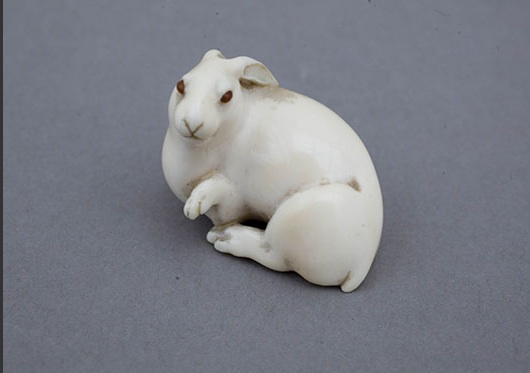
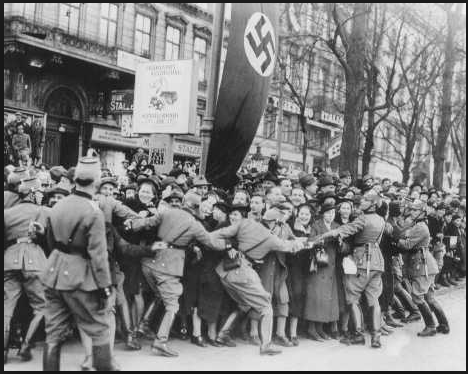
hare finallyAs I consider what to say about parts 3 and 4 of The Hare With Amber Eyes, I remember my daughter, Julia’s christening in early spring 1961. At the reception in our Don Mills apartment, her fraternal grandfather made a casual anti-Semitic joke. My objection was all but drowned out by laughter. What exactly he said, I have mercifully forgotten, but I have the satisfaction of knowing that the genes he handed down to my husband Blake and on to Julia got blended with Warsaw Jewish genes to produce a son, not strictly speaking Jewish since Julia is not, but good enough for Hitler. Even so, I mostly don’t let myself feel anything like the full force of what I could feel about the Holocaust which destroyed all but two members of that middle class Warsaw family. Until I read this part of The Hare With Amber Eyes. Oddly, it is the pillage and loss of beauty, which is irresistibly affecting to me, the netsuke sitting vulnerable in their glass cabinet while the mob breaks in and then the Nazis seize the palace and force Viktor to sign it over.

after anchluss palaisThis photograph was taken after the Anschluss. I imagine this crowd is waiting for a celebratory parade.

Unlike his children, Viktor does not have the instinct to flee. By the time, it is necessary, he has great difficulty doing so. It is true that none of the immediate family is deported to a camp, although one does not survive. On balance, the Ephrussis of Vienna, like my grandson’s Warsaw family, could be seen as lucky. Strange luck to survive in the face of such grief, of so much loss. The great advantage the Ephrussis have is Elizabeth, the lawyer and the author’s grandmother. Thus Viktor finds himself sitting by the kitchen stove in Tunbridge Wells, reading news of the war and Ovid’s poems of exile, while Elizabeth learns to cook. In December 1945, she goes back to the Palais Ephrussi, no longer a Nazi headquarters but an American one. Almost nothing is left, except Anna and, amazingly, the netsuke.

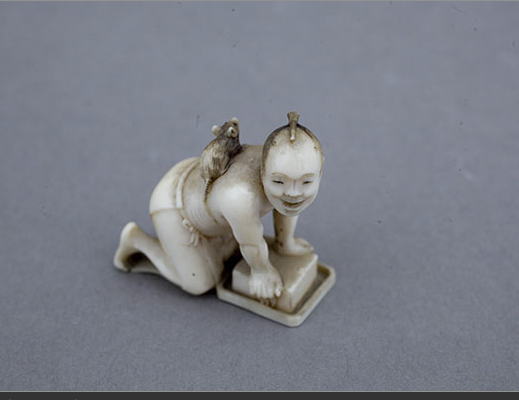
Then the story switches setting. Iggy, former fashion designer, and American Intelligence officer, returns to England from a year trading grain in the Congo and receives the collection from Elizabeth. It is as if the netsuke settle what he should do next. He takes the collection with him when he moves to war-torn Tokyo. Ironically, he will work as a banker there. “Iggy had a small attache case filled with ivory monks, craftsmen and beggars, but he knew nothing about the country.”

netsuke floor cleanerAbove, a floor cleaner has a surprise.

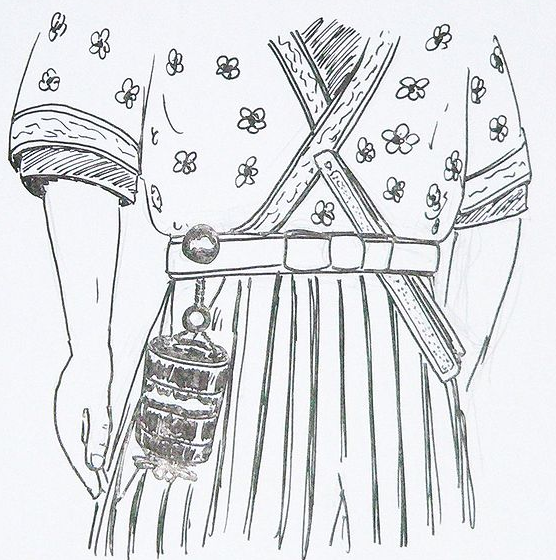
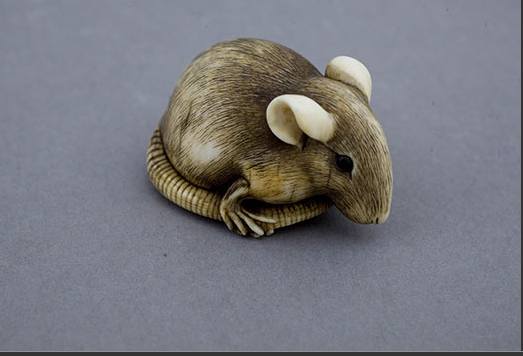
netsuke as wornThe netsuke is the bauble that is on the belt and attached by string to the purse or pocket below. It seems to be a rat pattern in this case.

Edmund De Waal gets to know his uncle when he goes to Japan as a teenager to study ceramics. By that time, Iggie has added Japanese to his German, Russian and English. He lives in a home with fewer objects, but nevertheless rare, Japanese antiques. He is successful and shares his life with a male friend, Jiro, some years younger. So there is beauty there and happiness, but this part feels elegaic. After Iggie’s death, De Waal stays with Jiro when he visits Japan.

iggy with netsukeFinally, the author goes to Odessa where he joins his younger brother and they discover clues of the Ephrussi brothers presence there before 1870, not only in stories but also in a school and an orphanage they founded.

The netsuke are in London now in a vitrine where they can be taken out and played with by children.

netsuke rat

The Hare With Amber Eyes: Viktor and Emmy Ephrussi

ringstrasse above(The second in a series of posts about Edmund de Waal’s book The Hare With Amber Eyes)

In 1899 the collection of 264 netsuke (net-ski), tiny Japanese carvings, arrived along with their black lacquered vitrine at the Ringstrasse in VIenna, a gift from Charles Ephrussi to his cousin Viktor on the occasion of his wedding to Emmy. They were uncrated at the Palais Ephrussi and began life anew in Emmy’s dressing room.

palais ephrussi colourThey were destined to live in the Palais Ephrussi (above) for the next 48 years, although the Ephrussis did not.

The palace was built soon after the street itself, the Ringstrasse, in 1865, a boulevard made for imperial parades and stood near other magnificent homes of wealthy Jewish families – the Libens, Todescos, Wertheims, Gutmanns, Epsteins. By 1899, Freud had his office around the corner. The 145,000 Jews in Vienna had had civic equality since 1867, including the right to teach and own property. The Ephrussis, like many others, were secular Jews and did not attend synagogue. They were Viennese, citizens of the Austro-Hungarian Empire and loyal to the Emperor Franz Joseph, who had granted them their rights.

Baron Ignace von EphrussiThe great house was built by Ignace Ephrussi, who arrived in Vienna from Odessa in 1865 when his son Viktor was 3 years old. Eventually, Ignace was ennobled by the Emperor and became Baron von Ephrussi.

De Waal, the author and present owner of the netsuke is a renowned potter of simple modern forms and his reaction to the palace, now Casino Austria, is much like my own would be. He notes the gold trim on the exterior, the many half-clad Grecian maidens in the niches. He feels smothered by the smoothness of the omni-present marble, as if he can not get a purchase anywhere – on the shallow wide steps of staircases, on the slick floors.

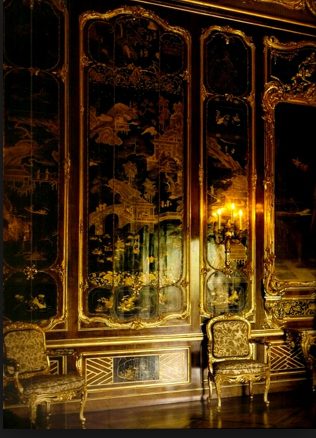
panneled wall palaisThe “implacably marble” interior was lavished with tapestry and ceiling murals.

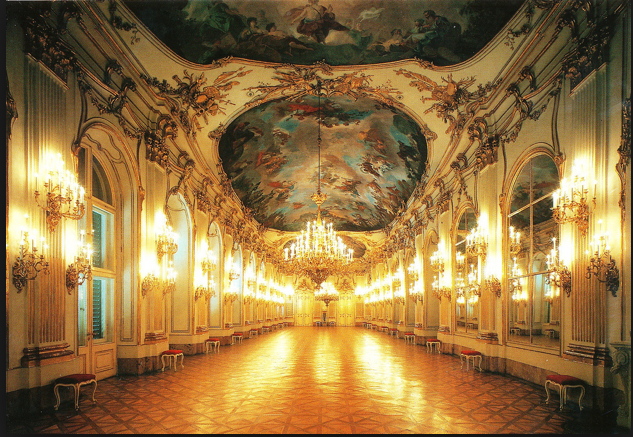
ballroom palais ephrussiMost of the paintings told classical stories, except oddly, the one on the ceiling of the ballroom, the only room that the Viennese, as opposed to Jews, would see. It told the story of Esther. De Waal says, “It is a long-lasting covert way of staking a claim for who you are.”

Viktor, like Charles in the Paris branch of the family was the spare son, so he too was spared bank training. Viktor preferred reading history and sitting in cafes with his friends – until, alas, his older brother Stefan, eloped with his father’s mistress and was disinherited. Suddenly the unprepared Viktor found himself working in the Bank Ephrussi, untrained, and, as it turned out, without a banker’s instincts.

Ignace died only 10 weeks after Viktor and Emmy’s wedding. They kept their apartment on the second floor, the Nobelstock, which Emmy had initially announced “looked like the foyer of the opera”. De Waal takes us into the palace where Ignace had had a a private staircase only he could use, servants’ rooms on a “secret” floor, one with no windows, tunnels to neigbouring houses, ways for naughty children to access the roof, and the glass-covered court yard where the carriages and horses and later the automobiles stood ready beside a statue of Apollo..

It was not a “cozy” place in the way that Charles’s home, opulent as it was, might have seemed. The netsuke vitrine evidently did not suit it except in the smaller more intimate surroundings of Emmy’s dressing room. Here her children gathered pre-dinner to watch her maid Anna dress her for dinner. Here Elizabeth, Iggy and Gisella were allowed to open the glass case and take the netsuke out to play with them.

But of course there was something secret and malignant, the worm in the rose, gnawing away beneath the surface beauty. Marble halls were not proof against it.

Even in Paris Charles was subject to anti-semiticism. Renoir turns against his patron when Charles buys paintings by Gustav Moreau.”It is ‘Jew art’ Renoir writes, galled to find his patron, the editor of the Gazette, with this gout Rothschild stuff on the walls..” Not only is Jewish artistic taste criticized, as bankers Jews are held to be exploitative and responsible for every economic setback. De Waal forces himself to read the newspapers, pamphets and books that target the Ephrussi family with hatred, and parody them as individuals, not only Charles, but others like Maurice, who has married Beatrice Rothschild. The Dreyfus scandal, in which the Jewish officer Alfred Dreyfus was accused of treason, effectively divided the nation into two parts, Semites with their few supporters and anti-semites. It was almost 10 years before he was exonerated and released from Devil’s Island.

But, if the French, in that era, were capable of anti-Semiticism, the German speakers had a positive gift for it. Elizabeth and Iggy, for example, found themselves shut out of a guest hut at the end of a long day’s mountain hike because they were Jews.

Franz Joseph knew a good thing when he saw it and courted the newly arrived Jews who brought wealth with them and soon made more. Viktor regarded himself as a loyal Austrian and, consequently did not follow the advice of his friends who spirited their money off to Switzerland when war was in the offing. In fact, he sunk his wealth into Austrian bonds. Just how reckless this was beame clear to me when I read Margaret MacMillan’s The War That Ended Peace. Austria-Hungary was a pasted together country, a collection of territory assembled by the Hapsbergs. Its soldiers spoke so many languages that units were divided accordingly and orders were sometimes issued in English. There were two parliaments and the Hungarian one erupted physical violence at one point. The heir to the throne was Franz Ferdinand, however, who had a sensible attitude that going to war was not a good idea. Then he and his wife were assassinated, the ostensible cause of the war’s outbreak.

By the end of the Great War in1918, Viktor’s branch of the Bank Ephrussi had to be bailed out. He still had the palais and personal money, but he had lost his fabulous wealth. And like every other family in Austria, his was almost starving because of food shortages. Emmy had just given birth to a fourth child, Rudolf, the Spanish flu was raging across Europe and it seemed as if mother and child might not survive.

They did survive as did their home, although there were half as many servants. Gradually, things improve. Elizabeth earns a doctor of law degree, marries and leaves the country. Iggie studies finance in Cologne. He is the only male Ephrussi in both branches of the family, but in 1933 wisely runs to Paris, giving banking up for a life in fashion eventually in New York City.

In 1938, there is the Anschluss. But this is part of the next section of the book, part 3, “Vienna, Kövecses, Tunbridge Wells, Vienna 1938-1947”.


The Hare With Amber Eyes: Charles Ephrussi

hare finallyThis is the Hare With Amber Eyes, for which Edmund de Waal named the book he wrote about his family, the Ephrussis. My edition is subtitled “A Family’s Century of Art and Loss”. The hare is one of 264 netsuke (net-ski), tiny sculptures that hung on traditional Japanese costumes, fastening pouches -external pockets. At the end of World War II, this collection of tiny objects was the only part of the great Ephrussi fortune to survive.

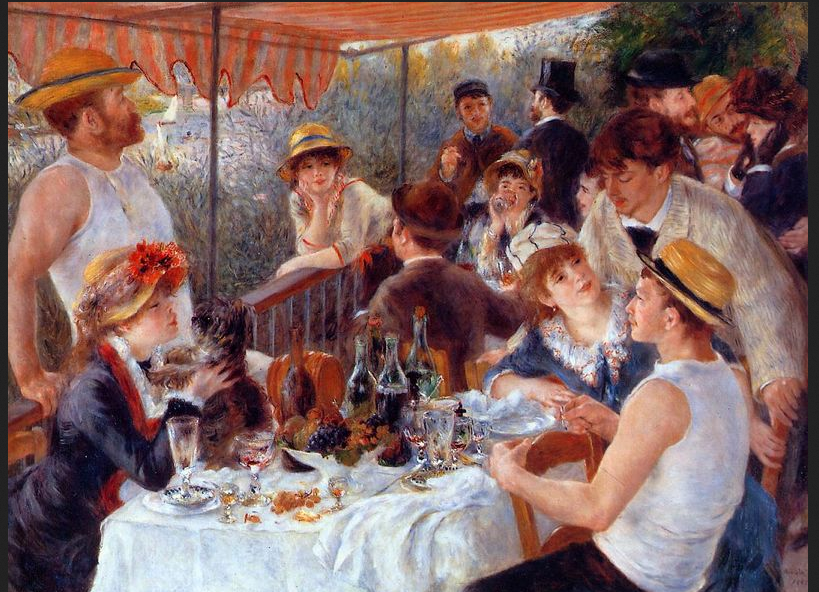
Charles Ephrussi bought the collection from a Paris dealer in 1880. Charles is the man in the top hat in The Luncheon of the Boating Party by Renoir and one of two men who served as the model for Proust’s Swann. (De Waal cautions us not to assume that Charles would actually wear such clothes to a boating party.)

luncheon of the boating partyNineteen years later, Charles sent the nesuke in their black vitrine to Vienna as a wedding gift to his cousin Victor and his bride, Emmy. There in the Palais Ephrussi on the Ringstrasse, the netsuke lived in Emmy’s dressing room where their children played with them. They remained there when the family fled in 1938. Although the palace was occupied by the Nazis, the netsuke were miraculously spared from plunder and came back into the family’s hands in 1947. Amazingly, Iggy Ephrussi took Tokyo where he lived until his death, leaving them to his nephew Edmund de Waal, the author of The Hare With Amber Eyes.

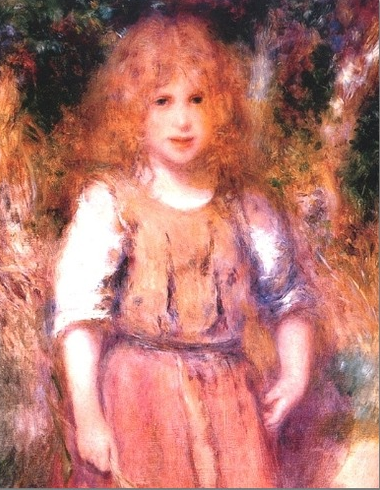
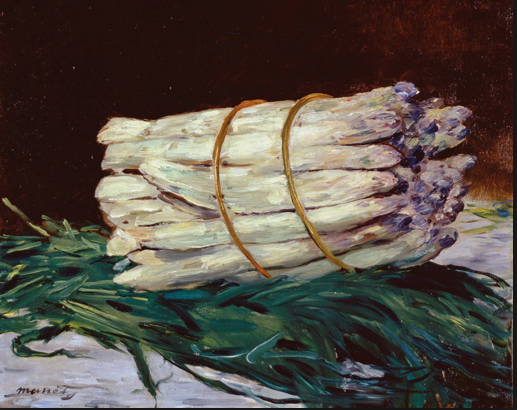
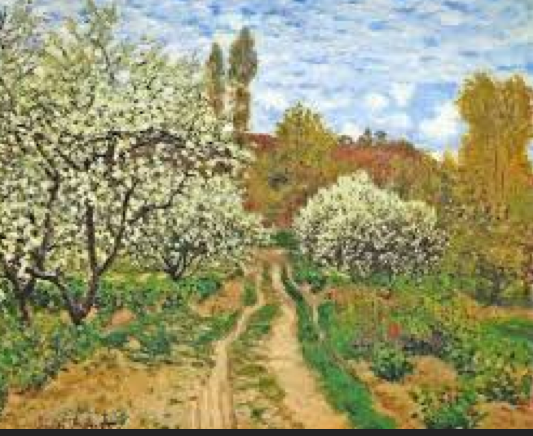
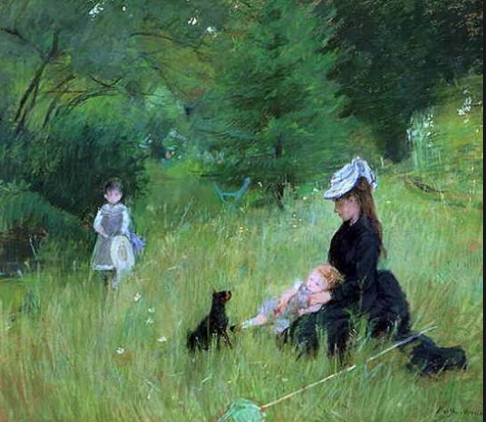
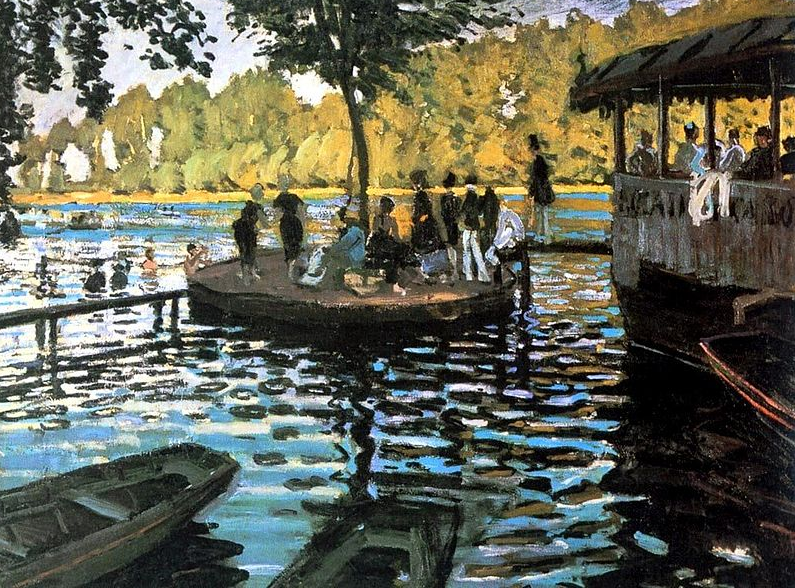
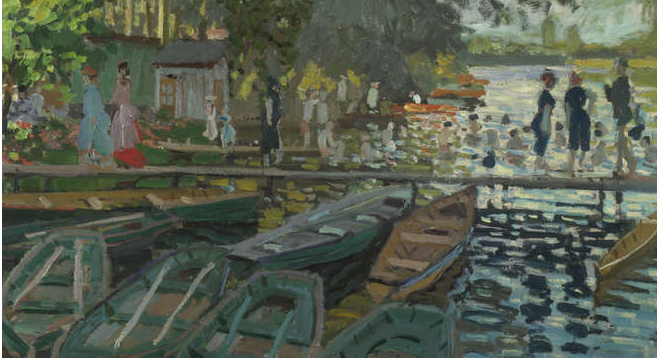
Charles Ephrussi, who first bought the collection, kept the 264 tiny carvings in the salon of his second floor apartment on a Parisian hill. Being the third and youngest son, bookish and uninterested in making money, he was not required to join the family business. It had started as wheat dealing in Odessa, but had grown into banking and family members had been dispatched to Paris, Vienna and ultimately, to Moscow to establish branches. Charles was free to indulge his interest in art, writing a book about Durer, as well as magazine articles, becoming the proprietor of the Gazette and collecting paintings by Impressionist painters for himself and others, as well as offering the artists personal encouragement and friendship. Edmund de Waal imagines the walls of the salon as it must have been, hung with these pictures three deep. Included among the 40 paintings Charles hung were Renoir’s Gypsy Girl, Manet’s Asparagus, Monet’s Pommiers and Morisot’s On the Lawn.

gypsy girlmanet Asparagusmonet PommiersSince there are several versions of apple trees painted by Monet and since I am not an art historian, I may not have the right picture here.

MOrisot on the lawnDe Waal goes to see one of Charles’s pictures at the National Gallery in London – for now the collection has been dispersed far and wide – and says, “You feel alive looking at it.

les bainsThis is Monet’s The Grenouille.

the bathers at GrenouilleMonet’s The Bathers at Grenouille

The description of Charles’ salon with its yellow arm chair, its walls glowing with luminous Impressionist paintings and the black lacquered vitrine is one of my favourite parts of the book.

The story is told anecdotally as the author travels to the places where the collection lived and delves deeper into the family history but because it is his family, de Waal is very much a part of it, offering his response to his discoveries. If I had to choose one word to describe The Hare With Amber Eyes, it would be charming. In spite of the fact that it is a story of great loss, reading about such beauty salves the soul.

(Another post will talk about the netsuke in Vienna.)

Daniel, Road Warrior

(This is one of a series of posts about my estranged son, Daniel.)

bike awardI opened the front door, looked down and almost fainted. There was my small son, clutching his throat, blood spurting out between his fingers. I screamed. His father came running and pried Daniel’s fingers open. It was his chin, not his throat after all. Blake swept him up and into the car while I stood there, immobilized. The small tricycle lay overturned on the sidewalk. The other children, including Daniel’s sister Julia stood beside their tricycles, most of them larger models. They had been racing like maniacs up and down the sidewalk and shouting in glee.

Daniel had had his first serious bike fall. It would not be his last. In the years to come, he would take many spills – on his first small two-wheeler, on his banana-seat bike, on his mountain bike, on his road racer, on his commuter. He would up-end over handle bars, somersault over car hoods, narrowly escape leg crushing in traffic, get doored, get run off the road on highways. He would bleed from road rash; his wounds would turn red, then blue, then yellow, but curiously he would never break a bone.

I didn’t know any of that then. I just knew that my husband who couldn’t stand the sight of blood, who fainted in movies that depicted blood loss had just leaped into the fray while I stood helplessly by.

After a few hours, they returned, Daniel sporting a series of brown stitches under his chin, which he rushed to show the other kids. He has that white scar still, just out of sight until he lifts his head.

(Strangely, it always turned out that when Julia was bleeding, I handled it. Daniel shut her in the oven of the toy stove – at her insistence – and I dealt with her bleeding hand, holding the compress in the emergency ward, etc. But whenever Daniel turned up bleeding or even reported a close call, I got weak in the knees.)

In summers in Guildwood Village, the kids would take off on their bicycles in early morning, riding off to the cliffside parks, ditching the bikes to climb the bluffs, coming home late for lunch, dusty and scraped, only to set out again. No questions asked. Well, none answered anyway.

When Daniel’s doctor recommended exercise to deal with his incipient asthma. we foolishly enrolled him in soccer. In full regulation gear, knee socks and all, he spent his time avoiding the action, hanging back, taking an ego hit until he decided that he was meant for racing. He began by racing on his feet and was soon doing training runs up the big hill and around our neighbourhood. It was later when he was in his twenties, living with me in my country village house that he moved on to bicycle racing. It’s a complicated sport because it involves a machine as well as physical conditioning. A bad tire or a dropped chain can finish off a skilled, fit rider. He started with road racing and moved on to mountain bike racing and then to cycle-cross. For many years, he was guaranteed a top spot in his category.  Training consisted, probably still consists, of hundred mile group rides on the weekend. (Much hated by some country types.)

The scariest time for me was the year or so he worked as a bicycle courier. Speed was imperative and this interval found him at his road-warrior scariest. Eventually, he quit to save his life, but he carried that style over into his commute to his safer job. He tangled with a car on Bloor St. and ended up because of our no-fault insurance having to report it to my car insurance company. An agent called me to confirm details. He asked me if Daniel was married. I said no. Then I said, “Hang on. He is married.” The agent said,” What’s with you people? Your son said exactly the same thing.” For political reasons, Daniel had been married for five minutes to a girl he loved. Politics changed. They had moved on, neglecting divorce.

After that accident, he gave up wearing a helmet. He said it was the only way, he could make himself slow down. Work that logic out.

When I was recovering from heavy duty surgery in 2001, he showed up, just back from a race and gave me his winning medal, pictured above.

So there it is, a snapshot of my reckless son, who has unorthodox principles.

Writing About Daniel #2:

(This is one of a series of posts about my estranged son, Daniel.)

I began writing about Daniel as I explained earlier (https://115journals.com/2014/02/08/writing-about-daniel/) because I wanted to “open the flow of my dammed up love for him” in view of the fact that we are not communicating. I talked about his birth, his unknowable infant self and considered the external world and its influence on him as a toddler. In the process, I have arrived at the spring of 1963  when he was 15 months-old. So how is it going so far?

Unexpectedly.

I thought I would gradually uncover the little person he was then and slowly move forward as he became his own person, distinct from his sister who was a year older. Instead, something else happened.

Out of the dusty attic of my mind, I retrieved another memory. It was of my father, leaning close to my ear as he was leaving after a visit, and whispering to me. He said, “You know I’m going to kill them both, don’t you? I’ve told you so.” Then he sniggered and got into his car.

By the time, Daniel was a year old I had heard this more than once. My father was a monster. Goes without saying. We all pretended this was not so. He was violent and abusive when the fit took him, but he genuinely loved children, especially these grandchildren. Unfortunately, his idea of love was way off-base as I knew from experience and I had warned him to keep his hands off Julia and Daniel. This was his revenge.

So why not report him to the police? The most I had ever been able to do was report him to a neighbour when I was eight. She was a pillar of the community, but her intervention consisted of scolding him soundly, with the result that I thought he was going to murder me, my mother, and my two baby sisters. Moreover, he always seemed to have the local cops in his pocket and, anyway, in those days, no one- nobody- believed such allegations.

I had assured him that if anything happened to my children I would write down everything he had ever done to us, mail it to the powers that be and kill myself. His giggling response was, “You’d never do that!”.”Wait and see,” I said. (We hadn’t yet learned to say “Try me”.)

So he sniggered in my ear and took off with my mother, back to Burlington where two of my siblings still lived under his roof, too old to tempt him and old enough to have designs on escape.

I didn’t believe him, but he terrified me. He had been terrifying me for years and years. He had almost killed me when I was six, but he deeply regretted it afterwards. (Is the sarcasm clear there?) Once he understood that I opposed him, he kept up a campaign of terror, oddly or perhaps not so oddly, combined with taking me and my sister, Georgia, with him whenever possible and referring to us as his angels.

So writing about this time on Benleigh Dr. in Scarborough in 1963, I came upon this whispered confidence and lost my mind. Post traumatic stress will do that for you. Transport you right back into the thick of things. Suddenly, you are in the midst of a flashback of feeling as intense as it was originally.

Basically, I feel a homicidal rage. I feel as if I could kill him. Then I remember that he is already dead and has been for 26 years. He phoned me and my sisters on the morning of the day he died and said to each of us, “If I have done you any harm, I’m sorry” -he couldn’t get hold of Rob in Europe. He knew he was going to die and not from natural causes.

I was late for class and I muttered something in reply -“That’s all right” probably. I had spent his old age trying to love the shambling wreck he had become.

Today, weighing the harm that got passed down the generations, I told my sister Georgia that if he died violently everyday, it would not be enough. And sure, that feeling has to be acknowledged, given some head room, but I can’t stay there. I must let it go- for my own mental health. I must forgive that monstrous old man. He asked me to.

I can speculate about why Daniel won’t speak to me but I don’t really know, except that somehow this lies at the bottom of it. It is bred into us and into our relationship.

It was supposed to be a secret. Now it isn’t.

(Never Tell, my e-book tells the story of my childhood more fully. See 115journals.com)