Particularly apt this morning. Re-blogged from Eva Tenter.
Leaving Things Undone
Reply

Particularly apt this morning. Re-blogged from Eva Tenter.
Once upon a time, I moved on Hallowe’en and like all moves, it was a truly scarey experience. But I want to talk about two moves later, the time, I moved to Z., a crossroads hamlet, an hour north of the city, hard to find on the map. Like most other newcomers, I moved there because I could afford it.
It was the second time a home-owning partnership had dissolved on me, only this time, the housing market had boomed. Whereas the first time, 10 years before, I could afford to buy a hovel on my own, city hovels were now well beyond my price range.
As luck would have it, I arrive with a Newfie dog, 7 cats and a badly sprained ankle. My partner and I have had 3 dogs and we divided them according to poundage. Bella, the Newfie is all I can handle, weight-wise. The 7 cats belong to my son and his girl friend, who are quitting the city in an anti-police protest. There have been demonstrations, friends have been roughed up. My 22 year-old son, his girl friend and the cats are seeking safe-haven with me in the country -in a white clapboard house with arched windows and gables, next door to the church.
The first load of furniture and all the animals have been dumped, my bed set up in deference to my lamed state and the young people have departed with their friends to pick up another load. Silence falls as silence can in the country, even at a crossroads. The cats don’t know me or trust me and have sequestered themselves in the summer kitchen, a one story extension at the back of the house. Belle has clumped upstairs after me and heaved herself up onto the bed, deaf to all arguments that Newfoundland dogs are too big to be bedfellows. I stand in the middle of the bedroom, gazing at the 3 pitch black, uncovered windows. No problem actually because there is nobody out there.
What about in here? A house built in 1889 surely had seen its share of death. Could it be haunted?
Fortunately, I fall immediately into the righteous sleep of the newly-moved who have badly sprained ankles, and barely notice when the second load of furniture arrives.
It is a chaotic next few days as 8 animals and 3 people sort out their roles. The big black dog soon learns her place relative to nose scratching cats. Gradually we clear paths between rooms and a nest of seating where we can take refuge and eat. Unfortunately, my son, Ben, steps on a rusty nail and we have to find the nearest walk-in clinic for a tetanus shot. Shocking how far away everything is in the country.
Unfortunately #2, now Ben and I are both limping on our left foot. I follow him through the kitchen one day. He is going out into the summer kitchen, while I am turning into the cooking area past the island. It looks like a gimp parade and I am just enjoying a quiet laugh, when another figure rushes past, arms thrashing and clothes flying. And laughing.
“Ben,” I yell, “did you see that?”
“What?” he calls back.
“Where’s Aunya?”
“Upstairs.”
We meet at the door. There is no one else there.
“An Indian – a First Nations person – whatever. Brandishing something -seemed like an axe, doing a kind of war dance and laughing!”
We stare at each other in silence. Well, if you are going to have a ghost, it is probably best to have a laughing ghost.
Some time later, I learn that the hamlet sits on the portage route up to Lake Simcoe.
Things settle down. We buy Ben a very old Ford pickup truck guaranteed to work just fine and he begins renovations. I begin commuting to work. Oh God, why did I ever move here? Surely, there is a shorter route. And there is. It takes only 60 minutes, not 75. Two hours a day, am I out of my mind? Etc, etc.
Ben is tearing up the floor in the dining room. But no wait, he has to tear out the roof in the summer kitchen. It’s leaking. There’s been a fire up there at some point.
And something in the house is not happy.
I know it’s not the native trickster. Anyway, he’s a wayfarer not a resident.
My city-bred son and girlfriend tend to vanish back to the city until late into the night. One night, Ben calls me around 10 P.M.
“We’re staying in town for the night,” he says.
“Okay,” I reply. I do have experience living alone. I lived alone in the hovel.
There is dead air on the phone line.
“Ben?” I querry.
“Uh, have you seen the ghost?” he asks.
What a truly terrible time to ask such a question, a dark rainy October night.
“I don’t actually see her,” I reply, “except in my mind’s eye, but I know she’s there.”
“Yeah,” he says, “she’s small and she wrings her hands.”
“She’s upset about the work you’re doing. I keep telling her we’re just making her house better.”
“Me too,” he says. “I didn’t want to mention her before. Are you all right staying alone?”
I want to say that I was a lot better before he outed the ghost, but I just go on reassuringly and get off the phone. I stand there in the kitchen. She is standing just out of sight beside the stairs. She is short and thin, wearing an apron which she has balled up in her hands. I feel so cold that I might as well be naked.
I give myself a shake.
“I’m going to put on the kettle for tea before I go to bed,” I announce.
A passing cat, the orange one, meows. No bristling, no raised hackles. Belle ambles along the hallway, right through the ghost lady. Co-residents. We have to get along.
The title search arrives in the mail. One family, the Toves, owners of a car dealership, owned the house for much of the century. One of them,Daisy died at the Village of Z., having her fixed abode there. Could be her. But on another document the most touching note of all concerns Edith, “a lunatic”. After that, various other last names, two of whom declared, “We are not a spouse”. Who cares about these late-comers in the second half of the the 20th century! My ghost now has a name.
Spoilers for earlier Nesbo books and dark hints for Police.
Some months ago, I finished Jo Nesbo’s novel The Phantom in a panic and querried whether that was the end of Harry Hole (pronounced hooleh). (See Is This the End of Harry Hole https://115journals.com/2013/03/27/jo-nesbos-the-phantom-is-this-the-end-of-harry-hole/ The appearance of a new book Police seemed to argue against it, but I got well into the new book -32% into it, my Kindle said- and Harry was still missing. It’s true there was a closely guarded coma patient in an otherwise empty locked ward in Oslo. That could be Harry, I thought. Last we knew, Harry’s “step-son” Oleg Fauke had gunned him down with a Russian Odessa – a copy of the better-known Stechkin – in a drug squat.
The first few pages of Police is told from that gun’s point of view, tracing its journey from Siberia to Norway in the hands of Rudolf Asayev and finally to Rakel Fauke’s house where it is now “sleeping” in a corner cupboard, smelling of old wood, powder residue and gun oil. Nesbo helpfully reminds us that two of its five bullets killed Gusto Hanssen who had pocketed Asayev’s money and dope, and that its next three bullets hit Harry Hole. Hitchcock said that if a gun is carried onto the stage in act one, it will sooner or later be an important plot device. There are 12 bullets left in the magazine.
As to the sleeping man in a hospital bed in a locked ward, a number of people hope never to see him again, including Mikael Bellman, the bent police chief, Harry’s nemesis.
After the glimpse of the hidden Odessa, Nesbo gives us a lovely picture of September in Norway and brings Erland Vennesla, a jogger and recently retired detective onto the scene. Poor Erland soon becomes the first victim in a series of carefully executed murders of police, mostly at the site of an unsolved murder that the victim investigated. As the bodies of police begin to pile up, Harry’s old boss Gunnar Hagen, head of Crime Squad, assembles a secret inside team consisting of Harry’s helpers: Katrine Bratt, the Bergen detective who spent time in a mental hospital, Beate Lonne, the head of Krimteknisk, who literally cannot forget a face, Stale Aune, Harry’s psychotherapist, and Rasta Hat, Bjorn Holm. Meeting in the Boiler Room as of old – so far beneath police headquarters that it’s almost in the prison next door- they bemoan the fact that Harry is totally unavailable. He was Norway’s only expert on serial murderers.
Long-standing bad guys are still on the scene, including Bellman, his lover Isabel Skoyen, a prominent city councilor, and Truls Bernsten, his erstwhile sidekick, temporarily suspended from the police department but still able to act the part of ‘burner’, destroyer of evidence. Bellman, of course, forbids Gunnar Hagen to split the investigation of the police murders between the regular police department and the four in the Boiler Room.
But who is the lecturer at the police college, the expert who has enthralled an attractive student, Silje Gravseng? And why are mysterious visitors waiting for him in his office? So his red-bearded colleague, Arnold, informs him? Surely this well-spoken, well-groomed person cannot be …..
As usual in Nesbo’s books, the murders are bizarre even grotesque, and in this case, duplications of old unsolved murders. And as usual Harry and his group leap to wrong conclusions. More than once. Harry is passionate about justice and committed to finding the bad guy, but bright? Not so much.
The trouble with Jo Nesbo as a writer is that he is capable of cold bloodedly killing off even the most beloved characters. He had Ellen Gjelten, Harry’s partner beaten to death just when she was about to tell Harry who the ‘Prince’ was. As a result, Oleg got kidnapped by the villain and narrowly escaped death, not for the last time. Then in the next book, Halvorsen, Harry’s new partner and father of Beate’s son, got gunned down. Moreover, Nesbo has said that Cockroaches due to be released soon is the last Harry Hole novel. (It is actually the second book after The Bat and before The Redbreast, translated only now.)
As the novel reaches its climax, Rakel and Oleg are menaced once again and surely this time, Harry cannot save them. Or himself.
Thus, this reader arrived near the end of the book at a solemn church service where the Boiler Room crew and the surviving cast members have assembled. Bellman is impatient for the organ to announce the ceremony. How inappropriate!
I may never forgive Nesbo for his tricky ways.
In one of Rumi’s poems, “There’s Nothing Ahead” (Coleman Bark’s translation on p. 205 of The Essential Rumi), the 13th century Sufi poet tells us that “The cure for pain is in the pain”.
This is a very enigmatic poem that begins:
Lovers think they’re looking for each other,
but there’s only one search: wandering this world is wandering that, both inside one
transparent sky. In here
there is no dogma and no heresy.
This idea echoes another poem where he says
Lovers don’t finally meet somewhere
They’re in each other all along. (Essential Rumi, p. 106)
By now we are beginning to get the idea that the ‘one search’ is not an outward one or a search for other.
After asserting that
The miracle of Jesus is himself, Rumi goes on to say that “if you can say, There’s nothing ahead, there will be nothing.” Then as though the reader is not confused enough, he adds
Stretch your arms and take hold of your clothes
with both hands. The cure for pain is in the pain.
Good and bad are mixed. If you don’t have both,
you don’t belong with us.
Faced with excruciating pain, I am more than glad to retreat to the coziness of a morphine drip, but it’s hard to come by. Lesser painkillers don’t impress me. Sure they can keep me quieter, but that’s about all. And over the counter pain remedies mess up my digestion and leave the pain the way they found it. So I am driven every so often to test this hypothesis.
I sat down earlier this week to get acquainted with the pain du jour. I made myself as comfortable as possible. No full lotus posture for me. If I’m going to look into the heart of darkness, I need pillows.
Whoa! It is bad. Really, really bad. Pull out of this dive. Just fear. Letting go never works for me. I have to own it. Hold it. Feel its center. Stay there. Stay there. Don’t fight it. This is not an alien force. This is me.
Forty minutes later, I seem to have sailed onto a clear sea.
The residual pain is bearable. I have no idea if that is what Rumi had in mind, but great poetry works that way. It is suggestive. What we make of it is up to us.
Rumi ends the poem:
When one of us gets lost, is not here, he must be inside us.
There’s no place like that anywhere in the world.
Recently, I lost my usual social group. It’s because of the flood, the basement flood at the tai chi club I attended two or three times a week. It wasn’t even a very deep flood, not what others in my town experienced that July 8th when the heavens opened, but deep enough to cause a flowering of mould or noxious fungi. Initially, it smelled like charred wood. When no one else seemed to smell it, I knew I was in trouble. A blinding headache confirmed my suspicion. I withdrew. I raised an alarm. This was a health hazard, I said. The contractor who dealt with the building agreed. The rug had to be pulled up and the floor treated with anti-fungal cleaner.
It is now three months later. The rug is still there and so is the over-growth of fungus.
I tried visiting a month ago. As soon as I walked in the door, I got light-headed. Surely, I would adapt. Half an hour later, I kept saying I had to go because my head was aching, but I seemed incapable of taking myself out the door. Walking toward my car, I knew it was the beginning of the end. On Friday, I turned in my key. The instructor who took it asked me how long it takes me to get to the club I now attend.
It is true that I am now going to another location of the same outfit, half an hour closer than the mouldy one, a spacious, airy building that brings to mind Hemingway’s “clean, well lighted place”. But it lacks the 50 or so familiar faces I used to gab to and the four good friends I had made there.
There is a good deal of self-pity involved. I had been going to that club for eleven years and was instrumental in its membership expansion, in upgrading the building and in fund-raising. Every so often, I am given public credit for this. Don’t want it. Want a de-fungused basement.
Give that up, Joyce. You did it. Now it’s done. Have the grace not to snivel.
So I took Magic Erasers into the new club and scrubbed the baseboards before class. I talk to absolutely everyone who will give me the time of day. I take food in for potluck lunches. There’s got to be a pony under this pile of — fungus.
In other news: the cottage I love is being sold. We will not be able to rent it next year. A beloved house in Southern California is being lost to bankruptcy, a loss which reminds me of an earlier loss that I spoke of in my post about The Great Gatsby. https://115journals.com/2013/05/17/the-great-gatsby-a-personal-response/
Worst of all and no joking matter, a young relative is dying. I do not claim that this will actually be my loss, because I am peripheral. It is, nevertheless, a source of grief, all the more because it reminds me that I very nearly lost someone much closer. https://115journals.com/2013/01/06/shed-come-undone/
Roots are being torn up. I pulled two fat carrots out of a garden a few days ago. They are destined to join parsnips and turnip in a mash-up tomorrow. Heat, butter, nutmeg and sea salt will transform them into a mouth-watering Thanksgiving delight. (A Canuckian Thanksgiving) And I know that these changes are also transformative, but, like the carrots, I don’t yet see what we are becoming. I catch glimpses – a new home for one of us among mountain pines, my renewed friendship with my ex-husband after 30 years estrangement and various spiritual books assure me that the young man is about to be changed into “something rich and rare”.
Blake has observed that if we had stayed together in that house under the hill, skimming the leaves out of the pool and feeding the birds outside the patio door, we would be stodgy and rigid. He doesn’t add “whereas we are flexible, large-minded and open-hearted”. But of course we silently believe we have made a transformation of that order.
So for that change, at least, I am grateful.
Someone has just read my post Fortunate Fall: change the future in a blink, so I decided to reread it myself. https://115journals.com/2012/12/11/the-fortunate-fall-change-the-future-in-a-blink/ and https://115journals.com/2013/01/12/the-fortunate-fall-a-further-exploration/
Events connected with the initial family crises are gradually working out and, any day now, we will begin to see happy results become manifest. In the meanwhile, we have forged new bonds. Yes, it’s a cliche´ but those connections seem as if they were welded in fire. You can probably guess that they were cooled by salt water.
Now a young man is dying. When he came home as a 3 day-old baby, I showed his mother how to bath him. When he was 7, I remembered his curly headed, mischievous- self when I fell into suicidal despair. How could my death be explained to him? It couldn’t. So between him and the crisis line of the Salvation Army, I kept on living.
He doesn’t know that. Indeed at this point, he doesn’t know what is happening.
I am writing this to honour him because I cannot talk to him. What I am honouring is not just his worldly achievements but his inner being, his perpetual light that will not be put out by disease and death.
And to thank him for his shining face that gave me hope and kept me here to aid and comfort others in my turn.
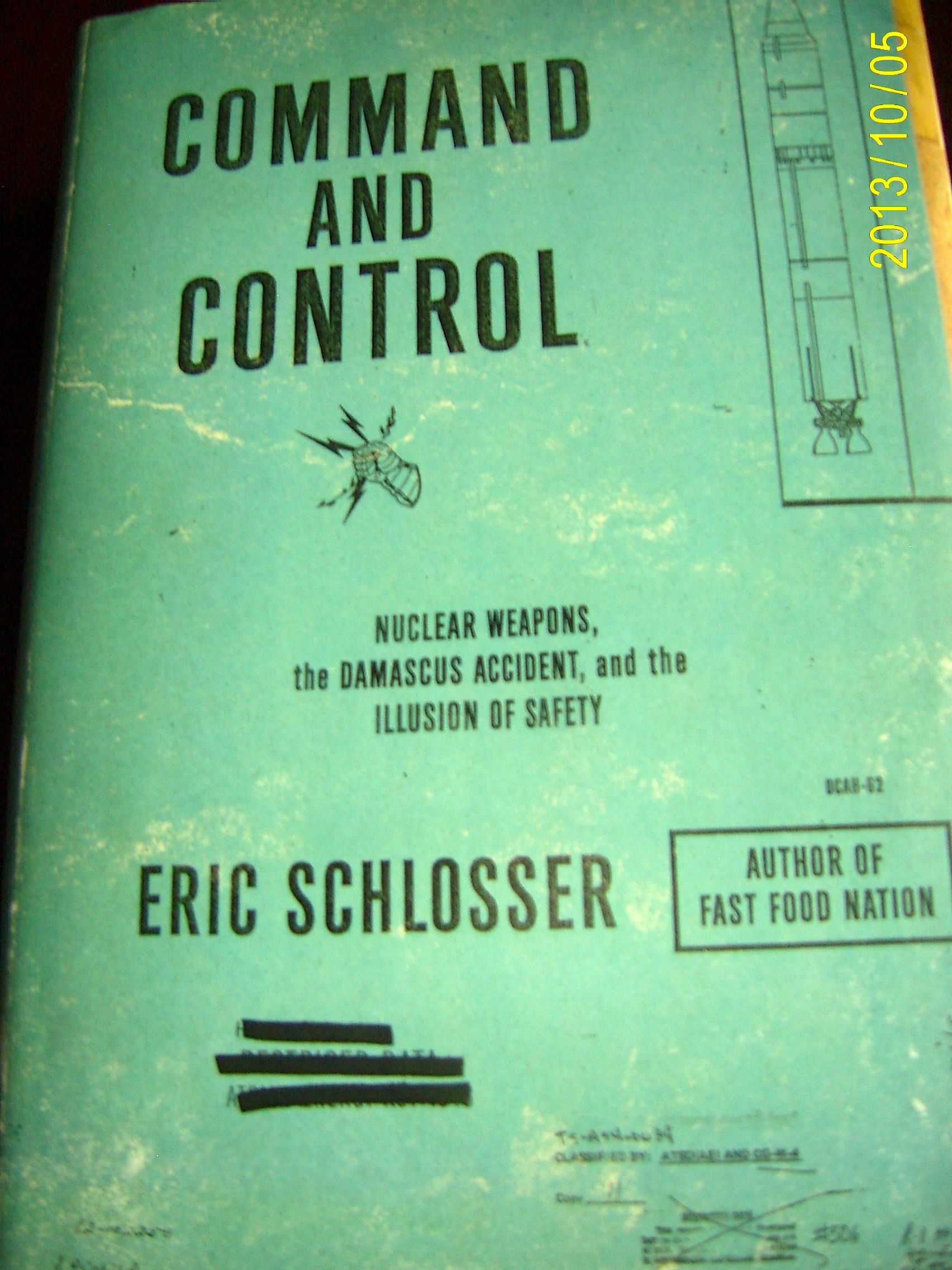 On January 24, 1961, a B-52 developed a fuel leak while being refueled mid-air. Unable to jettison the fuel inside its left wing, it went into an uncontrolled spin and began to break up over North Carolina. Four of its crew parachuted to safety. One died in the attempt and two died in the crash. The two Mark 39 hydrogen bombs it was carrying fell from the plane. In the process, various locking pins and arming wires were yanked out of one of them and the bomb responded as if it had been deliberately armed. The bomb hit the ground crushing crystals inside the nose, the firing signal. “But the weapon did not detonate.” (246 Command and Control). A simple switch in the ‘safe’ position had saved the eastern seaboard from devastation. The other bomb, unarmed, hit the earth, part of it burying itself more than 70 ft deep, never to be found.
A news item in the National Post on September 23, 2013 telling that long-secret story indicated that Eric Schlosser had revealed it in his new book, Command and Control: nuclear weapons, the Damascus accident and the illusion of safety.
I snapped to attention. I remembered that day very vividly. I was in a state of high anxiety myself. I was about to give birth to my first child and true to the wisdom of the day, I was all alone in a cold room high above a wintry street, listening to the shrieks of the woman down the hall who definitely wanted “Momma Mia”.
I saw the day in an entirely new perspective. Instead of latching-on problems in mid-January 1961, I could have been dealing with radiation sickness in a semi-destroyed civilization.
I didn’t want to know that. And yet, knowing it, I rushed out to buy the book. The book seller said, if I liked Fast Food Nation, I would love this. I hadn’t read Schlosser’s best seller, figuring I didn’t need to be convinced that many people eat badly. I’m a born-again feeder myself, converted by bad health. And goodness, what a thick book – over 600 pages.
The framework story around which Schlosser builds his book is an accident in a Titan II, ballistic missile silo in Damascus, Arkansas in 1980, which began when a mechanic dropped a socket. Ordinarily, a dropped tool just ended up in the W-shaped support at the bottom and had to be retrieved. This one ruptured a fuel tank. Warning lights came on all over the command panel. The silo crew evacuated. Now it was impossible to say exactly what was happening inside the silo, except that it was dire. Schlosser feeds us this story bit by bit, concluding it at the end of the book. In between the Damascus chapters, he recounts the story of atomic weapons, the struggle to make them, to determine who would control them and how to use them. Throughout it all, the public was lulled as much as possible in spite of unbelievably inept handling, accidents and near misses, like the time the rising moon over Norway was mistaken for a fleet of Soviet bombers.
Schlosser’s research is topnotch. He seems to have interviewed everyone involved in the Damascus incident, for example and the many characters involved come to life because of the detail. If you do get confused, there’s a handy glossary at the front, not only of the major players, but also of acronyms and abbreviations.
Some of you will understand the physics Schlosser outlines better than I do. It’s true that at school, some of my best friends were physicists and I lived across the road from the university’s reactor, but, no matter how many times I am told the difference between fusion and fission, I don’t get it. I’m pretty much stuck at really big bang and lots of destruction and unimaginably big bang and destruction. The latter would be the Mark 39, H-bomb.
So my baby daughter came home un-radiated, never did learn to latch on, but took to a bottle readily enough. She learned to walk and loved her baby brother deliriously. They were both short enough to walk upright into the crawl space of our new house. That was a good thing because we were likely going to have to live there for weeks, drinking out of the hot water tank and consuming stockpiled cans of food, after the Soviet missiles took off from Cuba.
But that didn’t happen either.
Still Schlosser doesn’t want us to be lulled into a false sense of security. And I’m willing to inform myself when a book reads this well. I’ll finish it and then slip back into willful ignorance.
I am reblogging this beautiful post about visiting Marrakesh because it recalls my visit there in 1970 with my 8 yr-old son and 9 yr-old daughter. We got adopted by a 20 yr-old Marrakeshee who guided us around and took us to his home, not before my son and then husband went out at night to a central square and got exhilaratingly scared. My daughter says the visit changed her suburban self forever.

It was 11.00pm when we arrived at the Riad (hostel). We expected a warm welcome but instead confused faces presented themselves to us when the door finally opened. Dirty, tired and hungry after a long flight and an even longer wait to get through passport control (nearly an hour), followed by a frantic search for our luggage which had been tossed off the carouse when it shut down, I was desperate for a shower and some sleep. I showed them the print out of our booking but they couldn’t find notification from the booking site. After some discussion the owners told us that it wasn’t a problem as they had a room, which they prepared, and we finally crashed at 3.00am Spanish time (12.30 Morrocan time). When the owner finally tracked down the booking it had been made for October and not September. It appears that using a Spanish booking…
View original post 729 more words
This post is about the conclusion of Breaking Bad and contains spoilers.
A tragedy such as Shakespeare’s Macbeth has to end with insight for the tragic hero and catharsis for the audience. The last episode of Breaking Bad broadcast on Sunday, September 29th had both. As a result, it left its viewers stunned but satisfied.
Macbeth realized how futile his murderous efforts to seize power had been when his beloved wife and partner went mad and killed herself. He had already concluded that his power had been paid for with loss of friendship and respect:
And that which should accompany old age,
As honour troops of friends,
I must not look to have, but in their stead
Curses, not loud but deep,
After Lady Macbeth’s death, his despair deepened:
Out, out brief candle,Life’s but a walking shadow, a poor player
That struts and frets his hour upon the stage,
And then is seen no more.
Nevertheless, he whales into battle, vowing “At least we’ll die with harness on our back”. He refuses to “play the Roman fool” and fall upon his sword when it is obvious that he will lose the battle. “Lay on, Macduff, and damned be he who first cries ‘Hold, enough’. Exeunt fighting. The next sight we have of Macbeth is his severed head, flaunted by Macduff.
He became an awful man and we are truly glad he is dead, but we are also sad and shocked by his catastrophe. Pity and fear have washed us clean.
Walter White was of the same sort of heroic stature.
His insight is clear when he confronts his wife Skylar in her downmarket accommodations. When he begins to talk about why he did it all, she says, “I don’t want to hear you say you did it for the family once more.” He continues, “I did it for myself. It made me feel alive.”
He has already arranged for his few remaining millions to be transferred to his son in trust on his 18th birthday, ostensibly from his wealthy ex- business partner and philanthropist. He sets out to rid the world of Lydia, who now owns his meth business – ricin in her stevia, Todd, Uncle Jack and his gang, in the process freeing Jesse from enslavement. He does not take revenge on Jesse when he has the opportunity nor does he force Jesse to shot him. He even acknowledges that he wants to die.
We see him in the meth lab, caressing a piece of apparatus – he loved what he achieved, 97% pure blue crystal meth. He was a brilliant chemist. Only then does he realize he has been shot – in the right lung. He falls to the floor of the lab. From high above, we see the police enter and stream around his body as the Badfinger lovingly sings, “It’s all over now, Baby Blue”.
Insight and catharsis! Like chemistry, tragedy is all about transformation.
See also https://115journals.com/2012/09/04/macmeth-walter-white-begins-his-tragic-fall/
http://115journals.com/2012/08/02/walter-white-a-macbeth-for-our-time/

 115 journals