Septuagenarian Puts Out Garbage

This is no country for old women.

On Saturday, I confirmed that hypothesis. I did a really hard tai chi class. I climbed into the little red Yaris, which helpfully told me the temperature was 2 degrees celsius (34 F), but of course, it had not factored in the bitter wind, which meant it felt to me much colder. I stopped at the local wine shop to pick up my drug of choice, a little Pinot Grigio to get me through the night. At home, I struggled out of my long, brown, old-lady coat and my fur-lined aviator ear-flapped hat. I unlaced my snow boots. Then I remembered.

Twice a week, at least, I have to put the garbage out. I had the recycling pail ready in the kitchen. The newspaper rack was over-flowing. The ‘real’ garbage pail under the sink was not too fragrant and the compost on the counter was fermenting big time.

I crawled back into the feather duvet, which passes as my coat. I couldn’t dare dash out with just a hoodie on. My screamingly sensitive cells would catch the bitter wind and go for … a week-long headache or pneumonia.  I tied the  hat under my chin. I dragged my tall black Wellingtons out from the back of the closet and clumped out with the recycling pail, the garbage bag and the compost bag. Thus laden I started down the walk that leads to the drive. OMG, I need to put more ice salt down. “Be very, very careful.” I manouevre carefully past the cedar trees that have started to lean with the weight of ice and snow. This gives me a sideways sort of hunchback-of-Notre-Dame look. I decide to leave one of my burdens on the stone wall so that I get a purchase on the wrought-iron rail on the steps. I open the green bin and deposit the compost. Then I move it back away from the basement window sill. The coon which moseyed by my front window this morning needs the sill’s height to get a purchase on the green bin.

I pass on to the blue bin where I upend the recycling pail, noting as I do so that my house mates drink a lot of pop. They may also drink wine, but we have stopped putting wine bottles in this huge bin because of the Polish-only scavenger who insists on rooting through it and putting the recycling into the garbage bin as he goes. True my Polish neighbour has helpfully translated my threats to him and on the third try, achieved the same angry volume as I did. I haven’t seen him since, but that may be because this is no country for old men either. (What do we do with the wine bottles? We have to haul them off to the beer store (!!!) to get our deposit back. I have a whole winter’s accumulation waiting for warm weather.) Last I retrieve the vraiment garbage from the stone wall and turn to the black garbage bin. Back in the house after a careful return walk, I go down to the basement to get the ice salt and carefully salt the walk and the steps and the patches of ice on the drive, which is on a steep slope.

Back in the first floor apartment, I divest myself of outer wear, hang it up and go into the kitchen to make lunch. Opening the freezer, I discover another bag of compost, which really prevents my putting in the frozen food, I just bought at the market where the wine shop is. See above, re outer wear, still icy walk, sloping drive, green bin.

When I was young, you know 30, when I could still whip out the side door in a sweater and put the ONE unsorted bag of garbage in the ONE garbage pail in our double garage, I had children, I had a husband. All I had to do was threaten them with death to get the garbage taken out. It all went to a landfill I never saw and I was content.

Then it transpired that we were killing the earth. We mustn’t buy packaged goods. That worked well. More and more things came sealed in impervious plastic and cardboard. We must reuse. Well, no problem. In my family we even drove our cars until they died of age.

I left the city. I moved to a country town sans help-mates, mostly. I got acquainted with the dump -sorry- transfer station. I got acquainted with the nice man in the gate house. I enjoyed fireside chats. I started sorting bottles into one dumpster, paper into another. I learned to heave heavy, real garbage bags exactly where I was supposed to that week and I enjoyed browsing through the stuff people left at the side, which you could reuse, no charge. I did have to pay when I needed to get rid of a truck load of drywall and old pieces of plumbing. But it was a reasonable cost and Daniel, now an adult, no longer had to be threatened. I had bought the 20-year-old truck for him.

In my back yard, which lay open to my little barn and open fields, I had a composting pile that yielded lovely black loam for my vegetable garden.

By the time I moved back to the city, I found myself with a grey box for paper, a blue box for glass, a real garbage bin and, eventually, a counter-top holder for compost and a small green bin outside, which was especially designed to accommodate the small hands of a raccoon. Luckily, my first apartment on the second floor of a house also had a pond, so we were coon-central for dining excellence.

Well, at least we didn’t have bears, so I saved a couple of thousand on a garbage safe.

Eventually, the city introduced large black garbage bins and blue recycling bins -the green bins were such a success, they carried on. The former two bins can be automatically lifted by the truck as you probably know, except on streets with parking, except…, except… And the green bin guy has to get out and hand load.

In the house, I have often stood with a ting scrap of food and a tiny bit of cellophane extracted from the sink strainer and puzzled my over-worked sorting brain. Which goes where? Sometimes, I confess, I just put both in the garbage, even though the voice of my friend, Sara, alias, the garbage police, is shouting in my head that I have just put another nail in Mother Earth’s coffin. It’s my small rebellion.

Forgive me, Mother, for I have sinned.

Note #1: Initially I gave the scavenger bags of bottles.  I was repaid by a grunt and intense self-satisfaction. Then he must have started coming when I wasn’t in the kitchen where I could hear his racket. That’s when he started trashing the recycling..

Note #2: A woman I know went out to her green bin one morning and a coon sprang out in her face. She staggered back, tripped, broke her hip and had to crawl next door. I visited her in rehab. She blamed her husband.

Note #3: Calling all coons -you are nocturnal.

Screamingly Sensitive Cells

As I stepped out of the shower, the skin cells of my upper arms began screaming,”We are dry. We are dry. We can’t stand it. We’ll probably die….” and all in spite of the fact that they always get rubbed with lotion after a shower.

A little earlier, the second toe on my left foot screamed, “I’m bruised you know. You dropped something on me. I can’t go down these stairs. Please don’t make me…”

Earlier still right lower back cells yelled, “We’re stiff. We’re stiff. OMG be careful. We could spasm….”

As I made the bed, the heating contractor cells began, “Oh, it’s sooo hot in here. Oh, don’t try to shake that sheet. We’re dying in here…” Stripping to an undershirt, I stifled them.

I plan to go out to shop and my face is already gearing up. As soon as a cold wind -or even, let’s be frank a moderately cool breeze- hits it, face cells will yell, “Batten the hatches. Put up the shields.” This is a cue for every muscle cell in my body to harden up and spasm.

And there is more, so much more. Years of therapy have made no dint in this cellular hysteria.

Here’s a new idea – stop stifling these voices. If you come upon me wandering about and vocalizing as I did just now, don’t be surprised. “We’re so itchy. We can’t stand. We’re going to die”. etc. It seemed to work.

Separatism Fatigue

SAMSUNG DIGITAL CAMERA

I was born in the Eastern Townships of Quebec, Canada, (on the border with Vermont and New Hampshire) and although I moved away when I was nine, my heart still lives under Hereford mountain. So imagine my surprise when I reacted to the latest uproar about Quebec separating from Canada by wearily wishing it would just go and be done with it.

I must have got old and crotchety, I thought. How could I think that? True I didn’t journey to Montreal in 1995 as thousands of others from right across Canada did in a massive demonstration of love, which worked. That referendum was defeated and we have had almost twenty years of something like peace, not all that peaceful but not excessively worrying either.

On the other hand, we have been stewing over this problem since the early sixties when A Royal Commission on Bilingual and Bicultural-ism was set up in answer to growing Québec nationalism. The effect was that people enrolled their children in French immersion schools across the country and seriously ambitious folk made themselves bilingual. We had a brief cultural détente during Montreal Expo in 1967, but the next year, we had FLQ terrorism and murder in the name of Separatism. We had the War Measures Act, martial law in Québec. Individually, we had serious inner conflict. That was the year the Parti Québeçois was formed by the merging of two existing parties. Under the leadership of René Lévesque, it won the provincial election in 1976.

I took that very hard. My mother, who had been given two weeks to live in 1970, was by the fall of 1976, unable to fight death off any longer and this Lévesque wanted to take away my motherland.

English speakers left Montreal in droves and flocked a few hours down the road to Toronto doing their bit to liven up their new city.

In 1980, Lévesque held the first referendum to that effect, weighting the question by what we Anglais considered to be an ambiguous question. Despite this the No’s prevailed, settling the question, we thought. Foolish hope. In 1995, after the Unity Rally, the No’s won again but barely.

Before I go on, a little personal history. I was an English-speaking Québecer. The mortgage on our farm was held by a Frenchman. He was depicted in family conversations like Simon Legree. I was dragged along by my father to “negotiations” with this man. The rest of the continent might have been pulling out of the Great Recession, but not Hereford Hill. The only reason we were still eating, and not well at that, was we grew potatoes, milked cows,  and hunted. I remember those tense ‘sort of’ conversations. Hard to talk when two people don’t share language, except for swear words. So my father gave up the farm. “Je me souviens” (“I remember”) is on the Quebec license plates. It’s not clear if it means the Battle of the Plains of Abraham where the British won over the French, or the humiliation of having to address the Federal government in English. When I read it, I remember being downtrodden by the French.

In the years since Lévesque’s win, Québec has passed laws limiting education in English schools. If you are a native French speaker or an immigrant, you are required to go to a French school. Together with the falling birth rate in the province, this policy has reduced the population, although people from Haiti or Morocco, French-speaking countries, flock in, it seems. Not sure how the “pur laine” (pure wool) the good old fashioned French Québecois, feel about that.

For a while in the 70’s, when I visited, store clerks, etc. actually pretended not to understand any English or my fractured French. I do have several years of study, but unfortunately under English speakers who had dreadful accents. My children fared better with French-speakers and summers in France. That is changed now. Hotel employees and other service providers are eager to communicate. They have lost their Parisian frostiness.

As I said in an earlier post, it is still not possible to figure out all the highway signs and I find myself praying – in English- that the one I just sailed past uncomprehendingly, didn’t say “Road closed ahead”. Let’s see “rue fermé…” And sort out “est” and “ouest” at 120 KPH!

Lately, Pauline Marois the P.Q. premier of Quebec and the merry band in her minority government, have sought to woo voters by plumping for a more secular state, à la France, which went that way after the French Revolution. She seeks to pass a bill forbidding the wearing of visible symbols of religious allegiance by public representatives and workers – the hijab, the turban, the yarmulka, even to be fair, ostentatious crosses, although small ones are to be allowed. So goodbye job, Muslim, scarf-wearing daycare worker/ teacher assistant. Marois called a provincial election for April 7, 2014 and proposes to win a majority in the legislature by this strategy. She vowed to fight the election on that bill and on the province’s economy.

Last week, she showed up at a press conference with PKP (Pierre-Karl Péladeau) in tow. He, she announced, would run in the election. He is the owner of a country-wide media conglomerate, including newspapers and television stations, which he vows to retain, but place in a blind trust if he is elected. (Blind, my eye; this guy is a hands-on publisher.) Trouble is he didn’t act like a humble, first time candidate. Immediately, he made it clear that he chose to run only with sovereignty in view. (Yes, that means Separation.) By the end of the week, Ms Marois was (gently) holding him back from the microphone. Then she went on to explain that a separated Quebec would still have open borders, use Canadian currency and have a seat on the Bank of Canada.  Really! but will there be a tariff on cheese?

Pundits including Conrad Black in Saturday’s (March 15, 2014) National Post (Let’s hold our own referendum) think that “the French are about evenly divided on the issue, and the 20% of Quebecers not native French Canadians are solidly Federalist” leaving opinion at about where it was in 1980 – 60 No to 40 Yes.

But … do I care? Finally, in Rex Murphy’s column in the same paper, I found out that I am not so special after all. In fact, he says that as a country we are worn out by this marital spat and we have all begun to think, “If you want to go, go.”

Did I actually say that? Oh my dear starvation mountains please still be there.

House of Cards- season 2: a personal response

THERE BE SPOILERS HERE.

The best thing about the release of Season 2 of Netflix’ House of Cards is that it made this interminable northern winter more bearable for two weeks. Yes, I rationed myself. The worst thing is that it led me to lower my estimate of my IQ.

I could follow the Zoe story, the Rachel story, the Freddy story, the Adam Galloway story, even the hacker story, but the Tusk/Walker/Underwood story not so much. More than once I said to myself, “Wait, what just happened there?” Nobody else was at the same episode as I was, so the only available answers were on-line. I got Donald Blyth, chief Underwood congressional hater, mixed up with Michael Kern, Senate Whip. I didn’t figure out where that damn bridge was/was not going to built until yesterday. Over Long Island Sound?! But mostly, I couldn’t believe that a sitting president could be impeached on such flimsy grounds.

I told myself to suspend my disbelief. Shakespeare played fast and loose after all – Birnam woods coming to Dunsinane! Perhaps I don’t understand the U.S. government. True, I studied it in my senior year in high school for a whole term, but as a Canadian, I find it easier to see how a British prime minister, in a parliamentary system, can be put out of office by a vote of non-confidence. (See U.K. House of Cards by Michael Dobbs, adapted by Andrew Davis) Really, I felt I needed a flow chart to figure out which side of Xander Feng Underwood was on this week. Tusk would automatically fall on the other side. In the end, of course, Xander, sexual proclivities and all, found himself on the altogether wrong side.

Still is it believable I kept asking myself that Walker can be impeached? He knows absolutely nothing about Feng’s money being laundered through the First Nation Casino into Democrat coffers. When Tusk breaks his silence at the congressional hearing, he lies. That Senator Kern would rather see the president impeached than face a Democratic minority, I couldn’t believe either. And Walker’s approval rate sinks to single digits, lower than Nixon’s. Whoa, those Americans can sure get riled up over a little incomprehensible financial hanky-panky. And possible Xanex!?

But, really, I didn’t care I was so sick of Garret Walker! He was so naive, such a git. How is that possible to rise to the highest office in the world and be so un-calculating? For a brief moment, he actually has Underwood’s measure and freezes him out, but then Frank “cuts out his heart and hands it to him” in a letter typed on an -wait for it- Underwood typewriter. At that point when Walker welcomed Frank back, I didn’t care that he was being railroaded He was in Kevin Yeoman’s words ( http://screenrant.com/house-of-cards-season-2-finale-review/ ) “the most feckless, susceptible individual on television today”. He needed to be put down.

I can see the illogic of this opinion. Shouldn’t I be blaming inept writing?

Some of the best writing was in Season 2, episode 1, which packed a real wallop. Even for me and I had been expecting it, having seen the U.K. version. It was brutal enough, but Francis Urquhart push for self-protection did not involve such sudden, noisy violence. And Mattie in the British show had a creepier relationship with Urquhart. Zoe was more likeable, more of a warrior, a worthier opponent. Indeed with her gone the game got less interesting. Lucas is less self-assured, more easily outwitted. (Lucas, don’t fall for random internet invitations!) As devious as Tusk can be and as powerful as he is -turning off the power and plunging Camden Yards into darkness just as Frank is about to throw out the first pitch – he doesn’t hold up.

Jackie Sharp, a military hero, whom Frank has chosen to take over his old position of Democratic Whip now that he is vice president, is a strong woman who makes up for the loss of Zoe. I predict that she will continue developing into worthy opponent for Frank, just as devious, but possibly slightly more principled.

Doug Stemper’s fate didn’t surprise me either, although it’s manner did. The U.K. version was filmed during the ongoing IRA crisis, so the odd, extra car explosion involving a Chief of Staff was taken as par for the course. As I remember it, I didn’t care much that such an evil manipulator had met his end, but this Doug Stemper had been turning into a human being, albeit, a creepy one. He had fallen in love with Rachel and loved to have her read to him. But you can only drive a person so far. Rachel leaps out at a stop light and flees into the woods where Doug, like Augustus Underwood in days of yore, finds himself a goner.

The British House of Cards dealt with political problems as they emerged, including the effects of Conservative politics, increasing marginalization of the working classes, homelessness, civil unrest. Indeed production came to a standstill when Margaret Thatcher resigned. Fiscal debate and uncompromising party lines bring Walker’s government to a standstill. White powder in the mail causes a lockdown, trapping Frank in the Capital. But these events don’t seem as raw as the U.K. version, perhaps because each of its seasons was shorter and real people, more clearly referenced.

The American series had good currency this week when a general faced charges of sexual abuse. Claire Underwood reveals in a television interview that she was raped by a man who is now a general. She works to pass a bill providing civilian oversight in such cases. It is possible that this is actually well-intended and not just another manuoevre. In the end, that turns sour and with a witness attempting suicide and Claire sitting at the bottom of the stairs, crying in genuine regret.

She doesn’t show much regret when she throws her former lover, Adam Galloway, under the bus. And talk about creepy – she has a thing for Meechum, the security guy. And not only that… Well, I wondered how the Underwoods were going to resolve their wandering ways, given the tight security around them now.

So what’s to come in Season 3? No more early morning ribs at Freddy’s. Freddy, like Galloway had to be sacrificed. Like Claire’s brief dream of a child. Like her brief excursion into humanity. All in the name of ambition. So Frank Underwood is president, what lies in wait for him? Or who?

Jackie Sharpe: Remy Danton; Rachel Posner who knows too much about Russo; Tom Hammerscmidt  and Ayla Sayyad, investigative reporters; Gavin Orsay, hacker; Linda Vasquez, former presidential chief of staff: Heather Dunbar, special prosecutor? All of the above? And what about Claire? is she actually the more villainous of the duo? To those wondering if there will be a season 4, I recommend season 3 of the U.K. series.

Macbeth and his lady wife rose to the top in their murderous ambition, but they were doomed to fail. Birnam Woods did come to Dunsinane.

The Hare With Amber Eyes: Iggy and Edward no

hare finallyAs I consider what to say about parts 3 and 4 of The Hare With Amber Eyes, I remember my daughter, Julia’s christening in early spring 1961. At the reception in our Don Mills apartment, her fraternal grandfather made a casual anti-Semitic joke. My objection was all but drowned out by laughter. What exactly he said, I have mercifully forgotten, but I have the satisfaction of knowing that the genes he handed down to my husband Blake and on to Julia got blended with Warsaw Jewish genes to produce a son, not strictly speaking Jewish since Julia is not, but good enough for Hitler. Even so, I mostly don’t let myself feel anything like the full force of what I could feel about the Holocaust which destroyed all but two members of that middle class Warsaw family. Until I read this part of The Hare With Amber Eyes. Oddly, it is the pillage and loss of beauty, which is irresistibly affecting to me, the netsuke sitting vulnerable in their glass cabinet while the mob breaks in and then the Nazis seize the palace and force Viktor to sign it over.

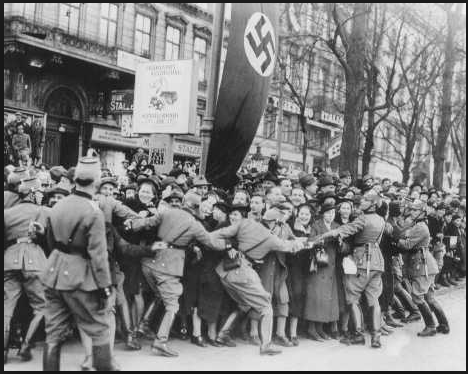
after anchluss palaisThis photograph was taken after the Anschluss. I imagine this crowd is waiting for a celebratory parade.

Unlike his children, Viktor does not have the instinct to flee. By the time, it is necessary, he has great difficulty doing so. It is true that none of the immediate family is deported to a camp, although one does not survive. On balance, the Ephrussis of Vienna, like my grandson’s Warsaw family, could be seen as lucky. Strange luck to survive in the face of such grief, of so much loss. The great advantage the Ephrussis have is Elizabeth, the lawyer and the author’s grandmother. Thus Viktor finds himself sitting by the kitchen stove in Tunbridge Wells, reading news of the war and Ovid’s poems of exile, while Elizabeth learns to cook. In December 1945, she goes back to the Palais Ephrussi, no longer a Nazi headquarters but an American one. Almost nothing is left, except Anna and, amazingly, the netsuke.

Then the story switches setting. Iggy, former fashion designer, and American Intelligence officer, returns to England from a year trading grain in the Congo and receives the collection from Elizabeth. It is as if the netsuke settle what he should do next. He takes the collection with him when he moves to war-torn Tokyo. Ironically, he will work as a banker there. “Iggy had a small attache case filled with ivory monks, craftsmen and beggars, but he knew nothing about the country.”

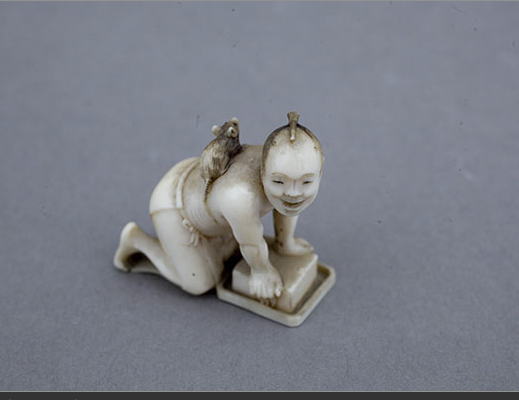
netsuke floor cleanerAbove, a floor cleaner has a surprise.

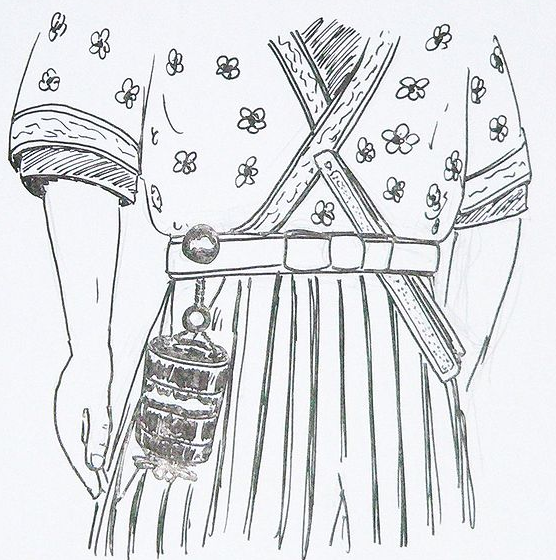
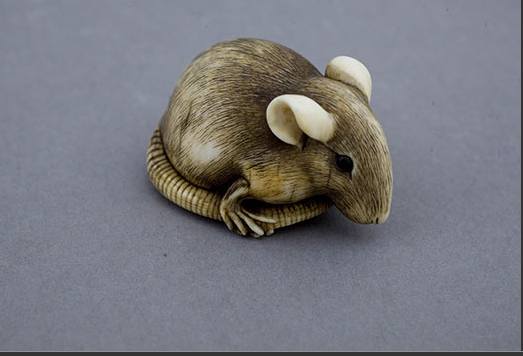
netsuke as wornThe netsuke is the bauble that is on the belt and attached by string to the purse or pocket below. It seems to be a rat pattern in this case.

Edmund De Waal gets to know his uncle when he goes to Japan as a teenager to study ceramics. By that time, Iggie has added Japanese to his German, Russian and English. He lives in a home with fewer objects, but nevertheless rare, Japanese antiques. He is successful and shares his life with a male friend, Jiro, some years younger. So there is beauty there and happiness, but this part feels elegaic. After Iggie’s death, De Waal stays with Jiro when he visits Japan.

iggy with netsukeFinally, the author goes to Odessa where he joins his younger brother and they discover clues of the Ephrussi brothers presence there before 1870, not only in stories but also in a school and an orphanage they founded.

The netsuke are in London now in a vitrine where they can be taken out and played with by children.

netsuke rat

The Hare With Amber Eyes: Viktor and Emmy Ephrussi

ringstrasse above(The second in a series of posts about Edmund de Waal’s book The Hare With Amber Eyes)

In 1899 the collection of 264 netsuke (net-ski), tiny Japanese carvings, arrived along with their black lacquered vitrine at the Ringstrasse in VIenna, a gift from Charles Ephrussi to his cousin Viktor on the occasion of his wedding to Emmy. They were uncrated at the Palais Ephrussi and began life anew in Emmy’s dressing room.

palais ephrussi colourThey were destined to live in the Palais Ephrussi (above) for the next 48 years, although the Ephrussis did not.

The palace was built soon after the street itself, the Ringstrasse, in 1865, a boulevard made for imperial parades and stood near other magnificent homes of wealthy Jewish families – the Libens, Todescos, Wertheims, Gutmanns, Epsteins. By 1899, Freud had his office around the corner. The 145,000 Jews in Vienna had had civic equality since 1867, including the right to teach and own property. The Ephrussis, like many others, were secular Jews and did not attend synagogue. They were Viennese, citizens of the Austro-Hungarian Empire and loyal to the Emperor Franz Joseph, who had granted them their rights.

Baron Ignace von EphrussiThe great house was built by Ignace Ephrussi, who arrived in Vienna from Odessa in 1865 when his son Viktor was 3 years old. Eventually, Ignace was ennobled by the Emperor and became Baron von Ephrussi.

De Waal, the author and present owner of the netsuke is a renowned potter of simple modern forms and his reaction to the palace, now Casino Austria, is much like my own would be. He notes the gold trim on the exterior, the many half-clad Grecian maidens in the niches. He feels smothered by the smoothness of the omni-present marble, as if he can not get a purchase anywhere – on the shallow wide steps of staircases, on the slick floors.

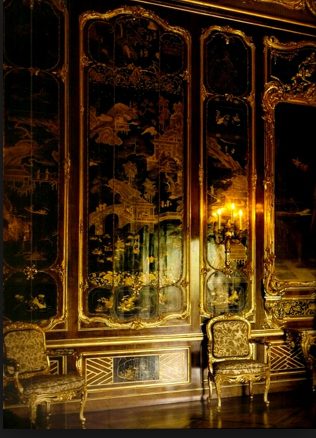
panneled wall palaisThe “implacably marble” interior was lavished with tapestry and ceiling murals.

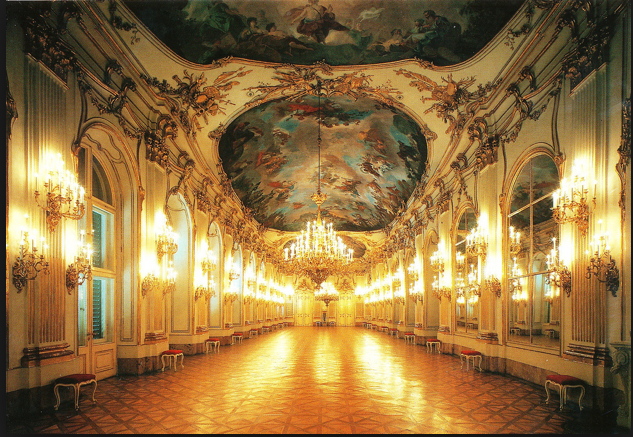
ballroom palais ephrussiMost of the paintings told classical stories, except oddly, the one on the ceiling of the ballroom, the only room that the Viennese, as opposed to Jews, would see. It told the story of Esther. De Waal says, “It is a long-lasting covert way of staking a claim for who you are.”

Viktor, like Charles in the Paris branch of the family was the spare son, so he too was spared bank training. Viktor preferred reading history and sitting in cafes with his friends – until, alas, his older brother Stefan, eloped with his father’s mistress and was disinherited. Suddenly the unprepared Viktor found himself working in the Bank Ephrussi, untrained, and, as it turned out, without a banker’s instincts.

Ignace died only 10 weeks after Viktor and Emmy’s wedding. They kept their apartment on the second floor, the Nobelstock, which Emmy had initially announced “looked like the foyer of the opera”. De Waal takes us into the palace where Ignace had had a a private staircase only he could use, servants’ rooms on a “secret” floor, one with no windows, tunnels to neigbouring houses, ways for naughty children to access the roof, and the glass-covered court yard where the carriages and horses and later the automobiles stood ready beside a statue of Apollo..

It was not a “cozy” place in the way that Charles’s home, opulent as it was, might have seemed. The netsuke vitrine evidently did not suit it except in the smaller more intimate surroundings of Emmy’s dressing room. Here her children gathered pre-dinner to watch her maid Anna dress her for dinner. Here Elizabeth, Iggy and Gisella were allowed to open the glass case and take the netsuke out to play with them.

But of course there was something secret and malignant, the worm in the rose, gnawing away beneath the surface beauty. Marble halls were not proof against it.

Even in Paris Charles was subject to anti-semiticism. Renoir turns against his patron when Charles buys paintings by Gustav Moreau.”It is ‘Jew art’ Renoir writes, galled to find his patron, the editor of the Gazette, with this gout Rothschild stuff on the walls..” Not only is Jewish artistic taste criticized, as bankers Jews are held to be exploitative and responsible for every economic setback. De Waal forces himself to read the newspapers, pamphets and books that target the Ephrussi family with hatred, and parody them as individuals, not only Charles, but others like Maurice, who has married Beatrice Rothschild. The Dreyfus scandal, in which the Jewish officer Alfred Dreyfus was accused of treason, effectively divided the nation into two parts, Semites with their few supporters and anti-semites. It was almost 10 years before he was exonerated and released from Devil’s Island.

But, if the French, in that era, were capable of anti-Semiticism, the German speakers had a positive gift for it. Elizabeth and Iggy, for example, found themselves shut out of a guest hut at the end of a long day’s mountain hike because they were Jews.

Franz Joseph knew a good thing when he saw it and courted the newly arrived Jews who brought wealth with them and soon made more. Viktor regarded himself as a loyal Austrian and, consequently did not follow the advice of his friends who spirited their money off to Switzerland when war was in the offing. In fact, he sunk his wealth into Austrian bonds. Just how reckless this was beame clear to me when I read Margaret MacMillan’s The War That Ended Peace. Austria-Hungary was a pasted together country, a collection of territory assembled by the Hapsbergs. Its soldiers spoke so many languages that units were divided accordingly and orders were sometimes issued in English. There were two parliaments and the Hungarian one erupted physical violence at one point. The heir to the throne was Franz Ferdinand, however, who had a sensible attitude that going to war was not a good idea. Then he and his wife were assassinated, the ostensible cause of the war’s outbreak.

By the end of the Great War in1918, Viktor’s branch of the Bank Ephrussi had to be bailed out. He still had the palais and personal money, but he had lost his fabulous wealth. And like every other family in Austria, his was almost starving because of food shortages. Emmy had just given birth to a fourth child, Rudolf, the Spanish flu was raging across Europe and it seemed as if mother and child might not survive.

They did survive as did their home, although there were half as many servants. Gradually, things improve. Elizabeth earns a doctor of law degree, marries and leaves the country. Iggie studies finance in Cologne. He is the only male Ephrussi in both branches of the family, but in 1933 wisely runs to Paris, giving banking up for a life in fashion eventually in New York City.

In 1938, there is the Anschluss. But this is part of the next section of the book, part 3, “Vienna, Kövecses, Tunbridge Wells, Vienna 1938-1947”.

The Hare With Amber Eyes: Charles Ephrussi

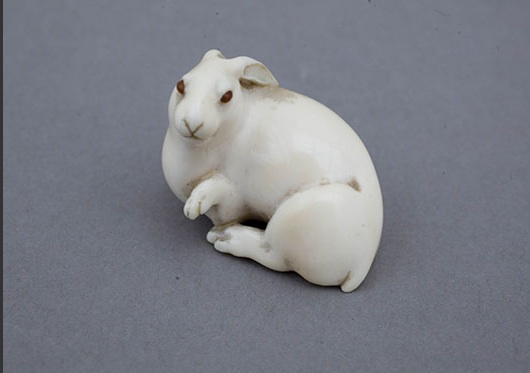
hare finallyThis is the Hare With Amber Eyes, for which Edmund de Waal named the book he wrote about his family, the Ephrussis. My edition is subtitled “A Family’s Century of Art and Loss”. The hare is one of 264 netsuke (net-ski), tiny sculptures that hung on traditional Japanese costumes, fastening pouches -external pockets. At the end of World War II, this collection of tiny objects was the only part of the great Ephrussi fortune to survive.

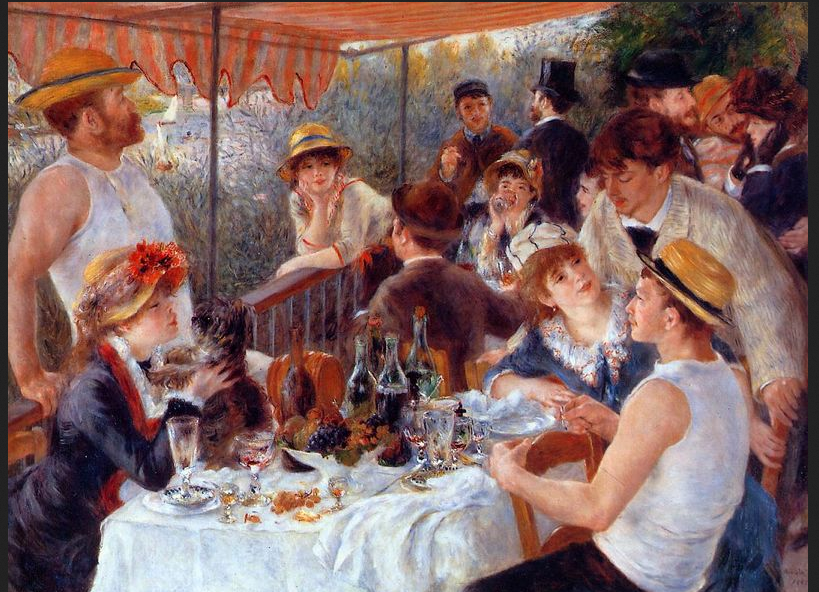
Charles Ephrussi bought the collection from a Paris dealer in 1880. Charles is the man in the top hat in The Luncheon of the Boating Party by Renoir and one of two men who served as the model for Proust’s Swann. (De Waal cautions us not to assume that Charles would actually wear such clothes to a boating party.)

luncheon of the boating partyNineteen years later, Charles sent the nesuke in their black vitrine to Vienna as a wedding gift to his cousin Victor and his bride, Emmy. There in the Palais Ephrussi on the Ringstrasse, the netsuke lived in Emmy’s dressing room where their children played with them. They remained there when the family fled in 1938. Although the palace was occupied by the Nazis, the netsuke were miraculously spared from plunder and came back into the family’s hands in 1947. Amazingly, Iggy Ephrussi took Tokyo where he lived until his death, leaving them to his nephew Edmund de Waal, the author of The Hare With Amber Eyes.

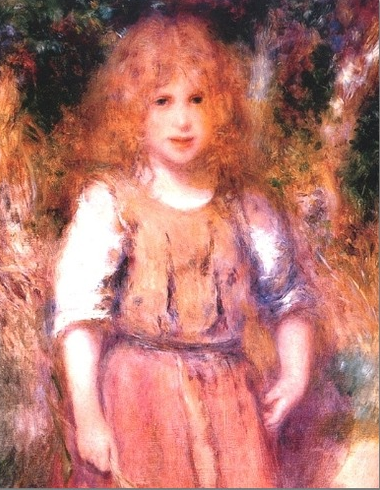
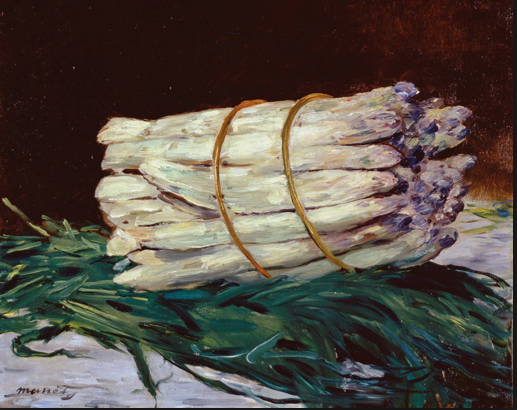
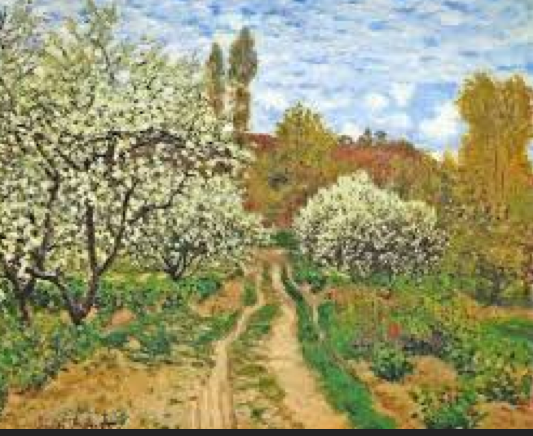
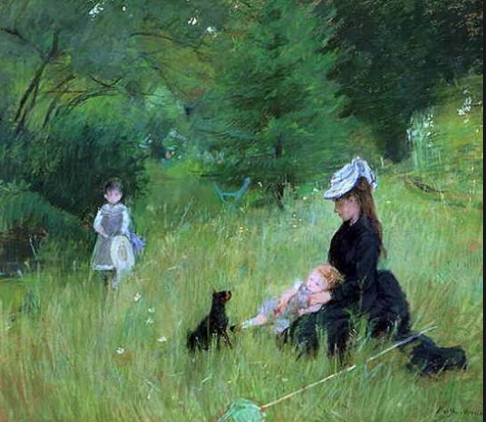
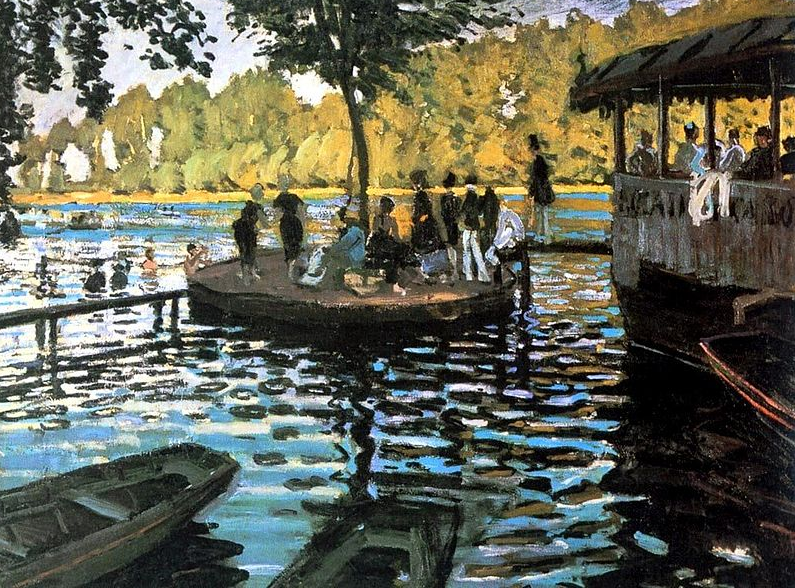
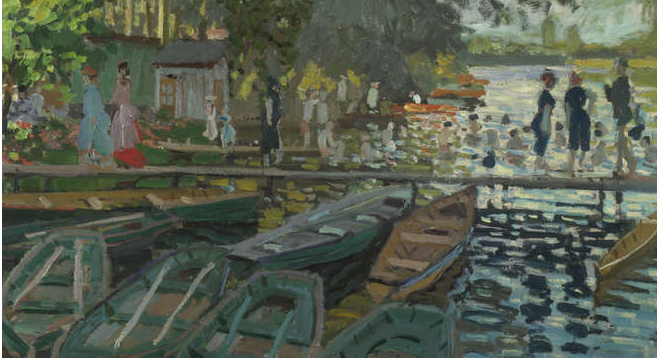
Charles Ephrussi, who first bought the collection, kept the 264 tiny carvings in the salon of his second floor apartment on a Parisian hill. Being the third and youngest son, bookish and uninterested in making money, he was not required to join the family business. It had started as wheat dealing in Odessa, but had grown into banking and family members had been dispatched to Paris, Vienna and ultimately, to Moscow to establish branches. Charles was free to indulge his interest in art, writing a book about Durer, as well as magazine articles, becoming the proprietor of the Gazette and collecting paintings by Impressionist painters for himself and others, as well as offering the artists personal encouragement and friendship. Edmund de Waal imagines the walls of the salon as it must have been, hung with these pictures three deep. Included among the 40 paintings Charles hung were Renoir’s Gypsy Girl, Manet’s Asparagus, Monet’s Pommiers and Morisot’s On the Lawn.

gypsy girlmanet Asparagusmonet PommiersSince there are several versions of apple trees painted by Monet and since I am not an art historian, I may not have the right picture here.

MOrisot on the lawnDe Waal goes to see one of Charles’s pictures at the National Gallery in London – for now the collection has been dispersed far and wide – and says, “You feel alive looking at it.

les bainsThis is Monet’s The Grenouille.

the bathers at GrenouilleMonet’s The Bathers at Grenouille

The description of Charles’ salon with its yellow arm chair, its walls glowing with luminous Impressionist paintings and the black lacquered vitrine is one of my favourite parts of the book.

The story is told anecdotally as the author travels to the places where the collection lived and delves deeper into the family history but because it is his family, de Waal is very much a part of it, offering his response to his discoveries. If I had to choose one word to describe The Hare With Amber Eyes, it would be charming. In spite of the fact that it is a story of great loss, reading about such beauty salves the soul.

(Another post will talk about the netsuke in Vienna.)

Daniel, Road Warrior

(This is one of a series of posts about my estranged son, Daniel.)

bike awardI opened the front door, looked down and almost fainted. There was my small son, clutching his throat, blood spurting out between his fingers. I screamed. His father came running and pried Daniel’s fingers open. It was his chin, not his throat after all. Blake swept him up and into the car while I stood there, immobilized. The small tricycle lay overturned on the sidewalk. The other children, including Daniel’s sister Julia stood beside their tricycles, most of them larger models. They had been racing like maniacs up and down the sidewalk and shouting in glee.

Daniel had had his first serious bike fall. It would not be his last. In the years to come, he would take many spills – on his first small two-wheeler, on his banana-seat bike, on his mountain bike, on his road racer, on his commuter. He would up-end over handle bars, somersault over car hoods, narrowly escape leg crushing in traffic, get doored, get run off the road on highways. He would bleed from road rash; his wounds would turn red, then blue, then yellow, but curiously he would never break a bone.

I didn’t know any of that then. I just knew that my husband who couldn’t stand the sight of blood, who fainted in movies that depicted blood loss had just leaped into the fray while I stood helplessly by.

After a few hours, they returned, Daniel sporting a series of brown stitches under his chin, which he rushed to show the other kids. He has that white scar still, just out of sight until he lifts his head.

(Strangely, it always turned out that when Julia was bleeding, I handled it. Daniel shut her in the oven of the toy stove – at her insistence – and I dealt with her bleeding hand, holding the compress in the emergency ward, etc. But whenever Daniel turned up bleeding or even reported a close call, I got weak in the knees.)

In summers in Guildwood Village, the kids would take off on their bicycles in early morning, riding off to the cliffside parks, ditching the bikes to climb the bluffs, coming home late for lunch, dusty and scraped, only to set out again. No questions asked. Well, none answered anyway.

When Daniel’s doctor recommended exercise to deal with his incipient asthma. we foolishly enrolled him in soccer. In full regulation gear, knee socks and all, he spent his time avoiding the action, hanging back, taking an ego hit until he decided that he was meant for racing. He began by racing on his feet and was soon doing training runs up the big hill and around our neighbourhood. It was later when he was in his twenties, living with me in my country village house that he moved on to bicycle racing. It’s a complicated sport because it involves a machine as well as physical conditioning. A bad tire or a dropped chain can finish off a skilled, fit rider. He started with road racing and moved on to mountain bike racing and then to cycle-cross. For many years, he was guaranteed a top spot in his category.  Training consisted, probably still consists, of hundred mile group rides on the weekend. (Much hated by some country types.)

The scariest time for me was the year or so he worked as a bicycle courier. Speed was imperative and this interval found him at his road-warrior scariest. Eventually, he quit to save his life, but he carried that style over into his commute to his safer job. He tangled with a car on Bloor St. and ended up because of our no-fault insurance having to report it to my car insurance company. An agent called me to confirm details. He asked me if Daniel was married. I said no. Then I said, “Hang on. He is married.” The agent said,” What’s with you people? Your son said exactly the same thing.” For political reasons, Daniel had been married for five minutes to a girl he loved. Politics changed. They had moved on, neglecting divorce.

After that accident, he gave up wearing a helmet. He said it was the only way, he could make himself slow down. Work that logic out.

When I was recovering from heavy duty surgery in 2001, he showed up, just back from a race and gave me his winning medal, pictured above.

So there it is, a snapshot of my reckless son, who has unorthodox principles.

Writing About Daniel #2:

(This is one of a series of posts about my estranged son, Daniel.)

I began writing about Daniel as I explained earlier (https://115journals.com/2014/02/08/writing-about-daniel/) because I wanted to “open the flow of my dammed up love for him” in view of the fact that we are not communicating. I talked about his birth, his unknowable infant self and considered the external world and its influence on him as a toddler. In the process, I have arrived at the spring of 1963  when he was 15 months-old. So how is it going so far?

Unexpectedly.

I thought I would gradually uncover the little person he was then and slowly move forward as he became his own person, distinct from his sister who was a year older. Instead, something else happened.

Out of the dusty attic of my mind, I retrieved another memory. It was of my father, leaning close to my ear as he was leaving after a visit, and whispering to me. He said, “You know I’m going to kill them both, don’t you? I’ve told you so.” Then he sniggered and got into his car.

By the time, Daniel was a year old I had heard this more than once. My father was a monster. Goes without saying. We all pretended this was not so. He was violent and abusive when the fit took him, but he genuinely loved children, especially these grandchildren. Unfortunately, his idea of love was way off-base as I knew from experience and I had warned him to keep his hands off Julia and Daniel. This was his revenge.

So why not report him to the police? The most I had ever been able to do was report him to a neighbour when I was eight. She was a pillar of the community, but her intervention consisted of scolding him soundly, with the result that I thought he was going to murder me, my mother, and my two baby sisters. Moreover, he always seemed to have the local cops in his pocket and, anyway, in those days, no one- nobody- believed such allegations.

I had assured him that if anything happened to my children I would write down everything he had ever done to us, mail it to the powers that be and kill myself. His giggling response was, “You’d never do that!”.”Wait and see,” I said. (We hadn’t yet learned to say “Try me”.)

So he sniggered in my ear and took off with my mother, back to Burlington where two of my siblings still lived under his roof, too old to tempt him and old enough to have designs on escape.

I didn’t believe him, but he terrified me. He had been terrifying me for years and years. He had almost killed me when I was six, but he deeply regretted it afterwards. (Is the sarcasm clear there?) Once he understood that I opposed him, he kept up a campaign of terror, oddly or perhaps not so oddly, combined with taking me and my sister, Georgia, with him whenever possible and referring to us as his angels.

So writing about this time on Benleigh Dr. in Scarborough in 1963, I came upon this whispered confidence and lost my mind. Post traumatic stress will do that for you. Transport you right back into the thick of things. Suddenly, you are in the midst of a flashback of feeling as intense as it was originally.

Basically, I feel a homicidal rage. I feel as if I could kill him. Then I remember that he is already dead and has been for 26 years. He phoned me and my sisters on the morning of the day he died and said to each of us, “If I have done you any harm, I’m sorry” -he couldn’t get hold of Rob in Europe. He knew he was going to die and not from natural causes.

I was late for class and I muttered something in reply -“That’s all right” probably. I had spent his old age trying to love the shambling wreck he had become.

Today, weighing the harm that got passed down the generations, I told my sister Georgia that if he died violently everyday, it would not be enough. And sure, that feeling has to be acknowledged, given some head room, but I can’t stay there. I must let it go- for my own mental health. I must forgive that monstrous old man. He asked me to.

I can speculate about why Daniel won’t speak to me but I don’t really know, except that somehow this lies at the bottom of it. It is bred into us and into our relationship.

It was supposed to be a secret. Now it isn’t.

(Never Tell, my e-book tells the story of my childhood more fully. See 115journals.com)

Valentine’s Day: reconsidered

Romantic love has co-opted February 14th. Hard to believe that is what St. Valentine was all about,although Wikipedia would have us believe that he championed courtly love. Just to be clear courtly love is all about poetry and wearing a lady’s favour, not something sweaty.

It’s turned into a festival of red roses and chocolate. And heartbreak. Not evough cards in the classroom valentine box. No engagement ring again this year. He/she actually forgot. That convenience store bouquet. Dinner out in a much too crowded restaurant with bad service. The roses you bought for yourself drooped over next day.

Let’s re-conceive the idea.

Valentine’s Day is the celebration of love, the feast of the god of love or God of Love, if you prefer. Whether that is Eros or something other dude, up to you. Change the gender if it helps. Now let’s take a look.

Feel your most beautiful feeling. Remember it. Imagine it. Picture its beauty. The full moon in August hanging over the Tioga Pass is a good one. The effervescent foam on the moonlit gulf of Corinth. Use your own.

Now focus deeply within.

Perhaps you will hear yourself say “You are more beautiful.  More beautiful than all the red roses, all the red hearts, all the chocolate given and received. More beautiful than sunlight. More beautiful than warmth on a snowy day. More beautiful than _____(name a recent or beloved new born baby.) More beautiful than ____ (name your most beloved animal and/or person).” You get the drift. Just keep piling it on, naming gardens and places, islands, mountains, individuals, whatever warms your heart.

Does it happen? Do you begin to know that that great beauty and love lives there? Repeat as necessary.

Love does dwell within.