I’m reblogging this from Power of Positive Thoughts for the vibrant colour and the good idea.
The Way is in the Heart
Reply

I’m reblogging this from Power of Positive Thoughts for the vibrant colour and the good idea.
What I want is to get on with my post about satire in which I discuss with my usual clear-eyed insight novels by Jo Nesbo and Martin Amis and short stories by George Saunders. What I want is to finish my post about my new way of cooking rice, which is apparently actually old and Persian.
What I want is to be the 27 year-old second ballerina, I dreamed the other night, with a gorgeous male partner, capable of lifting and protectively holding me.
What I’ve got is 50 more years and doggy bootcamp.
Georgia thinks it’s funny. Georgia says write about that. But she’s just a baby septuagenarian, just barely started, so what does she know? Blake and I have seniority. I’ve known Georgia since I was 6, longer than anyone else still extant, that is to say ‘above ground’. Blake I met when I was 16, so he’s the oldest friend apart from siblings. We have had various septuagenarian adventures together, but this one is a solo. (See 115journals.com under septuagenarians)
The crux of the matter is that Blake has gone walkabout or, more prosaically, flown off to the west coast to see his daughter, who is, coincidentally, my daughter. The thing about children, even adult children, is that they cement you together. So when Blake cast about to see who could dog-sit, I came immediately to mind. Why not? He had taken the measure of my mothering skills some years ago. And I had mothered quite a few dogs as well, notably a big black Newfoundland throughout her long, lumbering life, but also a couple of her playmates including a spaniel. A 7 kilo sheba innu would be no problem.
“She’s a zen dog,” he assured me, alluding to her Japanese origin, “and she only needs to be walked 3 times a day.”
I felt better already.
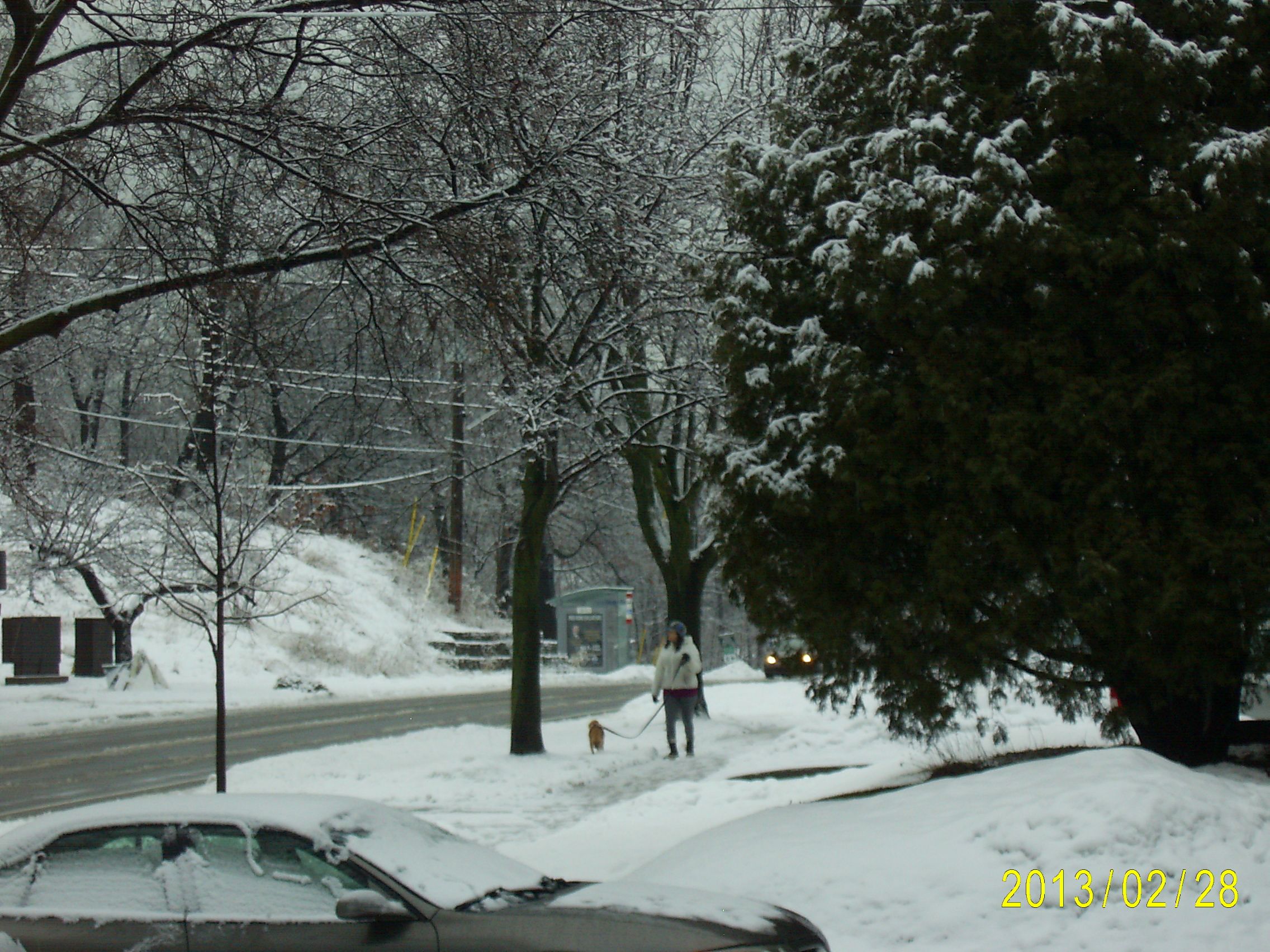
March in the north -can I call Toronto north?- is unpredictable. Last year temperatures got up to 20 celsius, well into the 70s F. This year not so much. It is below freezing, there are brisk winds, especially from the north and a windchill. Okay, no problem. First walk of the morning: undershirt, merino wool long-sleeved undershirt, short-sleeved wool undershirt, ribbed cotton turtleneck, wool cardigan, vest and long down-filled coat, not to mention wool tights and fur-lined cap with ear flaps that tie. What?! Did I say I’m old? Did I say I was born in an unheated bedroom? Did I say God didn’t hand me an internal thermostat?
Right, we’re ready to head out the door. Despite the gear, I can still bend over enough to put the dog’s collar on. True she immediately starts to retch and gag. I still have something to learn there. Out the door. Well, not quite. We have to stand testing the air first. There could be danger. Down the front walk, turn right. Stop dead. There is a tree here and there are messages on it that have to be carefully ‘read’ by sniffing. Boy dog messages no doubt. ‘I was here. Where the hell were you?’ It isn’t a matter of gently tugging on the leash. Her 4 paws are glommed onto the frozen ground. There is no moving her. The bad news is that there is a tree in front of every house. And I have forgotten much in the last 25 years. A quick stoop to mark is not the same as an actual pee. It will take several walks to teach me this.
The second or afternoon walk is meant to be longer. Typically Blake hikes with the dog along disused rail tracks or up hidden ravines that wind under city streets and emerge miles later in its centre. Then they hike back, I make a foray down the bike path beside the woods in the afternoon. We come upon five robins foraging for worms in puddles that are about to freeze over. Initially, there is a strong smell of skunk, but that doesn’t concern Ms Zen. She moves on inspecting the leave-strewn margins minutely until, finally, she finds exactly the right spot. It transpires that I have a lot to learn about poop and scoop. Suffice to say, I am glad she is in favour of a quick return. I desperately want to wash my hands.
The rest of the afternoon is devoted to rest and recuperation. Yes, I exercise every day but I don’t go out in the cold and walk up and down hills. After dinner the wind is roaring and another walk is on. I long for the good old suburban dogs who stood in a writhing heap at the back door. I would open it, they would dash out and one of them would shout when they wanted back in.
And how does Blake even have a life? All I can seem to squeeze in is a short trip for groceries. Tai chi class seems to be out of the question. Gear up,walk, take the gear off, collapse.
Days pass. It becomes clear to me who’s in charge. She chooses the direction or rather her nose chooses the direction. There is absolutely no discussion. If I tug the leash too hard, she throws up. Simple as that. One sunny afternoon, we get as far down the paved path as the mown lawn. Having done her ‘job’, as my grandmother used to say, she stands gazing into the woods. These are the woods where she, Blake and I came upon 3 deer last year. She stands and stands. She gazes and gazes. A twitch on the lead. No response.
“Let’s go,” I say, my voice rising, my best kindergarten teacher voice.
She looks at me balefully, as if to say, ‘that voice!’ She looks back at the woods. She wants the lead off. She wants to run up and down those wooded hillocks, following those hidden paths. And if she were my dog I would let her. If Blake were here he would let her, but not and not. (Dear Blake, The weather is getting warmer. Your house is fine. Your roof hasn’t leaked. No one has stolen your car. Yours truly, Joyce p.s. Your dog is lost.)
It is only when a white-haired man comes down the path that she deigns to move. She thinks it might be Blake.
The first 2 nights she sleeps in her bed in the living room near the front door. Surely, he will return for her! On the third night, she accepts a helping hand onto my bed. I’m not keen on a bedmate but, otherwise, she is just going to stand beside the bed and stare at me. Weekends I sleep in the second best bed (See 115journals.com “Consider the Second Best Bed” ), a narrow bed. I sit her bed beside it. No dice. I drop a quilt there. Well maybe. As a septuagenarian I am acquainted with the night and I observe that she alternates between the bedside and the living room couch. In the morning, I discover a wet spot there.
Now Blake has assured me that this former show dog never has an accident. I believe him. I am familiar with an ‘on-purpose’. My Newfie dog once protested the fact that she was not permitted on the couch while the cats were by emptying her capacious bladder in the middle of my bed. Fortunately, I wasn’t in it.
Okay, no problem. Georgia can tell the story of having to change her entire bed at 4 a.m. because her Springer Spaniel did have an accident.
When Ms Zen arrived 5 days ago, I typically got up bent from the hips and shuffling, your standard septuagenarian gait. Ten minutes of tai chi put the spring back in my step. Now I walk like one of those extreme body builders I used to see in Venice Beach. My thighs are so stiff, they can barely scrape by each other. It takes a long hot shower to limber me up enough to do tai chi to limber me up. On the other hand, once it gets going, this old body seems more balanced and functional.
While it’s true, she eats only home-cooked meals, Blake brought them, frozen for easy ‘heat and serve’.
She’s just rolled her body off my bare feet and gazed at me with what looked like adoration.
Reminds me of living in El Segundo, near LAX.

.
Sara was inspecting the garbage when she shrieked, “Who put this in here?” She was flourishing a dirty tissue which she had fished out of the black garbage bin and was now flinging into the green compost bin. At lunch she announced to me and our mutual friend Robin that she no longer gave to ‘people’ charities. People were a blight on the planet, she said. She gave to animal charities and environmental causes only now.
A few days later, I was talking to Robin on the phone. “The world is not going to be saved by recycling,” Robin said. We agreed that it might be saved by empathy, by caring for others and by extension for Earth.
“But if it isn’t, it doesn’t matter because God is already perfect,” said Robin.
“And God is within us?” I asked, just to make sure she wasn’t talking about that remote, supernatural fellow, the church used to tell me about.
“Of course,” she said.
“So, in fact, we are already perfect,” I concluded. And we changed the subject to family.
But it began to get to me, that February week. I had shingles. Again! Economic recovery still hadn’t kicked in. I had seen one too many shows about terrorism and torture. And I had shingles.
“What the fudge, is it all about?” I asked my sister, Georgia. “Why are we here, working hard like you, hurting hard like me? What does it mean?”
“It doesn’t mean anything,” she replied. “It’s what Shakespeare said, ‘All the world’s a stage and all the men and women merely players’. It’s when we go off stage, we find our real life. But then, I’m a simple soul.” She didn’t add, “Unlike you who make everything complicated”. Then she did say, “We just do our best. It’s just practical.”
And that is how she lives. She devotes herself to making life better for others.
But she was right in her unspoken assessment of me. I couldn’t drop it.
My osteopath explained to me that the herpes or chicken pox virus that had been lying dormant in my body for these many years was doing its job and attacking the nerves. That was why I had had what I called the achey flu since mid-January, but now that it had surfaced in the form of a rash, I would begin to recover. The aching had already diminished as the itching increased. Recovery would come through rest and relaxation, not through yet more exercise and effort, he said, thus dismissing my default methods.
More time to think. Just what I wanted.
Maybe I hypothesized, we are trying to perfect the material world, to raise its consciousness. Okay, but the maple tree outside my window seems pretty perfect as it is. And the sheba innu I am going to dog-sit next week, ditto. Hum!
How about this? Out of the One came the many. Are we just trying to get back to the One, trying to remember that we are not isolated, victimized, powerless individuals but part of the powerful Whole?
So I posed the question to Julia in a long, long-distance phone call.
She said, “We are God experiencing Itself.”
“Well, why does it have to be so painful?” I demanded.
“That’s the nature of perception,” she said. “The nerves are part of the mind.”
I had a fleeting thought that as soon as there is mind, there is pain. That brought my mind back to torture.
“Someone like Thomas More,” I mused -I was thinking about how he was portrayed in A Man for All Seasons– “is invulnerable to torture because he is at one with God’s perfection.”
Perhaps during my relaxed and restful recovery, I could take short excursions there.
Isn’t there a liturgical blessing, “May the peace of God, which passes all understanding, keep your hearts and minds in the knowledge and love of God…”?
“If you lie to me, I will hurt you,” so says Dan, the CIA interrogator.
There has been much debate about whether Zero Dark Thirty was right to depict torture as the way that the U.S. got the initial information that led to the killing of Osama bin Laden on May 2, 2011. Either it wasn’t or the powers that be want us to believe it wasn’t, but that is not what I want to talk about.
The early scenes of the torture of detainee, Ammar, in a black op detention centre got me thinking about the nature of abuse. Jason Clarke portrays Dan, the torturer brilliantly. His Dan is bearded, exudes vitality and, of course, incites terror. The viewer readily understands his determination to uncover bin Laden’s hideout. Then the torture starts. It is, as ever, deeply personal, an intimate experience. Hands on. Ammar is naked, utterly exposed, totally isolated. He is kept awake for 96 hours. (Is that even possible?) Or he is left in total darkness, his ears bombarded with loud rock and roll. His handlers wear black ski masks – except for Dan. He presents himself as Ammar’s friend. If Ammar tells the truth. If not, he will string him up by his arms, waterboard him, or stuff him into a box much too small and leave him there for hours. It is all up to Ammar. Eventually, Dan moves on to a friendlier phase with a cleaned up Ammar sitting down to a delicious meal and convinces him that he has already given Dan most of the information he asked for, so he might as well fill in the details.
Presumably, Dan learned these techniques in torture class and may well have practised them and been practised on. Others come by them without such training. Growing up with one presents challenges both then and afterwards.
Abusers tell you that they don’t want to hurt you. They have to because you deserve it. It is in your nature. It is punishment for what you have done. It’s because you think bad thoughts. It’s because of what you won’t do. If you stand up to the abuser, if the pain inflicted on you doesn’t bend you to his (could be her, but I’m going with his) will, others may be drawn in, smaller, perhaps, or just more vulnerable. But the abuser insists, he is really your friend, your best friend, your only friend. How could anyone else like you since you are —— (fill in the blank).
While this may be character building in the short run, it has some long term negative results. Your abuser may have fallen silent years ago. It may, in fact, be the 25th anniversary of his death and yet, he has taught you so well that you can now run the script yourself, even though you are not aware of it. So whatever happens, you find that you have not quite measured up. You’re just a bit slimy, not very nice, socially undesirable. You have, in point of fact, failed many times and in important ways.
Not only that, you are permanently pissed off. It was all grossly unfair. It was unjust. Nobody should be treated that way. Years later, you watch a movie called Death of the Maiden and identify deeply with the rage of the torture victim.
What is the answer to this self-perpetuating abuse?
Perhaps it can start simply with the idea that you have always been well-intentioned, no matter how things turned out. Perhaps it can go on to note that you have done your best and that effort needs to be respected. You have respected and even cherished others for these virtues. Why not yourself? Your love has flowed out to others, why not let it flow through you as well? There may be a hiccup of grief at the beginning, but once the furnace of self-love is stoked, it will begin to heat and heal the body so that it lets go of pain, so that it relaxes and unfolds.
 photo by Arvid Stridh
Jo Nesbo has lightened my long, flu-ridden winter. I received 7 of his Harry Hole detective novels for Christmas and his thriller The Headhunters.
Jo Nesbo is Norwegian and so his first name is not actually pronounced Joe but rather Yu, if you can imagine pursing your mouth Norwegian-style. His detective’s name, Harry Hole, is an embarrassment to Harry when he goes to Australia in The Bat, so he tells people it is pronounced Holy. In Norwegian, it actually sounds more like Whoole, with a short ‘e’ sound accented at the end. Having said that, I have read it as plain Harry Hole in 5 novels and suffered no ill effects.
Nesbo’s CV implies he is a Renaissance man – musician, songwriter, economist and author. His band is called Di Dirre, which means, Those Guys, and is successful in Norway. He worked for many years as a stockbroker, but he doesn’t need to anymore. His latest novel The Phantom is a bestseller in England, Sweden and Germany. The Headhunters has been made into a movie and NBC is going to release the pilot of a series for I Am Victor. His novels have been translated into every conceivable language. The English translator is Don Bartlett.
Nesbo’s detective, Harry Hole works for the Oslo police department and, as one reviewer says of The Phantom, Oslo itself is like a second main character. All of the novels have its map at the front, so that the reader has some idea of where Harry is when he is wandering the streets, the names of which an English speaker will be unable to pronounce. If I were dropped off at Oslo’s central railway station, I could find my way to police headquarters at this point.
Nesbo regards Harry as quintessentially Norwegian – a man of few words with a dark sense of humour who prefers to work alone. Harry doesn’t care much what rules he breaks and tends to disregard his superiors when they make rules to rein him in. He is not, to use Nesbo’s words, a moral superman. Far from it. His work has all but destroyed him. There was that car accident in which his young assistant died. The question of who was driving haunts Harry. And two other partners have been murdered. Harry deals with the ghosts that visit him in nightmares by drinking. He easily outstrips Ian Rankin’s Rebus and Henning Mankell’s Wallender as a booze artist. And my spies tell me that he adds hard drugs to his addictions in The Phantom, which I have not yet read.
I don’t like stories about drunkenness. I find them tiresome, so I got impatient with The Bat when Harry, after a serious emotional blow, goes on a long bender. I was glad when he went back on the wagon, falling off only briefly from time to time.
Nesbo says that character is more important to him than story. Nevertheless, his books are carefully plotted and often take sudden unexpected turns. More than once I have been only two thirds of the way through and thought that the murderer had been uncovered. Then, lo and behold, something altogether new, and sometimes quite bizarre develops.
The main question Nesbo is trying to answer is whether Harry will make the right moral choice or more generally, whether characters will save their immortal soul. Nesbo has a gift of showing us the mind of his villains, at times, so we come to care about the state of their souls. And, at least in one case, Harry shows more mercy than vengeance.
There is an ongoing narrative of Harry’s life, professionally, in relation to his department and personally, in his relationship with Rakel and her son, Oleg. I read the books slightly out of order because I went by the date of publication of the English translation rather than the original Norwegian publication date. I would have preferred to read them in order. The person who assembled the collection for my Christmas gift, suggested I start with The Redbreast because The Bat, which was published earlier, is not, in her opinion, as strong. I can see her point.
I liked The Redeemer (2005) best so far because of the decisions Harry makes in it are unusual and satisfying to me. I liked The Red Breast (2000), which deals with the division in Norway during World War II, when some people, like Nesbo’s mother worked in the Resistance, and some like his father, fought for the Nazis and how this past impacts on neo-naziism in the present. Nemesis (2002) is about a bank robbery, which becomes a murder, or is it the other way around, and it has Nesbo’s trademark twists and turns. The Devil’s Star (2003) lead me to say as I finished it that it was the product of a diseased mind, by which I guess I meant that it was creepy. The Snowman (2007) is brilliantly plotted, but now snowmen as well as waterbeds creep me out. I am reading the stand-alone thriller (i.e. not a Harry Hole book) The Headhunters at present and I still have The Leopard as well as The Phantom on the shelf, waiting to be read.
Reading thrillers is itself an addiction and I can hardly wait to get back to Harry. Will he ever stop drinking?

I am reblogging this breath of spring from The Power of Positive Thought
Bed is one of my favourite places. How about you?


A small collection of beautiful and cool bedroom / bed designs. Take a Nap!
/ unknown photographers
.
I am reblogging this wisdom from Joseph Campbell, who understood myths as well as fear.

 115 journals