Daniel’s World: what made him

kids(One of a series of posts about my estranged son, Daniel)

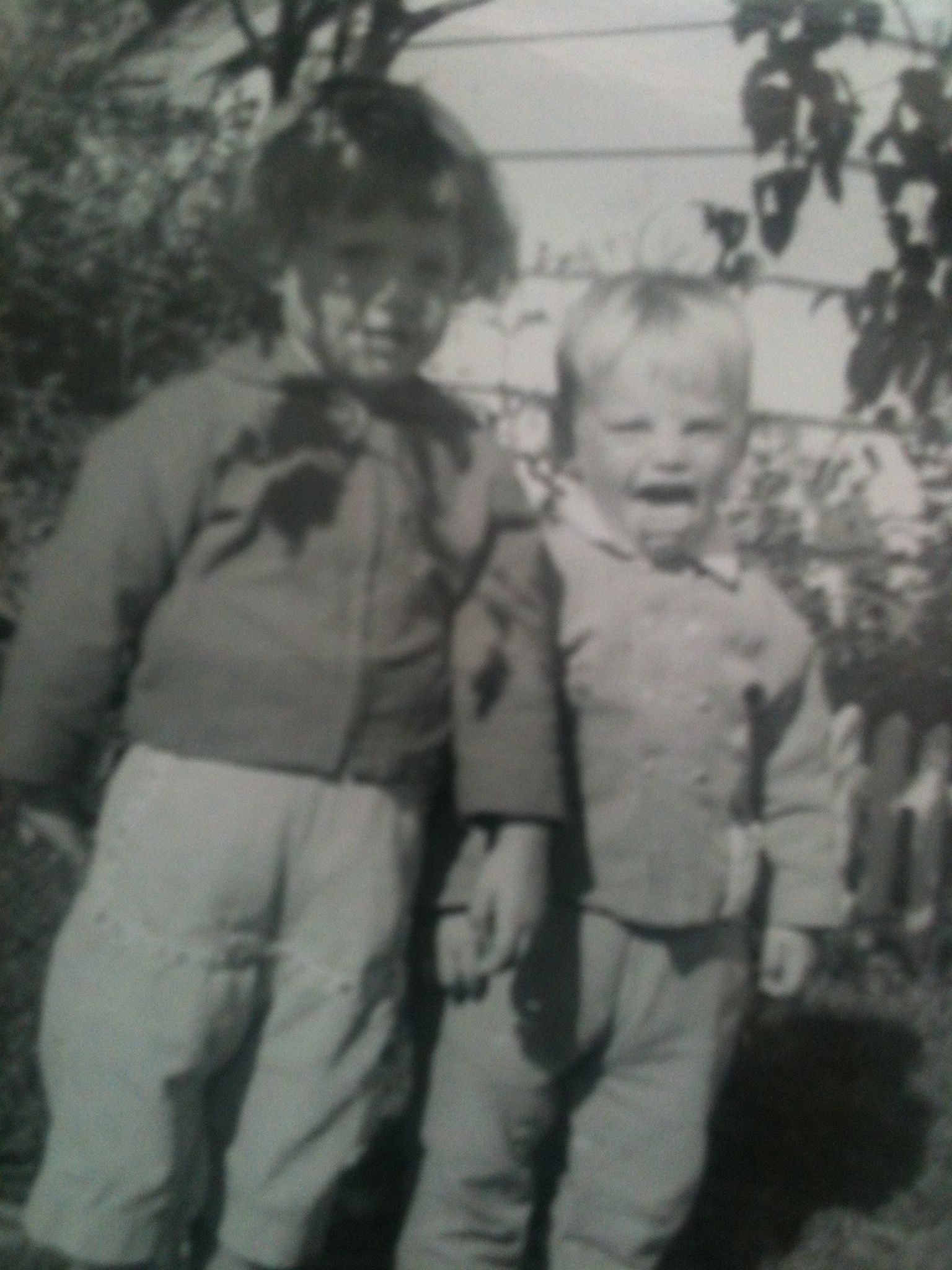
So we moved six-month old Daniel and his eighteen-month old sister to a rented house in the summer of 1962 – three bedrooms, more space, our very own washer and dryer, nobody thumping around overhead and a fenced backyard waiting for children. Blake still had three jobs going on, so we could make ends meet – maybe.

The sewing machine had pride of place in the living room in the front window, just as my mother’s had for years. The bookcase sat next to it, filled with our university texts and a 12- inch black and white television set, mostly wooden cabinet, a hand-me-down.

People were poorer then.

I made drapes for the front window out of burlap, tape with pockets sewn in for a heading and wire hooks that pleated the fabric. Sort of. I had also made the baby overalls that were passed from Julia to Daniel, pounding in the rivet-like snaps that ran up the legs for diapering access. One pair lost a snap. I couldn’t fix it. Too bad. The garment got worn anyway.

I had been trained for this. Along with Latin and French and algebra, 18th century literature and Kant and logic, I had been taught home economics. I had even passed -with a little help on those blouse sleeves. I knew how to price out individual portions of a balanced meal -not that I actually did – and set a table. I could mitre bed sheets with the best of them. I didn’t need to be taught how to clean a house within an inch of its life. My mother drummed that into me. Literally.

But what was I thinking?! I absolutely hated home economics. I loved Shakespeare and Samuel Johnson and thinking about whether a tree falling in the forest really did fall if nobody was there -subjective or objective reality. (Well, okay, nobody loves Kant.) I wanted children and I wanted ideas, but I was finding the two mutually exclusive.

Television was no help, even if we could actually make out the shadowy forms our rabbit- ear aerial pulled in. The radio was better because we got CBC. And, of course there was the library, even if reading had to wait until bedtime when I was worn out.

Meanwhile Daniel learned to crawl. Whereas his sister had humped along on one hip, he used an inch-worm or caterpillar method. Such mobility began his differentiation. Julia soon discovered that he wasn’t just an audience. He wanted that toy too and could grab and hang on for dear life.

To get things done I let them play together in their child-proofed room with a baby gate across the door, but I could hear them as I scrubbed the kitchen floor – on my knees of course, my mother’s injunction ringing in my head: mops don’t work. I let them work things out until murder seemed imminent and then I would fly up the seven steps to the bedroom level. Daniel would have to go in the playpen and Julia sit in the high chair, but, hey, that was fine with them. They could watch me scrub and talk about it in baby-speak.

The evenings were hardest, especially during teething. I remember one such evening. We had moved them to separate bedrooms by then; otherwise, they never went to sleep. They stayed up chatting from crib to crib. The big green rocking chair had found its home in the middle bedroom with Daniel’s crib. He couldn’t get to sleep, so I sat him on my right knee and Julia climbed up on my left. We rocked and rocked. I sang. Everything I knew. All the old country songs from my childhood, all the camp songs, all the love songs – Smoke Gets in Your Eyes, After You’ve Gone.. Still they were awake. Then I cried.

I cried because I was lonely. My husband was never home and when he was, he was marking papers or studying. I had no friends. Moving hadn’t helped, of course, but I had never had many. The neighbour women treated me warily. I spoke like the English teacher I was. I cried because I was depressed. I cried because I was bored. The kids knew that instinctively, no doubt, but now they knew it because my tears ran down their faces as they comforted me. Something had to be done.

But first …. we had the Cuban Missile Crisis. October 1962, suddenly there really was going to be World War III. The new twist was none of us were going to survive. They say it lasted only 12 days and yet I had a stock pile of canned goods down in the crawl space as well as a can opener, so the run-up to the crisis must have been menacing. I actually convinced myself that we could survive down there until the radiation blew itself off, if only Blake could figure out how to tap the water heater. We were all terrified, but I seemed to have a special gift for hysteria.

John Kennedy fixed it. My babies were not going to die for the present.

At some point, by some miracle, Blake and I were able to sit down at the kitchen table to address the situation, a grey card table, I might add.

“If you could do anything you wanted right now, what would it be?” Blake asked.

What an amazing idea! But I just sat there, stunned into silence.

“Come on,” he said. “say what comes into your head.”

“I’d go up to the bedroom and put on my navy suit,” I said.

“Then where would you go?” he asked.

“To Cedarbrae Collegiate,” I said.

“You want to go back to teaching,” he said.

The blood rushed away from my head. I almost fainted.

“Well, I can’t do that,” I replied.

“Why not?” he said.

“What would happen to the kids?”

So we began to sort it out. Someone could be hired to come in and look after them. Even if it cost half of my salary, it would be worth it. I would have no problem getting a job. Teachers were in such short supply now. All I would have to do would be to show up at the job fair in the spring.

The next day and for the next week, I kept deciding this was a crazy idea and then deciding that I had to do it. My anxiety level got pumped up almost to Missile Crisis levels. The deciding factor was the money. Among other stresses, I was being pestered by bill collectors for the landlord’s debts, including mortgage payments. Our rent money was just disappearing apparently. If we had two incomes, we would be able to buy the house.

I got a job at Thomson Collegiate, a few blocks away. As it turned out, it was the worst job there, consisting of three different subjects, six classes and a different classroom for every class, but I would be paid the same as Blake.

I hired a housekeeper strictly on instinct. I watched her interact with the children. She was a Scots woman from Glasgow who had worked in a Canadian munitions factory during the Second War. She was tiny and feisty, smoked like a chimney and turned out to be a secret drinker. In other words, she was so wrong, but she was also so right. She was happy as a clam mothering and keeping house, and in my defense, in 1963, we didn’t know second hand smoke was bad.

In retrospect, I’m not sure whether Daniel got a worse start than his sister because I abandoned him when he was eighteen months old or whether he got a better start for the same reason.
Daniel – unknowable infant

(Part of an on-going series about my estranged son.)

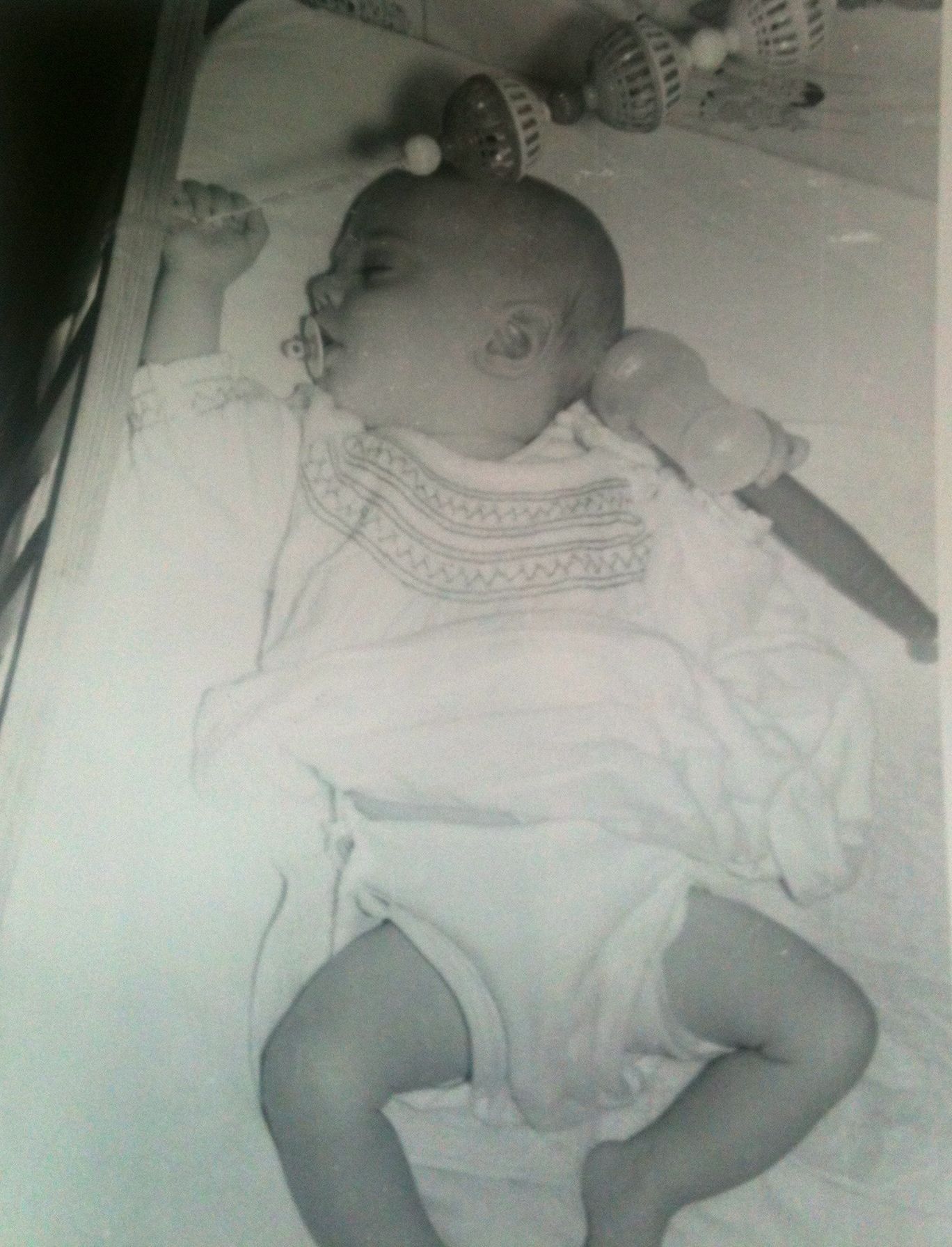
Babby D.So we came home from Mt Sinai Hospital, Daniel and I and the red roses. Blake went off to collect Julia from the babysitting friend’s house and I put the sleeping baby into the baby carriage that served as a bassinet and lay down to rest close beside it. I had missed one-year-old Julia badly and wondered how she would react to this little rival.

In a few minutes, I had my answer. Her father put her down on the bed and I picked up her brother. Her face was suffused with joy. In her excitement, she leapt to her feet, over-balanced on the mattress and crashed to the floor, hitting her head and howling in pain. Blake rescued her and sat down to comfort her. She really was hurt.

Daniel barely flinched at the noise. He slept on. Evidently, this was a different sort of baby, a calm infant, not given to nervous response.

In a few minutes, Julia got over crying and leaned her tear-stained face in to kiss her brother’s round face. The next minute we were all laughing. As far as she was concerned, I had brought home a living, breathing doll for her to play with.

And he happened to be a boy. In those days, there was no way of knowing that before hand. Older women would whisper,”She’s carrying low. Must be a boy.” They had said that throughout my first pregnancy. That worked out! Boys were scarce on the ground in both families. Although Blake’s father had been one of many boys, Blake was the only one carrying the Durant name in his generation. Now there was Daniel Durant. And the only male member of my family was my little brother, Rob. My father was a man who wanted male heirs, hence my sister, Georgia’s name. Blake was pleased as well, although lineage meant little to him.

And me? I was intrigued and a little unnerved. But it didn’t take me long to learn to take evasive action while changing diapers. One face full of pee was enough.

The thing about little Daniel was that he was quiet. At first newborns don’t seem to realize they’ve been born, but even when he got past that sleepy stage, Daniel was quiet. For one thing, he was well-fed. Bottle-fed. Not from choice. Not many mothers breast-fed in those days – 1962. I had been determined to, a year before, but it hadn’t gone well. The head nurse had screamed at my left breast’s in-turned nipple and then screamed at my doctor’s incompetence. My own mother and mother-in-law just shook their heads silently over my outrageously old-fashioned idea. My grandmother seemed to have forgotten the “unpleasant” experience. I had no friend, no group support. And Julia lost weight in the process of a session of nursing and screamed in starved protest. When she was a week old, we boiled up the bottles and began to give her formula. Now, a year later, she climbed on the traitorous mattress, sat beside me and watched me feed her brother his bottle.

She adored him. We all adored him. He was adored.

He had to be Danny because Daniel was too big.

He had big blue eyes and when they began to focus, they sought out his big sister. She was delighted to entertain him and he was delighted to be entertained.

D watches sisterMy idea of heaven was to get them both down for a nap at the same time although, of course, Julia was often busy pulling every pot and pan out of the kitchen cupboard and bashing them about while he slept. I was considered a very liberal mother for permitting this kind of kitchen chaos.

There were two baby cribs in the bigger bedroom and a second high chair standing ready. There was a playpen for containment of joyous energy when necessary.

Mostly we three were alone. Blake taught math in North York, 40 minutes away and returned there two nights a week to teach night school. On Sunday mornings, he went out to tutor an adult student. We were trying to make ends meet. So as I worked I listened to the CBC, especially from noon to 1:30 when books were read aloud. We listened to popular music as I worked or I sang to them. I loved singing and still had a voice. They seemed to like the singing and danced as small children do. Once he got into his high chair, Danny waved his arms and jumped on his seat. Or he bounced in the Jolly Jumper which hung in doorway. Later, Jolly Jumpers like bottle feeding, got a bad rap, but what did we know?

We moved when Danny was six months old. Long story there – adult only apartment building, furious neighbours….. Besides we reasoned, children need a yard. So we rented a house and moved to the Bendale subdivision in Scarborough. It had only 600 square feet, but it also had a finished basement room, with good big windows. Once again, we kept them together in the biggest bedroom, so they could keep each other company. One of the things I have stood charged with as a mother is not providing visual stimulation for these budding visual artists. Apparently, the only wall decoration was a blue thing, that I was able to identify to the adult complainers as a thermometer.

We had had to leave Dr Anchelson behind since I didn’t drive. We had only one car anyway. So I found a new doctor around the corner on Lawrence Ave.

One day, I loaded them both in the buggy and cut through the walkway beside the Catholic Church and School to his office. All morning Daniel had been crying and pulling at his ear. Holding him in my lap, I told Dr. Isaacs that he had an earache. Carefully, he examined Daniel’s ears, first one, then the other. Then he turned to Julia, who was standing beside us, and examined her ears. “This one has the earache,” he said, pointing at her.

In a nutshell, that explains why Daniel, as an infant, was unknowable. He and his sister acted as one organism.

Writing About Daniel

It’s three years and more since Daniel spoke to me privately. That is to say, he speaks to me readily enough when there are others present, at a reception, for example, or a family dinner when his sister Julia visits from California, infrequent though these events are. Then he acts as if things are normal between us. Otherwise, he doesn’t call and has specifically forbidden me to visit him at the shop where he works. At a certain point, he invited me not to update him about the family by email, saying he needed peace. What mother could argue with that? On the other hand, what mother could bear it? So, to make the unbearable bearable, I decided to write about him because that will be a way to open the flow of my dammed up love for him.

As soon as I made that decision, I said to myself, “But I don’t know him.” It’s been a long time now, for one thing, and he has always been an enigmatic character. “Proceed on a path of discovery then,” I sagely advised myself. Begin at the beginning.

The Beginning

Daniel is a second child, born almost to the day, on his sister’s first birthday.  (See Daniel’s Birth Day  https://115journals.com/2014/02/07/daniels-birth-day/ ) Just this week, I learned that this makes him an Irish twin, either a scathing and racist judgement on those who have their children close together or a tribute to the Irish lust for life and vitality. Certainly, my mother-in-law greeted the news that I was “expecting” again negatively. It wasn’t wise in her opinion. But, even though it was 1961, he was planned and not an accident.

His father and I decided as teenagers to take control of our lives, although it entailed the embarrassing process of journeying to the main library branch and signing out the books on birth control that were kept behind the counter. Study and a basal thermometer had done the trick.

(The oral contraceptive, whose imminent arrival had been toasted by madcap pre-med students at a New Year’s Eve party I attended in 1957, was on the market by 1962. I did not share their faith that such a miracle was possible.)

We decided to have our first child when I was in my second year of teaching. I knew I would be required to give up my job, but by then Blake had a teaching job of his own in another city.  Obviously, pregnant women were frowned upon in the classroom then. There were a few married women on staff, but none with children as I recall.

(At the end of Christmas vacation in my first year of teaching, I came into the women’s staff room -yes, segregated staff rooms- and someone asked rather archly, “And what did you do for your holiday, Miss Hood?” I had been the object of pity all fall as I struggled with discipline. “I got married,” I replied. The sharp intake of breath around the entire table was deeply satisfying.)

Once Julia was born, the question was when, not whether, there would be a second. Blake was an only child and I was the one for those “My sister was an only child” people. In other words, I was six when my first sibling was born. Such children are regarded by psychologists as “only” children. Not a good thing, Blake and I had concluded. My reading led me to believe that waiting until Julia was two would make the adjustment harder for her. Age one or three, were easier, I had read. The trouble was that I had been terribly nauseated for the first trimester, nauseated for the second and still able to vomit right to the end. If I didn’t get going, I would lose my nerve.

Was it a wise decision? Probably not. Health-wise, for me, at any rate although Daniel has turned out to be healthy. But it would have been a better idea to give my body a rest, especially since I was actually even more nauseated during the second pregnancy and of course tired from looking after baby Julia and lugging her increasingly heavy self around.

And those were the days of cloth diapers. The diaperman showed up twice a week with 72 diapers, which I had to fold. One of toddler Julia’s favourite games was grabbing the  freshly folded pile and throwing it on the floor. When I heard hysterical laughter from the kids’ room, I knew I had to get there fast.

So it was way too much work and not the kind of work I was good at. Which may have been the reason I had them close together. I was bored by it, so doubling it at least challenged me.

(I know, I know, I’m a terrible person, incapable of settling in and enjoying the  miracle of childhood -its slowness, its playfulness, its repetition. I think that takes more mental health than I have ever had at my disposal.)

The why of it eludes me. Blame it on those selfish genes, wanting to replicate, seeking immortality.

Next time: the unknowable baby Daniel

Daniel’s Birth Day

My son Daniel’s birthday was last Saturday, so I sent him a card and wrote “Happy Birthday, beautiful boy” inside. Last year, he thanked me for his card by email; otherwise, we are “non-speakers”. I could indulge in a “Danny Boy” moment here – “And I shall hear though soft you tread above me and all my gr…” and all that malarcky, but he hasn’t been Danny since he started walking. And that was some time ago.

His birth was a notable occasion. For all concerned.

On his sister’s first birthday, I was walking the corridor of the labour ward, listening to the cacophony of vocalization attendant on severe pain from women who were getting somewhere. I was reciting Psalm 23 to myself. Because I was getting no where. Or rather we were getting nowhere, this new baby and I. Imagine the sheer embarrassment. Eventually, my husband had to be called out of class to come pick me up. Well, of course he had gone back to work. It was 1962. That’s what husbands did then or so he thought.

A week and a day later, I was back at being a toddler’s mother, getting dinner, when it slowly dawned on me that this “new” baby was going to make an appearance after all. My husband had moved smartly enough the week before, but now he was inclined to take things easy. He delivered daughter Julia to our friends around the corner in Don Mills and came back to find me waiting in my winter gear and it must be said in an agitated state.

“Surely, there’s no hurry,” he said. Julia had taken the better part of a day to arrive.

“I don’t think we have much time,” I replied, gesturing at the puddle of water on the floor.

Fortunately, the Don Valley Parkway had just opened and this north/south freeway would take us downtown. And Blake was nothing if not good at speeding. As it turned out, I had a skill I was not aware of. Unable to sit, I found I was able to climb over the back of the seat while the car careened around curves at 70 MPH. I was even able to conclude that underwear impeded birth and take appropriate action. I did a quick review of what would be involved in self-delivery. All the while clinging to whatever I could grab and more or less ignoring the shouted questions from the front seat.

Once we hit the surface streets, Blake leaned on the horn and cut in and out of traffic, running red lights as necessary. I was way past fear by now, off in some zone, trying to hold on, in spite of the urge to let go, but in the end, of course, the urge got the upper hand. Anything, anything to resolve this awful pain.

He pulled the Dodge up to the emergency room door and ran in screaming, “The baby is coming. The baby is coming.”

“Calm down. Calm down,” I heard voices say, as I climbed -very awkwardly- out the back car door.

A stretcher appeared and I was helped up onto it. The nurse took a look and all hell broke loose.

“The baby’s head is here,” she screamed, as she tore off my clothes.

In a split second, I was being wheeled stark-naked down the hall at very high speed. Who cared? Just get me out of here. Ether, epidural, whatever it takes.

In the delivery room, all was calm.

“I seem to always make you miss dinner,” I said to Dr. Anchelson.

“Oh, I’ve had my dinner,” he said.

“The baby’s heart is fibrillating,” someone cried.

“Have you eaten,” the anesthetist asked.

“No,” I said.

He brought a mask to my face. “Breathe deeply,” he said.

Absolutely, I thought, and passed into oblivion.

It was a glorious dark, deep sleep, but someone kept trying to wake me up. They were laughing and shouting.

“Wake up. Wake up and see your son!”

“I only have a daughter,” I said, grumpily. I wanted to be go back to sleep. “I don’t have a son.”

“Well, you do now,” they laughed.

And sure enough, there was a boy’s bottom being presented for inspection and a beautiful round pink baby face.

“What happened to you? You went out like a light,” the doctor asked.

“He gave me something,” I said, gesturing at the anesthetist.

“Oxygen,” he said and everyone fell about laughing again. “That’s why the baby’s so pink. No anesthetic, just oxygen. Now that’s what I call suggestible.”

I arrived at the hospital at 6:03 p.m. and Daniel arrived 3 fun-filled minutes later. Daniel just turned 52, but I still shake to tell it.

Not that you owe me, Daniel.

.

Snow Bound Reflections

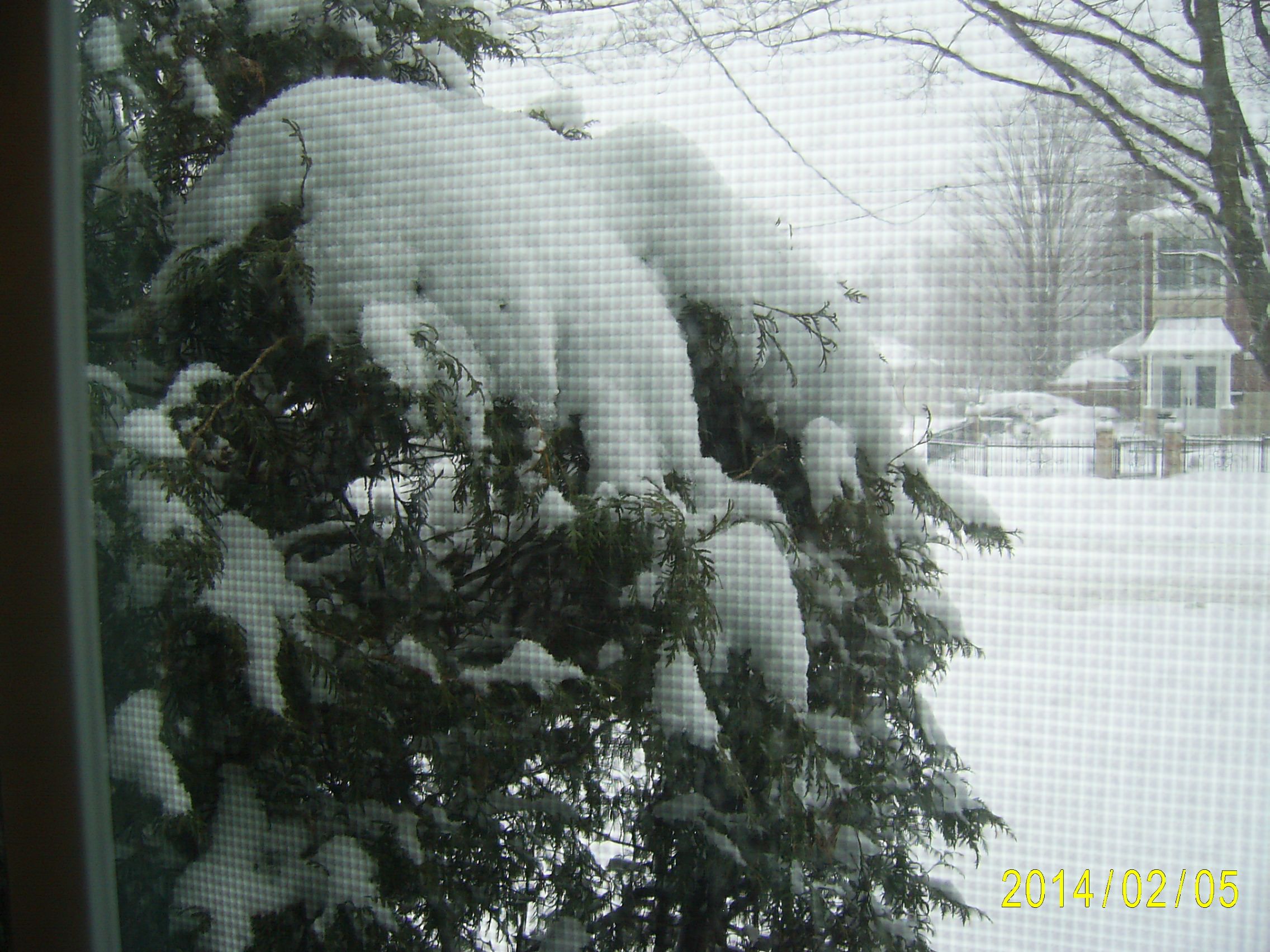
SAMSUNG DIGITAL CAMERAThe world is filling up with snow. Outside the windows, individual flakes are swirling. They start in one diagonal line and suddenly change direction into its opposite. Indeed as I write, they begin to be less single, distinct shapes and become a diaphanous white veil, faster, more wind-blown, a constantly changing beautiful spectacle, which, of course, I hate.

I assure myself that I am warm and dry with full pantry shelves, that such snow, unlike ice, presents no danger to the electrical grid, that I don’t have to go out and, if I did, I wouldn’t. What can I say? I had a bad experience in a storm in my formative years and I still bear the scars. Moreover, we haven’t had as much snow here as New England and the mid-west. Still I would be willing to send today’s downfall to Southern California where even the mountains are dry this year, or even to Sochi, just in case it’s needed.

No one is shovelling. No point. Not yet. The snow plows are rumoured to be working on the major highways. Then they’ll get to the roads and about midnight, they may get to the side streets. Come to think of it, I haven’t heard the bus go thundering up the hill in front of the house for a while. Usually, you can set your watch by them, two of them that do a quick loop down from the Old Mill Subway Station to the Humber streetcar loop, every 20 minutes. Almost as good as snow plows at clearing the road.

My earliest winter memories are of living in a farmhouse in the hills of Quebec’s Eastern Townships. Windswept! It had poplar trees on two sides that registered the slightest zephyr and talked to me about it. In a winter storm, they shouted as did the windows where the wind hummed in and left little drifts of snow inside on the window ledges. The wood box would be crammed full and several pails of spring water standing on the pantry shelf, carried in by my father who would have had to break the ice at the top of the spring. My mother was completely capable of keeping the stove going while he was away, pulping in the woods. That is cutting soft wood, trimming and hauling it back with the team of horses, to stack it in the long piles of pulp wood beside the road, work that snow and sleds made possible. There was no need to go to the store, what with the flour barrel, the potato bin, the canning cupboard filled with jars of berries and green beans and the deer meat hanging in the wood shed. Yet the house was full of terror.

What if… my mother wondered, when my father set out. What if, the place burned down? What if we needed the doctor? Etc. To each, my father responded with specific detailed solutions. The next farm was less than a mile away although out of sight. There was, of course, no telephone and no electricity. Anyway, he would be back in two days. Did she think he enjoyed freezing his ___ off in that camp? And John would look in when he came to milk the cows.

She would have been 22 then, a country girl, born and bred, but high-strung. When I was 22, I had just left residence at university and couldn’t have built a fire to save my life. She passed on her fearful nature and cold-hating physicality but not that practical skill.

I do remember one glorious day when it finally stopped snowing and freezing. The sun shone down on the glittering world. “Get on your snow suit,” she cried, joyfully. “We’ll go sliding on the crust.” And what a crust! Even she could walk on it without breaking through and it carried my sled, heavy laden with both of us all the way down to the bottom of the slope where the little brook lay frozen and buried.

Years later when I lived in the house under the hill (famous in this blog’s mythology), on a snow day, worse than today, school was cancelled. As teachers, my husband and I were off work and our small children were home. Curiously, our housekeeper had made it in and was busy in the kitchen. I was sitting at the table in the family room, close to the blazing fireplace, marking essays. I could see out the window to the high drift that lay there. Suddenly I saw the mailman step easily over the drifted-in wire fence and begin his progress over the side yard. “Stop,” I yelled, leaping to my feet. “Stop.” I started to pound on the window, but dropped my fists. And watched, dumbfounded. Slowly, he progressed through the heavy snow, one step after the other, mail bag banging at his hip. At each step. I prayed. He caught sight of me and smiled. Then he climbed over the fence at the other end. I collapsed in relief. He had just walked over our snow-covered, eight foot deep swimming pool.

SAMSUNG DIGITAL CAMERA

Septuagenarian Hobbit Has Ultrasound

My hobbit attitude is getting out of hand. I could say it’s the weather that’s making me a stay-at-home. And my age. My muscles are prone to spasm and never more than when there is a windchill of -30 C (-20F). So much of January, I’ve been hunkered down indoors, reading my Christmas books and watching my Christmas DVDs. I’ve even eschewed tai chi classes in favour of moving the furniture and practicing in the living room. But yesterday I had to go out.

I had an appointment for an ultrasound of my right breast. I first mentioned my oncologist’s concern about my right breast in The Cure for Fear https://115journals.com/2013/11/22/the-cure-for-fear/   Evidently, right breast felt that left breast had got altogether too much attention in the past and had started acting out.

When I wrote The Cure for Fear, I was convinced that I would know the scope of the disaster the next day. As it turned out, I didn’t. First the results got delayed. Word-processing of results is no longer done in-house. It’s moved off shore or something. Possibly there is a “typing” factory in South Asia. So my first appointment got cancelled. Then I made the trip to Streetsville, an hour away, to be told that the doctor had had an emergency and wasn’t there. But, not to worry, said his assistant. The results were okay. When I finally got to see the doctor, two weeks later, he was distracted. I tried to ask a question and he said, “Can’t you see I’m reading?”

OK.

I waited silently.

There was, apparently, a little party going on in my right breast: a swollen lymph node, a cyst and a small lump, all nicely lined up at 10 o’clock. After careful examination, Dr. ____ gave me the choice of having a biopsy right away or a further ultrasound in 3 months. Breaking my silence, I said, “Depends on what you mean by right away. I’ll be away the rest of December.” And so, it came to pass that I ended up with this appointment at the end of January. (How is that 3 months, anyway?)

First thing I did when I got home from the oncologist was fish out the reports from 15 years ago when left breast was getting all the attention. There I read that a small benign lump had been detected in my right breast at 11 o’clock. I hied myself off to my G.P., report in hand. I was careful not to speak while he was reading. Could be, he said. Might be the same lump lurking there all these years. Couldn’t be sure. Sure enough to get my hyper-vigilant, worrier off the case. I flew off to Brussels where I very nearly forgot it.

Yesterday, I arrived at the hospital early. Just as well since I had to drive nearly to the top of the parking garage. Like many others, I feel that I am a co-owner of this garage its tariff is so steep. Since I was so early, I decided to wipe the side windows, which I could barely see through for the dirty salt residue that had been whipped up off the highway. I wet paper towel with windshield washer fluid and wiped them down. Don’t try it. I seem to have forgotten everything I ever knew about driving in a Canadian winter. When I came out to drive home 2 hours and $12 later, the windows were covered with dirty swirls through which I could not see at all.

I’m used to the check-in procedure here now, having checked in at least once a year since the year of the left breast. I even manage to find the ultrasound waiting room, and get myself into one of those nice gowns that tie in the back. It’s inconvenient to have to carry my clothes and my long winter coat, which sit next to me while I wait. And wait. And wait.

No problem. Someone is texting me pictures and CP 24 is on the television set. It’s true that I am a little unsettled by the fact that everyone who comes in after me is immediately whisked out of there for their test. The announcer on the news channel tells me that Dufferin County has declared a state of emergency and closed all its roads. Whoa! That’s north of here but still, has the weather changed that much since I came in? Then “Code Blue in Cardiology. Code Blue in Cardiology”. Then there’s the mayor on the screen, looking like a candidate for a Code Blue himself and being served with papers alleging that he engineered a jail house beat-down. Not that Mayor Ford gets much airtime because Justin Bieber is back in town surrendering to police on a charge of assault. I tear myself away from all this hair-raising excitement. No one else waiting. Four people, presumably ultrasound technicians, are chatting away in front of computers. And I’ve been left here in limbo? It’s like a really bad dream I once had. https://115journals.com/2012/07/20/i-dream-of-etherica-life-changing-dream-2/

Finally, we get down to the task at hand, with apologies because they are so busy. ???? The good news is that the gel is warm these days. It takes a long while. It is clear that the cyst is alive and well, if cysts can be said to be well, but deep breathing helps with pain. This is taking much longer than usual. At last, the technician says, “Why are you here?” For one moment, I think “Wasting taxpayer’s money.. do you think we are going to pay for this?” But I explain about right breast’s recent party mode. “Well, I see the cyst but I can’t find anything else,” she says and tosses me a towel.  She’s just broken the sacred code of technician silence. “Oh, thank you, thank you. You’re so kind to tell me,” I cry, only just restraining myself from throwing my arms around her.

So that’s the end for now. Mr Death isn’t knocking on the door for this green-eyed girl just yet.

How the Light Gets In: Louise Penny’s latest

At the beginning of her new novel, Louise Penny thanks Leonard Cohen for generously allowing her to use a line from his song “Anthem”. Cohen tells us in that song that “There is a crack in everything/ That’s how the light gets in.” I have read all nine of Penny’s novels, so, presumably, I must have enjoyed them. And those lines by Cohen struck me from the first time I heard them as a neat summation of how good comes out of bad. Why, then, do I dislike their use as the title of her ninth and latest Armand Gomache mystery, How the Light Gets In?

Reviews, including one in the New York Times ranged from very positive to rhapsodic. Fans told of staying up half the night, of being totally emotionally engaged, of how they had waited breathlessly since the dire conclusion of book 8, The Beautiful Mystery for the resolution of this book. My goodness, I thought, and here I’ve been sleeping soundly oblivious to Gomache’s terrible suffering. I was so cold-hearted that I plodded through the book in my usual three days, closing it up at my regular bedtime.

How the Light Gets In, unlike The Beautiful Mystery, is set once again in the village of Three Pines, a place that cannot be found on any map, hidden and sheltered by wooded mountains where cell phone towers and internet connections cannot penetrate. And, despite its high body count over the years, an idyllic place with its village green, its outdoor rink, its used bookstore, its gourmet bistro with two fireplaces and its eccentric but helpful villagers. When he isn’t solving the latest murder there, Gomache retreats to it for solace, something he greatly needs now that his department in Quebec’s Sureté has been dismantled, his reputation is in decline and his good friend Jean-Guy Beauvoir is a drug addict.

Three Pines is south-east of Montreal in Quebec’s Eastern Townships.  I am familiar with this area. More or less. I recently made a sentimental journey back there to my birthplace. (See https://115journals.com/2013/09/11/septuagenarians-on-the-road-3/) While I was there, I stayed at Auberge Ayres Cliff (https://115journals.com/2013/09/14/septuagenarians-on-the-road-5/ ),an excellent hotel, every bit as cozy as the one in Three Pines, although much more on the beaten path.

When it comes to the willing suspension of disbelief, I’m a hard case. I spent my first five years freezing and starving in the hills of the Eastern Townships, albeit in a place that couldn’t be found except by those who had been there. True we were on a hill farm which produced a bumper crop of stones every year. Over the hill and down the valley, there was rich land with fat herds of dairy cows. Presumably, the hilltop soil had been scraped off our high land and deposited there. One of those farmers held the mortgage on our place. In the end, it seemed better to move to town.

But okay, I’ll go along with this Brigadoon-like village. I’d even like to sit by one of those two fire places drinking hot chocolate and eating hot buttered croissants. (No wait I’m gluten intolerant.)

Something I won’t dispute is fear of the Champlain Bridge. Too long, too high, too confusing with those changeable lane markings and too prone to traffic jams. In the opening chapter, a woman driving across that bridge comes undone. Some time later, her body is discovered dashed against the rocks beneath. It used to be the bridge that took you from Montreal across the wide St. Lawrence to Auto Route 20 and so into Les Cantons Est. Imagine my delight when I discovered this past summer that a new bridge allowed me to cross the river without going near Montreal.

Another thing I won’t dispute is the corrupt reputation of Quebec’s construction industry and its bureaucrats or some of them at least. Whether it is believable that they could be quite so dastardly or that the dastardliness could reach quite so high is a stretch. (Whoops – I seem to have lifted “dastardly” from Marilyn Stasio’s New York Times review.)

Nevertheless, the mystery of why a 77 year-old visitor to Three Pines is murdered on her return home to Montreal is intriguing. What does her murder have to do with her siblings? And, of course, there is the ongoing question of whether Gomache is going down to defeat as some terrible act of terrorism befalls La Belle Province.

Why do I resent Penny’s appropriation of Leonard Cohen’s line? I think it’s because Cohen’s idea belongs to the real world, which, let’s face it, is fraught with suffering and hard-earned insight. Penny’s world, on the other hand, is a fantasy, an imagined place of cozy friendship and monstrous villainy. It is the dissonance that bothers me.

Living in 3 Time Zones: a matriarch’s tale

There were stars overhead. A long-legged eight year-old had plunked himself down in the bed beside me. We could hear the revelers downstairs, but youngest and oldest, we craved rest. The stars on the ceiling glowed in the dark and I remembered sleeping under just such stars 20 years ago in Venice Beach, California, an ocean and a continent away. This is how far my family has spread. This is how far I have had to spread my arms to keep them – what? – not safe, for that is impossible. Let us just say “to keep them”.

Technology has made the job easier in the last 15 or 20 years. E-mail was a great help, so much faster that snail mail. Answering machines and FAX machines appeared. Then long distance rates started to fall, the mobile phone came along, and texting became possible. Distances were easier to bridge.

In Brussels last week, I watched the last episode of the BBC’s David Copperfield in which the Micawbers embarked on a sailing ship for a new life in Australia. Something had finally come up, as Mr Micawber so optimistically kept on saying it would, throughout his disastrous life. The villain of the story, Uriah Heep, was also on his way there, barefoot, chained to other prisoners, to pay for his crimes. His mother cried out, “My poor boy. I’ll never see him again.” Australia was just too far then, even supposing Heep lived to get released. Letters might be exchanged, but probably only two or three a year, given the time the voyage took.

In 1945 when my father moved us from the Eastern Townships of Quebec to Hamilton Ontario, my nine year-old self seriously doubted that I would ever get back to the mountains and the family I loved. Letters were posted and received weekly, but we had no phone. In the event of something momentous like a new baby brother, we could borrow the neighbour’s phone and pay the exorbitant long distance cost. In fact, we did return the summer after my brother Rob was born, in 1947.

Rob was the first family emigrant, hying himself off with a backpack at the age of 19 to explore the world. Our mother cashed in his life insurance policy to finance his getaway. By then it was a tossup whether our father would murder Rob or Rob would murder our father. All of the three older girls in the family harboured the same homicidal urge, but were not as capable of the deed.

Rob stayed safely out of reach of familial harm in Afghanistan, India, and Turkey, where various strangers had a go at him. Finally, he settled in Belgium. Where he had a phone which I could now afford to call to tell him our mother had been given only weeks to live. He thought it was a trick, and indeed, our mother survived against all odds for another 6 years. She had that ace in her pocket though -imminent death- and he came back for a visit – 3 years after he had left. He invited us to visit him and  2 years later I did, with my young family. We formed a friendship then that had not been possible before. So I began the process of long distance living. What time is it here? What time is it in Belgium or Italy or Sweden, wherever his career as a film gaffer took him?

Just when I got the knack of that, my daughter Julia took off for New York City. No problem, same time zone. But -what’s this? She’s off to the west coast. She’s getting married in Las Vegas. And so I began living in 3 -count’em – 3 time zones.

It’s quite dizzying. Whenever I want to talk to Rob, he’s already asleep. Initially, after I returned from Brussels last week, I woke up at 4 a.m., Eastern Standard Time, thinking it was already 10 a.m., and called him then. My daughter up on her west coast mountain would be snoozing away in her 1 a.m. world. As I acclimatized to Toronto time, I kept missing windows of communication. I ended up texting Rob while he slept and getting his reply when I woke up. Julia is beyond the reach of cell phone texts at present, but I catch her at odd moments as she builds the fire in early morning.

As I lay there on Christmas Eve, looking up at the stars, I thought about all the grandparents who travel great distances to be with their far-flung families and sleep as like me in children’s bedrooms. I thought about older women alone in their cars on lonely highways and on long distance flights. Like me, they may well count over 50 such trips and see the results in maturing children who know they are part of something bigger.

That something is family. I can’t help it. I have to communicate, to be there. Someone needs to hold the family together and time has made me the matriarch.

The Septuagenarian Hobbit Gets a Parking Lesson

Oh, stop trying to make me hate you, Toronto. You’ve already got sub-zero temperatures, vicious storms and week-long power outages going for you. Why did you have send the SUV woman to give me parking advice?

I was in the under-ground parking garage at Mountain Equipment Co-op, still jet-lagged from my return from Brussels, but putting a good face on it and taking advantage of a break in the weather to return a faulty product. I had already paid for parking at the wonderfully old-fashioned booth. The attendant was happily gossiping with a friend. There were many empty spaces. I was taking the opportunity to change the carpet floor mats to the rubber winter ones, when a woman in a beige SUV pulled up behind me.

“I realize it’s hard to see the lines,” she said, “but you are parked so that no-one can use the next spot.”

I could just barely discern a yellow line when I looked down. It was covered with salt and dirt.

“Thank you so much for telling me,” I replied. “But try not to get hysterical. I’m leaving immediately.”

“I’m not hysterical…”

No, just really, really annoyingly self-righteous and hidebound and so very, very puritanical, typically Torontonian, indeed typically North American.

While I was thanking her again for rendering my day more pleasant, I was remembering how cars on my brother’s one-way street in Brussels were often parked facing the wrong direction. No tickets. No outraged neigbours. Oh, carry me back!

I’ll hate myself for saying this later, but at least our mayor is a little looser.

(I know that’s an allusion, but I figure you’ve all heard about Rob Ford.)

The Septuagenarian Hobbit Returns: New Year’s

(This is one of a series of posts in which I have explored my hobbit-like reluctance to travel.)

The arrival of 2014 was confusing for me. My body-clock registered it at Brussels time and took me to bed shortly afterwards, but not before I received a text from my brother Rob, who had probably just set off fireworks in Bois Fort: Where are you? I have looked all over the house.

I can’t imagine how confused my fellow travellers must be. I joined their flight at the Brussels airport, half way through their journey from Delhi – mothers, fathers, grandmothers, children, babies and one grandfather. Shortly after take-off at 10:15 a.m., the lights were turned down and  most of them went to sleep. I joined them.

Even as I was swept south on Highway 427 from YYZ, otherwise known as Pearson International Airport, I felt as if some essential part of me had still not landed.

It is after 3 a.m. eastern standard time. My neighbours have just come in from partying and gone to bed. I went to bed at 6 p.m., so here I am.

I postponed the return to my home by stopping to eat. I was ready for dinner. Blake, who had picked me up, wanted brunch. Easy to get dinner at noon, but brunch on a weekday, New Year’s Eve or not, took some convincing.

Finally, I got home. The lights were on. I had carefully set the timer to put them on at sunset, but the ice storm cut the power, so the timer clock thought it was dark already. Warily, I approached the refrigerator. Four days without electricity! Nothing. No dreadful smell. My landlord had come in, I knew, and all the frozen meat was gone, but all the glass containers of stock, soup and stew were still there. For a brief moment, I thought there was a reason, but of course, there wasn’t. Refrozen they sat patiently waiting to give me ptomaine. For the third time in a year, I had lost everything in the freezer. (But global warming is a myth and all this crazy weather is just part of a natural cycle!!!!!!!)

The news showed me poor people in long lines waiting -many in vain – for food vouchers. They had lost their Christmas food and very likely had spent the holiday freezing in the dark.

I had gone with Rob to the fish market in Brussels to pick up a huge iced platter of oysters, sea snails and shrimp, destined to join turkey as our Christmas Eve feast. (The snails were particularly delicious.) I had been warm and cozy throughout. Evidently, there are advantages to travel.

(I will post one more blog in this series, in which I will explore the surprising fact that my Brussels family, whose language I can barely follow, has so much in common with my Canadian family and my Southern Californian family.)

Happy New Year.