Bitter and Slow: part 2 -slow food

Having extolled the virtues of bitter greens, I am now moving on to the benefits of slow food.

LIke most people, I don’t look forward to hours at the kitchen counter after a busy day, so I don’t mean food that requires long and complicated preparation, but rather food that takes care of itself simmering away on a slow burner for hours, filling the place with mouth-watering fragrance. Specifically, I am talking about stock or broth and tomato sauce.

Two things have driven me to embrace slow food, diminishing financial resources and health concerns. The kind of restaurants I can afford, now, don’t serve the quality of food that I want to eat. Excellent organic fresh produce and meat prepared in an appetizing way comes with a high price sticker if I eat out,  but I got sick of the plain food I used to make before I took up slow-cooking stock. In addition, I have health challenges including a weak digestion and a tendency to osteoporosis.

Earlier, in “Helpless Human versus Pressure Cooker” posted on May 22, 2012, 115journals.com I alluded to the fact that I cook brown rice in an Ohsawa pot set into a pressure cooker. I soak the rice overnight and cook it for 50 minutes. Doing so, makes it easier for my system to digest it. I also soak the rice farina that I cook for breakfast and I have it on good authority that soaking steel-cut oats for 24 hours prior to cooking them for breakfast renders them as delicious as croissants. With or without butter and jam, I’m not sure. I have cooked my rice that way for years and I can make it more or less sticky by adjusting the amount of water, although I tend to use the usual twice as much water as rice, a stickier option.

It was only when I disagreed with my doctor about the significance of bone density scores that I turned to bone soup. (I have not broken a bone in 3/4 of a century and surely this says something about the strength of my bones; moreover, the medication would be entirely indigestible for my tum-tum.) Bone soup is an interesting name. I lived once in a sort of commune that served bone soup every Friday night, calling it a light supper. It was light all right. You could see through it. By the time, you had extracted the chicken bones, you were left with little more that broth with a few pieces of carrot and rice noodles. I soon learned to jump in the car and head out for the nearest burger joint that night.

That’s not what I mean. I’m talking about beef or chicken stock made by roasting bones with as much marrow as possible and then stewing them gently with vegetables for at least 6 hours. It takes less than half an hour to prepare the ingredients, 40 minutes to roast them, a few minutes to transfer them to a stock pot. Once the burner under the stock pot is turned down to its lowest setting, it doesn’t have to be tended and the only other time needed is the washing up and transfer to containers for freezing. I use a pyrex type of small container and stack them in my small freezer. If I plan ahead, I take one out and thaw it in the refrigerator for 24 hours before I make stew or soup or gravy. If I forget, I put the frozen container in a pan of cold water so that I can pry it out in a hour or so and finish thawing in a pan on the stove. I can put together chicken soup from left-over chicken, thinly sliced carrots, green beans or chard and pre-cooked rice in about 15 minutes.

I found inspiration online and in The Joy of Cooking, but I adjusted the recipes I found to suit me. I don’t use onion, for example, just carrots and celery. I do use good quality bones – beef, marrow bones, for example, with ox tails sometimes and always some chicken bones even in the beef stock or chicken backs with a few thighs, perhaps for substance. I roast all the ingredients at 400 degrees F. I roast the vegetables for the last half hour. This gives my smoke alarm a workout unless I remember to relocate it temporarily. I use much longer cooking times – 6 hrs.- than The Joy of Cooking suggests.

I got hooked on the idea of roasting bones, years ago, when my first (although not then) son-in-law arrived from NYC and sought to woo me to his cause by roasting bones and making a reduction. He made a delicious meal and won me over. Thanks P.

I also make a vegetarian stock for when I cook for friends who don’t eat meat. Then I do use onion and a whole bulb of garlic. I found a recipe at allrecipes.com and have cooked it twice, both times enjoying how great it smelled and how great it tasted in a vegetarian Irish stew made of course with stout. (Sam Smith’s is vegetarian.) I found such a recipe by Melissa Breyer online www.care2.com. I t uses root vegetables including carrots, parsley, parsnips and turnips as well of course as potatoes and pearl barley, all in the previously slow-cooked vegetable stock. The stew itself takes only an hour or so, but be sure to get the barley well-cooked, not crunchy. Recently a huge pot of this stew went over very well at a potluck lunch. It was a stick-to-your-vegan-ribs sort of meal.

The other thing I love to slow cook is tomato sauce, not exactly a novel idea, I know. But I couldn’t eat tomatoes at all until I was told by that same good authority who soaks oats for a day that if I cooked them many hours I maybe could. I opted for 6, just for consistency. I simmer 4  or more cut up pounds that long until they are more or less paste and puree the result. Once again I freeze the paste and I can make a tomato sauce from it in a few minutes. I can’t use much and I still find it challenging to digest but it adds flavour and interest to my diet a few times a month.

So there you have my ideas for slow food, which miraculously turns into fast food, which tastes as good as gourmet restaurant food and which keeps me healthy.


Early October: reflections from Journal 119

The first weekend in October has always been an important one for me. As a high school English teacher, I found that by that date I had finally forged a relationship with my classes. I knew their names and I was interested in them as individuals and they had, usually, stopped testing me, having presumably given me a passing grade. So by then the hard slog of the new school year was over.

And there was another reward – it was a long weekend, the first Monday in October being Thanksgiving Day here, where harvest time comes earlier than it does south of the border.

Some teachers in the States have a long weekend as well in honour of Columbus Day. Not all, as I found it one year when I took my 7 year-old grandson for a hike in Topanga Canyon that day. I discovered to my mortification (I was a teacher after all) that his school, a private school in Los Angeles, didn’t have that holiday. It was the sort of school that let its students plan the lessons, so, in fact, our day trip was not much out of line.

This year, that child is in his first year residency at a New England hospital. Just saying.

On Saturday I drove to Stratford to see a production of Shakespeare’s Much Ado About Nothing, a trip of about an hour and a half with a bonus that hadn’t occurred to me. The trees were aflame with colour. In the middle distance woodlots glowed with orange and red and golden phosphorescence. (We are lucky here to have so many hard maples that produce such bright colours. The photographer who originally posted “A Tribute to Autumn”, which I reblogged lives farther north and west, I think, because the trees there produce mostly yellows.) The corn nearer the highway still stood dusky gold, but as we drove farther northwest, the fields became brown and beige stubble.

Surprising how cold it was when we got out of the car to find lunch. I had worn a sheepskin-lined rain coat and a wool tam, scarf and gloves, but the cold wind went right through me as if I were wearing diaphanous cotton. No doubt about it, summer was long gone.

I note by the way that, although it is only 70 degrees F. in Los Angeles today, it will be back up to 92 next week.

The Festival Theatre in Stratford Ontario has a thrust stage, rather than a proscenium arch. I first saw it when I was a teenager in the second year of its operation, although at the time, it was housed in a huge circular tent. The permanent structure was designed to mimic the tent. By the time, we had hiked through the park from our car, we were chilled to the bone and it seemed as if a glass of pinot noir was in order to get the blood moving again.

Once seated, I realized that my friend who had made the reservation online had upgraded us, not to the very best seats, but almost, thinking I wouldn’t notice her largess. It is hard in such a theatre to get a bad seat, but the sections at the sides of the horseshoe-shaped auditorium are more challenging. And the row in front of us was entirely empty, sold no doubt to some sponsoring company but not distributed so no heads obscured our view. The set had a staircase that swept up around a palm tree!!!! This production had been relocated to Brazil in the early 1900s.

I had looked up a summary of the plot of Much Ado About Nothing, just to sort it out from Shakespeare’s other comedies, but I was not prepared for how familiar I found it. I knew the next line before the actor spoke it. It was unsettling! Apparently, in my 35 year career, I had taught it many times and forgotten I had done so. Considering that most years I taught 5 plays by Shakespeare, I had much opportunity.

Basically, the play is about the duelling couple who apparently scorn each other and are always putting each other down, but eventually ….. Shakespeare used the same sort of plot device in Taming of the Shrew. He liked to set a headstrong, witty woman, in this case Beatrice, against the equally willful, caustic man, Benedict. There’s plenty of scope for pratfalls as they eavesdrop on their friends who are setting them up to fall in love.

After the show, we stopped at Balzacs for coffee and sugar enough to get us home through a dark and rainy drive.

Monday, turkey day, was a roast beef day in my house, roast beef and Yorkshire pudding, which I came to love when I was married to a Yorkshire lad. Fortune had carried him back to my table after many years’ absence and he assured me that I had channelled his mother’s pudding. (See recipe below.) My mother-in-law used beef fat but beef doesn’t have much fat these days so I opt for butter. And it turned out well even though we never succeeded in raising large bubbles. Like my mother-in-law, I chose a loaf tin rather than the 9 by 6.You start the oven at 400 and turn it down to 350 after 20 minutes. If you are like me, you forget when you turned it down and have to wing it after that. Maybe that’s when I got help from beyond. Proof I had channelled her: it came out of the oven puffed high and lightly browned. You have to serve it asap, so the mashed root veg (See recipe below.) had to be ready, the beef sliced and the gravy made. (Why is there never enough gravy?) The roasted beet and argula salad had to wait its turn. The meal was so delicious that we four fell to expressions ofthankfulness spontaneously. And of course there was pumpkin pie.

There were absent friends, some more permanently absent than others. We were a family reconstituted with good fellowship and food.

Early October has a way of reconciling me to the inevitable, which comes earlier here than it does down there in my second home.

 Yorkshire Pudding according to The Joy of Cooking 75th anniversary ed.

Have all ingredients at room temperature, about 70 degrees F. Preheat oven to 400 F. Sift into a bowl:

3/4 cup all-purpose flour minus 2 tablespoons
1/2 tsp of salt
Make a well in the centre and pour in
1/2 cup milk
Stir in the milk. Beat in:
2 large eggs well beaten
Add:
1/2 cup water
Beat the batter until large bubbles rise to the surface. …Pour 1/4 in. beef drippings or melted butter into a 9 by 6 baking dish or 6 regular muffin cups. Heat pan or dish until hot. POur in batter and bake 20 min. Reduce heat to 350 and bake 10-15 min. longer until puffed and golden brown.

Mashed Root Vegetables a la Desmond, my hairdresser

Peel or scrub equal amounts of carrots, parsnips and turnip, dice, add water to cover, salt, bring to boil and reduce heat. Cook until fork tender, but not soft. Drain and mash. Add butter and pepper.
Desmond says, “Don’t even think of adding sugar. These vegetables are sweet enough.”

Septuagenarians at Sea: #2

Blake sent this text after his adventure:

Yesterday I went sailing with M. and her friend A. It was another exciting outward-bound type adventure that seems to  be becoming a Durant norm, Remind me to put that phrase into the brochure… I slipped the mooring with the main sail up and was getting too close to the neighbouring boat. I went to the bow and successfully fended off without touching. Unfortunately, I lost my footing and found myself dangling from the pulpit. We were a boat moving in the basin with nobody in control.

M. had sailed a little and A. none. Legs dangling in the water, I quickly moved hand over hand  back to the cockpit where M. and A. were chatting away completely unaware I had gone overboard. When they got over their surprise and shock at hearing my voice from over the side of the boat, I proceeded to steer the boat by remote control through M., around the anchored boats  and turned us towards the gap to Lake Ontario. I had a bit of time before we reached the lake, so I decided to get back aboard.

Again by remote control, this time through A., we got the ladder out of the locker and installed. Easier to say than do. I clambered aboard, but was not finished. We were very close to the cement side of the gap and I had to fend off again. This time I was careful not to lose my footing. We then hoisted the jib and had a wonderful sail around the Toronto islands, heaving-to on the way to have lunch. Today I am having a rest.

Mortality and Christopher Hitchens

In his recently released book Mortality, Christopher Hitchens tells the story of how British journalist John Diamond chronicled his battle with cancer in a weekly column. Hitchens confesses like many other readers, he quietly urged him on from week to week. He says,

But after a year and more…well, a certain narrative expectation inevitably built up. Hey, 
miracle cure! Hey, I was just having you on! No neither of those would work as endings.
Diamond had to die; and he duly, correctly (in narrative terms) did. Though – how can I put this?- a stern literary critic might complain that his story lacked compactness toward the end.
Hitchens’ own story was more elegantly structured. He told it in 7 essays published in Vanity Fair and now collected posthumously in this small book.

Mortality describes his initial collapse in a New York City hotel room during a tour in support of his latest book, Hitch 22, in early June 2010, saying of the emergency responders:

I had time to wonder why they needed so many boots and helmets and so much backup equipment, but now I view the scene in retrospect I see it as a very gentle but firm deportation, taking me from the country of the well across the stark frontier that marks off the land of malady.

He dislikes the use of the metaphor of battle, fight or struggle to describe what ensued after he was diagnosed with metastatic oesophageal cancer. He says

Myself I love the imagery of struggle. I sometimes wish I were suffering in a good cause, or risking my life for the good of others, instead of being a gravely endangered patient.

But sitting “while a venom sack gradually empties itself into your system, the image of the ardent soldier or revolutionary is the very last one that will occur to you.” And yet his dispatches from the Land of Malady are full of his customary wit and irony. His wife, Carol Blue, reports in the book’s Afterward that he wrote the jottings now collected as chapter 8 in bursts of energy and enthusiasm, his computer perched on the food tray of his hospital bed. He continued to hold court whenever he was hospitalized, “making a point or hitting a punchline for his “guests”, whom he treated like “participants in his Socratic discourses”. He had always been a great raconteur, as well as a bon vivant. He had an encyclopedic knowledge and a rapier-like intelligence. And he could hold his liquor. After an 8 hour dinner, he would rise to toast the assembled motley crowd with “a stirring, spellbinding, hysterically funny twenty minutes of poetry, limerick reciting, a call to arms for a cause and jokes. ‘How good it is to be us’, he would say in his perfect voice.”

I started reading him in Vanity Fair, after many years of avoiding his work and like many others, I was immediately won over. I avoided him because he had betrayed me. For many years he had espoused causes dear to my heart, workers’ rights among them, what might be called leftwing views, but then after 9/11, he made a sharp turn right and supported the war in Iraq, believing the now disproved weapons-of-mass-destruction premise. Not to mention, he dissed Mother Teresa and rounded on Salman Rushdie, when Rushdie, under fatwa pressure, published “Why I have Embraced Islam”. I read the rebuttals that his friend Martin Amis wrote and imagined, in my innocence, that Amis was actually alienated from Hitchens. I was wrong. Amis remained his great friend, Rushdie was at Hitchens’ memorial and Mother Teresa – well that goes without saying.

Hitchens was a famous atheist, author of god is Not Great, and on his last Thanksgiving Day in November 2011, he was in my town, Toronto, debating his point of view with Tony Blair, the former British prime minister and recent convert to the Catholic Church. Hitchens arranged Thanksgiving dinner for his family and friends here and by all accounts carried the day in the debate.

His reaction to the Christopher Hitchens Day of prayer on September 20, 2011 involved wondering exactly what was being prayed for – his survival, his redemption? He examined the nature of prayer -the importuning of an omnipotent being to suspend His laws of nature for personal benefit- and found the practice specious. He noted that certain religious zealots had pronounced that his illness was God’s punishment and in short order analyzed the ill-logic and cruelty of that by citing blameless children suffering from cancer. He said there would be no deathbed conversion and told of Voltaire being badgered as he was dying to renounce the devil, whereupon the great thinker replied, “that this was no time to be making enemies”.

The best gift that Hitchens gave me, besides many good laughs, was the realization that I can listen to a point of view I don’t agree with, indeed that I might find contrary and wrongheaded although, of course, he said much that I found true.

He concluded an essay on The Great Gatsby by saying, “It remains ‘the great’ because it confronts the defeat of youth and beauty and idealism and finds the defeat unbearable and then turns to face the defeat unflinchingly”.  He died on December 15, 2011 at the age of 62. HIs unflinching voice goes on.

The Weight: Take a Load off Annie

http://www.youtube.com/watch?v=sjCw3-YTffo
T
he Weight by the Band from The Last Waltz
http://www.youtube.com/watch?v=HmRDM7GyJXE

I’ve just shed weight in preparation for winter. No not that kind. I would like to lose pounds of actual me, but it goes very slowly about 2 lbs a month if I don’t even look at sugar and wine. The weight I have lost has come out of closets and storage spaces.

This is what I have thrown out/left on the curb/shredded/taken to the thrift shop in the last week:

a full length mirror with gilt frame;

a favourite Indian rug too big for my room;
all floppy discs, a floppy disc reader, the ZIP drive and its discs;
4 years of tax returns,
12 steno pads detailing flight options,
packing lists and hand-drawn maps, dating back to ’97;
10 tiny notebooks with grocery and to do lists;
pay stubs dating back to ’80;
2 boxes of research for a book that has been finished for years;
a large collection of postcards bought while travelling;
a large, puffy, pink elephant with a top handle;
a red velour hat that looks as if it were lost by the Mad Hatter;
some very bad poetry (I kept the somewhat bad poetry);
the white suit my 4 year-old wore as ring bearer;
a vase made by one of my children at summer camp;
their first books with their childish signatures.

The christening dress is due to go, we all agree. Not only has church-going fallen off en famille, people persist in marrying Jews. Anyway, it isn’t silk. It isn’t hand embroidered and although it was as much beauty as we could afford back then, it has to be admitted, it is ugly. Clearly, my courage has faltered or it would not still be in the keepsake box.

Late Breaking News: it isn’t.

Here’s what I haven’t given up: the 100 year-old portraits of my grandparents -I bought them a plastic storage box; my first novel – I might be able to use some of that detail about Greece -I certainly couldn’t actually read it; the pictures minus the negatives (but they could do with weeding); the canner – whaaaat?; the roast pan and lid; the portable sewing machine.

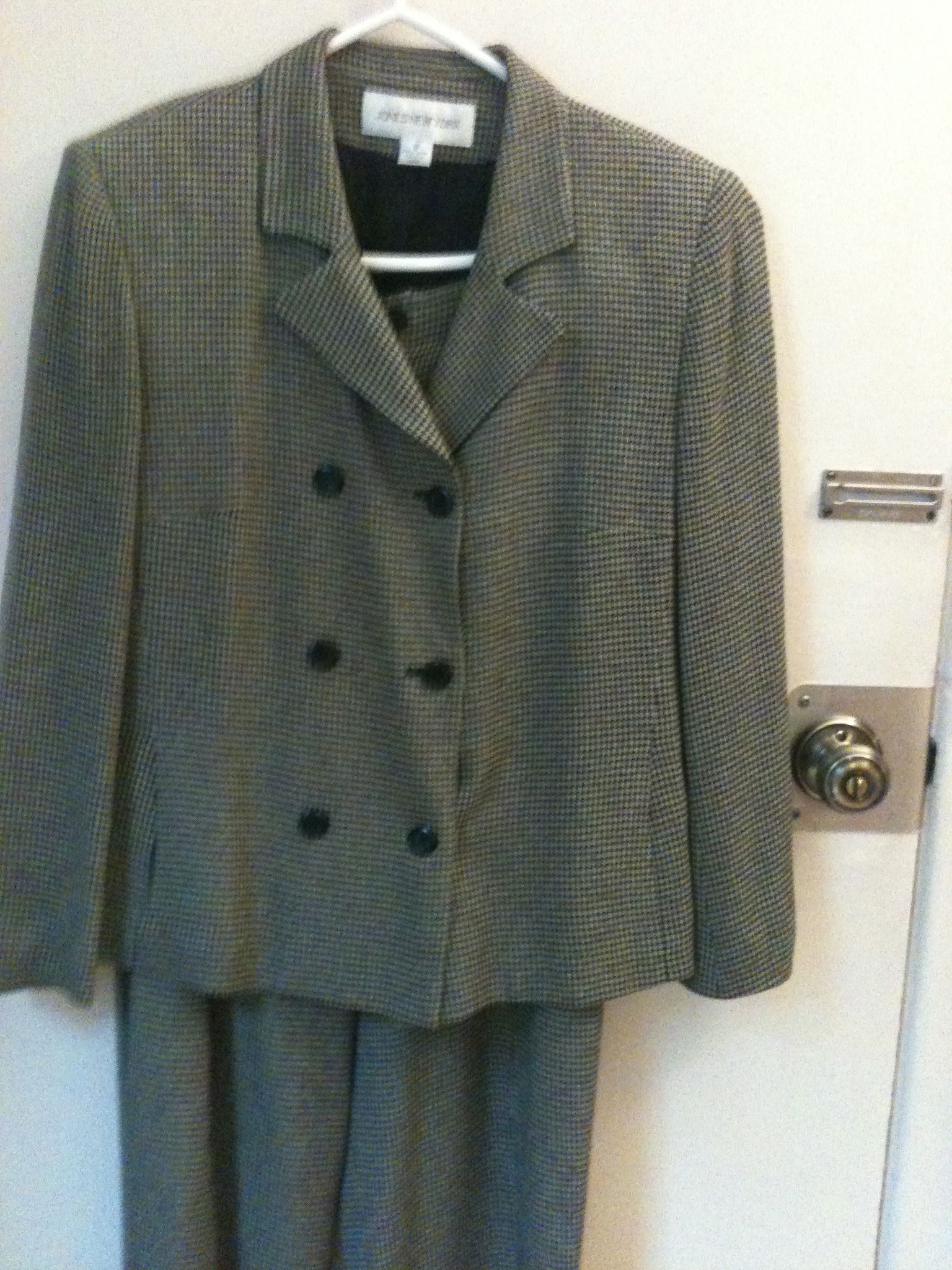
Here’s what I need to do: sort through the clothes hanging at the far end of my long, narrow closet – the houndstooth suit -what was I thinking?-, the gauzy red flowing  Indian thing, the jaloba from Morocco, not to mention the multiple  jeans in size 10 and the same number in size 12; my mother’s costume jewellery, and my mother-in-law’s and that third box that belonged to the stranger I used to be; my degree handwritten in Latin with a plaid ribbon! – these decisions require courage.

I feel much lighter in spite of what the scale reports. The air seems fresher. It is easier to breathe. All that past I was dragging behind felt like the slime of a dragon’s tail. Why did I think I needed it? I never looked at it. It seems to have functioned as insulation or protection, not effectively of course. Come to think of it, whenever I have been able to fit into those size 10 jeans, I have always felt on the verge of vanishing.

Is there a lesson here?

Motherhood: savage longing

Robert Thurman, renowned Buddhist and scholar, and famous Uma’s father, writes in The Jewel Tree of Tibet about an unusual way to learn compassion. While you are sitting in a subway car or bus, look around and realize that everyone you see has, in the course of repeated lifetimes and in some form or other, been your mother.

But will we ever forgive each other?

Earlier this year, I bought Colm Toiben’s new book called New Ways to KIll Your Mother, a title that dismayed at least one mother I know.

Toiben is an Irish novelist and critic, who has written here a series of book reviews or essays in which he explores how we treat parents, particularly mothers, in our novels. He notes that 18th century novels rarely feature mothers. It is true that 10% of women died in childbirth then, but still, it seems unusual especially since motherhood was then beginning to be idealized. Yet “the novel is a form ripe for orphans”. He quotes Ruth Perry, a critic, who says that this “may derive from a new necessity in an age of intensifying individualism.”

(That darned individualism, so marked in 2 year-olds, and 14 year-olds, and … oh, never mind.)

Jane Austen’s last three novels have no mothers. Her great success Pride and Prejudice has Mrs Bennet, Elizabeth’s social climbing, hysterical, embarrassing mother, whose husband escapes into his study. (Wait, doesn’t that sound like someone I know?) Aunts were permitted in many motherless stories, including those of  Henry James. They might be kindly as Elizabeth’s or autocratic as Darcy’s, or manipulative, but they were surrogates, not the real mother McCoy.

The middle section of Toiben’s book concerns Irish writers, including the poet W.B. Yeats, whose essay is subtitled, “New Ways to KIll Your Father”. Yeat’s father, an successful artist sounds almost as annoying as Mrs Bennet. He confidently wrote from New York to explain a brilliant book he expected to write and publish to great acclaim. Yeats, who had put in a long and painful writing apprenticeship, refrained from dashing his father’s hopes -and thereby presumably killing him. Instead he waited a long while, during which time no such book materialized and then responded in a restrained manner.

J.M. Synge, Irish playwright (The Playboy of the Western World, Riders to the Sea) and co-founder of Irish theatre, had a formidable mother who preached damnation at all three daily meals and organized his short life when he wasn’t escaped to Paris. Much as he disdained her ‘rule’, he followed her every summer to the family’s summer place. And much as she, an Irish protestant, abhorred his atheism, she continued to give him house-room. Despite disdain, he kept on coming back.

“Samuel Beckett Meets His Afflicted Mother” tells us of the author of Waiting for Godot and his mother. Apparently, she tended to be depressed. (Imagine that -the Becketts were depressed!) Beckett eventually also fled to Paris and insisted on remaining during the Nazi occupation. He wrote the following in 1937 while his mother was away traveling: (She had of course left her cook in place and Samuel continued to enjoy life good food.) “I don’t wish her anything at all, neither good nor ill. I am what her savage longing has made me….. I simply don’t want to see her or write to her or hear from her…”

“Savage longing” indeed. Sound like a mother you know?

In the interests of full disclosure, I ought to admit that I am a mother. But, of course, you knew that.

A few weeks after I became one, I sneaked off to the doctor, leaving my newborn in the care of her father. There I sat and wept that she hated me already. Stupid man, he just laughed and assured me that soon we would be deeply attached. We were and we are – from time to time. Did I say that out loud? At present, we have entered a Pax Romana or a  long Victorian empire of peace. I have finally matured.

Her brother, on the other hand, is in a Beckett phase, although he is cordial enough at weddings and funerals. Funny how infrequent they are.

It is quite breathtaking when our beloved off-spring begin as they say to “individuate”. Humbling of course. After the momentary slights and cuts of childish insults, we endure a decade where we are ill-informed if not actually stupid, uncool, unfashionable and just generally out of date. We may or may not suddenly improve when the child is 21.

Apologies to Robert Thurman, but no wonder we have such a problem with each other! If we have all been each other’s mothers, we’ve got history.

On her death bed, my own mother had what looked like a large ruby on her upper lip. She was about to slip into a coma. She looked at me and moved her dry mouth silently. I wiped it with a wet cloth. Than she found her voice. “I need a present,” she said.

And my heart filled with compassion.

Summer’s Almost Gone: Jim Morrison and I lament

Woke up this morning, not early, 7 o’clock. Whaaat? It’s still dark. Not a glimmer of dawn. But I happen to know the sun was supposed to rise here at 6:49. Simple solution – go back to sleep.

At 8:30, it is just very gloomy, rain is pelting down, trees are tossing their heads and the temperature is falling down past 15C/60F. At least the papers have arrived and their weather maps show rain from Iqaluit to Maimi. Even Houston and El Paso are getting wet.

Yesterday, Friday, it was hot and humid with sun burning down. But the traffic, which had been its usual summer-lite on Wednesday, was back to its non-summer impossible. I hit a detour 5 minutes from home that held me back 15 minutes and even my usual “deke-around” routes had huge trucks barrelling toward me on narrow residential streets.

I was late for my tai chi class. So were ten others. We sat on the benches changing our shoes.

“It’s over, isn’t it?” the woman across from me said. I only just kept myself from falling on her shoulder in a grieving embrace.

Then wouldn’t you know it, on the way home, Jim Morrison “Summer’s Almost Gone”, going on in atonal fashion about having been calmly unaware with gold burned into our hair, “Where will we be/when summer’s almost gone?”

Easy answer, Jim, sitting here, staring out at the rain and the maple leaves turning orange from the edges in before our very eyes.

We are moving on in our grief in my town at least. Mostly, we have stopped talking about it. Some of us have buried ourselves in a relentless round of movie-going or celebrity stalking attendant on our film festival. (That would be TIFF.) There are many more flyers in today’s papers and from the looks of them, others are going to hit the stores to buy crazily- patterned shoes and clothes. One caption cries, “Let loose the houndstooth”. Or look – what a nice dining room table and all the gewgaws to set it up for a harvest dinner party. I do have Perception and World Without End waiting on the TIVO.

Here in TO, we get to enjoy a lot of indoor time once summer ends, so why not get the rugs cleaned and set up the new filing system. That should be fun!

Jim, how can you people in California even pretend that you have winter?

Oh, come on now, buck up, Joyce! Temperatures of 27/80 are forecast for later next week. Didn’t I have to call you to task on this issue in Septuagenarians in the Wilderness part 3:
“Oh, give it up my friend. There will be warmer, dryer days. There will be other summers. There will be other burning chef’s hats. We’re a good way yet from closing time.”

Macmeth: Walter White begins his tragic fall

“Macmeth” turned up as a search word used to get to my blog 115journals.com, so I decided to put it into Google myself. There I found a series of short videos posted on Youtube, beginning with the 3 witches in a decidedly un-90%-pure lab, said witches sporting southern drawls and declaiming really bad lines. On a later post, we were told these scenes were intentionally bad. Wise disclaimer. I once had a grade 11 class that did a Jamaician Macbeth, which was really funny and also referenced illegal substances. Alas, we were living in the dark ages then and it didn’t make it to Youtube.

Here you are if you are interested: http://www.youtube.com/watch?v=X1dMc4azxQQ.

This post is a follow-up to my previous post, “Walter White: A Macbeth for our time” in which I looked at the protagonist of Breaking Bad and compared him to Shakespeare’s Macbeth.

Now to get back to Walter White. SPOILER ALERT! If you haven’t watched Sunday, Sept 2nd’s show, turn back, turn back!

Unless like me, knowing the ending just adds to your pleasure. Yes, I read the end of novels first, even sometimes mysteries. So you see I am in a unique position: I understand the pure evil that lurks in the human heart: evil bad enough to read endings first.

It was Tuesday morning before I could sit down to watch. I had had my admin assistant (Joyce) clear my calendar. Then I had the cook (Joyce again) prepare me a light lunch and serve it to me (Guess who? Joyce) in front of the television set. It takes a lot of person-power to keep the renowned critic going. I wasn’t unprepared, my sister, Georgia took time out of her birthday celebration to describe the entire plot of “Gliding Over All”, the final episode in this half of season five, the last season.

Look at the reviews and you will see that people are seriously ticked off at Walter. He didn’t actually shoot the kid on the dirt bike in the desert, who saw them robbing the train of thousands of gallons of the meth precursor. That was trigger-happy Todd. And it is possible that if the child had been allowed to live, he wouldn’t have caused a problem. After that, Jesse had a breakdown and refused to continue as Walt’s assistant cooker. Mike, who was in charge of distributing, also opted out, but, alas, Hank, Walt’s DEA brother-in-law, seized Mike’s money. When Mike sought to flee, he didn’t get far. Walt suddenly shot him in the stomach and he died sitting on a river bank, saying, “Let me die in peace”.

By now Walt has not only contributed to the inevitable decline of all his blue meth users, he has had Jesse kill his rival Gale Boetticher, he has poisoned a child with Lily-of-the-valley, he has arranged for a paralyzed pensioner to blow himself up taking his archenemy Fring with him, blown up Fring’s state of the art meth lab -complete with eyewash stations and safety equipment, robbed a train, allowed the boy’s murder, shot Mike and in this episode, arranges for the murder of 9 of Mike’s crew and their lawyer.

How does that stack up against Macbeth? Well, he began by carving up his king who was his cousin, who had honoured him lately with a new title and who was a guest in Glamis, Macbeth’s castle. He went on to eliminate his friend and fellow officer, Banquo, but failed to kill Banquo’s son, Fleance. He attacked Macduff’s castle and finding that Macduff had fled to England, made do by murdering Lady Macduff and their children. Meanwhile he ran the country into the ground. The people turned against the once popular general and a great military force was being marshalled to invade Scotland.

Is Macbeth worried? No. For the three witches have promised that no man born of woman could kill him and that he will reign until Birnam Woods shall come to Dunsinane. He hadn’t apparently heard of Caesarean birth, although Macduff had and even those who never read the play can figure out how a woods can move. By then Macbeth is grief-stricken over his lady’s suicide. He’s has had enough. He cries, “Lay on Macduff and damned be he who first cries hold, enough!”

I have been known to cry that myself.

So what of Walter White? Certainly he is a tragic hero about to meet his downfall. There is speculation that his cancer has come back. After his MRI he looks at the towel holder in the washroom that still bears the imprint of his fist, but he is completely controlled. Something is going to knock him off his prideful perch. The cancer? Some disaster relating to a child of his? Some machination of Lydia who thinks she has a deal that he will supply the Czechs with his great product? How can he in fact step back out of the meth business?

And then there is Hank who has discovered an inscription in a book in Walt’s bathroom, a book of Walt Whitman’s poems, that leads him to remember the “W.W” in Gale Boetticher’s notebook and what Walt said about it. Whatever else happens in next summer’s season, Hank will have to pursue Walter, without somehow bringing himself down in the process.

Ah, those were simpler times, back in Macbeth’s day. Evil comes in more shades now, not those 50 shades of gray, but black and ever blacker.

The worst downfall might be that Walter gets to live with what he has done.

Sage Baby: Bad Titles follow-up

A couple of posts ago, I ruminated about titles that get outdated by time, including George Orwell’s 1984 and my blog 115journals. I imagined that the three journals I have written since are seriously put out and I rashly promised journal 118 that I would mollify it by posting its highlights. Today I reached page 215, the last page. Journal 118 started on July 8th is now retired from active duty.

Let’s see what’s there.

Oh. My. Goodness. Anais Nin would have relegated its first part to her diary of pain. When she was mortally ill in Big Sur, as I remember, she divided her journal in two and kept the unpleasant stuff separate. I haste to add that my “pain” was more mundane and much alleviated by simple means such as a new regimen of supplements to replace the minerals I was short of.

Then I come to a dream I had in which I was a young doctor just beginning my residency when I learned that I was pregnant. The dream was suffused with love, warm, nourishing love for and from my husband, and a quickening sexual desire. I went out for a walk by myself on a rainy Sunday evening to relish this feeling. Oddly, I came upon my actual/ non-dream-life son in the course of this walk. He was working as a blacksmith -not of course in real life -outside his forge and raised his head only briefly to ask if I had written another book.

I seemed to be living an alternative past and seeing an alternative future.

When I looked at what the dream meant, I saw that I was dreaming of healing myself. The Sunday night walk could be seen as a sign I was now complete enough in myself to do so. Someone I told the dream to said I was dreaming about my “sage baby”, that gestation is a symbol of spiritual cultivation.

So I looked on the internet for “sage baby’ and found it was the name of a company that produces baby blankets, a name given to both boy and girl babies and the name of a musician. Not helpful. I imagined people sitting in a shamanic circle fashioning tiny doll babies out of sage leaves. Then I finally realized she meant “wise” baby.

Ah, a familiar idea. One of western civilizations most important festivals centres on the wise or sage baby, born in a manger. But it has seemed to me for some time that this is better understood as the birth of the Christ in the cave of the heart, in other words, our own soul discovering itself and knowing it is one with the divine creative spirit.

A book is another kind of sage baby and my real son was/is fashioning his own sage baby, in iron with fire.

So there you go, Journal 118. That is surely your highlight, an actual insight.

Isn’t it curious that in our dreams, we can be any age, possibly because we are not actually age-specific.

How’s your sage baby coming on?

Higgs Boson and Margaret Thatcher

Researchers at the Large Hedron Collider lab, which burrows beneath the Swiss/French border, announced on July 4th that they had detected Higgs boson or so called God particle. Science has postulated its existence since 1964, but until now it has alluded researchers. Oakland Ross writing for the Toronto Star has written a series called “Our Universe Explained” that describes the physics of the universe so that people who hated math and science can grasp it. the star.com/insight

I am going to quote an analogy he uses to explain how Higgs boson gave rise to mass and so made the universe possible.

“A useful analogy for the Higgs field and its influence on other particles is the so-called ‘Margaret Thatcher effect’, a reference to the former British prime minister, who was a colossal political force in her day. The analogy was dreamt up last year by David Miller, a physicist at the University College London.

“Imagine Thatcher swanning through a crowded room while at the height of her powers. Most of the minions in her vicinity would naturally veer toward her, owing to her authority and influence, and so the distribution of the crowd in the room – analogous to the Higgs field – would become distorted, or asymmetrical as more and more hangers-on shifted to be closer to the Iron Lady, thereby induing her with mass.

“This, metaphorically, is what happens when a particle moves through the Higgs field.

“For all its mass-giving properties, the Higgs particle is itself a rapidly decaying affair, with a lifespan measured in the minutest of a second. It made only a momentary appearance in the earliest pageant of our universe’s history and promptly vanished. But the field it engendered lives on.”