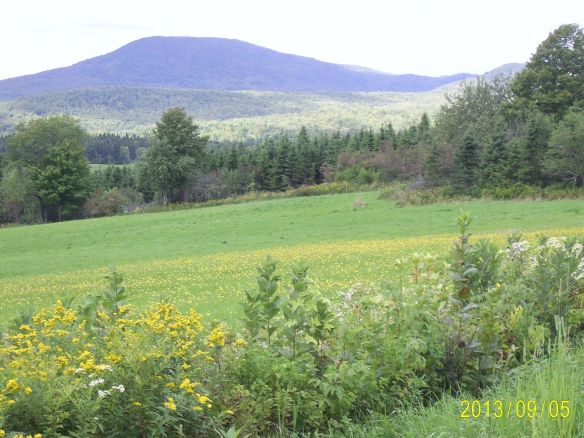
Septuagenarian Hobbit: Brussels con.

( the 4th in a series in which I examine my Hobbit-like reluctance to travel)

The street in Bois Fort, a district of Brussels, is narrow and lined with attached houses, many of which were once businesses. My brother Rob’s house used to be a bakery for example. The ovens used to be in a building in back, separated from the kitchen and store front by a small yard. The two buildings are now one and the ovens have been replaced by a fireplace. You can still see where the counter stood on the tiles in the living room and there is a tin sign hanging on a wall on which the prices of the various loaves could be written in in chalk.

As always people drop in. They don’t call first or even text. They just show up. If there is a meal on offer, they share it. They may even bring their wash.

I live in an “old” suburb of Toronto. The only people who ring my doorbell are from the Jehovah Witness program. I don’t even, anymore, get those annoying people who demand to see your utility bill because they can save you money. The rare visitor gives me fair warning of impending arrival.

I remember that open door policy here in Bois Fort even on my last visit 20 years ago. Whether it is actually a neighborhood phenomenon or my brother’s influence I can’t say. I remember that as a young teenager, he more or less lived with a neighbour, so communal living may come readily to him.

Across the street live two octogenarians that he calls his little old ladies. Their cottage sits four feet below the street on which it once sat level. It is freshly painted and has an indoor toilet now because of Rob. They protest that they don’t need these fancy new gadgets like water heaters, but they seem glad of his visits and the roast chicken he buys for them at the Sunday market. Sundays they get no meals on wheels, another thing he arranged for them. They are Bruxellois and although they speak French, their actual dialect is a language peculiar to that group.

They are not the only marginalized people Rob has adopted. He is mentoring a young man with mental challenges, teaching him the value of wearing his teeth and underwear, for example. The lame and the halt find sympathy here. He has a firm belief that we owe it to the world to make it a better place, no matter how annoying the process can be.

Why? We four siblings had every opportunity to become homeless addicts. While it is true our parents were hard workers who professed to love us, we lived in fear for our lives, constantly vigilant. At any moment, our father might take it into his head to beat us or our mother might try to drown us in the bathtub. Mental health issues! Ya think? In fact, three of us ended up in the teaching/preaching game and Rob, who was in a more creative line, took that vow to make life better for others. And did it laughing. Mostly. But if that kid doesn’t wear his teeth….

What’s not to like? Monastic me with the silent doorbell, practically imploded the other night as the table and then the family room filled up with laughing people. Long bouts of French too fast for me to follow made me go off line. Mostly translations followed so that stories got laughed at twice and that was, if anything, more overwhelming.

I have to do a certain amount of self-mentoring. I am in no danger of leaving my teeth out, but I have to tell me to relax. There is no danger here. These people actually like each other. My brother has gathered them around him, baggage and all. Despite illness and  grave prospects, there is a pocket of hope on this cobbled, narrow street.

The Septuagenarian Hobbit: part 3 -Brussels

Hobbits are notorious stay-at-homes. It takes a wizard to pry them away from their hearths, and urgent need. Bilbo in one generation and Frodo in the next took their place in the front lines of the war between good and evil, light and darkness.

I have turned into a Hobbit in my old age. I left my home with serious misgivings (see https://115journals.com/2013/11/28/the-septuagenarian-hobbit/) and the journey proved not to be an unmitigated pleasure (see https://115journals.com/2013/12/14/septugenarian-hobbit-part-2/). After three months of apprehensive planning, I find myself back in my brother Rob’s house in the Bois Fort district of Brussels. I was last here 20 years ago and before that 20 years earlier than that. We are, truth to tell, a little concerned about the next trip.

I am here at Rob’s invitation. As soon as he knew he had to have his knee “changed” -his English has grown creative in his 45 years here- he called to ask me over. Not right after the surgery but two weeks later when he would be better. Oh, foolish hope.

I owed Rob. He flew the other way in September 2001 at short notice to help me pull out of a steep decline following surgery. It took him one day to get me to eat, two to get me out of bed to eat and three to get me out to eat. To my credit, I have already inspired him to get behind the wheel of his van, clutch and all. It is his left knee that was changed. And today, we have done 16 leg lifts about an inch off the mat. It hurt one of us terribly.

I had two concerns when I set out. First of all, my brother is a force of nature. His ex-wives and girl friends, all of whom drop in on a regular basis attest to that. He is funny and charming and generous and kind and spontaneous and outrageous and alarming. You never know what he will come up with next, He claimed that a broken leg would slow him down to my speed for a change. Not a chance! He jumps out of the little white van and I have to go rushing after him waving his crutch.

The other concern I had was dealing with the language. He speaks French with, apparently, an odd accent. Some of his friends speak English. Some don’t. I can sort of follow along, recognizing enough words to guess at the meaning and he often translates. What I didn’t reckon with is Flemish. It looks as if it’s an Anglo Saxon language, but just when I need the French translation, there isn’t one.

For example, there are 2 washers and dryers in this house. At a certain point, I had all implements engaged and while I could get clothes clean, I couldn’t get them dry. I chose “Kast droog” I chose “Extra droog”. At a certain point, I realized there was a button which said “Laag” or “Faible”. I disengaged it. An hour later the clothes were still wet. Then I saw a little drawer on the left above the door. I opened it and found a  rectangular tray, 5 inches deep brimming over with water and a notation – in 5 languages, including English- commanding me to empty the tray after every load. My brother limped downstairs. He emptied the tray down the floor drain. And low and behold, there was one in the other dryer as well. The “woman” didn’t know about them, he opined. “I never do the washing,” I heard him say as he started up the stairs. Just now I went down to check them. They were full again after one load. I’m pretty sure the woman knows.

To be continued (Sorry my fingers got away from me again. I wanted to save not publish. See you in the morning.)

Septugenarian Hobbit -part 2

Hobbits, as I said in a previous post dislike adventures. Bilbo and Frodo of JRR Tolkein’s The Hobbit and The Lord of the Rings were healthy, contented hobbits living in their houses under the hill in the Shire. They had no desire to leave even though Middle Earth might depend on their becoming wandering “thieves” in a good cause. As time passes, we catch a glimpse of an older Uncle Frodo, but he was a relatively young hobbit when he reluctantly joined Gandolf’s ragtag seekers of a just world order.

I’m more of a curmudgeon. I blame it on the PTSD. (See my memoir Never Tell.) I just paid Jet Airways about $700 to torture me for seven hours and in about three weeks, I will do it all over again. Coincidentally, they were transporting me from Toronto to Brussels. They began, as most airlines do by cramming me into a seat so close to the one in front of me that my tray table practically jammed into my mid-drift when the guy in front took his ease. I dropped my water bottle. Impossible to reach by bending. I had to take off my shoes and rescue it with my feet. It took me half the night to get my shoes back on.

And what a night! We took off at 18:15 or 6:15 p.m. to you non-24 hr clock people. (I mention this because my ride to the airport arrived 12 hours early.) Dinner had to wait until cruising altitude and other arcane circumstances had been achieved. Some of us had already swallowed our sleep aid in preparation for the torment. We were going to arrive at 1:45 a.m. Toronto time and be expected to function as if it were 7:45. I opted for the vegetarian meal just for show -and/or the smell. Oddly enough the meals were Indian on this Indian airline, the only airline that flies non-stop from YYX to BRU. In truth, I had a plastic container of plain rice noodles, green beans and chicken. By avoiding curry and yogurt, I hoped to avoid gastric torture. I hesitate to admit that I also dropped the lid. (Well, see, there was this vortex…)

Then it was lights out about 9. Nothing but the glow of a dozen seat-back screens playing Bollywood movies silently. My own was not on. But wait, it is. I press the bottom of the screen, I get the menu, which invites me to “Turn off Screen”. I touch that choice. Nothing. I am back to the glaring white screen advertising Bandit Queen, which I have memorized, “Married at 11, —- escapes her husband’s demands, is raped by village elders…” Well good for you becoming a bandit queen. Now vanish. And she does, but she appears randomly throughout my short night, waking me from my fitful sleep. Finally I pull my red tam down over my eyes. Begone white light. I’m not ready yet.

My seatmate is a long-legged fellow on his way home to Delhi. He has been watching a spy movie with English subtitles and, for all I know, English dialogue, but, although he is now Canadian, he finds what little I say to him puzzling. I do not tell him that his elbows and knees are encroaching on my $700 space. Where else can he put them and besides imagine what he is paying to be tortured until Delhi at 20:30 tomorrow.

Actually I am quite surprised by the amenities – an actual meal, a little red pillow and a beige and brown plaid blanket, wrapped in cellophane. On transcontinental flights, I am used to paying $5 each, if they are even available, and being offered subs at an additional cost in case I should feel food necessary.

So here we are, crammed into a vertical shelf-space, getting a little entwined limb time. I know at my age I should thank my lucky stars. I am grieving a little because I wore my red shawl to the restroom. It must have slipped off and one of those scarf-wearing, India-bound women snaffled it for her own. Or turned it in, but not to the flight attendant, I asked. She can’t know that it was the only pretty thing I could jam in given the 23 kilo weight allowance. And it matched the tam.

So we turn -in unison of course- and shift and rustle about in our strange intimacy. We lose our pillows and retrieve them, twist our blankets, flinch when the over-lap is too much. How is it possible for the lower back to hurt so? And then suddenly, it’s morning. No dawn is not creeping up over the dark, deep ocean. (Floatation device under your seat.) It’s hospital rules. Lights shall come on. At midnight in this case. The big screen at the bulk head fires up to show our stalwart plane approaching the coast of Belgium. No glow from London off to the north. Did I mention I have a window seat?

A small wrapped cake lands on my tray table. Whoa! An Indian custom? I stare at it about half a second before ripping into it. Sugar! Food rules be damned.

An hour later -why did we need a whole hour to eat a small cake?- I find myself reporting to a custom’s officer with a Flemish name who silently feeds my passport into the computer to see if I am that septuagenarian terrorist they’ve been expecting. He asks me one question in English -what is your destination. Well, Brussels as it happens. Then I have only to wait and wait and wait at Belt #4 for my 23 kilo bag. It’s spooky. Only 3 other people and zero bags. We take comfort in each other until more people and finally a few bags arrive. And there is my purple one whanging down off the drop.

And now for that special European treat -the taxi ride. I say to myself 50 Euros, $75 CD. And guess what? After being charmed by my lawyer/ taxi driver and after being allowed to choose -highway or grid-locked streets, that is exactly what it costs. But the worst of it is, being Canadian, I tip him.

For part 1 see  https://115journals.com/2013/11/28/the-septuagenarian-hobbit/

The Septuagenarian Hobbit

Recently, I discovered my inner Hobbit. And no I don’t mean I found I have leathery feet with hair on top.

I am planning a trip to Brussels in December to stay with my brother. Blake congratulated me, saying it would be an adventure and I heard myself replying that I don’t want an adventure. Hobbits are notorious for their love of home. They want to enjoy their second breakfast in front of their own hearth, not go wandering over the earth on quests.

Don’t ask me how my brother, Rob, enticed me to go. He did hold out the promise of my own little apartment at the top of his house where the pigeon loft used to be. The first floor used to be a bakery and still has the wide Dutch door through which the loaves were sold. And so I was seduced.

There was a time when I set off gleefully for long summers on the road. Through Belgium, France and Corsica with side trips into Italy and Greece. In a tiny Fiat. Staying in “Clean but comfortable”, one star hotels.  Laughing at getting locked out and struggling through wet laundry lines to get in the kitchen door. Amused by the timed hall lights that left you in pitch darkness half way to the toilet. Undaunted by not understanding the language.

Now I am daunted.

As I recall Belgian cuisine, while outstanding, relies heavily on bread and frites. I haven’t eaten either for some time. My brother is a vegetarian of the fish persuasion.  Christmas dinner, (served on Christmas Eve) will be a huge fish stew perhaps or a steamed Irish salmon. I am ill-adapted to fishy feasts, living as I do far from the sea. Okay, I have those recipes buried somewhere in my memory or in that bottom drawer of the buffet. I’ll just have to go with a complete gastro shake-up. Years ago, I went on a family trip to Maui with the same sort of reservations about hotel food, but the astonishing thing was that the laughter at every meal rendered my digestion better than it had ever been.

But with some things I won’t take chances. My buckwheat pillow is going with me in my carry-on.


Toronto’s Mayor, Rob Ford: view from Etobicoke

SAMSUNG DIGITAL CAMERAIllustration by Richard Johnson on front page of National Post, Sat. Nov. 9, 2013

I live in Etobicoke (sounds like Etobicoe), Mayor Ford’s home territory, one of the suburbs of Toronto that were unceremoniously mashed together some years ago by the reigning provincial government. Etobicoke is the west end of the mega city and Scarborough, where I brought up my children, lies in the east end. To the north lies North York, wouldn’t you know. There are diverse other subdivisions and tucked up in the south and centre, right against the lake is the old city of Toronto.

It is easy enough to find its centre, Queen and Yonge, the old city hall, red, Victorian with its tall clock tower, where certain courts hold forth and across the way, the present city hall with its clam shell and two curving towers of unequal height.

When it comes to Etobicoke, there is no there there. I mean there is no centre, I can see, but I do not see it as Mayor Ford sees it. I’ve heard rumours that there is a town hall where Etobicoke used to actually determine its own fate, but in the seven years I’ve lived here, I’ve never figured out where it is. I haven’t needed to.

Herein lies the rub. The people here are alienated I hear. They are sick of being pushed around by those uppity “elites” (please tell me it isn’t true that some say e-lights), those gravy train wasters from the city centre. That’s why they embraced their native son, Rob Ford, who had pledged to stop the gravy train, reduce spending, privatize garbage collection and put a subway in every burg.

Unhappily, he was unable to discover enough waste to trim the spending significantly, although he has put some of the waste management in private hands. His project to extend subways into hinterlands, which very likely cannot produce ridership to support it, will entail a tax rise.

But that’s not why you know about him.

You know him as our crack smoking, gangster associating, drunk driving, lewd talking mayor. You may have heard about him first last May when Gawker reported that it had  seen a video of him smoking crack. Our Toronto Star reported that it had also seen the video, which was for sale.  The entire summer was taken up with speculation, along with jokes on late shows and denial by the mayor. Meanwhile one of the guys the mayor was pictured arm in arm with was shot and killed. A police investigation ensued. Houses were raided in Operation Traveller. Arrests were made. Gradually, these arrests moved into Mayor Ford’s circle and heavily redacted documents were released. Media outlets went to court and this week a judge released a much fuller version of the documents.

Mayor Ford, who stubbornly denied all allegations, has taken to public admissions that get worse and worse. Yes, he may have smoked crack once while in a drunken stupour. Yes, he may have been badly inebriated at a street festival and on St Patrick’s Day. Yes, he may have driven drunk once in a while. Yes, he has bought illegal drugs in the last two years. Today he may have reached a nadir -let us hope- when he used sexual explicit language while refuting a claim a woman had made. But wait, he was back out there at the media scrum apologizing for that, wifey by his side.

No, he will not resign. No, he will not take a leave of absence. He charged at Councillor Minan-Wong, yesterday during a council meeting, with evident intent, only to be stopped by brother, Doug Ford, also a councillor and, ordinarily, as rude as the mayor.

Oh, make it stop! Make it stop!

Apparently, Ford’s policies still have the support of 40% of voters, but candidates with the same platform are already lining up for the mayor’s race in 2014. Only 20% still support Rob Ford himself. They are probably my neighbours. They are decent, forgiving folk who are careful with their garbage.

I didn’t vote for him. I’m one of those “elites” in his mind. I dislike many things about him personally and our politics are different. Initially, I felt a good deal of schadenfruede and even laughed. I’m not concerned about Toronto being mocked and vilified on the world stage. It’s a big city, all grown up. It can take care of itself. And I love a Greek tragedy as much as anyone, but NOT IN SLOW MOTION.

Ghosts

Once upon a time, I moved on Hallowe’en and like all moves, it was a truly scarey experience. But I want to talk about two moves later, the time, I moved to Z., a crossroads hamlet, an hour north of the city, hard to find on the map. Like most other newcomers, I moved there because I could afford it.

It was the second time a home-owning partnership had dissolved on me, only this time, the housing market had boomed. Whereas the first time, 10 years before, I could afford to buy a hovel on my own, city hovels were now well beyond my price range.

As luck would have it, I arrive with a Newfie dog, 7 cats and a badly sprained ankle. My partner and I have had 3 dogs and we divided them according to poundage. Bella, the Newfie is all I can handle, weight-wise. The 7 cats belong to my son and his girl friend, who are quitting the city in an anti-police protest. There have been demonstrations, friends have been roughed up. My 22 year-old son, his girl friend and the cats are seeking safe-haven with me in the country -in a white clapboard house with arched windows and gables, next door to the church.

The first load of furniture and all the animals have been dumped, my bed set up in deference to my lamed state and the young people have departed with their friends to pick up another load. Silence falls as silence can in the country, even at a crossroads. The cats don’t know me or trust me and have sequestered themselves in the summer kitchen, a one story extension at the back of the house. Belle has clumped upstairs after me and heaved herself up onto the bed, deaf to all arguments that Newfoundland dogs are too big to be bedfellows. I stand in the middle of the bedroom, gazing at the 3 pitch black, uncovered windows. No problem actually because there is nobody out there.

What about in here? A house built in 1889 surely had seen its share of death. Could it be haunted?

Fortunately, I fall immediately into the righteous sleep of the newly-moved who have badly sprained ankles, and barely notice when the second load of furniture arrives.

It is a chaotic next few days as 8 animals and 3 people sort out their roles. The big black dog soon learns her place relative to nose scratching cats. Gradually we clear paths between rooms and a nest of seating where we can take refuge and eat. Unfortunately, my son, Ben, steps on a rusty nail and we have to find the nearest walk-in clinic for a tetanus shot. Shocking how far away everything is in the country.

Unfortunately #2, now Ben and I are both limping on our left foot. I follow him through the kitchen one day. He is going out into the summer kitchen, while I am turning into the cooking area past the island. It looks like a gimp parade and I am just enjoying a quiet laugh, when another figure rushes past, arms thrashing and clothes flying. And laughing.

“Ben,” I yell, “did you see that?”

“What?” he calls back.

“Where’s Aunya?”

“Upstairs.”

We meet at the door. There is no one else there.

“An Indian – a First Nations person – whatever. Brandishing something -seemed like an axe, doing a kind of war dance and laughing!”

We stare at each other in silence. Well, if you are going to have a ghost, it is probably best to have a laughing ghost.

Some time later, I learn that the hamlet sits on the portage route up to Lake Simcoe.

Things settle down. We buy Ben a very old Ford pickup truck guaranteed to work just fine and he begins renovations. I begin commuting to work. Oh God, why did I ever move here? Surely, there is a shorter route. And there is. It takes only 60 minutes, not 75. Two hours a day, am I out of my mind?  Etc, etc.

Ben is tearing up the floor in the dining room. But no wait, he has to tear out the roof in the summer kitchen. It’s leaking. There’s been a fire up there at some point.

And something in the house is not happy.

I know it’s not the native trickster. Anyway, he’s a wayfarer not a resident.

My city-bred son and girlfriend tend to vanish back to the city until late into the night. One night, Ben calls me around 10 P.M.

“We’re staying in town for the night,” he says.

“Okay,” I reply. I do have experience living alone. I lived alone in the hovel.

There is dead air on the phone line.

“Ben?” I querry.

“Uh, have you seen the ghost?” he asks.

What a truly terrible time to ask such a question, a dark rainy October night.

“I don’t actually see her,” I reply, “except in my mind’s eye, but I know she’s there.”

“Yeah,” he says, “she’s small and she wrings her hands.”

“She’s upset about the work you’re doing. I keep telling her we’re just making her house better.”

“Me too,” he says. “I didn’t want to mention her before. Are you all right staying alone?”

I want to say that I was a lot better before he outed the ghost, but I just go on reassuringly and get off the phone. I stand there in the kitchen. She is standing just out of sight beside the stairs. She is short and thin, wearing an apron which she has balled up in her hands. I feel so cold that I might as well be naked.

I give myself a shake.

“I’m going to put on the kettle for tea before I go to bed,” I announce.

A passing cat, the orange one, meows. No bristling, no raised hackles. Belle ambles along the hallway, right through the ghost lady. Co-residents. We have to get along.

The title search arrives in the mail. One family, the Toves, owners of a car dealership, owned the house for much of the century.  One of them,Daisy died at the Village of Z., having her fixed abode there. Could be her. But on another document the most touching note of all concerns Edith, “a lunatic”. After that, various other last names, two of whom declared, “We are not a spouse”. Who cares about these late-comers in the second half of the the 20th century! My ghost now has a name.

Considering Loss at Thanksgiving

Recently, I lost my usual social group. It’s because of the flood, the basement flood at the tai chi club I attended two or three times a week. It wasn’t even a very deep flood, not what others in my town experienced that July 8th when the heavens opened, but deep enough to cause a flowering of mould or noxious fungi. Initially, it smelled like charred wood. When no one else seemed to smell it, I knew I was in trouble. A blinding headache confirmed my suspicion. I withdrew. I raised an alarm. This was a health hazard, I said. The contractor who dealt with the building agreed. The rug had to be pulled up and the floor treated with anti-fungal cleaner.

It is now three months later. The rug is still there and so is the over-growth of fungus.

I tried visiting a month ago. As soon as I walked in the door, I got light-headed. Surely, I would adapt. Half an hour later, I kept saying I had to go because my head was aching, but I seemed incapable of taking myself out the door. Walking toward my car, I knew it was the beginning of the end. On Friday, I turned in my key. The instructor who took it asked me how long it takes me to get to the club I now attend.

It is true that I am now going to another location of the same outfit, half an hour closer than the mouldy one, a spacious, airy building that brings to mind Hemingway’s “clean, well lighted place”. But it lacks the 50 or so familiar faces I used to gab to and the four good friends I had made there.

There is a good deal of self-pity involved. I had been going to that club for eleven years and was instrumental in its membership expansion, in upgrading the building and in fund-raising. Every so often, I am given public credit for this. Don’t want it. Want a de-fungused basement.

Give that up, Joyce. You did it. Now it’s done. Have the grace not to snivel.

So I took Magic Erasers into the new club and scrubbed the baseboards before class. I talk to absolutely everyone who will give me the time of day. I take food in for potluck lunches. There’s got to be a pony under this pile of — fungus.

In other news: the cottage I love is being sold. We will not be able to rent it next year. A beloved house in Southern California is being lost to bankruptcy, a loss which reminds me of an earlier loss that I spoke of in my post about The Great Gatsby. https://115journals.com/2013/05/17/the-great-gatsby-a-personal-response/

Worst of all and no joking matter, a young relative is dying. I do not claim that this will actually be my loss, because I am peripheral. It is, nevertheless, a source of grief, all the more because it reminds me that I very nearly lost someone much closer. https://115journals.com/2013/01/06/shed-come-undone/

Roots are being torn up. I pulled two fat carrots out of a garden a few days ago. They are destined to join parsnips and turnip in a mash-up tomorrow. Heat, butter, nutmeg and sea salt will transform them into a mouth-watering Thanksgiving delight. (A Canuckian Thanksgiving) And I know that these changes are also transformative, but, like the carrots, I don’t yet see what we are becoming. I catch glimpses – a new home for one of us among mountain pines, my renewed friendship with my ex-husband after 30 years estrangement and various spiritual books assure me that the young man is about to be changed into “something rich and rare”.

Blake has observed that if we had stayed together in that house under the hill, skimming the leaves out of the pool and feeding the birds outside the patio door, we would be stodgy and rigid. He doesn’t add “whereas we are flexible, large-minded and open-hearted”. But of course we silently believe we have made a transformation of that order.

So for that change, at least, I am grateful.

High Anxiety: Eric Schlosser’s Command and Control

SAMSUNG DIGITAL CAMERAOn January 24, 1961, a B-52 developed a fuel leak while being refueled mid-air. Unable to jettison the fuel inside its left wing, it went into an uncontrolled spin and began to break up over North Carolina. Four of its crew parachuted to safety. One died in the attempt and two died in the crash. The two Mark 39 hydrogen bombs it was carrying fell from the plane. In the process, various locking pins and arming wires were yanked out of one of them and the bomb responded as if it had been deliberately armed. The bomb hit the ground crushing crystals inside the nose, the firing signal. “But the weapon did not detonate.”  (246 Command and Control). A simple switch in the ‘safe’ position had saved the eastern seaboard from devastation. The other bomb, unarmed, hit the earth, part of it burying itself more than 70 ft deep, never to be found.

A news item in the National Post on September 23, 2013 telling that long-secret story indicated that Eric Schlosser had revealed it in his new book, Command and Control: nuclear weapons, the Damascus accident and the illusion of safety.

I snapped to attention. I remembered that day very vividly. I was in a state of high anxiety myself. I was about to give birth to my first child and true to the wisdom of the day, I was all alone in a cold room high above a wintry street, listening to the shrieks of the woman down the hall who definitely wanted “Momma Mia”.

I saw the day in an entirely new perspective. Instead of latching-on problems in mid-January 1961, I could have been dealing with radiation sickness in a semi-destroyed civilization.

I didn’t want to know that. And yet, knowing it, I rushed out to buy the book. The book seller said, if I liked Fast Food Nation, I would love this. I hadn’t read Schlosser’s best seller, figuring I didn’t need to be convinced that many people eat badly. I’m a born-again feeder myself, converted by bad health. And goodness, what a thick book – over 600 pages.

The framework story around which Schlosser builds his book is an accident in a Titan II, ballistic missile silo in Damascus, Arkansas in 1980, which began when a mechanic dropped a socket. Ordinarily, a dropped tool just ended up in the W-shaped support at the bottom and had to be retrieved. This one ruptured a fuel tank. Warning lights came on all over the command panel. The silo crew evacuated. Now it was impossible to say exactly what was happening inside the silo, except that it was dire. Schlosser feeds us this story bit by bit, concluding it at the end of the book. In between the Damascus chapters, he recounts the story of atomic weapons, the struggle to make them, to determine who would control them and how to use them. Throughout it all, the public was lulled as much as possible in spite of unbelievably inept handling, accidents and near misses, like the time the rising moon over Norway was mistaken for a fleet of Soviet bombers.

Schlosser’s research is topnotch. He seems to have interviewed everyone involved in the Damascus incident, for example and the many characters involved come to life because of the detail. If you do get confused, there’s a handy glossary at the front, not only of the major players, but also of acronyms and abbreviations.

Some of you will understand the physics Schlosser outlines better than I do. It’s true that at school, some of my best friends were physicists and I lived across the road from the university’s reactor, but, no matter how many times I am told the difference between fusion and fission, I don’t get it. I’m pretty much stuck at really big bang and lots of destruction and unimaginably big bang and destruction. The latter would be the Mark 39, H-bomb.

So my baby daughter came home un-radiated, never did learn to latch on, but took to a bottle readily enough. She learned to walk and loved her baby brother deliriously. They were both short enough to walk upright into the crawl space of our new house. That was a good thing because we were likely going to have to live there for weeks, drinking out of the hot water tank and consuming stockpiled cans of food, after the Soviet missiles took off from Cuba.

But that didn’t happen either.

Still Schlosser doesn’t want us to be lulled into a false sense of security. And I’m willing to inform myself when a book reads this well. I’ll finish it and then slip back into willful ignorance.

Autumn Equinox: heaven’s wheel turns

earth at solsticehttp://www.universetoday.com/104998/electro-ls-fully-lit-view-of-planet-earth-at-the-autmnal-equinox/

I know, I know, I come late to the equinox. Perhaps it’s the equinox’s fault. All hell broke loose when I should have been sitting down to ponder its significance. Fortunately, the sun positioned itself directly over the equator at right angles to Earth and showered its light equally on both hemispheres without my help. The Russian weather satellite Electro L also got on without me and took this picture of the earth as it can be seen only at the equinox. If I think about this hard enough, I may actually figure out why. (Usually part of it would be in shadow?) But you’re better off if I don’t try to explain that, given my ignorance.

This happened on Sunday, September 22, 2013 around 4:45 p.m. Eastern Daylight Time. Coincidentally, the moon had been full three days before and was particularly beautiful from my front porch.

There are four heavenly events that we still note: the vernal equinox around March 21st, the first day of spring when day and night are of equal length; the summer solstice around June 21st, Midsummer Night, the longest day of the year, and the first day of summer after which the days start to shorten; the autumnal equinox around September 21st, the first day of fall when darkness and light are once again equal; and the winter solstice around December 21st, the first day of winter when day begins to lengthen and night to grow shorter. These changes amount to only a minute or two a day, so that spring creeps northward at that daily rate.

The autumn equinox is the festival of Mabon, an early Cornish saint, according to some internet sources. That would be a pagan or Wiccan saint. Some accounts assert that she is female while others say he is male. They all see the festival as a celebration of the second harvest, the first harvest presumably was in July. But whether female or male, the deity is about to descend into the underworld, just as the energy of nature withdraws and disappears from sight in winter.

We feel this in our own bodies and we may even wonder out loud if we really can survive another winter. Chances of such complaining probably relate to how far north we live and how old we are. Me, old and here at 43.7 ° N. But I have observed that those living at 34° N and much younger also dread winter.

To cope with these fears, we have used narrative. Mabon, Persephone or Ianna goes into the underworld sometimes as the bride of Hades. The yearly King Must Die as Mary Renault recounted and Joseph Conrad alluded to in Heart of Darkness. The Green Man is sacrificed. The Straw Man is burned.

On October 31, the third harvest is celebrated, as Samhain, the Celtic New Year. So why do I get so irritated by the appearance of Hallowe’en costumes and God help us- Happy Hallowe’en cards- in stores in September? It’s just humanity acclimatizing to the death of the god, preparing to embrace the darkness by mocking it in scarey costumes and forays into the night in pursuit of sweet solace. November 1st, the Christian church designates as All Saints Day, a day to remember all the dead.

Our goal is to get through to the goddess’s or god’s rebirth, the emergence from the underworld or womb at the festival of light at winter solstice. We hang lights -much too early- and bring evergreens and holly, red with berries, into our houses to assure ourselves that eventually divine forces will bring back the energy of growth and expansion at the spring equinox.

Since I am almost as old as Mabon, I have a 75 year-old memory of one autumn equinox that I recount in Never Tell: recovered memories of a daughter of the Knights Templar. (115journals.com)

On September 21, 1934, I was a 2 year-old, seated in a horse drawn buggy between my mother and my grandmother on my way to the church hall in Hereford, Quebec on the Vermont border. There was going to be a chicken pie supper and dance. The pies under the seat were ready to be reheated in the hall stove. They smelled delicious. I never made it. “The wind took my breath away.” Don’t ask. I heard my mother say that. Evidently, the wind was very strong and I couldn’t breathe. So I found myself unceremoniously  dumped back home in the care of my great grandmother and mentally challenged cousin. They did their best to comfort me, setting up my little table with tea for my dolls and me, but I was sore aggrieved.

Later that evening, I woke up to an incredible hullabloo, a great wind hammering at the isolated hilltop farm house, my caregivers pushing furniture against the windows, which were bulging inward. My great grammy fell down. She wouldn’t get up. My cousin started screaming. When I went near her, she pushed me away and shouted at me. Things went downhill from there.

By the time my father arrived next day, having chopped his way back up hill from the church hall, I was truly traumatized, Grammy had suffered a stroke from which she never fully recovered and my clever little mind had decided to forget the whole thing. It never happened.

Exactly what never happened, I didn’t figure out for 60 years. It was the Great New England Hurricane which whaled up the eastern seaboard without warning. It killed 680 people, destroyed 9000 buildings as well as damns, bridges, roads, and harbours. It leveled whole forests. It did $20,000,000,000 damage in today’s terms. Only one of the great white pines that stood on the road down the hill was left. Although I didn’t remember the event, I loved that tree with inexplicable intensity.

So here we are just past the autumn equinox. The days grow short, but no hurricane is knocking at the door and fortunately, our stories light our way.

Septuagenarians on the Road #4

SAMSUNG DIGITAL CAMERASee Septuagenarians on the Road #3 for the first part. (https://115journals.com/2013/09/11/septuagenarians-on-the-road-3/)

We wake up on the third floor of Auberge Ayres Cliff on the third day of our road trip. I go downstairs to see if the restaurant is open. It is not. Back up that wooden Everest!

Since we are booked into the Auberge Ripplecove, we have to pack up our things yet again, and Georgia has a plan for getting them downstairs.

We take turns using the shower and my cereal bowl. Georgia’s nosh is All Bran and mine is gluten-free granola. Our ice packs have melted and so has the ice and in keeping with its historic charm, the old auberge has neither ice machine, vending machine or coffee maker. No problem, we know a great little place to have breakfast in Coaticook.

I heard people working in the second floor office while I was reconnoitering, but saw no one. Georgia goes to top of the stairs and pushes her bag off the top step.  I hear it thump, thump, bump and crash. Silence. She heaves down the second one. It is not until I start to bump my wheeled suitcase down the top step, that a man shows up on the second floor and gallantly sweeps her bags up. Another sprints up the stairs to carry mine down. See, all we had to do was ask.

The guy carrying mine is likely the proprietor, whereas hers has been working outside on the deck. He speaks English well and by the time, I have carried down the remaining odds and sods, Georgia and he are deep in conversation about the town. Communication is proving to be a challenge, so this is welcome.

We debate about who will drive. As usual, Georgia wants to drive early when she is fresh.

“Which way do you intend to go,?” I ask. She points back the way we came.

“I’m driving,” I announce.

I pull a u-turn right there on Main St. and head around the corner on 141. I have these maps in my head or so I believe, and indeed, they fail me only once and then for only 6 miles. As we drive, I explain that basically there is a wide fertile valley where dairy farms flourish and on either side there is a two lane black top. When we were young our father took the left hand road to get to Sawyerville where we had moved in 1941, but the mail van took the right hand route. I travelled in the mail van with my mother that winter and noted the ‘exotically different towns’, St. Isadore, St. Malo, Paquetteville. We were on a mission to reveal to my Nanny that a baby was “expected”. My 5 year-old self made little sense of this, but I was very glad to go back to Hereford. I stubbornly refused to understand what was “expected” until that fateful first day of school when Georgia inconveniently arrived. (See https://115journals.com/2013/08/31/labour-day-weekend-reflections/)

In less than half an hour we are Coaticook. (This is an Abenaki word as is Massawippi, which means big, deep water.)

Coaticook is an agricultural town, the centre for production of milk products, especially butter, but it also boasts an industrial park largely devoted to farm and construction equipment. And it boasts a covered bridge as well as a round barn. It seems that every time we go there, a major road is under construction. This time it is Child St. In trying to park on the opposite side of the street I came in on, I get entangled in the detour, which kindly offers us a tour of parts of the town we have never seen before. Finally, we disembark at that parking spot we have been aiming for for 20 minutes, walk half a block and arrive at the Croissant Chaude.

I order my usual gluten/ milk/ bacon- free breakfast – ham and home fries, while Georgia enjoys a fresh-from-the-oven muffin with butter and jam. There is one French couple, clutching a map and looking for advice and two women speaking English, very loudly, with interesting personal detail. Then in comes a couple in their early 50s, speaking with an Australian accent. It is not long before Georgia has struck up a cross-the-room conversation and we have learned that they have ridden motor bikes from Las Vegas up through Colorado and on to Chicago. There they switched to a car and, like us, they are siblings. Georgia reminds them that the longest relationship most people have is with a sibling.

Hey, two conversations in one day!

After breakfast, we turn south on 147 and begin the final leg of our journey home. Since I am still driving, Georgia has the leisure to observe that the infrequent houses we are passing have the largest, greenest, weed-free lawns she has ever seen. Prosperity and ride-em lawnmowers, I suspect. Our grandfather’s dooryard stayed short and smelled of what I learned much later was camomile. Even later, I learned that camomile lawns were all the rage in Elizabethan England. As you walk over them, crushing the little yellow flower balls, the perfume rises. Surely my harried grandparents did not actually plant it.

We skirt what we called Wallace Pond with its cottages and youth camp, pass a haulage company bearing my last name, catch sight of the Line -the wide treeless cut up through the woods that marks the dividing line between Canada and the United States, round a corner and find ourselves in front of the church.
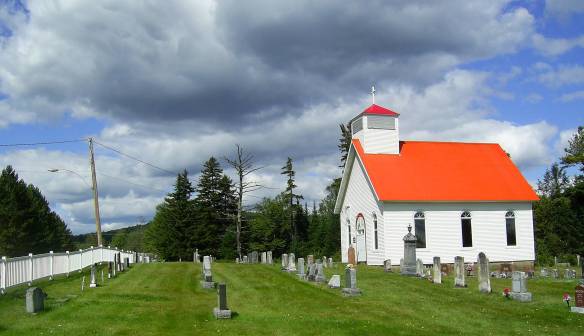
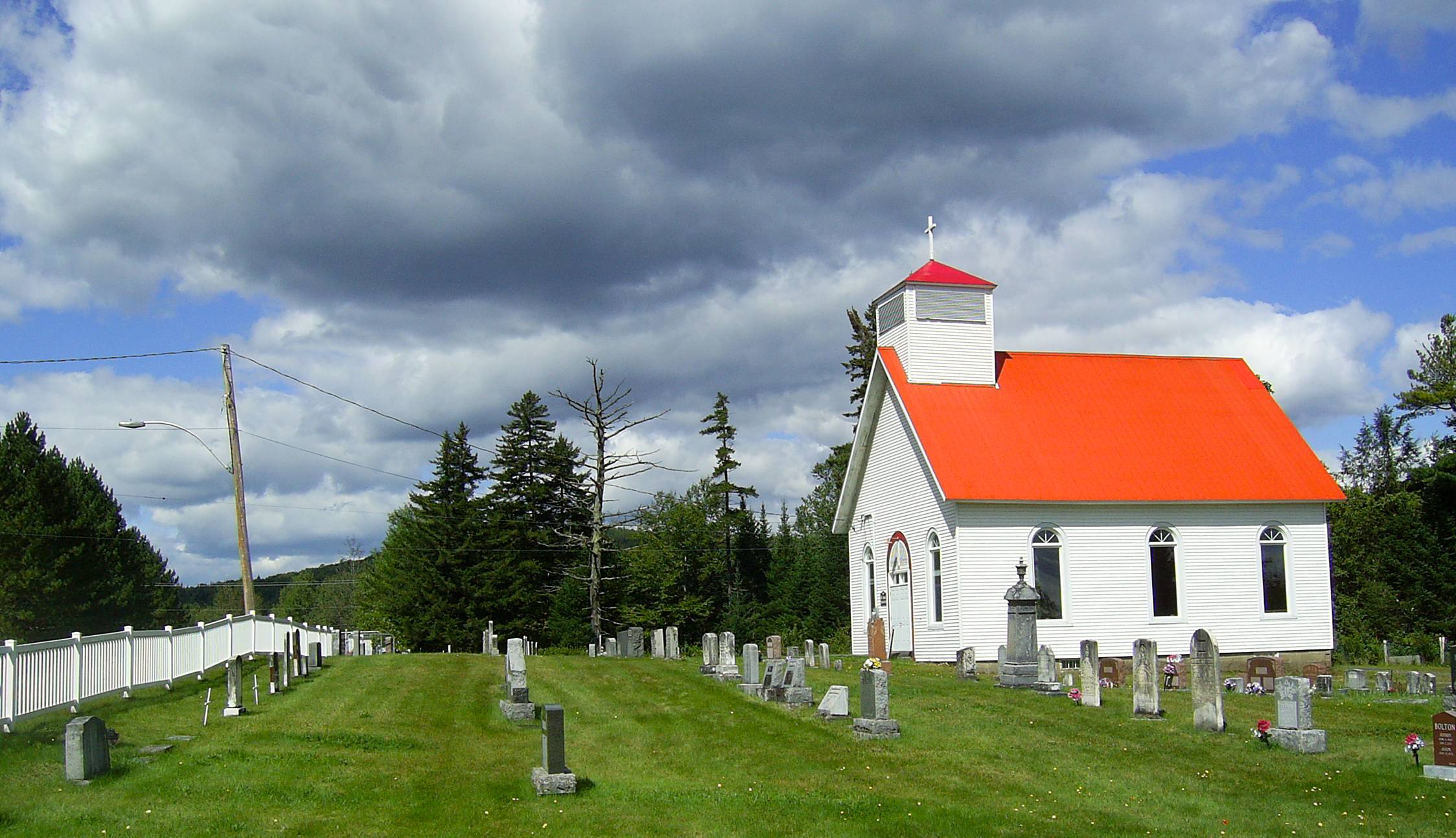
SAMSUNG DIGITAL CAMERAHere there will be silent conversations.

I park the car south of the church where the church hall used to be and the wagon sheds where the horses sheltered and munched from their bag of oats while we children skidded the wax onto the hardwood floor and the fiddles tuned up and the women hauled chicken pies out of the oven. I suppose this liveliness vanished long before the hall did. I was in it last in the mid 80s, having brought my father down from Ontario for his cousin’s fiftieth wedding anniversary. When it was pulled down, its lovely wood panelling sold for scrap, I do not know.

Georgia is the first to see that Uncle S. has died. His name joined his wife’s on the gravestone not long after we were here four years ago. Georgia is bitterly aggrieved that no one let us know. But, really, who is left that knows how to get in touch with us? Only our cousin R., 11 years older than me, but even he doesn’t answer my emails. Probably  an uncle and aunt my own age are still living in the States, but we don’t know each others’ addresses.

We visit each gravestone and leave flowers for our Nanny and our Aunt Mae. The wind purrs through the pines that stand at the edge of the church yard above Indian River. Nanny and I took off our shoes the last time I visited her -she was 87- and went wading in the cold mountain stream. And one of my best memories is of a church picnic a little farther up in a pine grove. After we had eaten, the women washed the dishes in the river. A well informed 4 year-old, I was aghast. “Don’t worry, Joy,” Maude sang out.” We’ll scald them off when we get home.”

We cross the bridge and point the car up the dirt road that leads to Cannon Hill. (Sometimes, we children called it McCannon.) It winds steeply up through the woods. I know that a good trout stream is dropping down through the trees beside us, for my father took me fishing there. I also know that wood spirits live there, brownies perhaps, rather malevolent little beings, quite unlike the fairies that lived in the corners of the hayfield and came in rainbow colours. Neither had the magnificence of the angels that I saw twice when I was little and once when I was 42. I don’t believe any of this really, but, on the other hand, I know it to be true.

Here on the right is the farm I remember living on, although both barn and house have long since been rebuilt. What used to be a hayfield is pasture now and there are cows there. Then we are back into woods. Soon we will come to the Swamp, the part we children didn’t care for. I want the road just to go on and on. I don’t want to sail out into open and see the house where Nanny lived alone until she was well over 90. There it is now, with a long well groomed side yard planted with small fruit trees. Much of the white siding is still missing as an insulating upgrade proceeds slowly. I prefer to remember the gleaming white siding and the neat, little screened porch. We turn right, pass in front of the house and continue on up into the wilderness that lies below the mountain. We are making a pilgrimage past Aunt Mae’s tiny house. The road is much better than it used to be because somebody with influence and money has built a house out back of beyond. A very nice house, quite a cut above Aunt Mae’s.

On the way out, we stop near where Nanny’s first house stood, the one that burned down- well, the second one burned down too actually. By ‘down’, I mean utterly, to the cellar hole. I want to walk but mine is apparently a minority opinion. We press on, waving at the men loading a pickup in Nanny’s yard. Yes, one is probably Aunt Mae’s grandson, but we don’t feel up to the explanations. Our cousin R. has just had his driveway paved. It is covered in fresh tar and roped off. No sign of his huge white SUV.. Now we are higher between open fields, past the new forest that covers our grandfather’s fields.

He  had a stone boat, a sledge into which he threw the heavy rocks he dug out of his fields. The horses would drag the contraption over to the stone pile around the big spruce tree or one of the other half dozen that he and his long dead predecessors had broken their backs building and he would heave them off. Sic transit and all that. A rich American bought the land and planted it in trees.

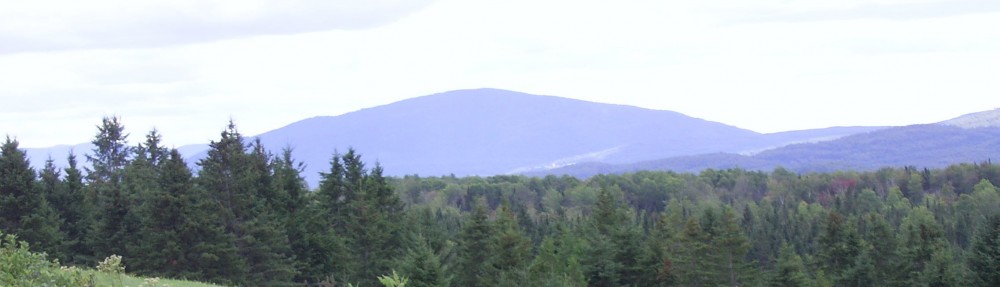
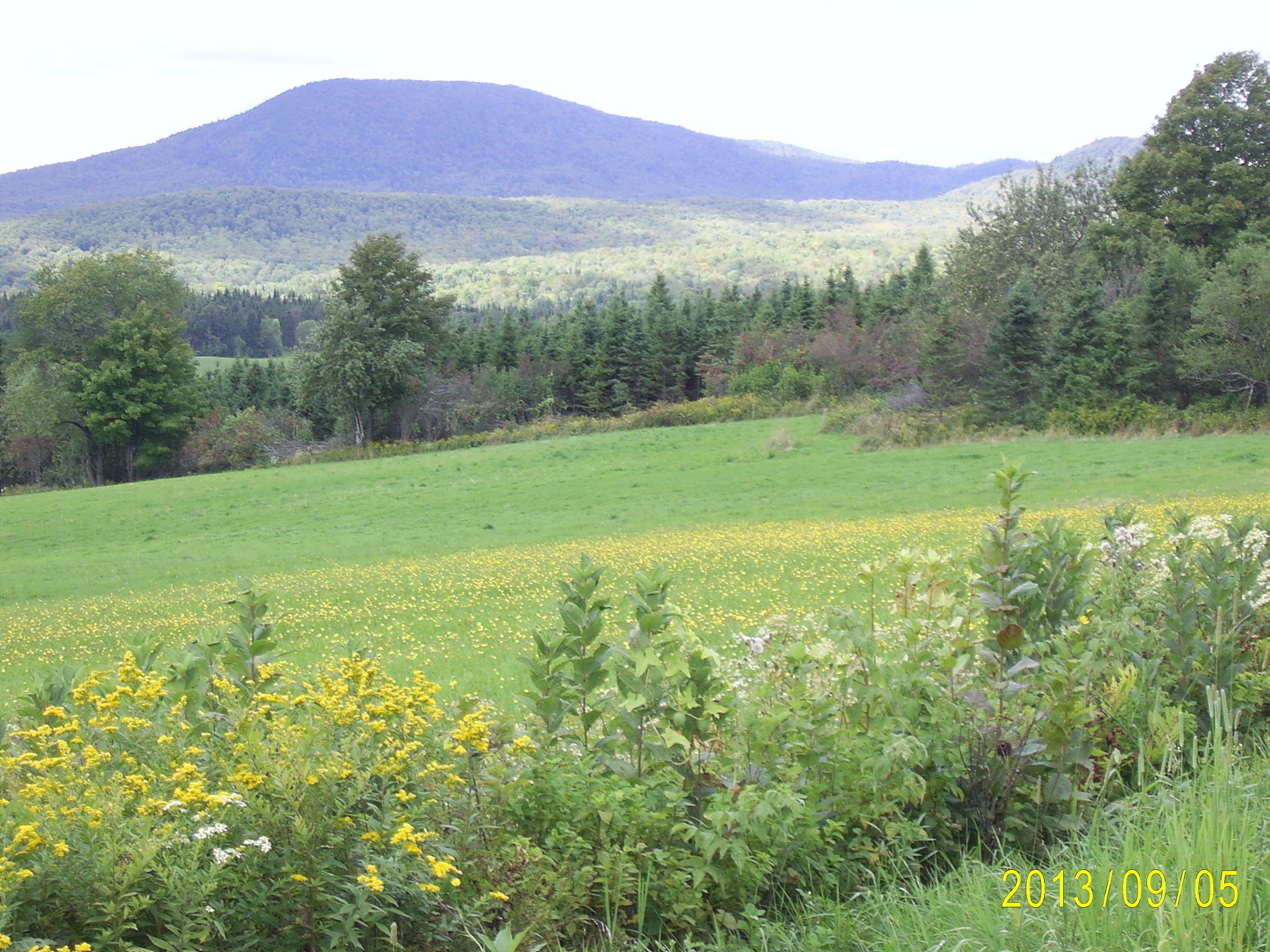
At the highest point, we stop to take pictures of the mountain vista.
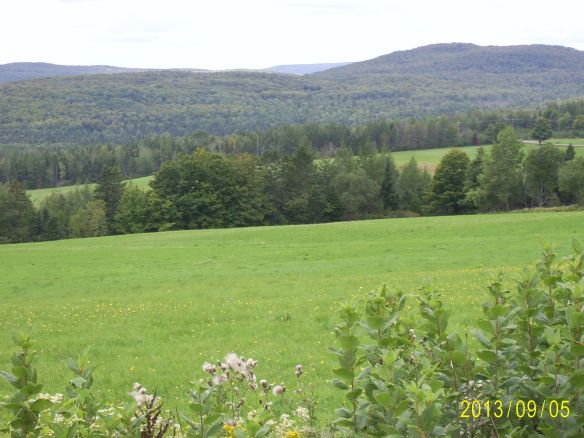
SAMSUNG DIGITAL CAMERA

SAMSUNG DIGITAL CAMERASAMSUNG DIGITAL CAMERASAMSUNG DIGITAL CAMERAThen we drive down a truly scarey incline past our Uncle S’s house, one of those that make you think you vehicle will tip end over end, Then we are on the road that once changed places with the brook during a flood and we drove on the stream bed for weeks. (It was war time and we didn’t vote for the party in power,)

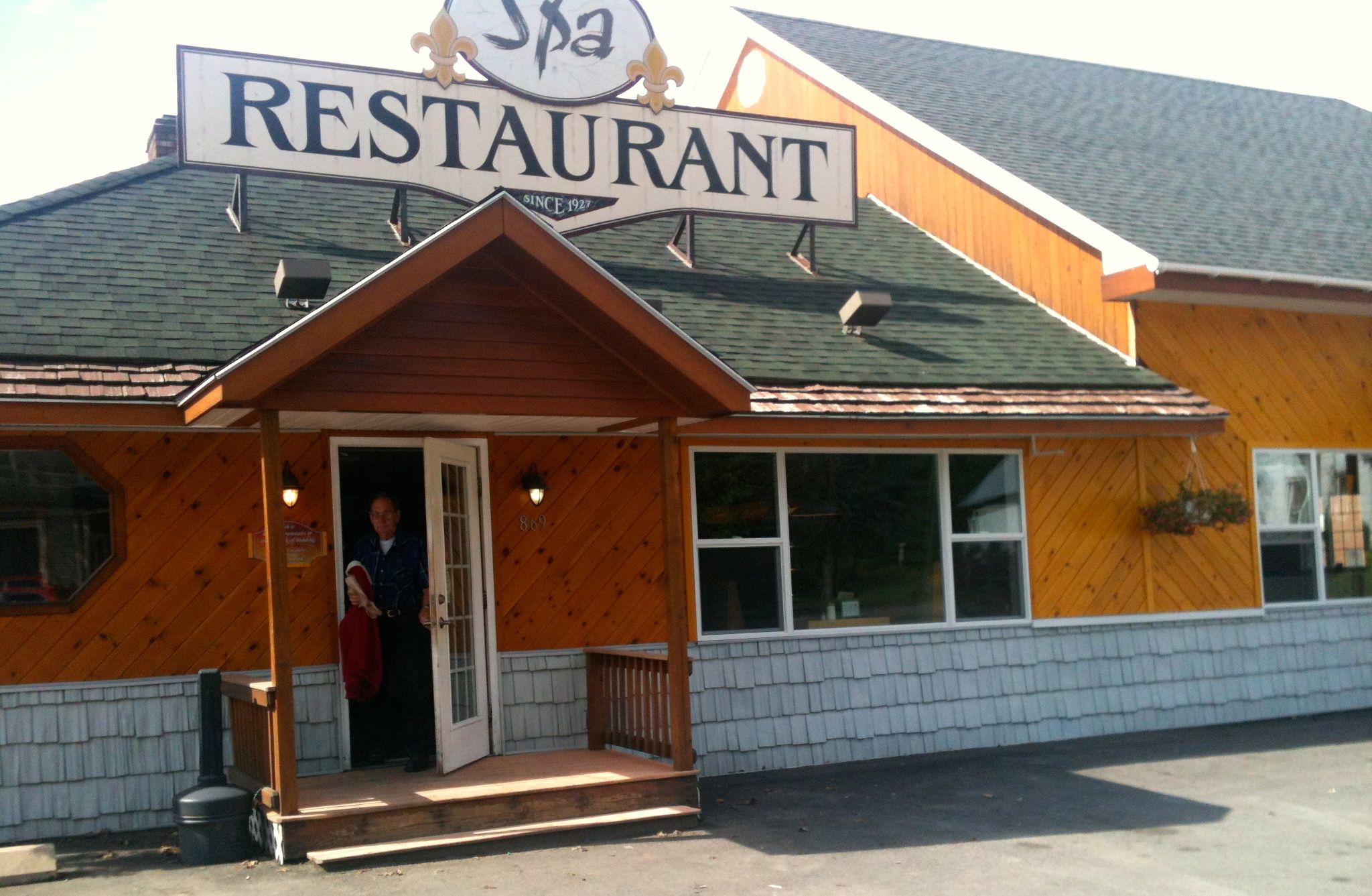
We cross the border at Beecher Falls, discovering that the agent on duty can fill us in about Cousin R. who seems to alive and kicking. We stop for lunch at Nanny’s favourite restaurant, the Spa in Canaan where I have fresh Maine lobster.

the SpaHereford was in Quebec and Canada, but we drew our identity from the States, from Vermont and New Hampshire and Maine, from New England. Every New Year’s Eve, we gathered in the hall for an oyster supper. We even spoke with New England accent. LIke most immigrants, I got rid of mine asap but when Nanny said “Spa”, I thought she meant “Spar”.

As we attempt to cross back into Canada at the Hereford crossing, the Canadian agent keeps questioning us closely. Georgia tells him we crossed at Beecher Falls an hour ago and ate lunch and that we are now returning to Ayres Cliff. I repeat the same story. He keeps glancing at the luggage filled hatchback. “So you are coming from New Brunswick?” he says. Well, no, we are coming from Ayres Cliff and going to Ayres Cliff. “Then why do you have your bags?” he asks in exasperation. Because we are changing hotels? I offer as if seeking his approval. “Ahhh” and he waves us through.

PLEASE CLICK ON PICTURES TO ENJOY FULL DETAIL.

to be continued -one more time