Septugenarian Hobbit -part 2

Hobbits, as I said in a previous post dislike adventures. Bilbo and Frodo of JRR Tolkein’s The Hobbit and The Lord of the Rings were healthy, contented hobbits living in their houses under the hill in the Shire. They had no desire to leave even though Middle Earth might depend on their becoming wandering “thieves” in a good cause. As time passes, we catch a glimpse of an older Uncle Frodo, but he was a relatively young hobbit when he reluctantly joined Gandolf’s ragtag seekers of a just world order.

I’m more of a curmudgeon. I blame it on the PTSD. (See my memoir Never Tell.) I just paid Jet Airways about $700 to torture me for seven hours and in about three weeks, I will do it all over again. Coincidentally, they were transporting me from Toronto to Brussels. They began, as most airlines do by cramming me into a seat so close to the one in front of me that my tray table practically jammed into my mid-drift when the guy in front took his ease. I dropped my water bottle. Impossible to reach by bending. I had to take off my shoes and rescue it with my feet. It took me half the night to get my shoes back on.

And what a night! We took off at 18:15 or 6:15 p.m. to you non-24 hr clock people. (I mention this because my ride to the airport arrived 12 hours early.) Dinner had to wait until cruising altitude and other arcane circumstances had been achieved. Some of us had already swallowed our sleep aid in preparation for the torment. We were going to arrive at 1:45 a.m. Toronto time and be expected to function as if it were 7:45. I opted for the vegetarian meal just for show -and/or the smell. Oddly enough the meals were Indian on this Indian airline, the only airline that flies non-stop from YYX to BRU. In truth, I had a plastic container of plain rice noodles, green beans and chicken. By avoiding curry and yogurt, I hoped to avoid gastric torture. I hesitate to admit that I also dropped the lid. (Well, see, there was this vortex…)

Then it was lights out about 9. Nothing but the glow of a dozen seat-back screens playing Bollywood movies silently. My own was not on. But wait, it is. I press the bottom of the screen, I get the menu, which invites me to “Turn off Screen”. I touch that choice. Nothing. I am back to the glaring white screen advertising Bandit Queen, which I have memorized, “Married at 11, —- escapes her husband’s demands, is raped by village elders…” Well good for you becoming a bandit queen. Now vanish. And she does, but she appears randomly throughout my short night, waking me from my fitful sleep. Finally I pull my red tam down over my eyes. Begone white light. I’m not ready yet.

My seatmate is a long-legged fellow on his way home to Delhi. He has been watching a spy movie with English subtitles and, for all I know, English dialogue, but, although he is now Canadian, he finds what little I say to him puzzling. I do not tell him that his elbows and knees are encroaching on my $700 space. Where else can he put them and besides imagine what he is paying to be tortured until Delhi at 20:30 tomorrow.

Actually I am quite surprised by the amenities – an actual meal, a little red pillow and a beige and brown plaid blanket, wrapped in cellophane. On transcontinental flights, I am used to paying $5 each, if they are even available, and being offered subs at an additional cost in case I should feel food necessary.

So here we are, crammed into a vertical shelf-space, getting a little entwined limb time. I know at my age I should thank my lucky stars. I am grieving a little because I wore my red shawl to the restroom. It must have slipped off and one of those scarf-wearing, India-bound women snaffled it for her own. Or turned it in, but not to the flight attendant, I asked. She can’t know that it was the only pretty thing I could jam in given the 23 kilo weight allowance. And it matched the tam.

So we turn -in unison of course- and shift and rustle about in our strange intimacy. We lose our pillows and retrieve them, twist our blankets, flinch when the over-lap is too much. How is it possible for the lower back to hurt so? And then suddenly, it’s morning. No dawn is not creeping up over the dark, deep ocean. (Floatation device under your seat.) It’s hospital rules. Lights shall come on. At midnight in this case. The big screen at the bulk head fires up to show our stalwart plane approaching the coast of Belgium. No glow from London off to the north. Did I mention I have a window seat?

A small wrapped cake lands on my tray table. Whoa! An Indian custom? I stare at it about half a second before ripping into it. Sugar! Food rules be damned.

An hour later -why did we need a whole hour to eat a small cake?- I find myself reporting to a custom’s officer with a Flemish name who silently feeds my passport into the computer to see if I am that septuagenarian terrorist they’ve been expecting. He asks me one question in English -what is your destination. Well, Brussels as it happens. Then I have only to wait and wait and wait at Belt #4 for my 23 kilo bag. It’s spooky. Only 3 other people and zero bags. We take comfort in each other until more people and finally a few bags arrive. And there is my purple one whanging down off the drop.

And now for that special European treat -the taxi ride. I say to myself 50 Euros, $75 CD. And guess what? After being charmed by my lawyer/ taxi driver and after being allowed to choose -highway or grid-locked streets, that is exactly what it costs. But the worst of it is, being Canadian, I tip him.

For part 1 see  https://115journals.com/2013/11/28/the-septuagenarian-hobbit/

The Septuagenarian Hobbit

Recently, I discovered my inner Hobbit. And no I don’t mean I found I have leathery feet with hair on top.

I am planning a trip to Brussels in December to stay with my brother. Blake congratulated me, saying it would be an adventure and I heard myself replying that I don’t want an adventure. Hobbits are notorious for their love of home. They want to enjoy their second breakfast in front of their own hearth, not go wandering over the earth on quests.

Don’t ask me how my brother, Rob, enticed me to go. He did hold out the promise of my own little apartment at the top of his house where the pigeon loft used to be. The first floor used to be a bakery and still has the wide Dutch door through which the loaves were sold. And so I was seduced.

There was a time when I set off gleefully for long summers on the road. Through Belgium, France and Corsica with side trips into Italy and Greece. In a tiny Fiat. Staying in “Clean but comfortable”, one star hotels.  Laughing at getting locked out and struggling through wet laundry lines to get in the kitchen door. Amused by the timed hall lights that left you in pitch darkness half way to the toilet. Undaunted by not understanding the language.

Now I am daunted.

As I recall Belgian cuisine, while outstanding, relies heavily on bread and frites. I haven’t eaten either for some time. My brother is a vegetarian of the fish persuasion.  Christmas dinner, (served on Christmas Eve) will be a huge fish stew perhaps or a steamed Irish salmon. I am ill-adapted to fishy feasts, living as I do far from the sea. Okay, I have those recipes buried somewhere in my memory or in that bottom drawer of the buffet. I’ll just have to go with a complete gastro shake-up. Years ago, I went on a family trip to Maui with the same sort of reservations about hotel food, but the astonishing thing was that the laughter at every meal rendered my digestion better than it had ever been.

But with some things I won’t take chances. My buckwheat pillow is going with me in my carry-on.


The Cure for Fear

Okay, I should be asleep. I need to be. I want to get up early. Things to do. May actually be getting something, (When am I not?) But I have this great opportunity, which I am going to lose tomorrow. I am uncertain and afraid. Tomorrow I will call my oncologist. If my appointment is moved forward to next week instead of the week after, I know the lump that we’ve detected needs further study.

Blake and I were sitting in Starbucks in the lobby of Toronto General, gazing back at the Art Deco facade of Princess Margaret Hospital from which we had just jaywalked.

“Even if I do get an immediate call-back it could still be A or B. That would have to be determined,” I say.

“Or it could be C,” Blake quips.

“Oh, it could very well be C,” and I have to laugh.

Yes, well,  we have just spent two hours waiting to hear Blake’s test results with regard to C. They weren’t bad, but then they weren’t good either. It’s the usual seesaw game of prostrate cancer. Knock down the PSA score and the testosterone with hormones. Ease off. Watch the PSA rise again. Today, it was decided that it was time to go back to the heavy ammunition. Not easy news for the manly Blake, but excellent news in that the drugs have improved since last time and he is line to get this extremely expensive medication for free.

Not many men in the clinic bring along their ex-wives probably, but Blake’s young second wife was carried off by cancer two years ago. So he and I are embarked on this mutual study of mortality.

Much else has been happening this week. My brother Rob underwent knee replacement in Brussels. My daughter and her husband declared bankruptcy and their home is about to be foreclosed on. True this “disaster” has opened up their lives and led them to a prospective mountain home. My grandson, Leo, who has to get his driver’s license or lose his job, has his own test redo to deal with. I had enough fear to go round.

So I kept up my mantra, “I love you and I trust you.” Initially, I just mouthed the words, but gradually I realized what they meant. Driving down to the hospital today, I found it had morphed into, “I love you. I know you are pure love. I trust love.”

Blake and I, out of nothing but pure love, created a home, two children and careers that supported us. An excellent foundation for this present project.

At home, afterward, I read Rumi’s poetry (Rumi: The Book of Love, trans. Coleman Barks). One section is called “Tavern Madness” and the poems in it are about the ‘drunkenness’ of the overwhelming contact with the divine. Dinners in our home were full of such non-alcoholic ‘drunken’ conversations, full of revelation and confidence in our vision of life.

Rumi says: I didn’t come here of my own accord
                  And I can’t leave that way.
                  Whoever brought me here will have to take me home.

I love the way, poetry lets you work things out for yourself. And I love the idea of surrender to the steady shoulder that is capable of supporting my staggering self.

In another poem, Rumi says, I am the clear consciousness core of your being,                                              The same in ecstasy
                                             As in self-hating fatigue.

And so, I came around to an open heart and fear dissolved.

Autumn Equinox: heaven’s wheel turns

earth at solsticehttp://www.universetoday.com/104998/electro-ls-fully-lit-view-of-planet-earth-at-the-autmnal-equinox/

I know, I know, I come late to the equinox. Perhaps it’s the equinox’s fault. All hell broke loose when I should have been sitting down to ponder its significance. Fortunately, the sun positioned itself directly over the equator at right angles to Earth and showered its light equally on both hemispheres without my help. The Russian weather satellite Electro L also got on without me and took this picture of the earth as it can be seen only at the equinox. If I think about this hard enough, I may actually figure out why. (Usually part of it would be in shadow?) But you’re better off if I don’t try to explain that, given my ignorance.

This happened on Sunday, September 22, 2013 around 4:45 p.m. Eastern Daylight Time. Coincidentally, the moon had been full three days before and was particularly beautiful from my front porch.

There are four heavenly events that we still note: the vernal equinox around March 21st, the first day of spring when day and night are of equal length; the summer solstice around June 21st, Midsummer Night, the longest day of the year, and the first day of summer after which the days start to shorten; the autumnal equinox around September 21st, the first day of fall when darkness and light are once again equal; and the winter solstice around December 21st, the first day of winter when day begins to lengthen and night to grow shorter. These changes amount to only a minute or two a day, so that spring creeps northward at that daily rate.

The autumn equinox is the festival of Mabon, an early Cornish saint, according to some internet sources. That would be a pagan or Wiccan saint. Some accounts assert that she is female while others say he is male. They all see the festival as a celebration of the second harvest, the first harvest presumably was in July. But whether female or male, the deity is about to descend into the underworld, just as the energy of nature withdraws and disappears from sight in winter.

We feel this in our own bodies and we may even wonder out loud if we really can survive another winter. Chances of such complaining probably relate to how far north we live and how old we are. Me, old and here at 43.7 ° N. But I have observed that those living at 34° N and much younger also dread winter.

To cope with these fears, we have used narrative. Mabon, Persephone or Ianna goes into the underworld sometimes as the bride of Hades. The yearly King Must Die as Mary Renault recounted and Joseph Conrad alluded to in Heart of Darkness. The Green Man is sacrificed. The Straw Man is burned.

On October 31, the third harvest is celebrated, as Samhain, the Celtic New Year. So why do I get so irritated by the appearance of Hallowe’en costumes and God help us- Happy Hallowe’en cards- in stores in September? It’s just humanity acclimatizing to the death of the god, preparing to embrace the darkness by mocking it in scarey costumes and forays into the night in pursuit of sweet solace. November 1st, the Christian church designates as All Saints Day, a day to remember all the dead.

Our goal is to get through to the goddess’s or god’s rebirth, the emergence from the underworld or womb at the festival of light at winter solstice. We hang lights -much too early- and bring evergreens and holly, red with berries, into our houses to assure ourselves that eventually divine forces will bring back the energy of growth and expansion at the spring equinox.

Since I am almost as old as Mabon, I have a 75 year-old memory of one autumn equinox that I recount in Never Tell: recovered memories of a daughter of the Knights Templar. (115journals.com)

On September 21, 1934, I was a 2 year-old, seated in a horse drawn buggy between my mother and my grandmother on my way to the church hall in Hereford, Quebec on the Vermont border. There was going to be a chicken pie supper and dance. The pies under the seat were ready to be reheated in the hall stove. They smelled delicious. I never made it. “The wind took my breath away.” Don’t ask. I heard my mother say that. Evidently, the wind was very strong and I couldn’t breathe. So I found myself unceremoniously  dumped back home in the care of my great grandmother and mentally challenged cousin. They did their best to comfort me, setting up my little table with tea for my dolls and me, but I was sore aggrieved.

Later that evening, I woke up to an incredible hullabloo, a great wind hammering at the isolated hilltop farm house, my caregivers pushing furniture against the windows, which were bulging inward. My great grammy fell down. She wouldn’t get up. My cousin started screaming. When I went near her, she pushed me away and shouted at me. Things went downhill from there.

By the time my father arrived next day, having chopped his way back up hill from the church hall, I was truly traumatized, Grammy had suffered a stroke from which she never fully recovered and my clever little mind had decided to forget the whole thing. It never happened.

Exactly what never happened, I didn’t figure out for 60 years. It was the Great New England Hurricane which whaled up the eastern seaboard without warning. It killed 680 people, destroyed 9000 buildings as well as damns, bridges, roads, and harbours. It leveled whole forests. It did $20,000,000,000 damage in today’s terms. Only one of the great white pines that stood on the road down the hill was left. Although I didn’t remember the event, I loved that tree with inexplicable intensity.

So here we are just past the autumn equinox. The days grow short, but no hurricane is knocking at the door and fortunately, our stories light our way.

Septuagenarians on the Road #5

Auberge Ripplecove, Ayres CliffThis account is taking as long as the trip itself.

We had just crossed back into Canada after an hour’s stay in the United States and close questioning by the Canadian border officer. (https://115journals.com/2013/09/12/septuagenarians-on-the-road-4/).

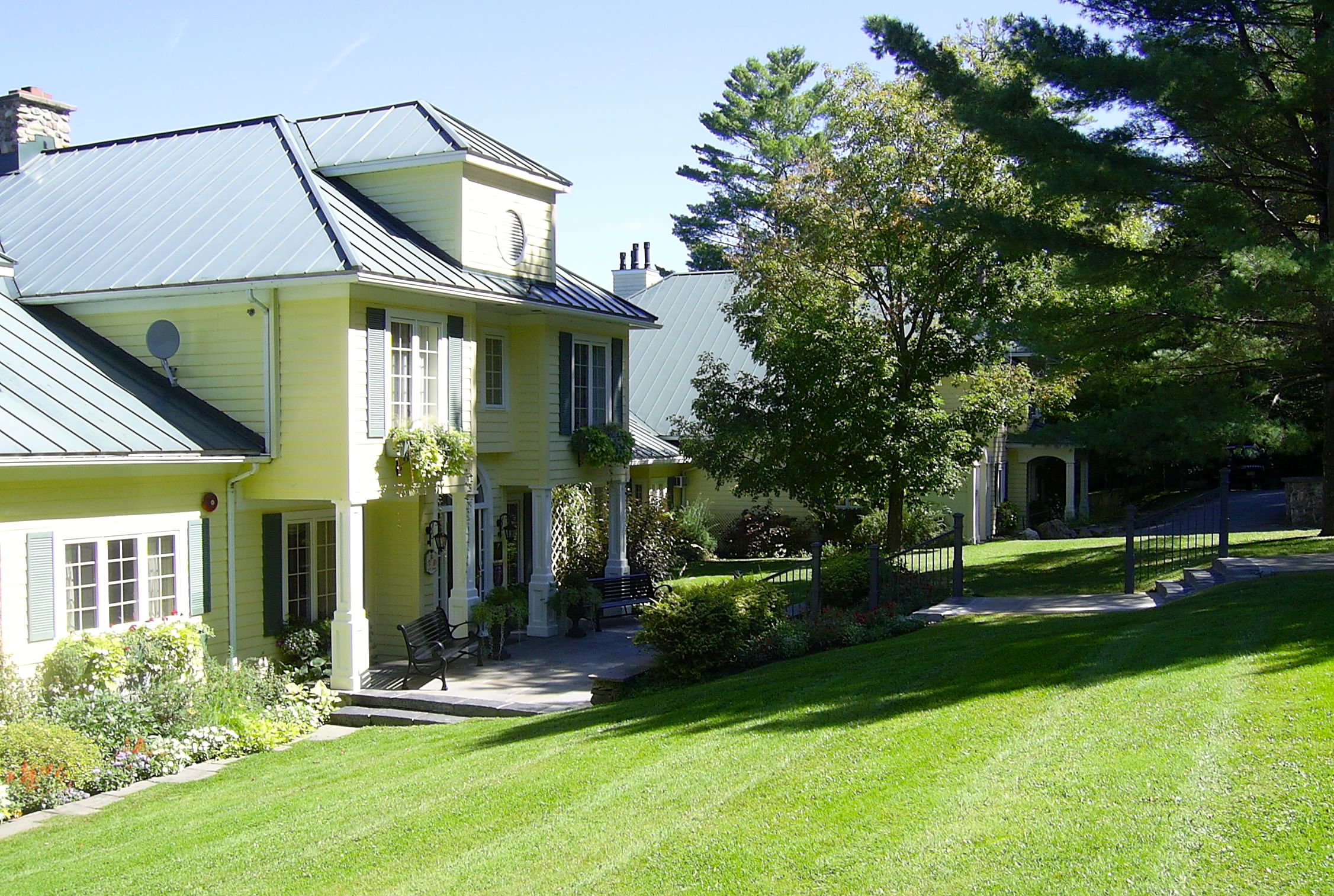
By 4:30 pm, we are checking in to the Auberge Ripplecove, our 5 star accommodation for the night and considerably more formal than Auberge Ayres Cliff. The lounge is well appointed. The man behind reception desk, resplendent in a dark suit. But he slips out from behind the counter to carry in our bags. Our room is just through a small  lounge with fireplace, lake view and a buffet large as one wall, a carved mythic piece of furniture, which will take some study when I have time. We are on the first floor with a garden view. Lake view costs more.

ripplecove interiorChintz and checks and stripes and even plaid and all in soft green and earthy tones. And very softly lit. There is a television set hidden in an armoir but there can be no viewing from either of the two double beds and, in any case, we seem to have given up television.

While Georgia unpacks her two Gladstone bags, I wander off to the bar downstairs to fill the ice bucket and get hot water for tea. There is a coffee maker in the room, one which suits my sister, a Kreug that takes those little packets of coffee and turns out one cup. No more simply pouring water in one end and collecting hot water at the other. Plus le change plus …le aggravation. Now the gentleman at the bar is preoccupied with his computer screen and evidently has not noted my arrival. I observe -him, the deck outside, the lake, the couple drinking martinis. I clear my throat. I ask for hot water and ice. He bustles off. I wait some more. Eventually he comes back. Period. He addresses the urgent need of a newly arrived woman for a rare brand of scotch which proves hard to find. Something about “chopped liver” swims to the surface of my mind, but just then a wait person of the female persuasion arrives with a tray, laden with an ice bucket, a white china teapot and a mug. “Shall I take it up for you?” she asks. Of course I decline, only to discover it is rather heavy for these skinny 70+ arms. We, my sister and I, are not slipping easily into old age. Too independent? I wanted to explore the hotel. That’s why I didn’t call room service and it seems impossible that this small tray could be beyond me. Short on graceful acceptance of decline?

I have been here at least three times before, but only for meals. I came here first in 1979, all that long ago. I had brought my new man to meet my Nanny and we were staying at the cheapest motel on earth but eating expensive food. We came to dinner here with a teacher friend from my previous  (married) life and her husband. We had left Belle my Newfie dog tied up outside the motel. The next year, same motel, same dog, but the friendship with Nancy had cooled, so we booked our own table. Then 30 years later, I brought Georgia here. I remember the pictures of Archie and Elizabeth Stafford who built the inn in 1945 and had to bring in electricity to ‘this remote corner of the Eastern Townships’. Could be. Didn’t seem all that remote to me as a child, but I knew Hereford, now that was remote. They didn’t get electricity up that hill until 1948. Apparently, the place has suffered a fire and been renovated twice during the 30 years I stayed away.

We take our mandatory rest, a little fraught with memory after our excursion and my realization that I had forgotten I stayed in Hotel Ayres Cliff as it was then, in 1997. Let’s be frank. There were a few idyllic memories here in Les Cantons Est, but there was a darker side, not just of poverty, some of which I have described in my e-book, Never Tell: recovered memories of a daughter of the Knights Templar. 115journals.com

It’s time to get out of the jeans for tonight’s dinner. I actually wear a dress with large red poppies. Something tells me  not only to wear the black cover-up but also to take a shawl. I’ve even stretched to stockings and tasteful heels. Georgia has accented her filmy navy outfit with fuchsia wedge heels (which she can barely walk in) and bag. She ends up with a compliment from a French woman. I end up freezing.

Turns out the preoccupied bartender is the Maitre d’ and he translates my last name into French and then explains he has made a joke. Our table is next over from the tables near the windows looking out on the lake. I seem to always get this same table.

So this is a real treat for me and I’m paying as part of the birthday tithe. Ordering from the French only wine list sets me thinking. I mean that the wine is French, the only kind of wine my Belgian brother will drink. I’ve lost any knowledge I had 30 years ago with that man I brought to Nanny’s. Literally, it was his knowledge. So I more or less take a stab and order a certain chablis. I can see why Rob has that snobbish attitude. The taste is finer and more subtle than the in-your-face Ontario chardonney I was drinking in the room.

The first course is a tiny portion of pressed duck breast and black pudding with figs and pistachios involved. Then I have scallops, while Georgia has strawberry gaspacho. She reports it is like starting with dessert. I have tiny lamb chops with beans and carrots for my main course, while she has lobster, shrimp and scallop. The portions are small but even so, I leave one chop. I don’t want to end up awake as I did in Kingston. Of course we have dessert, mine white chocolate enfolding caramel, hers pistachio cake. And then -surprise- a macaroon.

I haven’t paid attention to the ritual of service, the arrival of cutlery in little white pouches,  to be placed just so. Maybe it was that worldly long ago man that got me used to ignoring such ostentation. He always had a conversation steaming ahead, which he more or less dared a hapless wait person to interrupt. Georgia, it turns out is not so sanguine. The stuffiness bothers her. So far as the food goes, she likes it well enough, but says she doesn’t have a refined taste. I want to say, me neither, for I never caught up to that long ago man or to my own brother, but I let it go. I do absolutely love such food.

The sheets are lightly starched and crinkle like tissue when we turn, but in the end, we co-ordinate our turns, being awake for the nonce anyway, and get a good sleep. And so farewell to our $326 room. A groundsman carries our bags to the car and he and Georgia have a good gab.

SAMSUNG DIGITAL CAMERANow, I confess, I left out the bad part. When Georgia leaned over to deal with the cooler, she put her lower back -tightened by too much driving and weakened by the Everest stairs – into a total and utter spasm. It is fused, solid and agonizing.

She protests she is at her best in the morning but I drive.

You don’t want to go with us all the way back up 15, ouest to 30, over the river, back on 20, into Ontario and onto the 401. You don’t want to redo the squalor of those roadside fueling stations for cars and people. See even I am losing my positivity. You would prefer just to arrive back in Kingston at the Lasalle Travelodge -$126 plus US exchange on Hotwire. (Don’t ask. A Canadian hotel paid for in U.S. dollars?)

This is the winner according to my sister, my crippled sister. Having requested a ground floor room, we discover that I can park just outside the sliding door and easily get the bags in. The room has just had carpet replaced and been redecorated, Georgia notes and the linens are up to her standard. There is a fridge and a good, old-fashioned coffee maker. I am not so enthusiastic. The whole place, especially the restaurant, still looks like the 70s, cave-like and dark to me. (It takes a while for me to workout that Cavelier Room is not a mis-spelling, but the actual middle name of René-Robert Cavelier, Sieur de La Salle who once had command of the Louisiana Territory but started his explorations here in La Salle, a suburb of Kingston.)

By now we are so knackered- and injured, we order room service for dinner. I don’t hold out much hope for the roast beef and Yorkshire pudding and I am not disappointed. The beef is not bad, if too well done, and there is no Yorkshire pudding.

In the morning, looking for a vending machine for water, I stumble on the hot tub and indoor pool. This proves just the thing to loosen up Georgia’s lower back and a pleasant break for both of us.

We arrive back at my home in the west end of Toronto in the rain around 4:30 pm, load Georgia’s bags into her Corolla and she is off home to Mississauaga.

We have concluded that we will fly to Montreal next time, rent a car and drive the hour and a half. And, while I would love somehow to be able to spend four days at Ripplecove, its formaiity has put Georgia off. She didn’t feel comfortable there, so we will seek another place, and one less challenging than the Auberge Ayres Cliff.

There is another question, however. Do I want to go back? I balance the beauty of the mountains and wooded slopes against the drag of the church yard. All those people gone beyond recall with so much left to say, so much laughter still ringing in our ears and so much grieve left unresolved. Only us left, two young people in disguise as septuagenarians. It was ever thus. My 87 year-old grandmother was still a kid, wading in the river.

What I think is I could enjoy a pool like the Travelodge’s, access to excellent food like the Ripplecove’s, an evening on the patio at Auberge Ayres Cliff, in other words, a 4 or 5 day stay in a room with a view of hills and unstarched sheets. Just enough comfort to solace my soul.

Septuagenarians on the Road #4

SAMSUNG DIGITAL CAMERASee Septuagenarians on the Road #3 for the first part. (https://115journals.com/2013/09/11/septuagenarians-on-the-road-3/)

We wake up on the third floor of Auberge Ayres Cliff on the third day of our road trip. I go downstairs to see if the restaurant is open. It is not. Back up that wooden Everest!

Since we are booked into the Auberge Ripplecove, we have to pack up our things yet again, and Georgia has a plan for getting them downstairs.

We take turns using the shower and my cereal bowl. Georgia’s nosh is All Bran and mine is gluten-free granola. Our ice packs have melted and so has the ice and in keeping with its historic charm, the old auberge has neither ice machine, vending machine or coffee maker. No problem, we know a great little place to have breakfast in Coaticook.

I heard people working in the second floor office while I was reconnoitering, but saw no one. Georgia goes to top of the stairs and pushes her bag off the top step.  I hear it thump, thump, bump and crash. Silence. She heaves down the second one. It is not until I start to bump my wheeled suitcase down the top step, that a man shows up on the second floor and gallantly sweeps her bags up. Another sprints up the stairs to carry mine down. See, all we had to do was ask.

The guy carrying mine is likely the proprietor, whereas hers has been working outside on the deck. He speaks English well and by the time, I have carried down the remaining odds and sods, Georgia and he are deep in conversation about the town. Communication is proving to be a challenge, so this is welcome.

We debate about who will drive. As usual, Georgia wants to drive early when she is fresh.

“Which way do you intend to go,?” I ask. She points back the way we came.

“I’m driving,” I announce.

I pull a u-turn right there on Main St. and head around the corner on 141. I have these maps in my head or so I believe, and indeed, they fail me only once and then for only 6 miles. As we drive, I explain that basically there is a wide fertile valley where dairy farms flourish and on either side there is a two lane black top. When we were young our father took the left hand road to get to Sawyerville where we had moved in 1941, but the mail van took the right hand route. I travelled in the mail van with my mother that winter and noted the ‘exotically different towns’, St. Isadore, St. Malo, Paquetteville. We were on a mission to reveal to my Nanny that a baby was “expected”. My 5 year-old self made little sense of this, but I was very glad to go back to Hereford. I stubbornly refused to understand what was “expected” until that fateful first day of school when Georgia inconveniently arrived. (See https://115journals.com/2013/08/31/labour-day-weekend-reflections/)

In less than half an hour we are Coaticook. (This is an Abenaki word as is Massawippi, which means big, deep water.)

Coaticook is an agricultural town, the centre for production of milk products, especially butter, but it also boasts an industrial park largely devoted to farm and construction equipment. And it boasts a covered bridge as well as a round barn. It seems that every time we go there, a major road is under construction. This time it is Child St. In trying to park on the opposite side of the street I came in on, I get entangled in the detour, which kindly offers us a tour of parts of the town we have never seen before. Finally, we disembark at that parking spot we have been aiming for for 20 minutes, walk half a block and arrive at the Croissant Chaude.

I order my usual gluten/ milk/ bacon- free breakfast – ham and home fries, while Georgia enjoys a fresh-from-the-oven muffin with butter and jam. There is one French couple, clutching a map and looking for advice and two women speaking English, very loudly, with interesting personal detail. Then in comes a couple in their early 50s, speaking with an Australian accent. It is not long before Georgia has struck up a cross-the-room conversation and we have learned that they have ridden motor bikes from Las Vegas up through Colorado and on to Chicago. There they switched to a car and, like us, they are siblings. Georgia reminds them that the longest relationship most people have is with a sibling.

Hey, two conversations in one day!

After breakfast, we turn south on 147 and begin the final leg of our journey home. Since I am still driving, Georgia has the leisure to observe that the infrequent houses we are passing have the largest, greenest, weed-free lawns she has ever seen. Prosperity and ride-em lawnmowers, I suspect. Our grandfather’s dooryard stayed short and smelled of what I learned much later was camomile. Even later, I learned that camomile lawns were all the rage in Elizabethan England. As you walk over them, crushing the little yellow flower balls, the perfume rises. Surely my harried grandparents did not actually plant it.

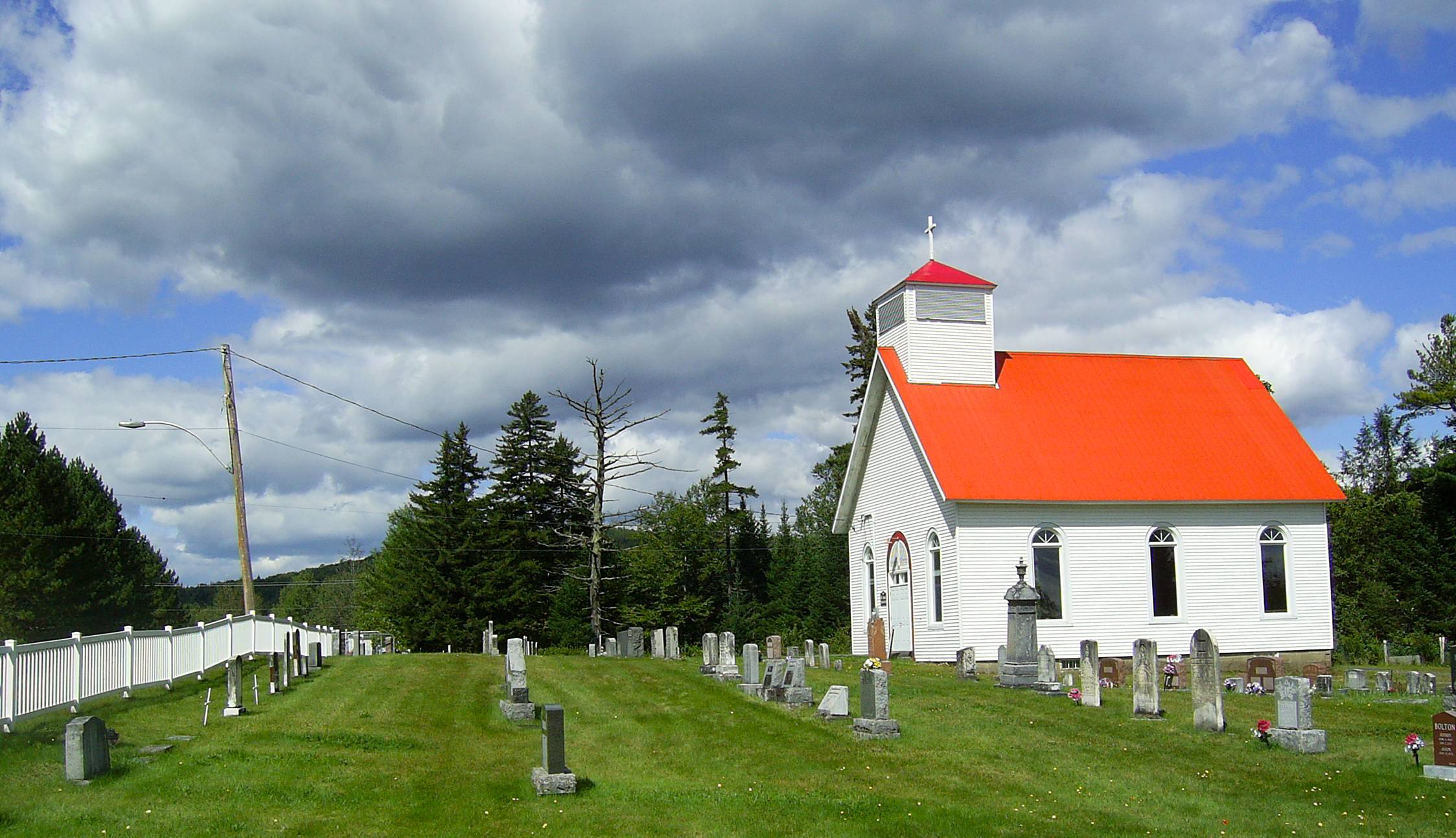
We skirt what we called Wallace Pond with its cottages and youth camp, pass a haulage company bearing my last name, catch sight of the Line -the wide treeless cut up through the woods that marks the dividing line between Canada and the United States, round a corner and find ourselves in front of the church.

SAMSUNG DIGITAL CAMERAHere there will be silent conversations.

I park the car south of the church where the church hall used to be and the wagon sheds where the horses sheltered and munched from their bag of oats while we children skidded the wax onto the hardwood floor and the fiddles tuned up and the women hauled chicken pies out of the oven. I suppose this liveliness vanished long before the hall did. I was in it last in the mid 80s, having brought my father down from Ontario for his cousin’s fiftieth wedding anniversary. When it was pulled down, its lovely wood panelling sold for scrap, I do not know.

Georgia is the first to see that Uncle S. has died. His name joined his wife’s on the gravestone not long after we were here four years ago. Georgia is bitterly aggrieved that no one let us know. But, really, who is left that knows how to get in touch with us? Only our cousin R., 11 years older than me, but even he doesn’t answer my emails. Probably  an uncle and aunt my own age are still living in the States, but we don’t know each others’ addresses.

We visit each gravestone and leave flowers for our Nanny and our Aunt Mae. The wind purrs through the pines that stand at the edge of the church yard above Indian River. Nanny and I took off our shoes the last time I visited her -she was 87- and went wading in the cold mountain stream. And one of my best memories is of a church picnic a little farther up in a pine grove. After we had eaten, the women washed the dishes in the river. A well informed 4 year-old, I was aghast. “Don’t worry, Joy,” Maude sang out.” We’ll scald them off when we get home.”

We cross the bridge and point the car up the dirt road that leads to Cannon Hill. (Sometimes, we children called it McCannon.) It winds steeply up through the woods. I know that a good trout stream is dropping down through the trees beside us, for my father took me fishing there. I also know that wood spirits live there, brownies perhaps, rather malevolent little beings, quite unlike the fairies that lived in the corners of the hayfield and came in rainbow colours. Neither had the magnificence of the angels that I saw twice when I was little and once when I was 42. I don’t believe any of this really, but, on the other hand, I know it to be true.

Here on the right is the farm I remember living on, although both barn and house have long since been rebuilt. What used to be a hayfield is pasture now and there are cows there. Then we are back into woods. Soon we will come to the Swamp, the part we children didn’t care for. I want the road just to go on and on. I don’t want to sail out into open and see the house where Nanny lived alone until she was well over 90. There it is now, with a long well groomed side yard planted with small fruit trees. Much of the white siding is still missing as an insulating upgrade proceeds slowly. I prefer to remember the gleaming white siding and the neat, little screened porch. We turn right, pass in front of the house and continue on up into the wilderness that lies below the mountain. We are making a pilgrimage past Aunt Mae’s tiny house. The road is much better than it used to be because somebody with influence and money has built a house out back of beyond. A very nice house, quite a cut above Aunt Mae’s.

On the way out, we stop near where Nanny’s first house stood, the one that burned down- well, the second one burned down too actually. By ‘down’, I mean utterly, to the cellar hole. I want to walk but mine is apparently a minority opinion. We press on, waving at the men loading a pickup in Nanny’s yard. Yes, one is probably Aunt Mae’s grandson, but we don’t feel up to the explanations. Our cousin R. has just had his driveway paved. It is covered in fresh tar and roped off. No sign of his huge white SUV.. Now we are higher between open fields, past the new forest that covers our grandfather’s fields.

He  had a stone boat, a sledge into which he threw the heavy rocks he dug out of his fields. The horses would drag the contraption over to the stone pile around the big spruce tree or one of the other half dozen that he and his long dead predecessors had broken their backs building and he would heave them off. Sic transit and all that. A rich American bought the land and planted it in trees.

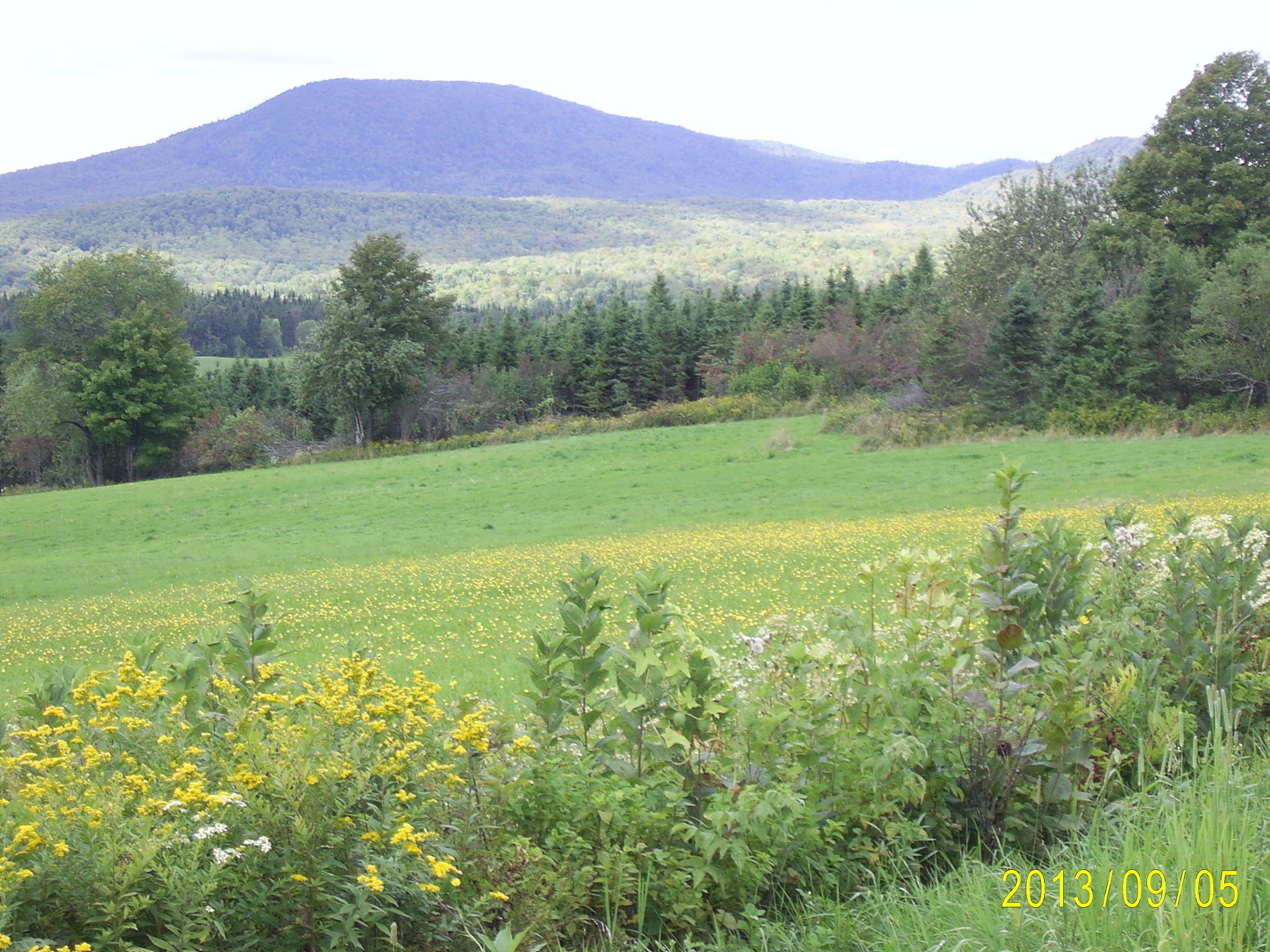
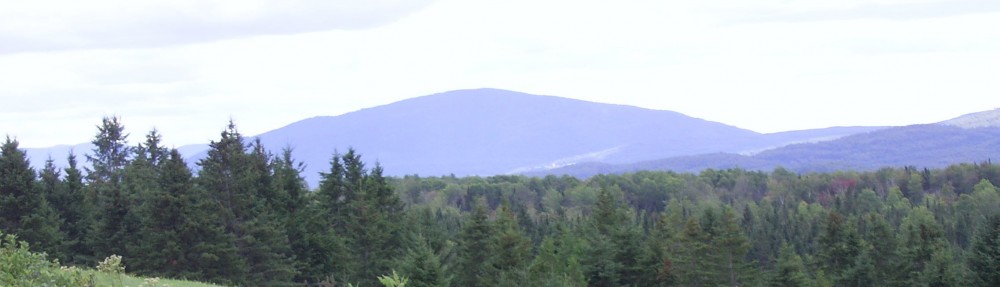
At the highest point, we stop to take pictures of the mountain vista.

SAMSUNG DIGITAL CAMERA

SAMSUNG DIGITAL CAMERASAMSUNG DIGITAL CAMERASAMSUNG DIGITAL CAMERAThen we drive down a truly scarey incline past our Uncle S’s house, one of those that make you think you vehicle will tip end over end, Then we are on the road that once changed places with the brook during a flood and we drove on the stream bed for weeks. (It was war time and we didn’t vote for the party in power,)

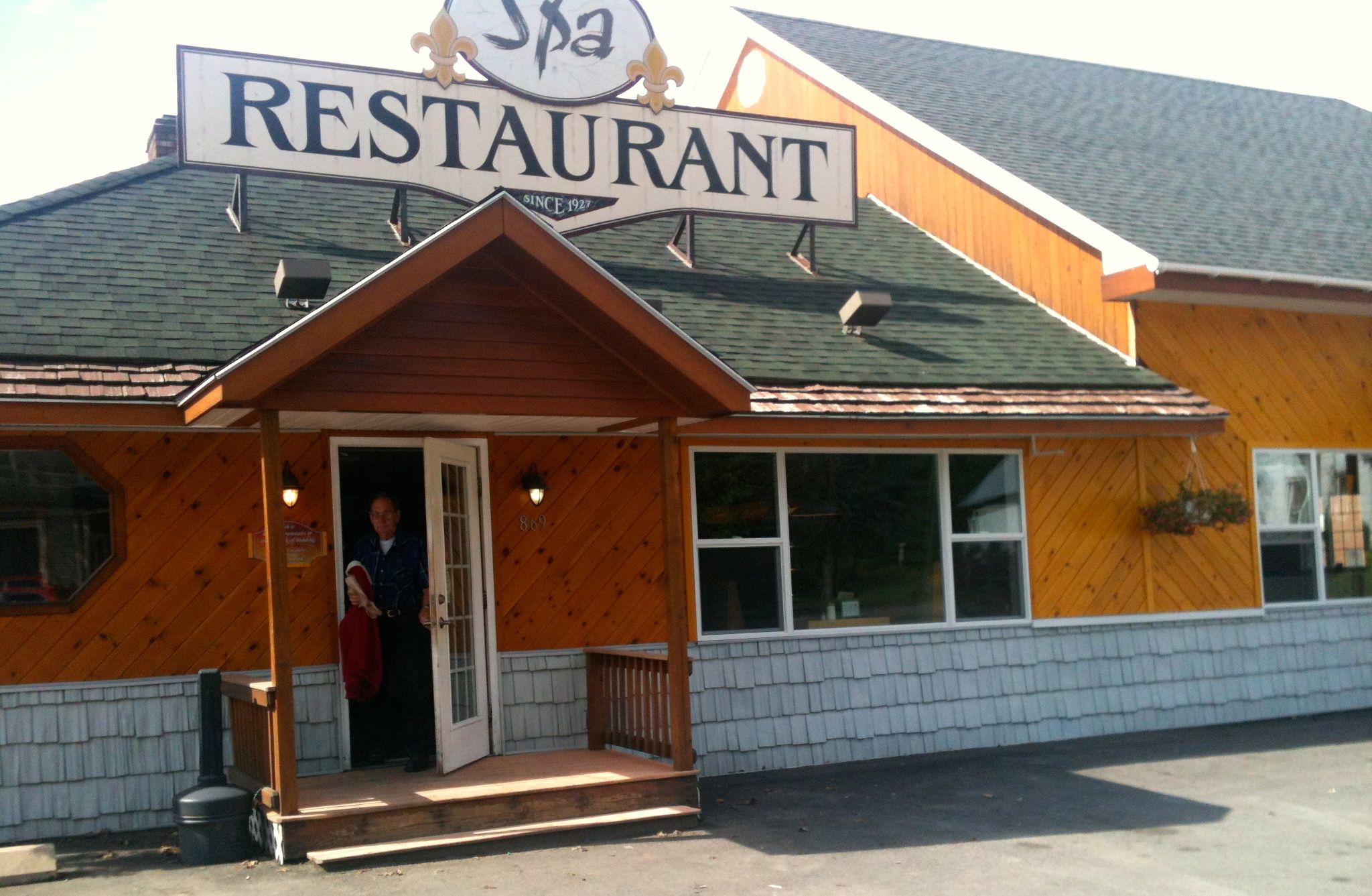
We cross the border at Beecher Falls, discovering that the agent on duty can fill us in about Cousin R. who seems to alive and kicking. We stop for lunch at Nanny’s favourite restaurant, the Spa in Canaan where I have fresh Maine lobster.

the SpaHereford was in Quebec and Canada, but we drew our identity from the States, from Vermont and New Hampshire and Maine, from New England. Every New Year’s Eve, we gathered in the hall for an oyster supper. We even spoke with New England accent. LIke most immigrants, I got rid of mine asap but when Nanny said “Spa”, I thought she meant “Spar”.

As we attempt to cross back into Canada at the Hereford crossing, the Canadian agent keeps questioning us closely. Georgia tells him we crossed at Beecher Falls an hour ago and ate lunch and that we are now returning to Ayres Cliff. I repeat the same story. He keeps glancing at the luggage filled hatchback. “So you are coming from New Brunswick?” he says. Well, no, we are coming from Ayres Cliff and going to Ayres Cliff. “Then why do you have your bags?” he asks in exasperation. Because we are changing hotels? I offer as if seeking his approval. “Ahhh” and he waves us through.

PLEASE CLICK ON PICTURES TO ENJOY FULL DETAIL.

to be continued -one more time

Septuagenarians on the Road: #3

SAMSUNG DIGITAL CAMERASo Georgia and I decided to take a sentimental journey, back to our roots. We started out on her birthday, the day after Labour Day (See https://115journals.com/2013/08/31/labour-day-weekend-reflections/)

We didn’t make the decision lightly. We divided hip stiffness into the mileage and arrived at a two day trip. We reserved a hotel room at the Waterfront Holiday Inn in Kingston Ontario, which we thought was half way from Toronto to Ayres Cliff, Quebec. We were wrong. It was more like a third of the way there, but when we got to KIngson, we realized that factoring in the fatigue of packing and hefting bags made it a good choice.

When asked if we need help with our bags, my macho sister says no. Being older, I know better. Imagine the most awkward grocery cart you have ever tried to steer, turn it into a luggage cart, top-heavy with a hanging bar, add a tiny elevator and thick pile on the hall carpet.

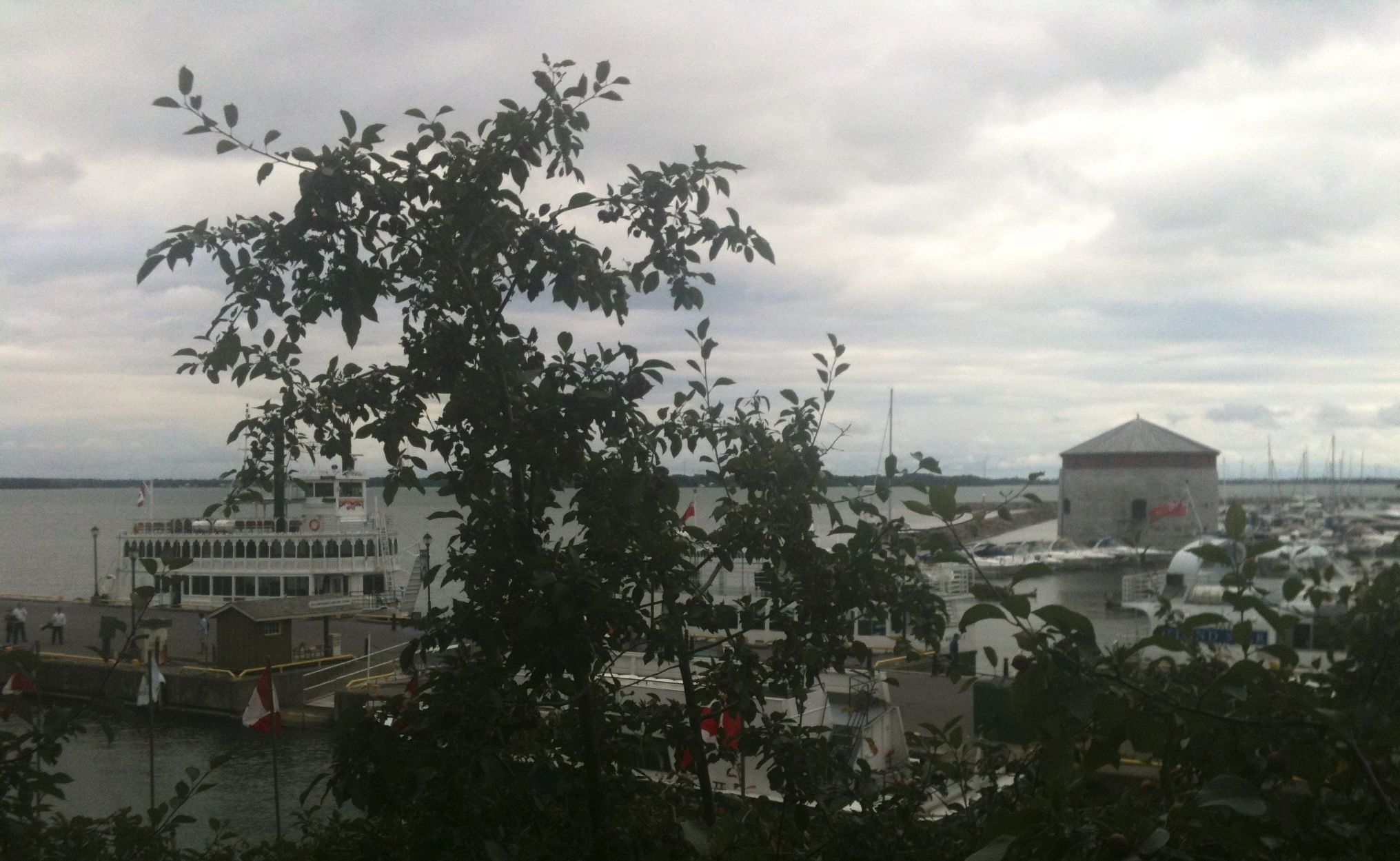
Still it is a beautiful room that looks out over the ferry docks and one of the six squat, round Martello towers that guarded Upper Canada from the American invaders.

Martello Tower, KingstonWe stayed in a similar room 4 years ago when we last made this trip. The place is not much changed. The question is are we?

We rest. Resting will be a recurring theme in this blog post as it is in our lives. I would say ‘in the lives of septuagenarians in general’, but Blake (see http://115journals.com/2012/05/26/septuagenarians-on-the-road-part-1/ and https://115journals.com/2012/05/27/septuagenarians-on-the-road-part-2/ ) doesn’t rest much. Resting like Archemedes’ lever makes all things possible.

Then it is time to pop the cork on the Veuve Cliquot. It is a birthday after all.

It seems wise to find a restaurant within walking distance, so we search through the available literature and come up with Olivia, an Italian restaurant two short blocks away. As it turns out there is live jazz from the Dave Barton trio with Amanda Balysy on vocals. Amanda has a retro look, blouse and skirt out of the 50s and songs to match. So the ambience is delightful. The day’s special of wild boar sausage seems too demanding for my digestion and I willfully ignore the black cod and order risotto. As soon as I lay eyes on it, I know I have been wrong. I’m used to risotto at Marcellos in Toronto where they don’t even add cheese. This dish is swimming in cheese and oil. But the optimism of the moment prevails and I take the risk.

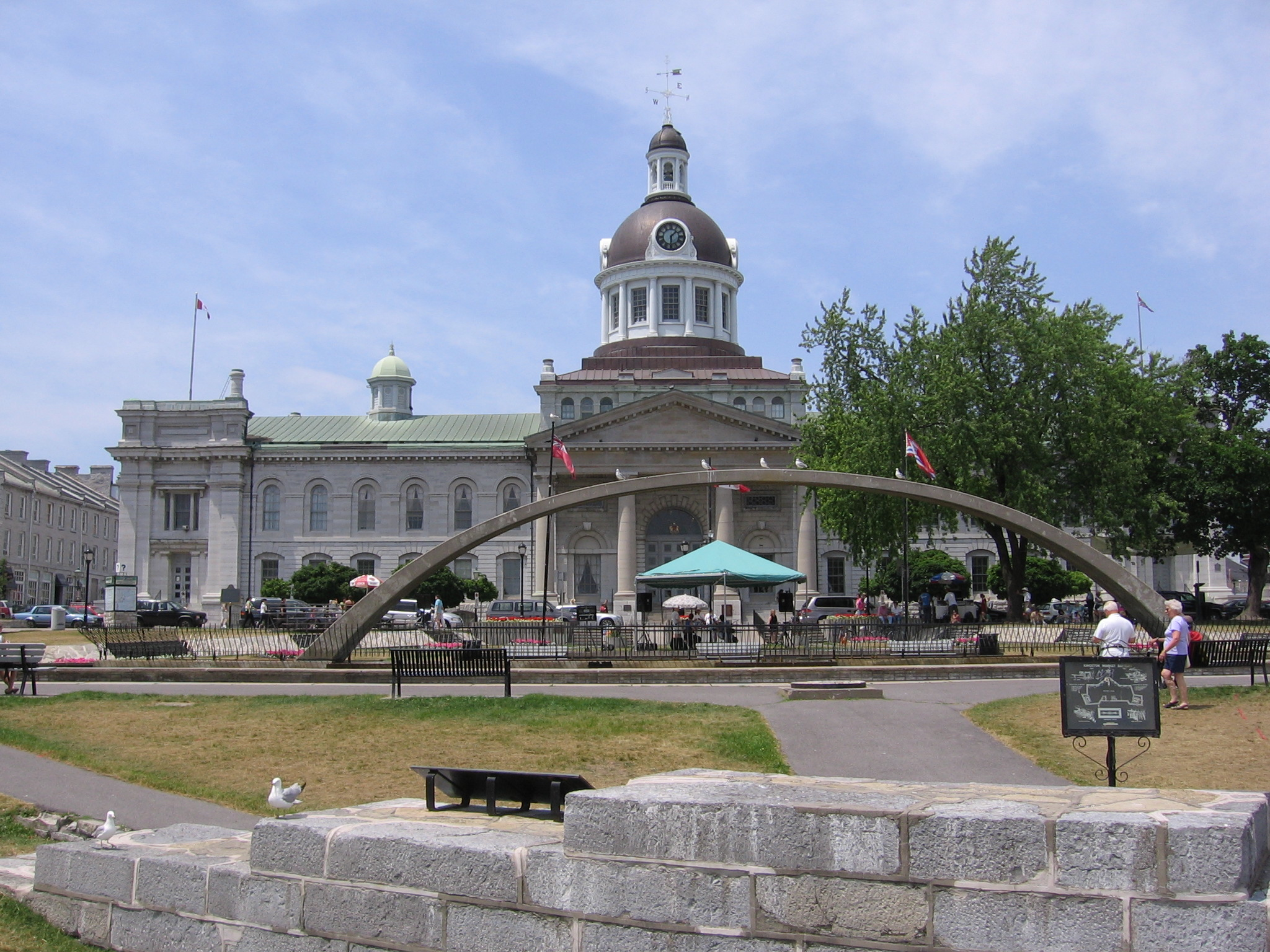
As evening falls, the Kingston City Hall across the square becomes ever more beautiful (http://en.wikipedia.org/wiki/File:Kingston_City_Hall_Andrew_pmk.JPG). Its limestone glows silver and its lovely dome stands etched against the sky. After dinner, we sit in the park at the water’s edge and enjoy its beauty.

Kingston_City_Hall__#3All in all, the day has gone well, we think. Georgia settles down to watch Netflix on my Mac Air Book and I lie down to sleep. To no avail. Yes, I am tired enough to sleep, but my body has other ideas. I am aching all over. The pillows labelled soft are so soft, I feel smothered. The ones labelled hard hurt my head but don’t support my neck. But most of all I blame the risotto. Years ago, in this same town, I spent the night sitting on the bathroom floor reading John Irving’s The World According to Garp.I might have been better to spend this night there as well.

I’ve had considerable experience with insomnia – who hasn’t at this age?- and developed strategies to deal with it. In between bathroom trips, I try them all. First, I roll up a bath towel and put it under my long neck, a softer version of the wooden Japanese head rest. I do my three part deep breathing exercise over and over. I take a sleep aid. I put in my ear buds and hit the white noise App on my iPhone. Even the continuous swish of heavy rain doesn’t send me off. By now, Georgia is soundly asleep, or so it seems for she is very softly snoring. At what seems like 2 a.m, but is actually much earlier, I get up to do tai chi exercises in the dark. That seems to calm my system down. Then just as I begin to slip into sleep, someone hammers on the door next to us and calls out in a aggrieved voice, “Come on Michael, I forgot my key.” Apparently that is just the ticket. I am gone. I don’t even wake up when Georgia spends an hour reading at 3 a.m. Of course, in the morning, she maintains not only that I had kept her awake, but also that I was groaning. Perhaps she is right.

So unrefreshed, we find our way to the complimentary breakfast with a view of the water. I am unenthusiastic about eating but I need to take on fuel. Fortunately, Georgia is able to enjoy the free meal, which we have earned by being members of the Canadian Automobile Association.

There is one more little hiccup. I neglected to bring down our parking stub. There is no attendant. Fortunately, someone from the bar across the street yells out instructions on what button to push to contact the office and my car is finally released. That is one drawback to this particular hotel. We call them parking Nazis.

So we set out on the second lap of our journey and a very long lap it turns out to be. It begins with a Google Map gaff -you have surely experienced at least one of those. Instructions are to head north on Princess St, which is, as luck would have it, one way, going south. We do what we can and find ourselves crossing bridges we’ve never seen before and confronting signs to west bound 401. We reason that east bound 401 has to be in approximately the same place, but the west bound signs proliferate and get larger. Just a little kick of adrenaline from the Ontario Ministry of Transportation. Once we have achieved the elusive east bound highway, we feel as if it can only get easier.

The newly renovated ONroute service centres are a plus, clean and up-to-date. You can take your own lunch in and eat it at the tables or make one up from Tim Hortons and Subway or Burger King. I carry in my rice crackers and home-made salad dressing, and manage to scrounge up salad and chicken to go with them. We take turns driving, trading off every hour or so. Some time after lunch, we cross the provincial border into Quebec. I recall that there used to be a lovely stone building in the old style, which served as an information centre. A few of those stones seemed to have been recycled into the service centre that has replaced it. I line up at the counter to ask the same question as everyone else. Google had told me to take exit 29 to new highway 30, but the maps show no bridge there. What gives? The bilingual receptionist has the interesting skill of being able to write on a map upside down and she assures me that there is now a bridge, which will cost me $1.50 to cross. If you have ever had to drive into the city Montreal to cross the St. Lawrence River on the Champlain Bridge, you may understand what a cause for rejoicing that is. As we discover the bridge is really two bridges, the first one low to the water and the second soaring up over the widest part of the river to let the ships pass up the St Lawrence Seaway.

So we skirt Montreal in that low level river land, which is fertile but also being eaten up by industry as time passes. Now all signs are exclusively in French. Sud and nord are simple enough and easy to figure out as south and north. Est and ouest are trickier. I keep reciting “est” as a clue to finding the right exit to #15, which will take us toward Sherbrooke. “Traveaux” is pretty clear, including as it does miles of orange cones and on occasion, actual workers and machines. The sign that orders us to respect the security zone or so it seems, puzzles me, until I realize that I am to pull out into the left lane when I see someone stopped on the shoulder. Then there is an urgent LED sign that absolutely eludes me. I can not catch even one word. We fly by oblivious.

Like all Canadian children, I have studied French, in my case until I was in grade 12. Moreover, I have a brother who lives in Belgium and speaks French most of the time. I have spent long holidays there and in France. I just finished watching Spiral on Netflix, a made-in-France police drama, with  sub-titles, it must be said. I’m more than willing to give it my all, but really! Nothing but French. The stop signs say “Arret”. Even in Europe, they say “Stop”. When I am flying along at 110 km, I could use a little help.

We can just glimpse Mount Royal over the river on the horizon. Then a solitary mountain rises from the plain, a volcanic cone. The country grows more rural. The road begins to rise and curve and finally, we begin to see the soul-soothing mountains of our childhood, the northern-most Appalachians.

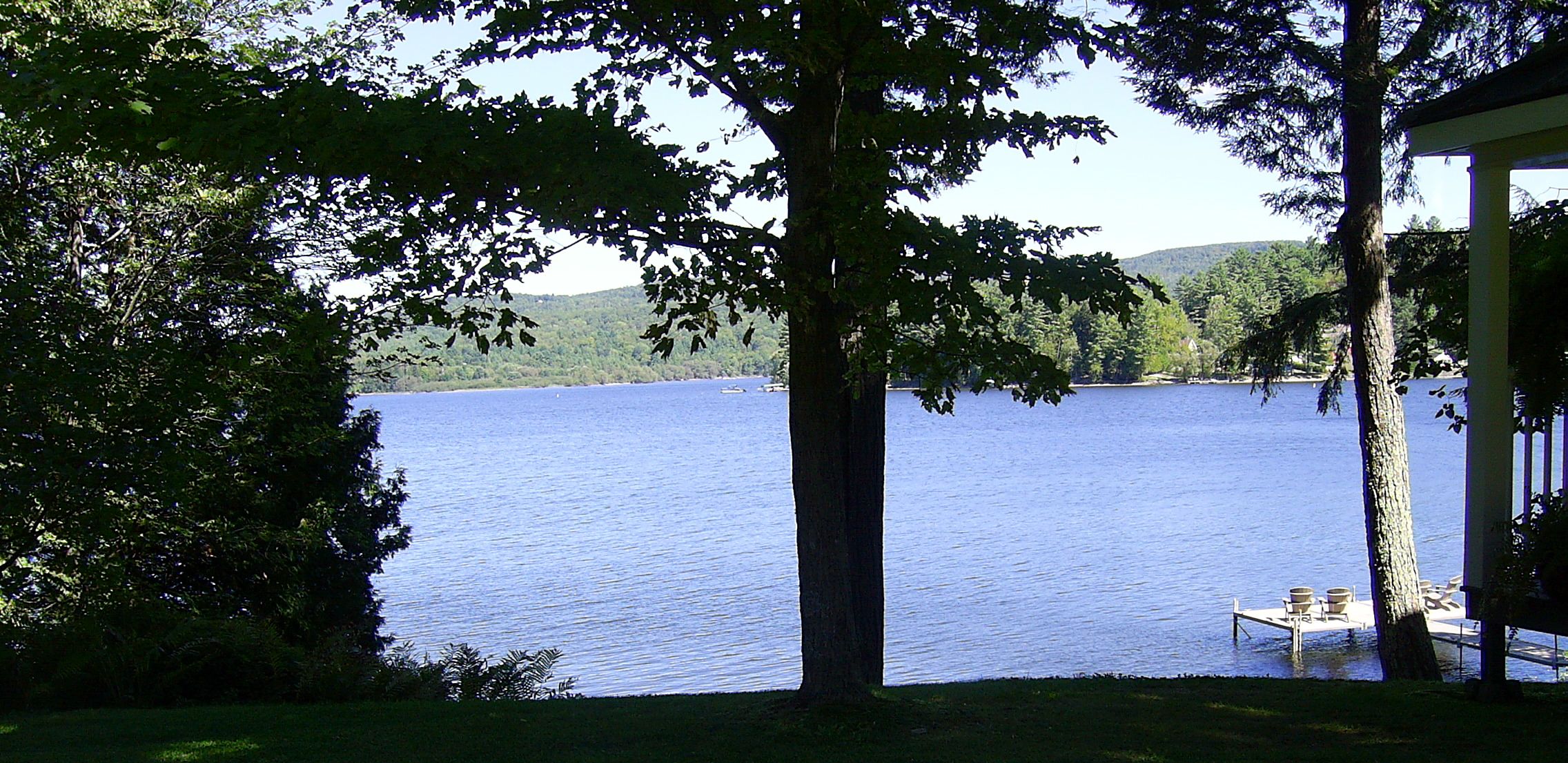
By the time, we round the corner into Ayres Cliff, we have been on the road for six hours. I seem to think I know where the Auberge Ayres Cliff is and I am not wrong, although I hadn’t realized it was right in the middle of town, a quiet tourist town of one main street and side streets leading down to Lake Massawippi. I stayed somewhere near here 16 years ago, but it takes me a full 24 hours to realize it was the same place and when I do, I seriously wonder if senility has crept up on me. It is a hard place to forget. It is said to be 200 years old and while that may not be an exact number, it is certainly very old. (www.aubergeayrescliff)

It has a huge patio at the side, full of expensive wicker seating and those outdoor heaters and little canvas-covered nooks, all on wooden decking. It also has seating on the veranda. We check in at the bar where some of the locals are having lively conversations. I’d like to join them, but we have to go up to see our room. Up is the operative word. We are the only guests, but we have booked two adjoining rooms, which are on the third floor. The second flight of stairs is made up of a large number of steps -each one 14 inches high.

The rooms are furnished with a double bed each, with good mattresses and dressers in a VIctorian style. And a  fan. There are no chairs. There certainly is no television set. No mention is made of this but apparently we were warned on the website. I give Georgia the room that has a more or less level floor, it being her birthday, and allot myself the one that slopes so dramatically that it takes all my tai chi balance to walk across it.

And yes, we want to have our bags brought up, a task that falls to the slim bartender/receptionist/ farmer’s daughter and a guy who gets up from dinner with his family to help her.

It is clear that we would not have got much sleep if we had come a few days before, on Labour Day weekend, but summer is over, the temperature has fallen, the tourists have left.

True to their hype, they have an excellent Angus beef fillet mignon. After dinner and the long slog back up the stairs, I get Georgia set up on the internet to watch Netflix: she is well into season 5 of Weeds and well fed with simple food, I fall fast asleep in my Alice in Wonderland room.

to be continued

Labour Day Weekend: reflections

SAMSUNG DIGITAL CAMERA(And yes, I can spell. It’s just that I follow a different tradition. Stubbornly, it seems.)

The dreaded weekend has come. The end of summer. A cacophony (strictly speaking a ‘murder’) of crows announced it this morning.

Oh, sure, we can assure ourselves that September can be the best of summer still, but that’s bravado, positive thinking gone rogue. Realistically, we know the light is failing. Vegetable gardens started telling us that weeks ago. Here at least, at 43.7° N. where the squash and cucumber vines have died back and the tomatoes are refusing to ripen. I can no longer count on light at 6 a.m. and the evening moves faster into night.

There were more swallows than ever sweeping across the sky two evenings ago, as they fatten up to cross the big lake and leave these shores. This evening, they may be gone. And it doesn’t help that I know they will come back to Capistrano on March 19th next year. It’s at 33° N and the swallows take another 40 days to get here.

Autumnal, that’s the word. ‘An early autumn walks the land/ And chills the breeze/And touches with her hand/The summer trees….’ etc. ( Courtesy Johnny Mercer) I would say it is all the more affecting because I am in the autumn of my life, but that would be false. The autumn of my life, I glimpse only in the rear view mirror. While I sometimes question how many more springs there are left, I never ask how many falls.

This weekend, the skies above are rent by low flying fighter jets, as the annual air show gets underway. While there are those who love the thrill of a group of jets roaring just above rooftop, I am not one of them, although I admit there is no need for coffee and the pumping adrenaline more than offsets the weary wintery-ness of age.

In the spirit of the occasion, let us consider Labour Day weekends past. Here in at 43.7° N., school begins on the Tuesday after Labour Day now as it did over 70 years ago when I started. My mother and I had planned that I would wear my sailor dress, light blue with a navy blue sailor’s collar and a narrow red stripe, and she would walk with me, holding my hand and teach me how to cross the street in our little town. The best laid plans and all that. Turned out my mother was far away in a maternity ward of the hospital that morning when I woke up. I was outraged. How could she? I was fed breakfast by my cousin next door and towed unwillingly to school by the grade 3-er across the street. Very early indeed, in case her friends saw her with my lowly grade 1-self, sailor dress or not.

The upside of this was that every Labour Day thereafter I got to celebrate my sister’s birthday. In addition, my mother’s betrayal led me to bond with Miss Graham, my teacher, to such an extent that I continued returning to school for the next 50 years, as student and teacher.

The year that I gave that up going back to school the day after Labour Day was so traumatic that I could deal with it only by setting out to drive across the continent to Los Angeles. Crossing the border in my heavy laden Tercel I was knocked sideways by the American border guard. (Metaphorically that is.) He was worried about whether I had green apples and where my ex-husband was at the moment. No and don’t know. He successfully banished all first-day-of-school nostalgia quite out of my head.

Driving across the continent by yourself takes a while, the sun streaming in through the driver’s side window, day after day. Mind boggled by the wide rivers and the deep canyons and the endless oppressive desert. Terrified of falling asleep at the wheel, of taking a wrong turn on a freeway. My expensive car phone without service most of the time. Then just so tired, I had to hole up and sleep in a well air-conditioned ‘better’ motel where the furniture wasn’t bolted to the floor. When I finally emerged and drove down off the Santa Monica Freeway to glimpse the Pacific, I had left my school self behind. But what did I discover in my daughter’s house? No not green apples! My ex-husband!  Just what the border guard feared. A reconstitution  of a family separated for 15 years for the purpose of defrauding the U.S. government. Somehow.

This year, I have other plans. My sister and I are going to return to the mountains of Quebec’s Eastern Townships where we were born. Her birthday treat. Not that there is family there any more. Well, maybe one. Eighty eight he’d be, if still extant. And the old house we loved isn’t tidy and white any more. The barn is just a heap, a mound of earth where the ramp to the haymow was. My grandfather’s fields, cleared with such killing effort, have been put back to trees. Unbelievably, actually planted with trees! You can barely see our slope-shouldered mountain for the woods. Nevertheless, we will drive the gravel roads and breathe the spruce air and feel our native earth beneath our feet.

And these two one-upon-a-time teachers will take solace in an excellent hotel on Lake Massawippi where the furniture is definitely not bolted to the floor.

Farewell to Old Filth: Jane Gardam’s Last Friends

SAMSUNG DIGITAL CAMERA

“You have to buy this, my friend said, thrusting Jane Gardam’s Old Filth at me.

We were standing at a table full of donated second-hand books, a fundraiser for our club.

“Why would I want to read a book called Filth”?

“Because it is very funny and a terrific read. Filth stands for “Failed in London Try Hong Kong. It’s about the Brits who went East to manage the British Empire.”

I read Old Filth and loved it. I searched out its sequel The Man in the Wooden Hat, and when the last of the trilogy, Last Friends, came out a few weeks ago, I devoured it. Then I started at the beginning and read them all again.

Sir Edward Feathers QC, a renowned judge by the end of his career, begins by “failing” in London and ends as a wealthy lawyer in Hong Kong. He is tall, good looking, always immaculately turned out – the first paragraph of the first book establishes this – and invariably called Filth, even to his face. He began life as a Raj orphan, a child of a Brit in the foreign service, sent home to England at 5 to live apart from his parents and to go to school. Like his cousins and the woman he eventually marries, Elizabeth Macintosh, and many other such children, his personality is shaped by that experience. Eddie and his cousins have a particularly bad start because their foster mother is such a sadist that the children wish her ill- with spectacular success.

These children know duty and loyalty but very little warmth and affection. The third main character, Terry Veneering, comes from a “lower” class, is brought up by loving if poor parents, is capable of love and spontaneity and is, of course, universally looked down upon as crass, despite the fact that he is every bit as successful as Filth both in Hong Kong and England. He is also Filth’s arch rival in love and law, but by a quirk of fate, ends up living next door to him in retirement. When he finds this out, Filth thinks to himself, “Well, thank God, Betty is gone.”

So it is not a spoiler to report that the novels end in death. Indeed they begin with death and only then go back to report the anarchic beginnings before World War II -Eddie’s childhood – and shortly after the war – his marriage to Betty in Hong Kong with a few glimpses of life at the height of his career and retirement to Donheads St Ague, in Dorset, southern England.

How can novels that begin with death be so entirely upbeat and genuinely funny? A secret known only to those of us like Gardam who have reached a certain age? (80 is the new 50!)

Gardam writes in episodes and flashbacks and uses incremental repetition. Some events like the wedding and Betty’s sudden death in her tulip bed are described more than once, sometimes in the same words but always with additional insight and variations on the initial telling. Old Filth tells Edward’s story, The Man in the Wooden Hat is more from Betty’s point of view and Last Friends is mostly Veneering’s although two peripheral characters, Dulcie and Fiscal-Smith, survive the other three and it is they from whom the novel takes its title. Or perhaps not. Perhaps in the end, even enemies are friends, at last.

The reviews for Last Friends are a mixed bag – some raves, some forgiving and some absolute pans – but personally, I wouldn’t take tea with those who panned it. Courtney Cook in the Los Angeles Review of Books (April 18, 2013) “Read Jane Gardam”, began by introducing readers to Gardam’s Queen of the Tambourine (1991), Crusoe’s Daughter (1985) and God on the Rocks (1978), before she gets to the trilogy. She calls Gardam’s books “a taxonomy of madness” by which she means “extreme confusion due to circumstances you can’t understand, can’t control and can’t possibly have foreseen”. Eddie Feathers, for example, is evacuated from wartime England to safety with his father who is serving in Shanghai. It takes months for his ship to near its destination just in time for the fall of the colony and, so, Eddie finds himself England-bound once more. Before he is carried off on a stretcher, he has spent the better part of a year on one ship or another. There are all sorts of dire happenings referred to – Japanese internment camps, bombing raids, ships torpedoed -if not actually depicted, but always with Gardam’s sure touch. Courtney Cook says one of the writer’s strengths is the way she handles death: “People die left and right in her books … and it’s horrible and it’s funny in that way that makes you feel badly and then all right again.”

Whenever I am reading a Jane Gardam novel, I feel optimistic and even happy about life.

I loved Last Friends because it gave me more of three characters I had come to like. I learned about Veneering’s early life in Herringfleet and the series of miraculous choices and interventions that kept him alive and prosperous into his old age, and, I suppose, because the trilogy muses on aging, an experience one finds oneself caught up in willy nilly despite the eternally youthful inner self.

Jane Gardam said, “What I don’t want is to be called an octogenarian. I saw ‘Octegenarian Jane Gardam’ and I thought ‘Blow me!’ I mean I am but that’s not the point.”