Pack in Haste: regret at leisure

suitcase(howtodothings.com)

You’ve see those movies where the grifters have to leave town asap. They throw their clothes, hangers and all, into suitcases. Easy to do, because they had only one suitcase of clothes to begin with. Or the flee-ers scoop everything out of drawers into suitcases, which they slam shut. In comedies, some personal item trails out.

This time I had a 2 hour notice that I had to get from Toronto to Southern California. (Last time I got maybe 20 hrs.) It took me a half hour to figure out how to book  ticket while in a state of shock. (Definitely, on-line. Definitely don’t pay attention to prices.) Signed, sealed, delivered, checked in, bag paid for, boarding pass printed. Now what to pack?

I had made the same trip under more relaxed conditions, in early May, four weeks earlier. No problem, pack what I took then.

I dragged the purple suitcase out of the back of the long narrow cupboard. I set it on the blanket box at the foot of the bed, opened it and began flinging clothes at it. I had to be at the airport at 6 p.m. It was 5. Okay, this isn’t working.

I phoned Blake, my ex-husband. He knew he would have to drive me to the airport already. I said, “You have to come now,” I can’t think. He was with his young female friend. Let’s call her Noreen. “As soon as he could,” he said. They were caught in traffic. I kept flinging clothes. Breaking off now and then to empty the fridge, tie up the garbage, unplug the fountains. Forget the timer for the lights. I could cancel the papers once I got there. I was a whirling dervish.

5:20, they arrived.

“Joyce, this is Noreen” etc. I had heard a lot about Noreen. She seemed amiable enough.

“Can you two roll all this stuff up tightly and pack it.” The first time I’d met her and she was rolling my underwear.

I was stuffing toiletries into a plastic bag. When they finished, I put the dresses, etc. into the top compartment where they stood a small chance of not getting wrinkled.

They dropped me at Pearson International airport at 6:15. Noreen helped me put the bags on a cart and hugged me goodbye. Big surprise. No crowds. I self-served all the way through baggage check, customs, immigration, baggage loading – a nice Jamaician man lifted my bag onto the belt and sang me a song of his own devising- and finally, that metaphysical hurdle, security check, to arrive in good time at the gate for an 8:15 departure.

I forgot to mention the stop at the exchange counter. I have several hundred untouchable U.S. dollars in the bank, untouchable unless I present myself at the bank counter to claim them. I paid $138 Cdn for $100 US.

Fine.

At the first of June, on the mountain, north of Los Angeles, I survey my suitcase. What a difference a month makes! 24 times 31 little hours! It is hot, even at 5000 feet.

The grey wool suit, however light, is a non-starter. The tights will work on cold mornings or for midnight trysts. The desert cools down at night, especially at altitude. I have one t-shirt. No problem, here are 3 t-shirts from my male host. They should work. No shorts. Not even any capris or clam diggers. Well, here are 3 dresses and a wrap-around skirt that my size 2 hostess can give me. I am a size 14, but by some miracle, these are loose and flowing – on her. On me, not so much. I have brought the top of my bathing suit but not the bottom. (You should have some fun even in the middle of an emergency.) You know how they always say, “You can buy what you need when you get there.” They weren’t talking about the wilds of Kern County, but it is true in this one case. I find myself in Bakersfield and  buy a black bottom in Walmart. No sandals. No problem. I order some from Birkenstocks. I do not upgrade the shipping. Two weeks later I try to track the package. It has just been accepted by the mail service. In China. I pull out the silky tank top. It’s not the plain, soft one. It’s covered with glittery bits of plastic, like scales. I bought it for a costume.

Everyday, I discover new left-behinds: the list of my passwords for example. And no one will believe that I know my mother’s maiden name.

Bell has handed my cell coverage over to AT&T. The mountain is served only by Verizon. I send pleading texts from other people’s phones: please water the plant, did my parcel from Amazon come? Have they stopped paper delivery?

I can get most websites on my computer up here, but not my bank’s. I am reduced to telephone banking. How 90s!

They say that new experiences keep the aging brain young. I figure mine has dialed back to 17.


Bouts of Joy

Not us. Another group of haymow jumpers

Not us. Another group of haymow jumpers

Back in the Sierra Nevadas, having exhausted myself walking up the mountain at 7,000 ft., I came down to the village to walk beside the lake, really a pond that holds the water for the fire department. One side of the water is thick with cat tails and behind there is a slope covered with deciduous bushes of different hues, including a soft red. Suddenly, I had a flash of standing beside the Indian River with my grandmother, Gladys, when she was the age I am now and I was 42.

She and I had found ourselves single and living alone that summer. Her son had gone off to live with his best friend’s wife, best friend having passed to his reward. Gladys had left the farm and gone to live in a small house on the Quebec/U.S. border. Meanwhile, my husband, daughter and son had gone off in their own directions. Gladys and I were heart-broken and yet she still made me laugh.

She recalled a day in her first home, a farmhouse. It was spring cleaning time and she had hired a French Canadian girl whom I remember later as Aunt Kate. Kate was cleaning upstairs, when she suddenly came rushing down yelling, “Gladness, Gladness, the house is on fire.” It burned to the ground. All that was left was a stone-lined cellar hole. Gladys roared with laughter as she imitated Kate.

They didn’t lose everything. The “men” -two of them would have been about 12- must have smelled the smoke or heard the sound of pots smashed together that called them back. They rushed in and grabbed the first thing the saw, the big round oak table, which immediately got  jammed in the door. Gladys screamed and yelled. They pushed and shoved. Finally the door jam yielded and the table flew out, but precious time had been wasted. Other men began to arrive and grab what they could. Some things Gladys loved were lost and the family of 6 was homeless. But in the country, someone can always squeeze in a family of six.

Twenty seven years later, the family had changed shape. My mother, who was 13 when the house burned, was married as were her next three brothers. But there were still three children at home, more or less the same age I was and I was 19. This house, too, caught fire. Once again the men seized the oak table first. Once again it got stuck in the door and Gladys screamed, “Leave that damned thing to burn”. Gladys never damned anything. It was the worst word to her. They didn’t leave it. See above.

The third house was built by the community across the road from the second one. The porch was smaller but screened. There was a coal furnace in the cement cellar and no longer needed to be insulated on the outside with banks of sawdust. And there was an actual bathroom. Until 1955, the old out-house had stood at the back of the wagon shed and only little children could use the commode inside. Gladys was very happy there. Her kitchen stove had a wood side for heating and an electric side for cooking. She had hot and cold running water, which ran into a claw foot tub. Many a visit, we sat at the much despised round oak table and laughed.

We laughed about the time that four of us, aged 11 to 13 decided to jump in the hay. It wasn’t a dangerous sport once the new hay had been harvested, but it hadn’t. All there was in the mows was last years hay, so low in the mow that it could be pulled down through the lowest door. Moreover it had compacted and was hard.

I was 13, Evelyn and Ted, twin aunt and uncle, 11 and Percy, 10. The boys dared us to go out onto the side beam that led across the mow from the barn floor (ramp) and jump from there. Sure, we girls said we can do that. The boys went first, sliding on their bottoms far across so as to leave space for us. I went next, noting as I began that it was at least 20 down. I could barely move. Finally, Evelyn began the crossing. We were all scared but she was terrified. She didn’t want to lose face in front of her brothers and once, embarked, she couldn’t go back either.

My sisters, Georgia 7 and Anne 5 stood watching on the barn floor.

I was sweating and gripping the beam. First Ted and then Percy launched himself off into the air with a bloodcurdling whoop. They would crash together, I thought. Both disappeared. A few seconds later their heads appeared as they dug themselves out of the dusty hay.

I knew I couldn’t do it. “Go back, Evelyn,” I cried.

“I can’t move”, she said. Me neither, I thought.

I studied the mow. The boys were urgently calling us to jump. “It’s fun. It’s not so bad.” My stomach heaved. I had to go to the out-house. I jumped.

The worst part was drowning in hay dust and desperately scrambling out. But now we had another problem. Evelyn was deaf to our pleading. She was weeping in terror and hiding her face in her shoulder.

“Go get Ma,” Ted yelled to my sisters. They clomped off down the wooden ramp. Crying and yelling ensued while we waited. Then Gladys was there with her small grand daughters, wiping her hands on her apron, and clearly not happy.

“What in the name of heaven were you kids doing out on that beam?” We always jumped from the barn floor and never into low hard hay. “Get back here,” she screamed at her daughter.

“Can’t,” said Evelyn,” Can’t move.”

“Well, then jump!”

Evelyn protested she would die if she did.

“Well, you’ll die if you don’t, Evelyn Grace. I’ll come out there and give you such a clout…”

Evelyn threw herself headlong, screaming, and landed on her face. We pulled her out and I dusted her off, but she continued to scream that it was all our fault. The boys and I ran across the hay, through to the mow over the cowshed, down the trap door, out through the empty cow shed and up around the barn. There on the dirt ramp, stood Gladys, her face in her apron, laughing so hard her body shook. My little sisters, who were totally unused to laughter, clung to her skirts.


Bulletin #2 from Shangri-La: altitude

The village I am visiting in the Sierras sits in a bowl, at about 5000 ft., surrounded by 9000 ft. mountains. The mountains I was born in are the northern end of the Appalachians in Quebec, Canada. Mt. Hereford is less than 3000 ft. high, but down the way in the New Hampshire, White Mountains, Mt. Washington rises to over 6000. I went up it once with my young children and had to fight the urge to crawl. My additional 5 ft. 4 in. were just too much. I had the same impulse on Mer de Glace in the French alps.

One summer, I went camping in Yosemite with my daughter and her family and my French brother. He joked about being the only member of a film crew on a mountain shoot that had to go down to sleep. Poor thing, I thought. Then I lay down in my tent at 9000 ft.

Half an hour later, I woke up suffocating. I got out of bed, unzipped the tent flap and walked around in the pitch dark. That got tiring. I crawled back into my sleeping bag. Repeat and repeat and repeat. Around 1 a.m., I ran into my brother, who was even worse off than me. He was babbling. My daughter emerged from the tent where she, her son and husband had been sleeping soundly. Being a health care professional, she questioned us about our symptoms. Her most alarming question was, “Are you hallucinating?”  She advised us to go down to sleep.”Don’t sleep in the car. The cops don’t like that,” her husband called out from inside their tent.

I’m not sure what happened next. Rob seems to have set out to walk to the car, some distance away. I must have gone back to my tent to get something. My next memory is of walking the long dark track wrapped in my sleeping bag. A figure up ahead suddenly came toward me.

“Joyce,” it cried out.”Is that you?” Rob walked up to me. His face in the moonlight was full of horror. “I thought you were a giant ninja turtle come to take my soul.”

This was hysterically funny to both of us. We staggered toward the car, laughing. We laughed and laughed until we started to cut down through Tioga Pass where a huge full moon hung in a velvet black sky. Then we both began to cry, convinced that no matter how difficult our lives had been and they certainly had, this moment made it all worthwhile.

It took some time to find a motel. Rob disappeared into reception and came out laughing and waving a key.

“I told her you were my sister,” he chortled. “And I think she believed me.”

There were five beds in the room. It took us an age to chose.

So I scratched vacation spots of 9000 ft. off my list. The town where I was able to sleep was 7000.

Peppermint Creek up the Kern River in Kern County qualified. We spent several vacations there camped under the redwoods beside the rock pools. No problem. Well, there was the time I was getting breakfast food out of the car trunk when something breathed down my neck. Something taller than me. I took a breath. I slowly turned to meet death by bear and found myself nose to nose with a cow.

Then came the year after I had had major surgery, a whole year after. Shouldn’t I be ready to camp up there?

Obviously not. This was my daughter’s dream vacation after a very hard year. Both sons-7 and 16-were there, the latter of whom lived with his father across the continent, her newish man, her best friend and me, old short-lunged me.

Suffice to say that I spent my nights sitting in a car seat, only slightly reclined, the only way I could breath. Well some of the night. The rest of it was devoted to taking the trenching tool and the flashlight and hying myself off into the bushes. This time, altitude sickness featured the runs. But rattle snakes hunt at night and we seemed to be camped in the middle of rattlesnake city. And the flashlight seemed to have a black spot in the middle of the beam. True I could see the bowl of heaven above me and it was absolutely dense with stars. I felt as if God were talking to me. During the day, I got more and more skittish. I was getting about 2 1/2 hours sleep a night. I didn’t want to spoil the holiday. Guess whether I did.

So now I am here at  5000, among pines and bird song. And sun. I’m Canadian, don’t forget, and we’ve had a cold, rainy spring. I  have taken two walks. All roads are uphill! I stop frequently. I aim for benches. Getting showered and ready for the day makes me breathless. I sit gazing out windows at the pines. I sit on the deck gazing at the pines. I sit and read. Once in a while, when I get rested, I do tai chi. Down at sea level, I am full of energy, all those new red blood cells racing around.

I want to stay of course.


Bulletin from Shangri-La: the boxcar house

boxcar house #2

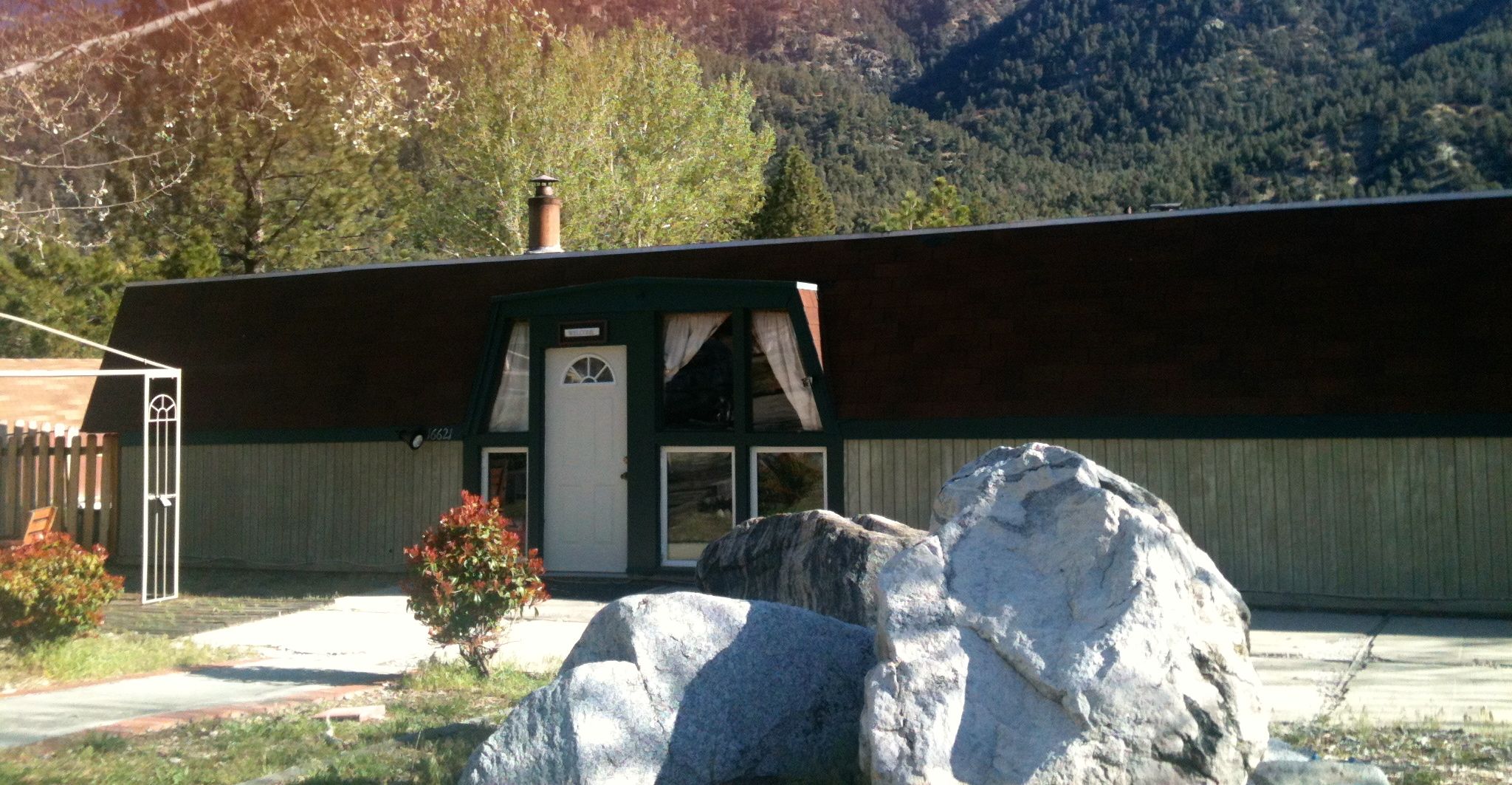
Shangri-La, here in the Sierras at the bottom end of Kern County has a type of house called the boxcar house.

This is the possible view from the back of the boxcar house.

mountain view from boxcarmountain view #2This is the actual view.

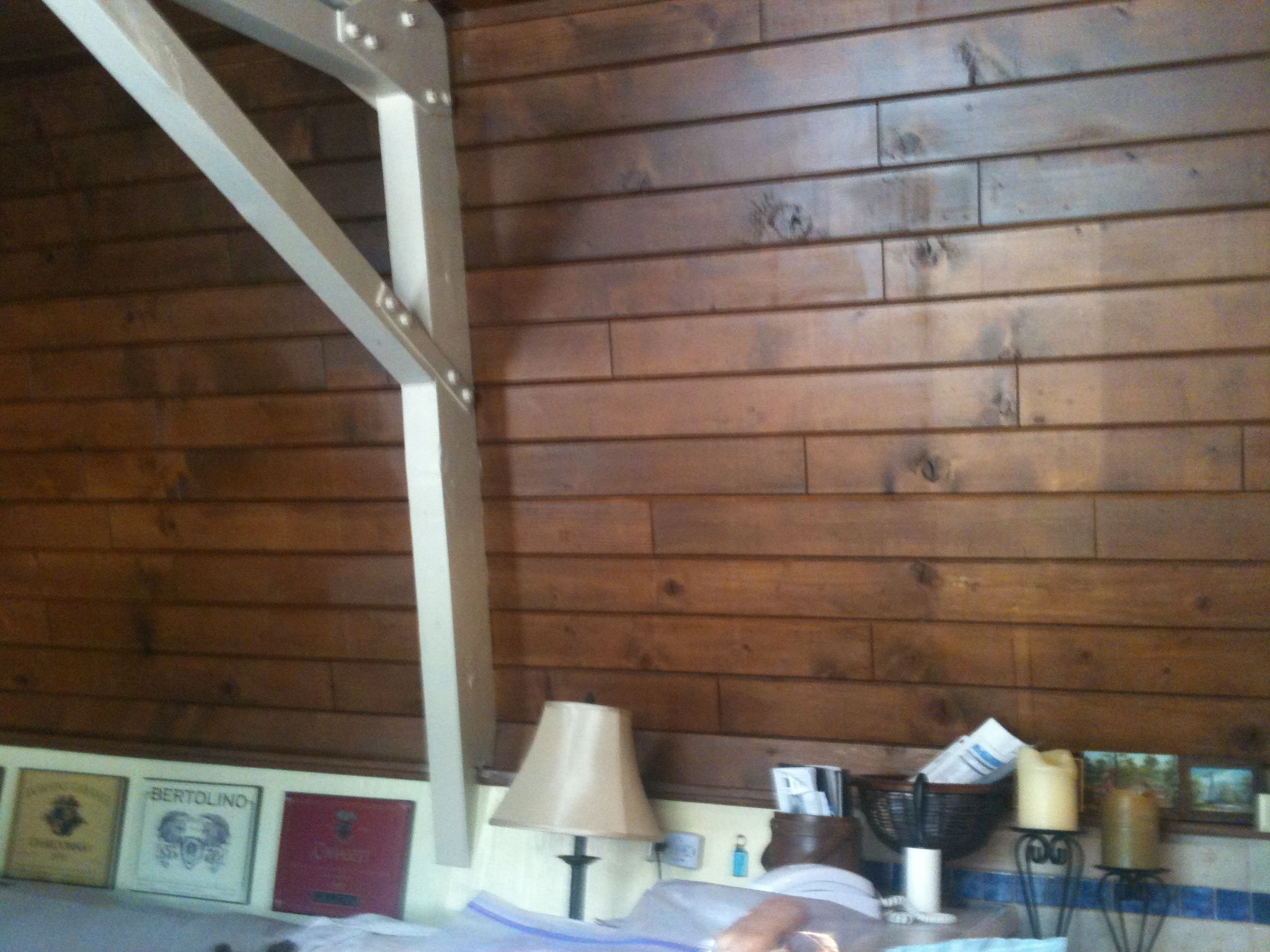
actual viewThere are no windows on the long side, except around the front door. There are sliding doors at either end, but we are enjoined not to leave them open, in case of bears. THey are the only windows that open.

During the day when we are out, the temperature inside soars. It is still about 90F/33C when we return. There is no AC. Someone used to live here full-time. How?

My room-mate and I have 163 years between us. The bathtub is two feet off the floor. Tai chi and a well-anchored bar makes it possible for me into it to take a shower. The other gal showers elsewhere.

Our first night is amusing. It is about 60F/15C inside. We have been told there are wall heaters. And yes there are. I turn on the one in the living room. It heats well enough, but not as far as the open kitchen and certainly not to the bathroom or the bedrooms, which are at either end. I turn on the heater in my bedroom. The fan powers up. A little guy inside is hitting heavy metal with a sledge hammer. I actually try to bear it. After three minutes I shut the heat off. I prefer silent cold.

The phone will not make long distance calls. The owner lives in Ventura. My cell phone gets no reception at this spot. Who carries a phone card these days? Next day, we learn that the noise will quit after the first five minutes. That proves to be true.

I start to make my bed. Like all rental cottages, this one does not provide linens. We have brought linens from the house in the pines, over the way. The bed is queen-sized. My sheets are not. If you turn the top sheet crossways and tuck it in at the sides, it more or less covers the mattress. Then the fitted sheet can be tucked in at one bottom corner to serve as a top sheet. I pile the five blankets, I find in the cupboard on top.  Quite a heavy load. I wrap what turns out to be a padded baby crib mattress cover around my shoulders and endeavour to read in bed.

In the morning, I decide to boil water for tea. I search all the cupboards. No kettle. For a few dizzy moments, I can’t find any dishes at all, until I spy the narrow cupboards built into the front wall. I find a pan to fill with water. How to turn the ceramic top burner on high. I take a guess. Ten minutes later the pan is still cold. My room-mate is an outgoing, former actor, a famous joker, but with less salty language. I stand there in exasperation and hear myself exclaiming, “Bad word, bad word, bad word.”

But here’s the best part. It is silent. No railway trains, no traffic noise. One jet – overhead in two weeks -a fighter from Lompok. No light pollution. Great beds. Excellent water pressure. Lots of hot water. And it is costing less than $60 a night. I have the address.


What I Learned at the Airport

Not taken at 6:30 on a Monday!

Not taken at 6:30 am on a Monday!

Toronto Pearson Airport 6:30 a.m, a Monday. The septuagenarian hobbit is about to learn a lot.

Lesson 1: The physics of a rolling object 1.0.. The new large roller suitcase isn’t as easy to roll as they claim. The carry-on rolls better. The bigger problem is how to co-ordinate two rolling bags.

Lesson 2: Times change 1.0. I’m already checked in on-line. I’ve already paid for my checked bag. What the –? I have to print my own baggage tags. Do the check-in kiosks do  that? The very tall man in front of me, who hasn’t checked in yet – how old school- assures me they do. Then an attendant, one of a rare breed, identifies me as old. Helps me flatten my passport, sticks the baggage tag on, scans it and send me off to find the E entrance.

Lesson 3: The physics of rolling objects 2.0. Should have got a push trolley. E is half a kilometer away. The big bag weighs at least 23 kilograms.

Lesson 4: Patience 1.0. There are at least 1000 people in the U.S. customs hall. They are all ahead of me.

Lesson 5: How to Queue. By spreading my feet and doing a high sit into my hips, I can keep from fainting in the dense, winding line. Tearing off the coat, scarf and tam I have worn against Toronto weather helps as well, as does chatting to the people behind and in front.

Lesson 6: Times Change 2.0. Eventually, I arrive at  another kiosk which also wants to read my passport and again, I have to flatten it with both hands. Then on to the next line with a real human being at the end.

Lesson 7: Times change 3.0. American Customs and Immigration officers have mellowed. In 2002, I was almost denied entry. I had family in the U.S. and it was felt I was going to stay. I bit my tongue and did not say, “As if.” I said that if I did, I would lose all my benefits. She let me through. Today I am asked if I am having a good day.

Lesson 8: Patience 2.0. At the security check, I am behind an older couple and their adult son. (They are probably younger than me.) Totally emptying his pockets is too much for the old guy. He thinks that’s an imposition. His wife puts her smart pumps in the bin. The next thing I hear is, I have to take my shoes off too.” He steps through the metal detector which sounds its alarm. The officer tells him to step back. He is told to go through his pockets again. He is wearing cargo pants. He fishes out a wad of paper. He steps through again and again. Same result. I stand waiting for my turn. The officer uses the wand which squawks many times. I want to shout,” He has metal knee replacements.” I don’t. Dad is moved over to stand on a black square, facing the wall. Mom is stood on a second square beside him. A female officer joins the fray and both desperadoes are carefully patted down. Nothing. I pass through the metal detector. Dad is standing at the conveyor built, which is standing still. “My money’s in there,” he cries. Mine too, Dad. A second invigilator arrives. Much study ensues. Son has moved Dad back to sit in a chair. Mom stands beside him. “My shoes,” cries Dad as the belt starts moving. “Dad’s shoes,” Mom cries. “Get Dad’s shoes!” I pick them up and turn to Son, saying,”Dad’s shoes.” As I reassemble myself and claim all the valuables I have in the world, I hear, “Flashlight. It was a flashlight.” Right, can’t have seen many of those before.

Lesson 9: Perspective. The tall, rangy West Indian guy who lifts my checked bag onto the belt, makes up a special song to wish me on my way.

Lesson 10: Patience 3.0. The line at Starbucks is 20 passengers, 4 pilots long.

Lesson 11: How to count. My gate is F34. I set off on the moving sidewalks, pulling the carry-on bag. Near the end, it occurs to me that F34 is not going to come after F80. The moving sidewalk says, “Do not enter”. I need to hurry. It is boarding time. I begin to trot back – “boats beating against the current” (F. Scott Fitzgerald), but I am working up a good sweat, so it isn’t all bad.

Lesson 12: Self-worth. I am finally seated in 18D. A woman is in 18F at the window. She gets to see the Grand Canyon . I get to pee. We are both praying no one will claim 18E. He is the last person to board. He is 6’4″ with the weight to go with it. As he folds himself into his seat, he says, “I tried to switch to an aisle seat but couldn’t.” And can’t now, I observe to myself. Age before beauty.

ac 321


Septuagenarian Hobbit -another adventure

cinco de mayoAs a septuagenarian hobbit (a stay-at-home 70-something), I board a plane the way I get into an Athens taxi: I accept my death. After that I can relax.

I leave the pseudo-leather folder containing my will and insurance policies out on my desk. Clearly labelled.

When I was a mere 50-something hobbit, I actually flew to the other place. Very instructive. https://115journals.com/2012/07/20/i-dream-of-etherica-life-changing-dream-2/

My eastern medical adviser says this idea results from liver heat. General Liver is trying to help my weak, damp digestion by going into battle. The fire rises to my head and produces scarey images.

My western medical adviser prescribes Lorazepam. Which I carry on my body in case I have to slid down the escape exit without my purse.

I have given up wine with airline breakfast. Too dehydrating.

Last time this hobbit went on an adventure it was Christmas season and I flew to Belgium. See https://115journals.com/2013/11/28/the-septuagenarian-hobbit/ and posts following. There I contended with the confusion of three languages and found myself embraced by mon frère and his many friends. Turned out I was so Europianized by my three week stay that I found it hard to adjust back. https://115journals.com/2014/01/05/the-septuagenarian-hobbit-gets-a-parking-lesson/

This time there will be no language problem. Well almost none, although Los Angeles is near the top of the list of large Spanish-speaking cities.

I am due to arrive on Cinco de Mayo, a day of celebration. So nice of people to party on my birthday. For indeed it is. After this, I’ll have only one more septuagenarian birthday. Figure it out.

So what to do? Shall we immediately set out for the mountain fastness where Julia now lives. Not a chance. Let’s round up a little party of our own, hit that place in Culver City and crash at someone’s house when we are partied out.

I don’t travel for the love of travel. I travel for love.


What I Learned At Easter Brunch: the times they are a-changing

IBM SelectricAt Easter brunch, I learned that a 15 lb, 3-month-old baby is too heavy for these ancient arms. I learned that a grade 3-er doesn’t read cursive writing, except her name, which she can proudly sign. I learned that a 30 year-old is baffled by the expression “ham it up” and others, which astonished elders then trotted out to further bafflement. I learned that this same young man can solve a computer problem that I have struggled over for at least an hour in a split second. I relearned that even the grade 3-er spends half her time face down to her device – a tablet, as did those 20 and 30 with their smart phones.

I already knew that my 19-year-old grandson, who was having Easter brunch across the continent, had a problem telling time on a non-digital clock and my 28-year-old grandson prefers to print rather than write. Although he must have also more or less mastered his signature – to be a doctor. That can be blamed on the “hippie” school he went to in Los Angeles. I have heard about an 18-year-old who went to apply for his passport and couldn’t sign his name. There is an ad posted in my doctor’s office for private lessons in cursive writing. My sister, Georgia says that curriculum is so demanding these days that teachers can’t give much time to practice, although cursive is still taught in the school she knows best.

In the spirit of cultural exchange, I recalled to a 20-something, my progress from straight pen and ink well to fountain pen. She knew about fountain pens, but had never much considered there was a time before the ball point pen or biro as the Brits say. She had never heard about the dastardly male-child practice of dipping the braids of the girl in the desk in front into his inkwell. She obviously had never been chosen for the momentous task of filling the ink wells. She had missed the joys of ink splatters and blotting paper. I inevitably got marked down for messy writing. We were allowed fountain pens eventually and I got one when I graduated from grade 8. And lost it in early grade 9.

The computer whizz recalled that first they had to write their essays in cursive and then they were forbidden to. In fact, even I experienced the shift to typed-only essays in my night school courses, a major pain since I had deliberately not taken typing so that my father couldn’t make me quit school to work in an office. In addition, school secretaries no longer typed material for teachers – cost cutting started in the 70s. The typewriter with corrective ribbon -an IBM Selectric- came along to save me. I could barely lift it.  I learned to type one-handed, 3-fingered, quite fast, as I am doing now – while looking at the keys. My first Apple desk top computer in 1992 was a dream come true, of course no corrective ribbon, but “delete” and “undo” and “copy” and “paste”.

The conversation at brunch moved to the study of key board/ typing skills. Mostly, it doesn’t seem to be happening. It is assumed that one way or another kids have those skills once they get to high school. So much for QWERTY. The little finger may become vestigial.

The 50-year-olds watched cartoons from the thirties as children and learned old-fashioned expressions then or from Andy Rooney pictures. The 30-year-olds are more apt to have learned expressions from Rooney Mara, whose tattooed girl had computer chops they can admire.

My own colloquial history, alas, goes back to the 19th century. My grandparents were born at the end of it, and dragged their parents’ language from mid-century in to my early life in the late 30s. One internet citing traces “ham it up” to a mid 19th century touring theatre group in the U.S. led by a man named Ham, and given, I suppose, to exaggerated gestures and bombast. (The 19th century means 1800 to 1899, by the way.)

Sorry if that note is offensive, but yesterday I told someone that one of my grandsons is in California, the other in Massachusetts and she asked if they were far apart.

Earlier I remarked to a friend about the beautiful robin song we could hear and she said, “Is that a robin? I don’t know bird calls.”

What is the world …… etc?

It’s Earth Day. It wasn’t called that in 1949. It was called Arbour Day and we were herded outside with rakes and other implements of mutual destruction to clean up the school yard and we were jolly well expected to know the birds we heard there and the trees we raked under and the bushes and even the bloody weeds.

Okay. Times change. Catch up girl.

I dislike the way the French police their language. The number of French words in use – so quick research tells me is about 43,000. Samuel Johnson’s 2 volume English dictionary of 1755 had about the same number -of English words. Today’s Complete Oxford Dictionary, 20 volumes, has over 200,000 and some estimates put the number of English words even higher. The amazing thing about our language – you are reading this in it after all, so it’s ours- is its adaptability. We accommodate change and even embrace it. (I do still bristle at “grow our business”, having the old idea that you can grow carrots but not businesses.)

True, for over 30 years, I was in the business of holding the line on grammatical structure. I had that mandate, but I didn’t like it much. I saw that sentence fragments could be the best way for students to express an idea, for example. I red-penned errors that made a sentence incomprehensible, but I may have let down standards otherwise.

Talking to Georgia, I said wealth distribution is changing so that a small percentage of people -1%?- have most of it and I think there is a similar disparity between the percentage of people who read and those who don’t, between the intellectual and the non-idea people. Of course they are not at all the same group. In fact, apart from Conrad Black, the 1% and the readers seem exclusive of each other. (I know, really, me bad, as the kids now say. Dumbed down from my bad. Even dumbness can be dumbed down.)

I failed to transmit my knowledge and love of the King James Bible and the Anglican liturgy to my children. I made a stab at it by giving my bar mitsva-ed grandson the King James Bible and he used it as a literary resource. The younger one eats up marketing books. He believes strongly in the necessity of being cultured, but his definition differs from mine. He seems to mean “becoming fully human”.

Looking at my past, I see that apparently, I don’t want to set our culture in stone but I am uneasy with the rapid change I observe. I suspect that my uneasiness comes from the fact that I am cut off from what is replacing it, out of touch, a relic of a bygone age. Except at Easter brunch.


Easter Retrospective

115 journals

journaling, reading as strategies for survival and change

pagan Christ

I am re-posting this from last year. Of course Easter was not early this year, but given the weather we are still having, those Easter clothes of yesteryear would be too cold.

I love Easter as a time of rebirth, a resurrection of life. When I was a child, there was always a new outfit, hand-sewn and often cut down and reworked from other garments, new white shoes and a new hat, usually white straw with flowers, chilly to wear when Easter was early as it was this year -2013. To me, it was an unparalleled celebration of light, a miracle – like finding the horse radish root pushing green up out of the newly thawed soil.

In those days, I hadn’t heard about the Easter bunny. He didn’t come to the hills where my family farmed hardscrabble soil. But the hens had started laying eggs again by then and they were served in abundance on Easter Sunday breakfast. It wasn’t unheard of for a farmer like my father to polish off a dozen when he came in from milking and before we all set off for church.

Once we moved to town there were still new clothes at Easter and our growing family might even present itself at church, but that was a special occasion. I would have been the only family member who went for all the Sundays in Lent and right the way through, I would have been looking forward to the exuberance of Easter Sunday.

My love for the Anglican liturgy in the Book of Common Prayer and the King James Bible were enough to keep my child self coming  back for more.

This Easter Sunday, I revisited some of that poetry as I drove north to Barrie, Ontario for brunch. I fired up my iPhone and listened to the second part of Handel’s “Messiah”, beginning just before the “Hallelujah Chorus”. Handel took the passages from the Bible and set them to his stirring music. One of my favourite pieces is the soprano aira, “I know that my redeemer liveth”, (Job XIX, 25-26) which ends with “And tho’ worms destroy this body, yet in my flesh shall I see God”. The remaining songs are taken from Psalms and the writings of the Apostle Paul, mostly the 1st Epistle to the Corinthians.

I have been lucky in my religious education. I listened to the beautiful King James Bible being read aloud in church and at my grandmother’s, daily in the latter case. I went to church religiously: I sang in the children’s choir. And the university I went to was affiliated with the Baptist Church still when I attended it. Not my church and at the time, I was not happy with the mandatory religious studies, but it gave me a ‘grown-up’ perspective on the New Testament, especially on Paul.

As I listened to “The Messiah” – and drove northward, I remembered reading Tim Harpur’s book The Pagan Christ at Easter in 2004 and I got to thinking about Paul’s letters to the early Christian church. The Apostle’s letters are actually the earliest writings in the New Testament and are “virtually” silent “on the whole subject of a historical Jesus of Nazareth” (Harpur, 166). Paul’s writing predates the earliest gospel, that of Mark, by about 20 years. First Corinthians probably dates from 55 A.D. “Paul was a mystic and he knew only the mystical ‘Christos’, Christ not ‘after the flesh’ but after the spirit. As he says, ‘The Lord is that spirit’.” (Harpur, 172) Paul does not talk about Jesus Christ as a personal saviour, in other words, he talks about redemption through the Christ within. It was the next generation of writers, working from an oral tradition, who wrote about a historical Jesus who died 70 years before.

Harpur, like other scholars before him, noted the similarity between the story of Jesus and the stories of other divine sons of God like the Egyptian, Horus.  He concluded, after much research and soul searching, that the Gospel stories were “true myths” but not meant to be taken literally. This was not an easy conclusion for him to come to. It had unsettled him badly at first, but ultimately, it lent depth to his faith. It meant that he as an individual was responsible for his own salvation, the Bible having shown the way. Jesus Christ had to be born in the cave of his own heart. The stone had to be rolled away from the tomb of his own deadness, the oblivion of being incarnated in flesh, so that the Christ within would be resurrected and true spiritual consciousness be attained.

By the time I read The Pagan Christ, I did not find the idea surprising. I had worked my way around to a similar position reading Buddhist and Taoist writing. It seems to me that all religions come around to that idea. The 13th century Sufi poet, Rumi, speaks of the ecstatic union with the Friend as a sort of drunken abandon. My Aunt Mae dwelt in great joy with her best buddy Jesus. You could hear her singing His praises as you walked up to her isolated, tiny house. I do not doubt that she saw heaven on earth.

At such festivals, I find myself reworking meaning, sorting out the literal from the metaphorical. But in the end, I do not doubt that “my redeemer liveth… and in my flesh shall I see God”

On a less serious note: this year, 2014, the local Jehovah Witnesses invited me to a memorial for the death of Jesus Christ. That’s what I call a zinger.

The Ex – a love letter

I needed a date the other night, someone who would appreciate a family party and would be willing to drive an hour north into white-out country, late March though it was. Naturally, I called my Ex.

When I was 16, the year that Blake and I met on a Good Friday bicycle hike, the word “ex” hadn’t been invented and had certainly not devolved from meaning ex-husband/wife down to meaning ex-boy/girl friend. Only the rich and scandalous and movie stars got divorced in those days. I can’t even remember whispered adult conversations about divorced people in my home and I always heard the whispered, good stuff.

Blake and I were together for over 25 years before we broke my grandmother’s heart. (My mother had passed on, so my grandmother had to fill the role.) She thanked God that at least my grandfather had not lived to see it. Then divorce began spreading like a nasty disease and she started working hard to keep up.

So my second niece was turning 50. My children and my sister’s are all one year apart – Irish twins, as they say. This niece was the last of the four to reach 50. Initially I phoned her daughter -great niece, that would be – to say sorry, apologies and all that. I got off the phone and had a brainwave. The invitation had been addressed to Joyce and guest. I phoned Blake and he readily agreed to be my date. It would be good to see the family, he said. I cancelled my regrets.

Blake could drive through hell without turning a hair as he proved in Paris, Rome, Athens and on the Autobann when we were married. And although we have been divorced for 36 years, he has come to family gatherings in the last few years. My sister greeted him at that first Easter dinner, “Gee Blake, I didn’t know we were going to get you back.”

It hasn’t always been hearts and flowers. At first when divorce loomed, the kitchen knives lured me, sang siren songs, but both Blake and I have a blood phobia and being a bright guy, he moved out.

Even so, we didn’t fight over the division of property or children. Fifteen and sixteen -year-olds make up their own minds. The rest we divided in half, although I resented being given the cabinet television set, which took 2 men and a boy to move. We didn’t divide my brother’s drug stash in the crawl space because we didn’t know about it and he didn’t know we were selling the house. It’s still there if you look up in the rafters near an air vent or so he claims. But that’s on your head.

Any lingering angst evaporated when Blake’s wife died. No, I didn’t mean it like that. She was a beautiful, vital young woman, as passionate as only the Spanish can be and she was a brilliant cook of Mediterranean food, ambitious and hard-working. She and Blake were coping with the idea that he would go first since he already had a cancer diagnosis. Then she was diagnosed, but the prognosis was good. Not to worry. But in the course of one autumn, she turned very badly for the worse and passed away on the winter solstice.

Our daughter came flying back to aid and comfort her father. Although neither of us had known his wife well, we felt a great out-pouring of love as if she were sending it back from the other side. Blake was perhaps too overwrought to register it. It wasn’t hard to realize that Blake could use support once our daughter left.

We go to movies like August, Osage County, I cook steaks or stew, or we eat out and we talk about politics or current events: ‘what did happen to that airplane’. Julia says it’s just what we did at our own table all those years ago.  We go along with each other for medical appointments, just to have a second set of ears and to decide on treatment if necessary. It’s true that Blake has other companionship as well. Fine with me. She can keep up with him. Being younger. Is there a pattern …. No, no, that’s small minded.

Dressing for this masked ball proved challenging for me, but I pulled together a long sleeveless dress, heavy tights and a black scoop-necked top with long sleeves for a suitably “formal” look. Blake showed up in maroon cords, a blue shirt and the softest grey/blue jacket that invited touch, mine and that of several other women.

We had a charming misunderstanding about our gift of cash. He insisted on being generous. I thought we were dividing what I had ready in half. He thought he was adding to what I had ready.

When we arrived, my niece’s grandchildren greeted us at the door, the boy in a tuxedo,  two girls in long dresses and one in a tutu. Our coats were whisked away and we were provided with masks.

Shortly, thereafter, Blake wished my older niece happy birthday and she thanked him, noting that he was 5 weeks early. “Wrong niece, Blake”, but Blake is forgiven everything. He is the beloved, absent-minded uncle to them and always has been.

It is an interesting venue, the long narrow foyer of an athletic club where the birthday girl works, with a bar and tiny kitchen in the middle and  glassed in squash courts in clear view. There is one baby. Two others have been left at home, to great disappointment. And all those flying beautiful sub-teens. So septuagenarians right down to a one-year-old. In the kitchen is the family chef, birthday girl’s son-in-law, father of 6, churning out nibblies, that the kids pass around, explaining each in detail.

Someone is reported to have said, “It’s nice to see Blake and Joyce back together.” It’s not clear if this was a joke.

Blake and I enjoy a chat with my younger sister, Georgia. They have always liked each other and are not above flirting. Then we try to mingle and find ourselves with the most mono-syllabic fellow in the room. He regards innocuous questions as an invasion of privacy.

Then a remarkable thing happens. Georgia’s ex-husband takes his two daughters – my nieces- aside and tells them he is giving each of them $40,000 from their grandfather’s estate.

It takes me only a minute to slide over to the gift table, unseal the envelope  and pocket my gift money. NO, no. I didn’t do that. Honestly, I didn’t.

Then in general jubilation, the band starts up – Rolling Stones, Led Zepplin – and the dancing begins.

Once upon a time as in the best fairy tales, Blake and I danced. We square danced, we polka-ed, we two-stepped, we jitterbugged, we foxtrotted. Since we parted all those years ago, neither of us has danced. Sixty years later, we dance.


Septuagenarian Puts Out Garbage

This is no country for old women.

On Saturday, I confirmed that hypothesis. I did a really hard tai chi class. I climbed into the little red Yaris, which helpfully told me the temperature was 2 degrees celsius (34 F), but of course, it had not factored in the bitter wind, which meant it felt to me much colder. I stopped at the local wine shop to pick up my drug of choice, a little Pinot Grigio to get me through the night. At home, I struggled out of my long, brown, old-lady coat and my fur-lined aviator ear-flapped hat. I unlaced my snow boots. Then I remembered.

Twice a week, at least, I have to put the garbage out. I had the recycling pail ready in the kitchen. The newspaper rack was over-flowing. The ‘real’ garbage pail under the sink was not too fragrant and the compost on the counter was fermenting big time.

I crawled back into the feather duvet, which passes as my coat. I couldn’t dare dash out with just a hoodie on. My screamingly sensitive cells would catch the bitter wind and go for … a week-long headache or pneumonia.  I tied the  hat under my chin. I dragged my tall black Wellingtons out from the back of the closet and clumped out with the recycling pail, the garbage bag and the compost bag. Thus laden I started down the walk that leads to the drive. OMG, I need to put more ice salt down. “Be very, very careful.” I manouevre carefully past the cedar trees that have started to lean with the weight of ice and snow. This gives me a sideways sort of hunchback-of-Notre-Dame look. I decide to leave one of my burdens on the stone wall so that I get a purchase on the wrought-iron rail on the steps. I open the green bin and deposit the compost. Then I move it back away from the basement window sill. The coon which moseyed by my front window this morning needs the sill’s height to get a purchase on the green bin.

I pass on to the blue bin where I upend the recycling pail, noting as I do so that my house mates drink a lot of pop. They may also drink wine, but we have stopped putting wine bottles in this huge bin because of the Polish-only scavenger who insists on rooting through it and putting the recycling into the garbage bin as he goes. True my Polish neighbour has helpfully translated my threats to him and on the third try, achieved the same angry volume as I did. I haven’t seen him since, but that may be because this is no country for old men either. (What do we do with the wine bottles? We have to haul them off to the beer store (!!!) to get our deposit back. I have a whole winter’s accumulation waiting for warm weather.) Last I retrieve the vraiment garbage from the stone wall and turn to the black garbage bin. Back in the house after a careful return walk, I go down to the basement to get the ice salt and carefully salt the walk and the steps and the patches of ice on the drive, which is on a steep slope.

Back in the first floor apartment, I divest myself of outer wear, hang it up and go into the kitchen to make lunch. Opening the freezer, I discover another bag of compost, which really prevents my putting in the frozen food, I just bought at the market where the wine shop is. See above, re outer wear, still icy walk, sloping drive, green bin.

When I was young, you know 30, when I could still whip out the side door in a sweater and put the ONE unsorted bag of garbage in the ONE garbage pail in our double garage, I had children, I had a husband. All I had to do was threaten them with death to get the garbage taken out. It all went to a landfill I never saw and I was content.

Then it transpired that we were killing the earth. We mustn’t buy packaged goods. That worked well. More and more things came sealed in impervious plastic and cardboard. We must reuse. Well, no problem. In my family we even drove our cars until they died of age.

I left the city. I moved to a country town sans help-mates, mostly. I got acquainted with the dump -sorry- transfer station. I got acquainted with the nice man in the gate house. I enjoyed fireside chats. I started sorting bottles into one dumpster, paper into another. I learned to heave heavy, real garbage bags exactly where I was supposed to that week and I enjoyed browsing through the stuff people left at the side, which you could reuse, no charge. I did have to pay when I needed to get rid of a truck load of drywall and old pieces of plumbing. But it was a reasonable cost and Daniel, now an adult, no longer had to be threatened. I had bought the 20-year-old truck for him.

In my back yard, which lay open to my little barn and open fields, I had a composting pile that yielded lovely black loam for my vegetable garden.

By the time I moved back to the city, I found myself with a grey box for paper, a blue box for glass, a real garbage bin and, eventually, a counter-top holder for compost and a small green bin outside, which was especially designed to accommodate the small hands of a raccoon. Luckily, my first apartment on the second floor of a house also had a pond, so we were coon-central for dining excellence.

Well, at least we didn’t have bears, so I saved a couple of thousand on a garbage safe.

Eventually, the city introduced large black garbage bins and blue recycling bins -the green bins were such a success, they carried on. The former two bins can be automatically lifted by the truck as you probably know, except on streets with parking, except…, except… And the green bin guy has to get out and hand load.

In the house, I have often stood with a ting scrap of food and a tiny bit of cellophane extracted from the sink strainer and puzzled my over-worked sorting brain. Which goes where? Sometimes, I confess, I just put both in the garbage, even though the voice of my friend, Sara, alias, the garbage police, is shouting in my head that I have just put another nail in Mother Earth’s coffin. It’s my small rebellion.

Forgive me, Mother, for I have sinned.

Note #1: Initially I gave the scavenger bags of bottles.  I was repaid by a grunt and intense self-satisfaction. Then he must have started coming when I wasn’t in the kitchen where I could hear his racket. That’s when he started trashing the recycling..

Note #2: A woman I know went out to her green bin one morning and a coon sprang out in her face. She staggered back, tripped, broke her hip and had to crawl next door. I visited her in rehab. She blamed her husband.

Note #3: Calling all coons -you are nocturnal.