Septuagenarians on the Road #5

Auberge Ripplecove, Ayres CliffThis account is taking as long as the trip itself.

We had just crossed back into Canada after an hour’s stay in the United States and close questioning by the Canadian border officer. (https://115journals.com/2013/09/12/septuagenarians-on-the-road-4/).

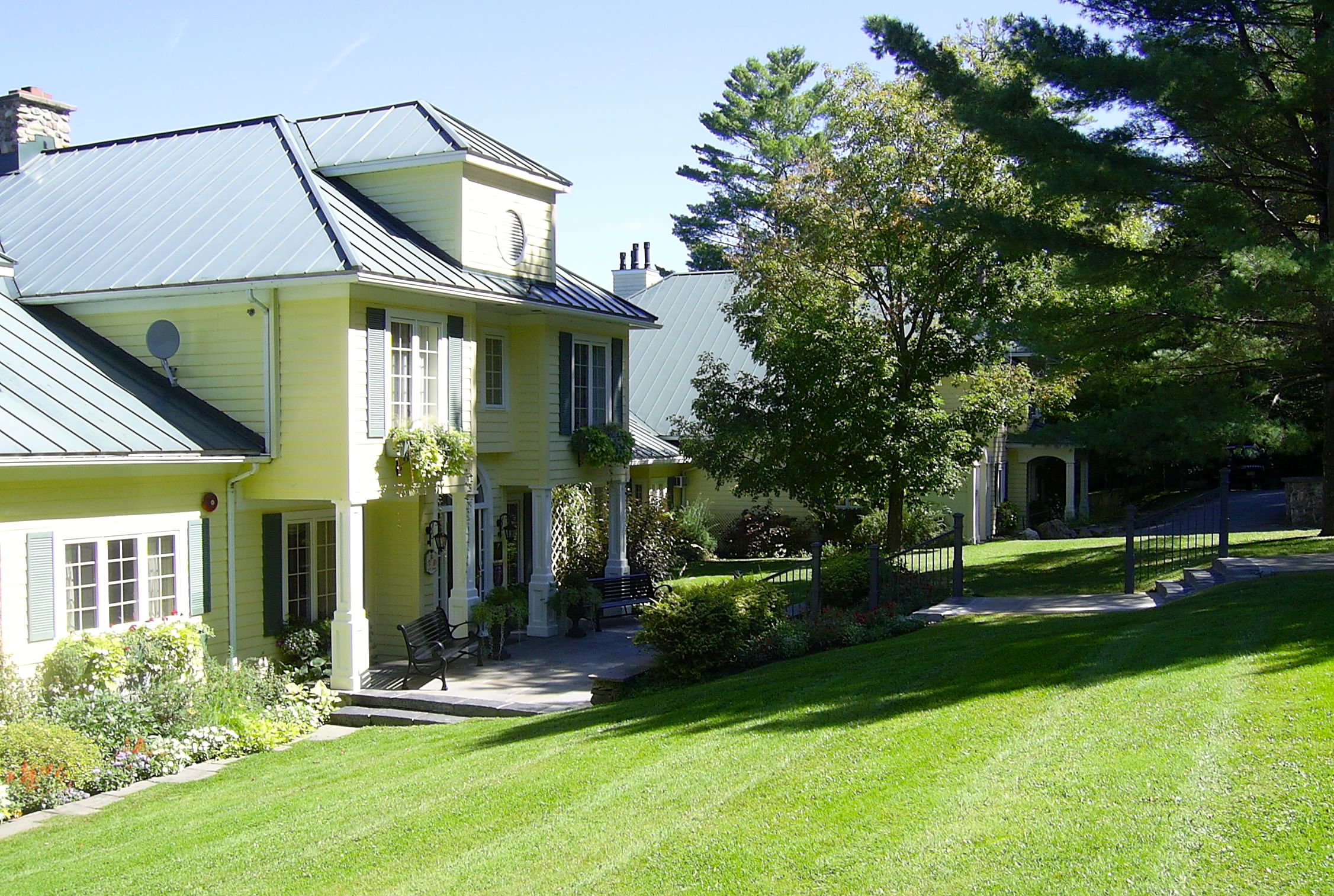
By 4:30 pm, we are checking in to the Auberge Ripplecove, our 5 star accommodation for the night and considerably more formal than Auberge Ayres Cliff. The lounge is well appointed. The man behind reception desk, resplendent in a dark suit. But he slips out from behind the counter to carry in our bags. Our room is just through a small  lounge with fireplace, lake view and a buffet large as one wall, a carved mythic piece of furniture, which will take some study when I have time. We are on the first floor with a garden view. Lake view costs more.

ripplecove interiorChintz and checks and stripes and even plaid and all in soft green and earthy tones. And very softly lit. There is a television set hidden in an armoir but there can be no viewing from either of the two double beds and, in any case, we seem to have given up television.

While Georgia unpacks her two Gladstone bags, I wander off to the bar downstairs to fill the ice bucket and get hot water for tea. There is a coffee maker in the room, one which suits my sister, a Kreug that takes those little packets of coffee and turns out one cup. No more simply pouring water in one end and collecting hot water at the other. Plus le change plus …le aggravation. Now the gentleman at the bar is preoccupied with his computer screen and evidently has not noted my arrival. I observe -him, the deck outside, the lake, the couple drinking martinis. I clear my throat. I ask for hot water and ice. He bustles off. I wait some more. Eventually he comes back. Period. He addresses the urgent need of a newly arrived woman for a rare brand of scotch which proves hard to find. Something about “chopped liver” swims to the surface of my mind, but just then a wait person of the female persuasion arrives with a tray, laden with an ice bucket, a white china teapot and a mug. “Shall I take it up for you?” she asks. Of course I decline, only to discover it is rather heavy for these skinny 70+ arms. We, my sister and I, are not slipping easily into old age. Too independent? I wanted to explore the hotel. That’s why I didn’t call room service and it seems impossible that this small tray could be beyond me. Short on graceful acceptance of decline?

I have been here at least three times before, but only for meals. I came here first in 1979, all that long ago. I had brought my new man to meet my Nanny and we were staying at the cheapest motel on earth but eating expensive food. We came to dinner here with a teacher friend from my previous  (married) life and her husband. We had left Belle my Newfie dog tied up outside the motel. The next year, same motel, same dog, but the friendship with Nancy had cooled, so we booked our own table. Then 30 years later, I brought Georgia here. I remember the pictures of Archie and Elizabeth Stafford who built the inn in 1945 and had to bring in electricity to ‘this remote corner of the Eastern Townships’. Could be. Didn’t seem all that remote to me as a child, but I knew Hereford, now that was remote. They didn’t get electricity up that hill until 1948. Apparently, the place has suffered a fire and been renovated twice during the 30 years I stayed away.

We take our mandatory rest, a little fraught with memory after our excursion and my realization that I had forgotten I stayed in Hotel Ayres Cliff as it was then, in 1997. Let’s be frank. There were a few idyllic memories here in Les Cantons Est, but there was a darker side, not just of poverty, some of which I have described in my e-book, Never Tell: recovered memories of a daughter of the Knights Templar. 115journals.com

It’s time to get out of the jeans for tonight’s dinner. I actually wear a dress with large red poppies. Something tells me  not only to wear the black cover-up but also to take a shawl. I’ve even stretched to stockings and tasteful heels. Georgia has accented her filmy navy outfit with fuchsia wedge heels (which she can barely walk in) and bag. She ends up with a compliment from a French woman. I end up freezing.

Turns out the preoccupied bartender is the Maitre d’ and he translates my last name into French and then explains he has made a joke. Our table is next over from the tables near the windows looking out on the lake. I seem to always get this same table.

So this is a real treat for me and I’m paying as part of the birthday tithe. Ordering from the French only wine list sets me thinking. I mean that the wine is French, the only kind of wine my Belgian brother will drink. I’ve lost any knowledge I had 30 years ago with that man I brought to Nanny’s. Literally, it was his knowledge. So I more or less take a stab and order a certain chablis. I can see why Rob has that snobbish attitude. The taste is finer and more subtle than the in-your-face Ontario chardonney I was drinking in the room.

The first course is a tiny portion of pressed duck breast and black pudding with figs and pistachios involved. Then I have scallops, while Georgia has strawberry gaspacho. She reports it is like starting with dessert. I have tiny lamb chops with beans and carrots for my main course, while she has lobster, shrimp and scallop. The portions are small but even so, I leave one chop. I don’t want to end up awake as I did in Kingston. Of course we have dessert, mine white chocolate enfolding caramel, hers pistachio cake. And then -surprise- a macaroon.

I haven’t paid attention to the ritual of service, the arrival of cutlery in little white pouches,  to be placed just so. Maybe it was that worldly long ago man that got me used to ignoring such ostentation. He always had a conversation steaming ahead, which he more or less dared a hapless wait person to interrupt. Georgia, it turns out is not so sanguine. The stuffiness bothers her. So far as the food goes, she likes it well enough, but says she doesn’t have a refined taste. I want to say, me neither, for I never caught up to that long ago man or to my own brother, but I let it go. I do absolutely love such food.

The sheets are lightly starched and crinkle like tissue when we turn, but in the end, we co-ordinate our turns, being awake for the nonce anyway, and get a good sleep. And so farewell to our $326 room. A groundsman carries our bags to the car and he and Georgia have a good gab.
SAMSUNG DIGITAL CAMERANow, I confess, I left out the bad part. When Georgia leaned over to deal with the cooler, she put her lower back -tightened by too much driving and weakened by the Everest stairs – into a total and utter spasm. It is fused, solid and agonizing.

She protests she is at her best in the morning but I drive.

You don’t want to go with us all the way back up 15, ouest to 30, over the river, back on 20, into Ontario and onto the 401. You don’t want to redo the squalor of those roadside fueling stations for cars and people. See even I am losing my positivity. You would prefer just to arrive back in Kingston at the Lasalle Travelodge -$126 plus US exchange on Hotwire. (Don’t ask. A Canadian hotel paid for in U.S. dollars?)

This is the winner according to my sister, my crippled sister. Having requested a ground floor room, we discover that I can park just outside the sliding door and easily get the bags in. The room has just had carpet replaced and been redecorated, Georgia notes and the linens are up to her standard. There is a fridge and a good, old-fashioned coffee maker. I am not so enthusiastic. The whole place, especially the restaurant, still looks like the 70s, cave-like and dark to me. (It takes a while for me to workout that Cavelier Room is not a mis-spelling, but the actual middle name of René-Robert Cavelier, Sieur de La Salle who once had command of the Louisiana Territory but started his explorations here in La Salle, a suburb of Kingston.)

By now we are so knackered- and injured, we order room service for dinner. I don’t hold out much hope for the roast beef and Yorkshire pudding and I am not disappointed. The beef is not bad, if too well done, and there is no Yorkshire pudding.

In the morning, looking for a vending machine for water, I stumble on the hot tub and indoor pool. This proves just the thing to loosen up Georgia’s lower back and a pleasant break for both of us.

We arrive back at my home in the west end of Toronto in the rain around 4:30 pm, load Georgia’s bags into her Corolla and she is off home to Mississauaga.

We have concluded that we will fly to Montreal next time, rent a car and drive the hour and a half. And, while I would love somehow to be able to spend four days at Ripplecove, its formaiity has put Georgia off. She didn’t feel comfortable there, so we will seek another place, and one less challenging than the Auberge Ayres Cliff.

There is another question, however. Do I want to go back? I balance the beauty of the mountains and wooded slopes against the drag of the church yard. All those people gone beyond recall with so much left to say, so much laughter still ringing in our ears and so much grieve left unresolved. Only us left, two young people in disguise as septuagenarians. It was ever thus. My 87 year-old grandmother was still a kid, wading in the river.

What I think is I could enjoy a pool like the Travelodge’s, access to excellent food like the Ripplecove’s, an evening on the patio at Auberge Ayres Cliff, in other words, a 4 or 5 day stay in a room with a view of hills and unstarched sheets. Just enough comfort to solace my soul.
Septuagenarians on the Road #4

SAMSUNG DIGITAL CAMERASee Septuagenarians on the Road #3 for the first part. (https://115journals.com/2013/09/11/septuagenarians-on-the-road-3/)

We wake up on the third floor of Auberge Ayres Cliff on the third day of our road trip. I go downstairs to see if the restaurant is open. It is not. Back up that wooden Everest!

Since we are booked into the Auberge Ripplecove, we have to pack up our things yet again, and Georgia has a plan for getting them downstairs.

We take turns using the shower and my cereal bowl. Georgia’s nosh is All Bran and mine is gluten-free granola. Our ice packs have melted and so has the ice and in keeping with its historic charm, the old auberge has neither ice machine, vending machine or coffee maker. No problem, we know a great little place to have breakfast in Coaticook.

I heard people working in the second floor office while I was reconnoitering, but saw no one. Georgia goes to top of the stairs and pushes her bag off the top step.  I hear it thump, thump, bump and crash. Silence. She heaves down the second one. It is not until I start to bump my wheeled suitcase down the top step, that a man shows up on the second floor and gallantly sweeps her bags up. Another sprints up the stairs to carry mine down. See, all we had to do was ask.

The guy carrying mine is likely the proprietor, whereas hers has been working outside on the deck. He speaks English well and by the time, I have carried down the remaining odds and sods, Georgia and he are deep in conversation about the town. Communication is proving to be a challenge, so this is welcome.

We debate about who will drive. As usual, Georgia wants to drive early when she is fresh.

“Which way do you intend to go,?” I ask. She points back the way we came.

“I’m driving,” I announce.

I pull a u-turn right there on Main St. and head around the corner on 141. I have these maps in my head or so I believe, and indeed, they fail me only once and then for only 6 miles. As we drive, I explain that basically there is a wide fertile valley where dairy farms flourish and on either side there is a two lane black top. When we were young our father took the left hand road to get to Sawyerville where we had moved in 1941, but the mail van took the right hand route. I travelled in the mail van with my mother that winter and noted the ‘exotically different towns’, St. Isadore, St. Malo, Paquetteville. We were on a mission to reveal to my Nanny that a baby was “expected”. My 5 year-old self made little sense of this, but I was very glad to go back to Hereford. I stubbornly refused to understand what was “expected” until that fateful first day of school when Georgia inconveniently arrived. (See https://115journals.com/2013/08/31/labour-day-weekend-reflections/)

In less than half an hour we are Coaticook. (This is an Abenaki word as is Massawippi, which means big, deep water.)

Coaticook is an agricultural town, the centre for production of milk products, especially butter, but it also boasts an industrial park largely devoted to farm and construction equipment. And it boasts a covered bridge as well as a round barn. It seems that every time we go there, a major road is under construction. This time it is Child St. In trying to park on the opposite side of the street I came in on, I get entangled in the detour, which kindly offers us a tour of parts of the town we have never seen before. Finally, we disembark at that parking spot we have been aiming for for 20 minutes, walk half a block and arrive at the Croissant Chaude.

I order my usual gluten/ milk/ bacon- free breakfast – ham and home fries, while Georgia enjoys a fresh-from-the-oven muffin with butter and jam. There is one French couple, clutching a map and looking for advice and two women speaking English, very loudly, with interesting personal detail. Then in comes a couple in their early 50s, speaking with an Australian accent. It is not long before Georgia has struck up a cross-the-room conversation and we have learned that they have ridden motor bikes from Las Vegas up through Colorado and on to Chicago. There they switched to a car and, like us, they are siblings. Georgia reminds them that the longest relationship most people have is with a sibling.

Hey, two conversations in one day!

After breakfast, we turn south on 147 and begin the final leg of our journey home. Since I am still driving, Georgia has the leisure to observe that the infrequent houses we are passing have the largest, greenest, weed-free lawns she has ever seen. Prosperity and ride-em lawnmowers, I suspect. Our grandfather’s dooryard stayed short and smelled of what I learned much later was camomile. Even later, I learned that camomile lawns were all the rage in Elizabethan England. As you walk over them, crushing the little yellow flower balls, the perfume rises. Surely my harried grandparents did not actually plant it.

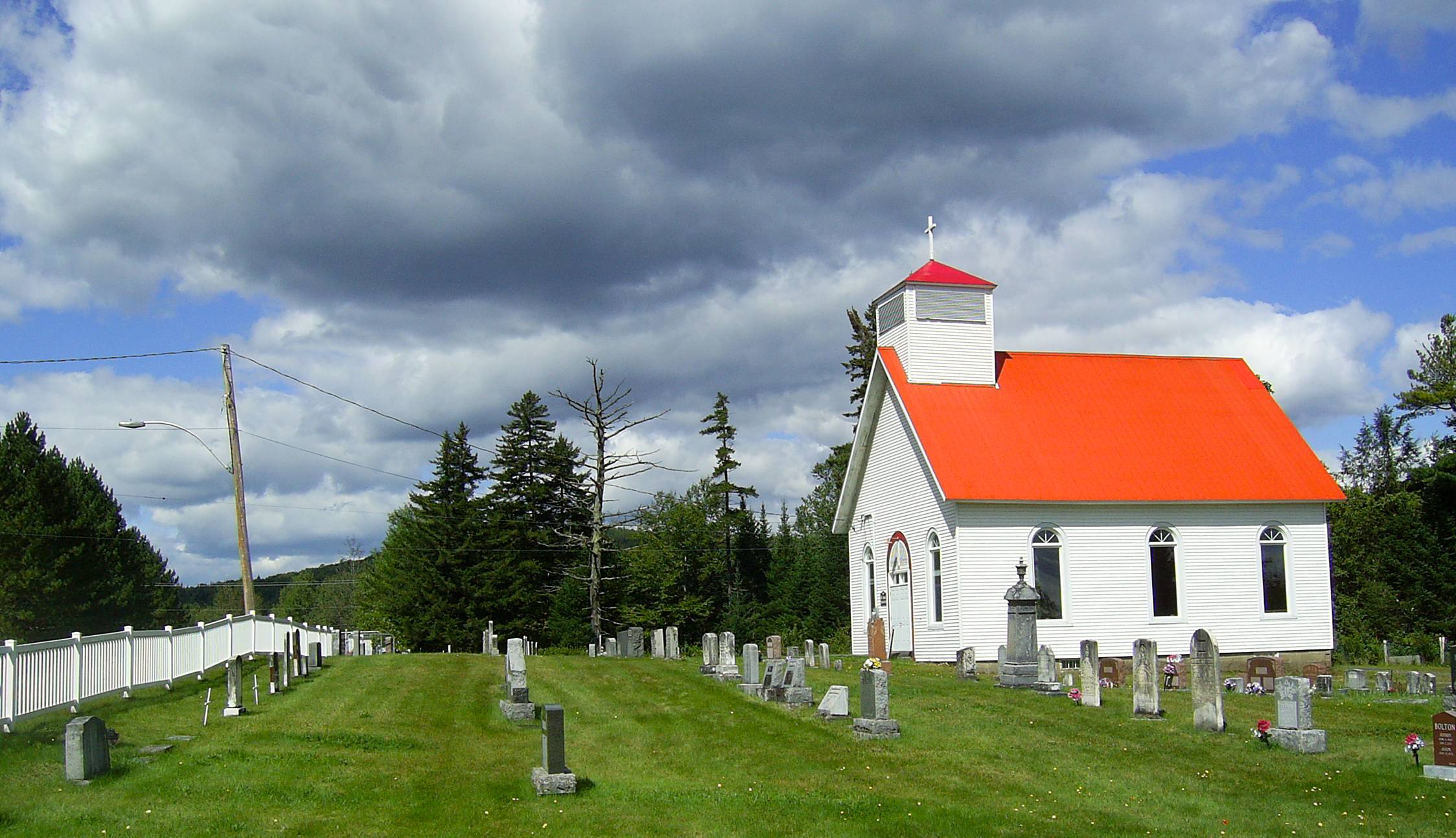
We skirt what we called Wallace Pond with its cottages and youth camp, pass a haulage company bearing my last name, catch sight of the Line -the wide treeless cut up through the woods that marks the dividing line between Canada and the United States, round a corner and find ourselves in front of the church.

SAMSUNG DIGITAL CAMERAHere there will be silent conversations.

I park the car south of the church where the church hall used to be and the wagon sheds where the horses sheltered and munched from their bag of oats while we children skidded the wax onto the hardwood floor and the fiddles tuned up and the women hauled chicken pies out of the oven. I suppose this liveliness vanished long before the hall did. I was in it last in the mid 80s, having brought my father down from Ontario for his cousin’s fiftieth wedding anniversary. When it was pulled down, its lovely wood panelling sold for scrap, I do not know.

Georgia is the first to see that Uncle S. has died. His name joined his wife’s on the gravestone not long after we were here four years ago. Georgia is bitterly aggrieved that no one let us know. But, really, who is left that knows how to get in touch with us? Only our cousin R., 11 years older than me, but even he doesn’t answer my emails. Probably  an uncle and aunt my own age are still living in the States, but we don’t know each others’ addresses.

We visit each gravestone and leave flowers for our Nanny and our Aunt Mae. The wind purrs through the pines that stand at the edge of the church yard above Indian River. Nanny and I took off our shoes the last time I visited her -she was 87- and went wading in the cold mountain stream. And one of my best memories is of a church picnic a little farther up in a pine grove. After we had eaten, the women washed the dishes in the river. A well informed 4 year-old, I was aghast. “Don’t worry, Joy,” Maude sang out.” We’ll scald them off when we get home.”

We cross the bridge and point the car up the dirt road that leads to Cannon Hill. (Sometimes, we children called it McCannon.) It winds steeply up through the woods. I know that a good trout stream is dropping down through the trees beside us, for my father took me fishing there. I also know that wood spirits live there, brownies perhaps, rather malevolent little beings, quite unlike the fairies that lived in the corners of the hayfield and came in rainbow colours. Neither had the magnificence of the angels that I saw twice when I was little and once when I was 42. I don’t believe any of this really, but, on the other hand, I know it to be true.

Here on the right is the farm I remember living on, although both barn and house have long since been rebuilt. What used to be a hayfield is pasture now and there are cows there. Then we are back into woods. Soon we will come to the Swamp, the part we children didn’t care for. I want the road just to go on and on. I don’t want to sail out into open and see the house where Nanny lived alone until she was well over 90. There it is now, with a long well groomed side yard planted with small fruit trees. Much of the white siding is still missing as an insulating upgrade proceeds slowly. I prefer to remember the gleaming white siding and the neat, little screened porch. We turn right, pass in front of the house and continue on up into the wilderness that lies below the mountain. We are making a pilgrimage past Aunt Mae’s tiny house. The road is much better than it used to be because somebody with influence and money has built a house out back of beyond. A very nice house, quite a cut above Aunt Mae’s.

On the way out, we stop near where Nanny’s first house stood, the one that burned down- well, the second one burned down too actually. By ‘down’, I mean utterly, to the cellar hole. I want to walk but mine is apparently a minority opinion. We press on, waving at the men loading a pickup in Nanny’s yard. Yes, one is probably Aunt Mae’s grandson, but we don’t feel up to the explanations. Our cousin R. has just had his driveway paved. It is covered in fresh tar and roped off. No sign of his huge white SUV.. Now we are higher between open fields, past the new forest that covers our grandfather’s fields.

He  had a stone boat, a sledge into which he threw the heavy rocks he dug out of his fields. The horses would drag the contraption over to the stone pile around the big spruce tree or one of the other half dozen that he and his long dead predecessors had broken their backs building and he would heave them off. Sic transit and all that. A rich American bought the land and planted it in trees.

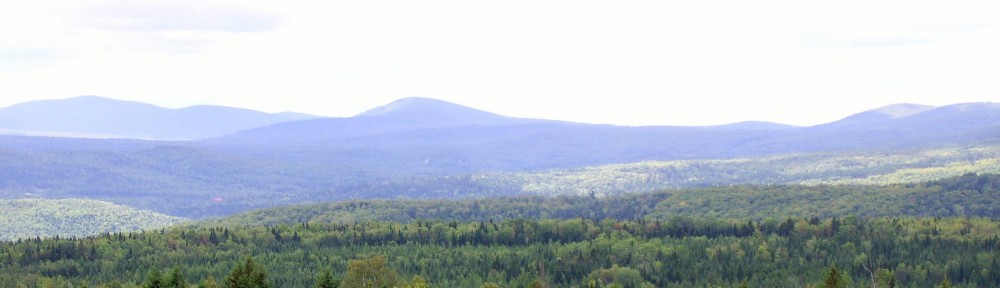
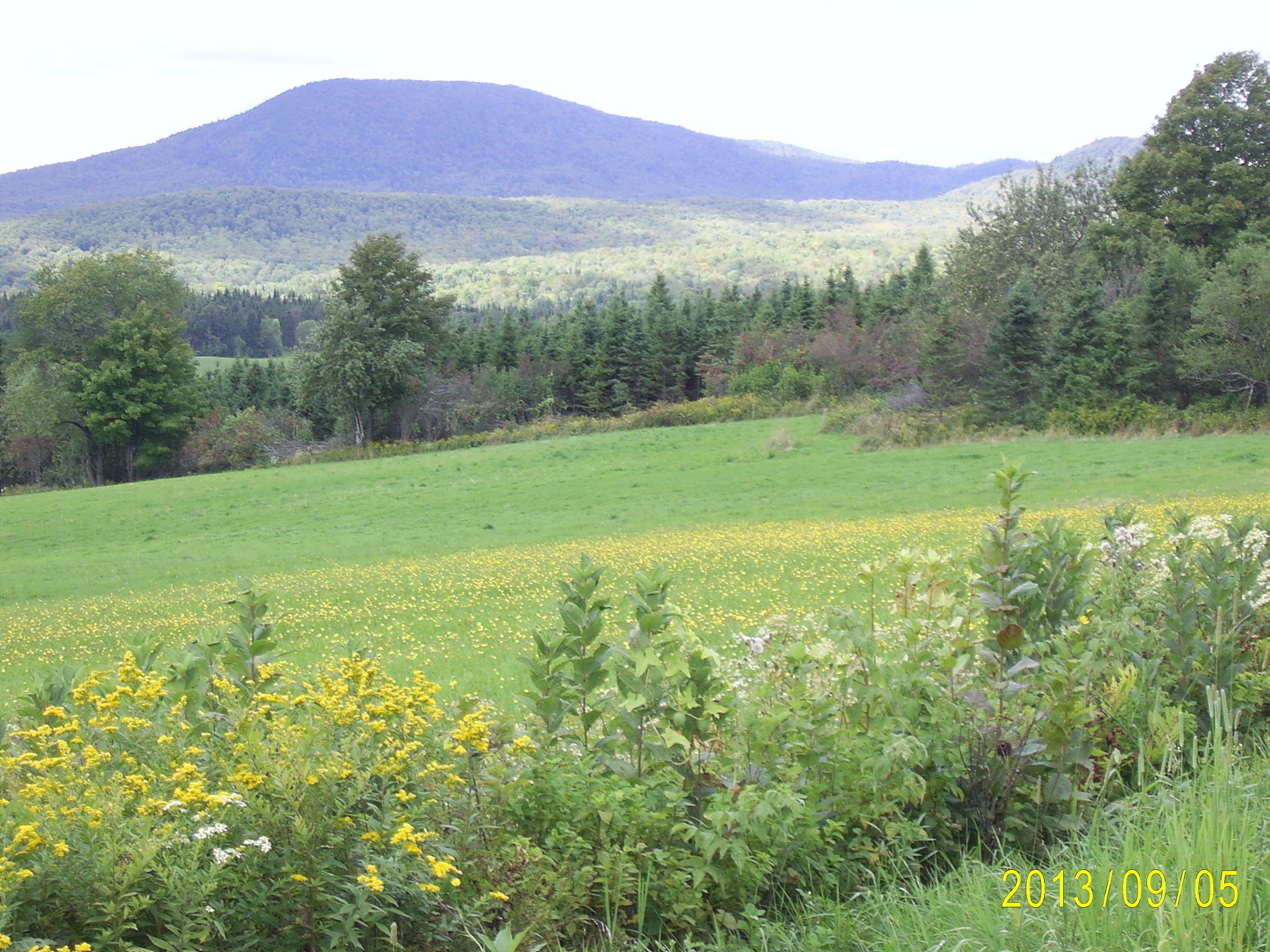
At the highest point, we stop to take pictures of the mountain vista.

SAMSUNG DIGITAL CAMERA

SAMSUNG DIGITAL CAMERASAMSUNG DIGITAL CAMERASAMSUNG DIGITAL CAMERAThen we drive down a truly scarey incline past our Uncle S’s house, one of those that make you think you vehicle will tip end over end, Then we are on the road that once changed places with the brook during a flood and we drove on the stream bed for weeks. (It was war time and we didn’t vote for the party in power,)

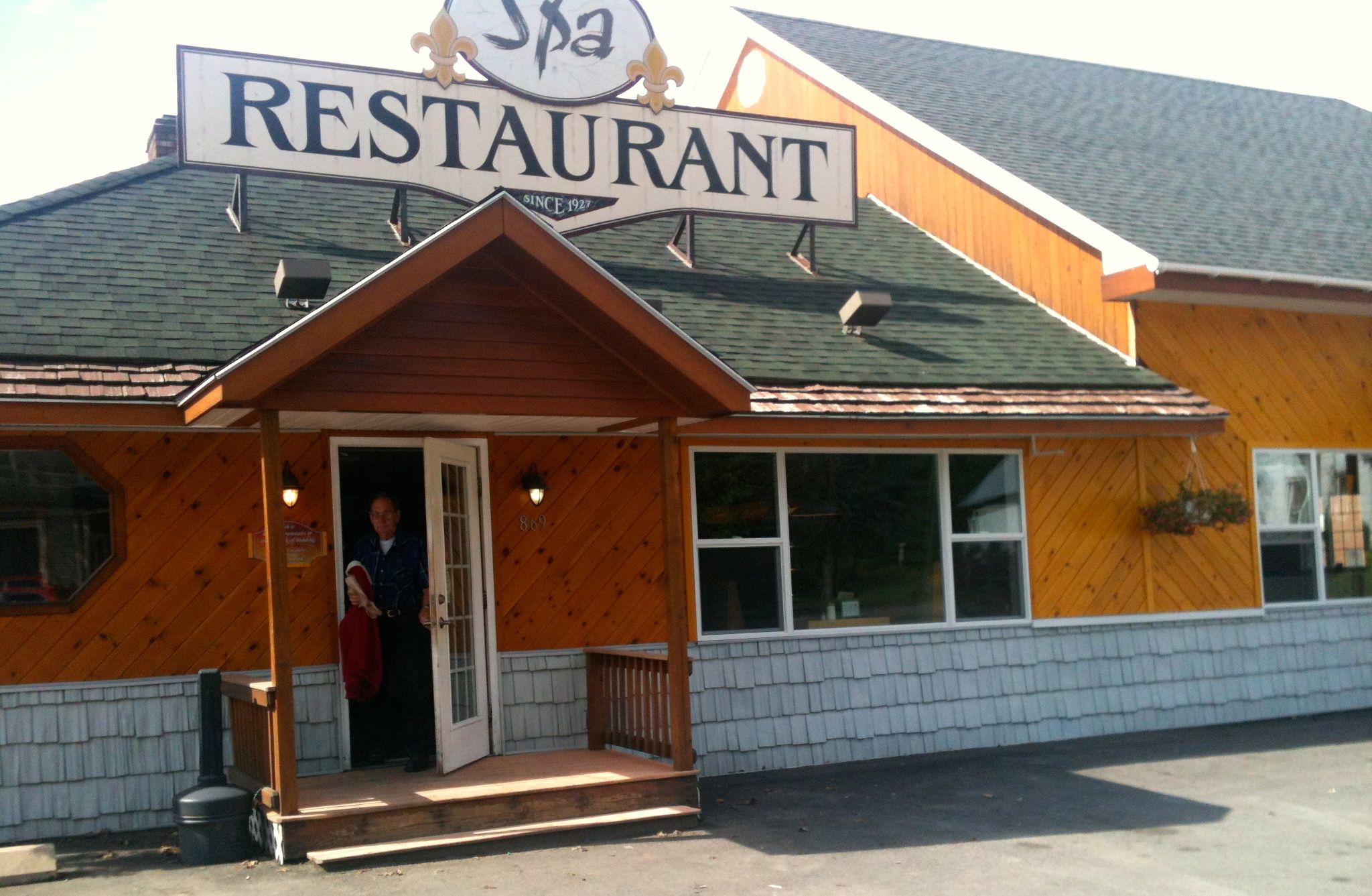
We cross the border at Beecher Falls, discovering that the agent on duty can fill us in about Cousin R. who seems to alive and kicking. We stop for lunch at Nanny’s favourite restaurant, the Spa in Canaan where I have fresh Maine lobster.

the SpaHereford was in Quebec and Canada, but we drew our identity from the States, from Vermont and New Hampshire and Maine, from New England. Every New Year’s Eve, we gathered in the hall for an oyster supper. We even spoke with New England accent. LIke most immigrants, I got rid of mine asap but when Nanny said “Spa”, I thought she meant “Spar”.

As we attempt to cross back into Canada at the Hereford crossing, the Canadian agent keeps questioning us closely. Georgia tells him we crossed at Beecher Falls an hour ago and ate lunch and that we are now returning to Ayres Cliff. I repeat the same story. He keeps glancing at the luggage filled hatchback. “So you are coming from New Brunswick?” he says. Well, no, we are coming from Ayres Cliff and going to Ayres Cliff. “Then why do you have your bags?” he asks in exasperation. Because we are changing hotels? I offer as if seeking his approval. “Ahhh” and he waves us through.

PLEASE CLICK ON PICTURES TO ENJOY FULL DETAIL.

to be continued -one more time

Septuagenarians on the Road: #3

SAMSUNG DIGITAL CAMERASo Georgia and I decided to take a sentimental journey, back to our roots. We started out on her birthday, the day after Labour Day (See https://115journals.com/2013/08/31/labour-day-weekend-reflections/)

We didn’t make the decision lightly. We divided hip stiffness into the mileage and arrived at a two day trip. We reserved a hotel room at the Waterfront Holiday Inn in Kingston Ontario, which we thought was half way from Toronto to Ayres Cliff, Quebec. We were wrong. It was more like a third of the way there, but when we got to KIngson, we realized that factoring in the fatigue of packing and hefting bags made it a good choice.

When asked if we need help with our bags, my macho sister says no. Being older, I know better. Imagine the most awkward grocery cart you have ever tried to steer, turn it into a luggage cart, top-heavy with a hanging bar, add a tiny elevator and thick pile on the hall carpet.

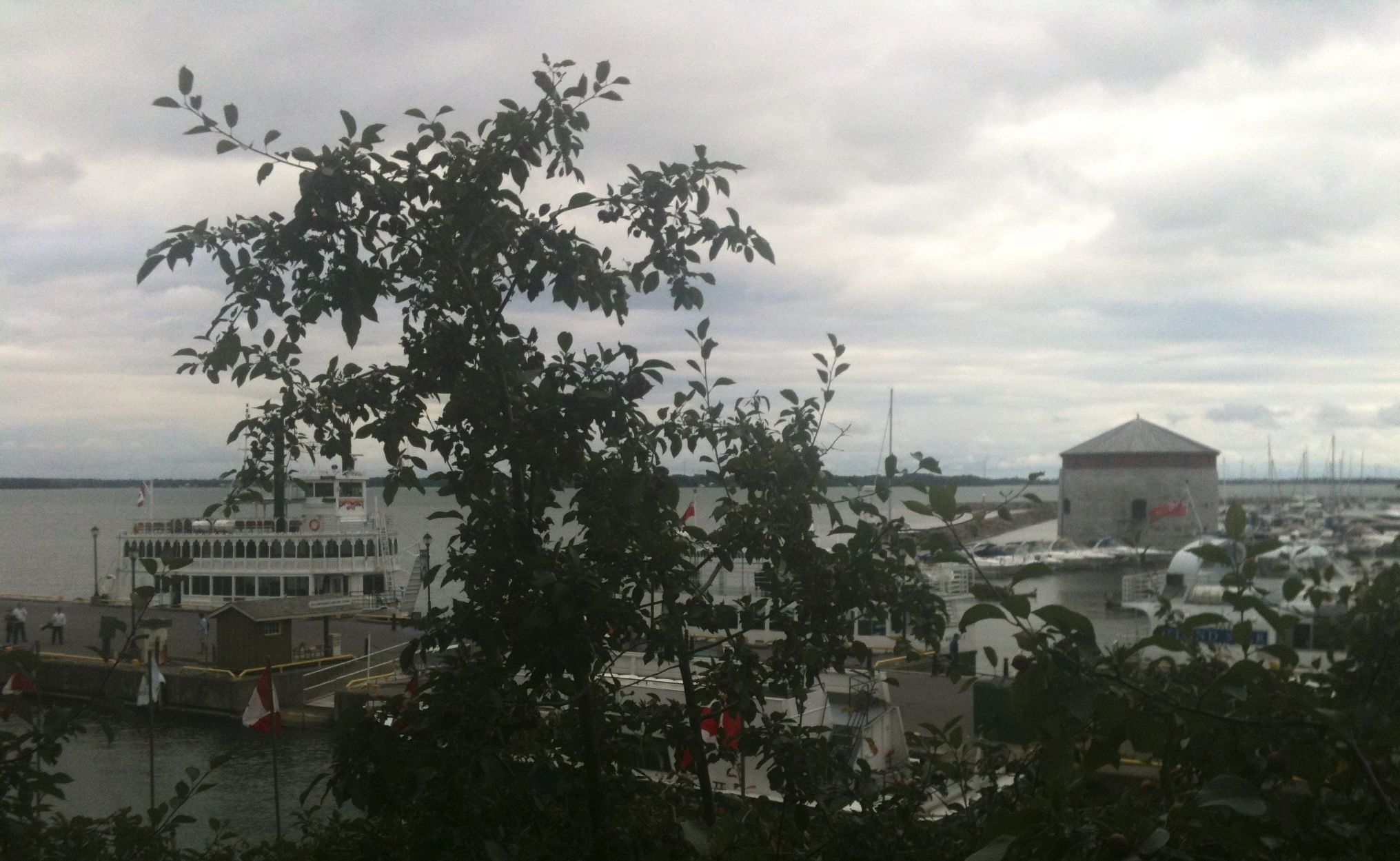
Still it is a beautiful room that looks out over the ferry docks and one of the six squat, round Martello towers that guarded Upper Canada from the American invaders.

Martello Tower, KingstonWe stayed in a similar room 4 years ago when we last made this trip. The place is not much changed. The question is are we?

We rest. Resting will be a recurring theme in this blog post as it is in our lives. I would say ‘in the lives of septuagenarians in general’, but Blake (see http://115journals.com/2012/05/26/septuagenarians-on-the-road-part-1/ and https://115journals.com/2012/05/27/septuagenarians-on-the-road-part-2/ ) doesn’t rest much. Resting like Archemedes’ lever makes all things possible.

Then it is time to pop the cork on the Veuve Cliquot. It is a birthday after all.

It seems wise to find a restaurant within walking distance, so we search through the available literature and come up with Olivia, an Italian restaurant two short blocks away. As it turns out there is live jazz from the Dave Barton trio with Amanda Balysy on vocals. Amanda has a retro look, blouse and skirt out of the 50s and songs to match. So the ambience is delightful. The day’s special of wild boar sausage seems too demanding for my digestion and I willfully ignore the black cod and order risotto. As soon as I lay eyes on it, I know I have been wrong. I’m used to risotto at Marcellos in Toronto where they don’t even add cheese. This dish is swimming in cheese and oil. But the optimism of the moment prevails and I take the risk.

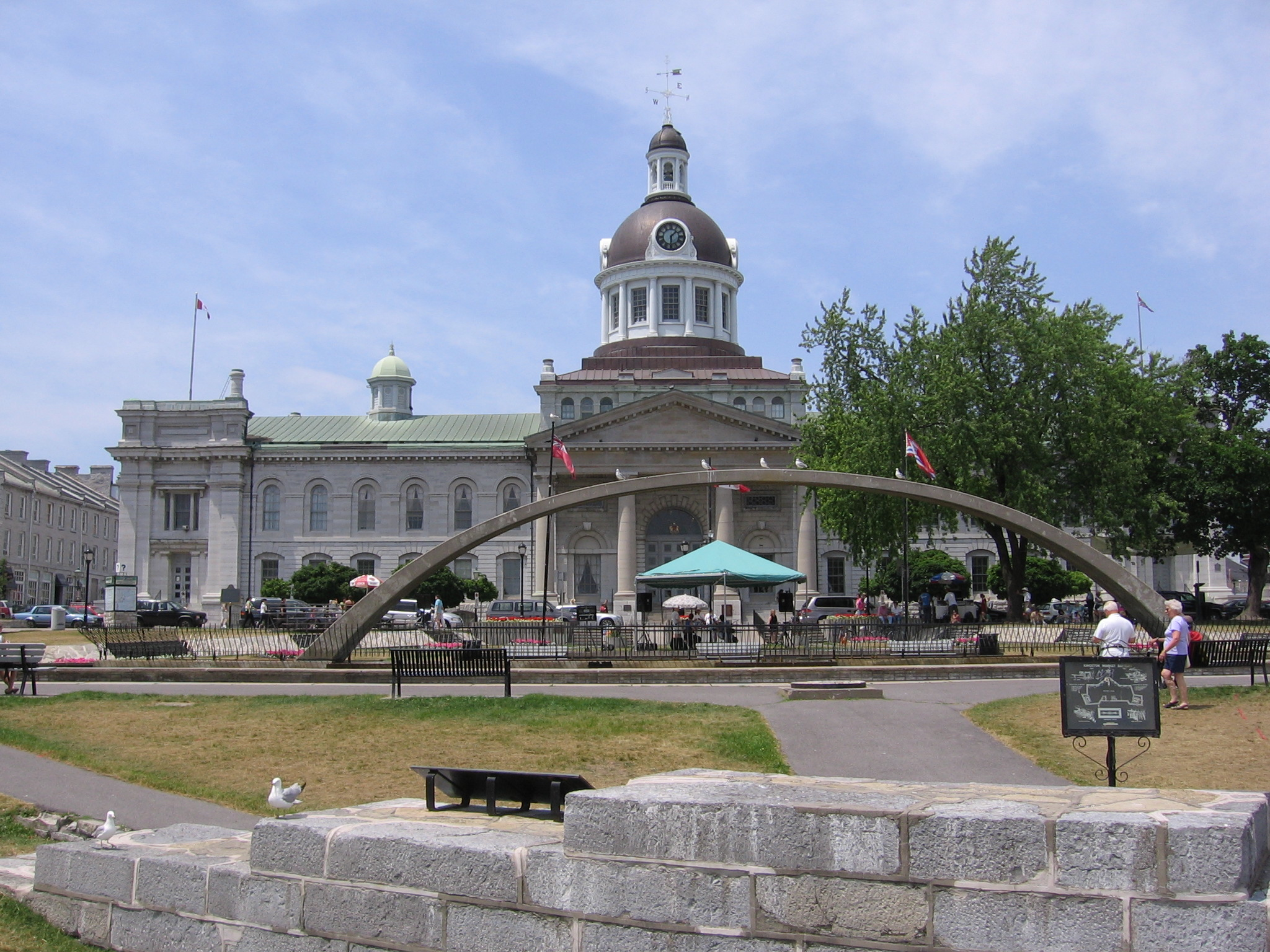
As evening falls, the Kingston City Hall across the square becomes ever more beautiful (http://en.wikipedia.org/wiki/File:Kingston_City_Hall_Andrew_pmk.JPG). Its limestone glows silver and its lovely dome stands etched against the sky. After dinner, we sit in the park at the water’s edge and enjoy its beauty.

Kingston_City_Hall__#3All in all, the day has gone well, we think. Georgia settles down to watch Netflix on my Mac Air Book and I lie down to sleep. To no avail. Yes, I am tired enough to sleep, but my body has other ideas. I am aching all over. The pillows labelled soft are so soft, I feel smothered. The ones labelled hard hurt my head but don’t support my neck. But most of all I blame the risotto. Years ago, in this same town, I spent the night sitting on the bathroom floor reading John Irving’s The World According to Garp.I might have been better to spend this night there as well.

I’ve had considerable experience with insomnia – who hasn’t at this age?- and developed strategies to deal with it. In between bathroom trips, I try them all. First, I roll up a bath towel and put it under my long neck, a softer version of the wooden Japanese head rest. I do my three part deep breathing exercise over and over. I take a sleep aid. I put in my ear buds and hit the white noise App on my iPhone. Even the continuous swish of heavy rain doesn’t send me off. By now, Georgia is soundly asleep, or so it seems for she is very softly snoring. At what seems like 2 a.m, but is actually much earlier, I get up to do tai chi exercises in the dark. That seems to calm my system down. Then just as I begin to slip into sleep, someone hammers on the door next to us and calls out in a aggrieved voice, “Come on Michael, I forgot my key.” Apparently that is just the ticket. I am gone. I don’t even wake up when Georgia spends an hour reading at 3 a.m. Of course, in the morning, she maintains not only that I had kept her awake, but also that I was groaning. Perhaps she is right.

So unrefreshed, we find our way to the complimentary breakfast with a view of the water. I am unenthusiastic about eating but I need to take on fuel. Fortunately, Georgia is able to enjoy the free meal, which we have earned by being members of the Canadian Automobile Association.

There is one more little hiccup. I neglected to bring down our parking stub. There is no attendant. Fortunately, someone from the bar across the street yells out instructions on what button to push to contact the office and my car is finally released. That is one drawback to this particular hotel. We call them parking Nazis.

So we set out on the second lap of our journey and a very long lap it turns out to be. It begins with a Google Map gaff -you have surely experienced at least one of those. Instructions are to head north on Princess St, which is, as luck would have it, one way, going south. We do what we can and find ourselves crossing bridges we’ve never seen before and confronting signs to west bound 401. We reason that east bound 401 has to be in approximately the same place, but the west bound signs proliferate and get larger. Just a little kick of adrenaline from the Ontario Ministry of Transportation. Once we have achieved the elusive east bound highway, we feel as if it can only get easier.

The newly renovated ONroute service centres are a plus, clean and up-to-date. You can take your own lunch in and eat it at the tables or make one up from Tim Hortons and Subway or Burger King. I carry in my rice crackers and home-made salad dressing, and manage to scrounge up salad and chicken to go with them. We take turns driving, trading off every hour or so. Some time after lunch, we cross the provincial border into Quebec. I recall that there used to be a lovely stone building in the old style, which served as an information centre. A few of those stones seemed to have been recycled into the service centre that has replaced it. I line up at the counter to ask the same question as everyone else. Google had told me to take exit 29 to new highway 30, but the maps show no bridge there. What gives? The bilingual receptionist has the interesting skill of being able to write on a map upside down and she assures me that there is now a bridge, which will cost me $1.50 to cross. If you have ever had to drive into the city Montreal to cross the St. Lawrence River on the Champlain Bridge, you may understand what a cause for rejoicing that is. As we discover the bridge is really two bridges, the first one low to the water and the second soaring up over the widest part of the river to let the ships pass up the St Lawrence Seaway.

So we skirt Montreal in that low level river land, which is fertile but also being eaten up by industry as time passes. Now all signs are exclusively in French. Sud and nord are simple enough and easy to figure out as south and north. Est and ouest are trickier. I keep reciting “est” as a clue to finding the right exit to #15, which will take us toward Sherbrooke. “Traveaux” is pretty clear, including as it does miles of orange cones and on occasion, actual workers and machines. The sign that orders us to respect the security zone or so it seems, puzzles me, until I realize that I am to pull out into the left lane when I see someone stopped on the shoulder. Then there is an urgent LED sign that absolutely eludes me. I can not catch even one word. We fly by oblivious.

Like all Canadian children, I have studied French, in my case until I was in grade 12. Moreover, I have a brother who lives in Belgium and speaks French most of the time. I have spent long holidays there and in France. I just finished watching Spiral on Netflix, a made-in-France police drama, with  sub-titles, it must be said. I’m more than willing to give it my all, but really! Nothing but French. The stop signs say “Arret”. Even in Europe, they say “Stop”. When I am flying along at 110 km, I could use a little help.

We can just glimpse Mount Royal over the river on the horizon. Then a solitary mountain rises from the plain, a volcanic cone. The country grows more rural. The road begins to rise and curve and finally, we begin to see the soul-soothing mountains of our childhood, the northern-most Appalachians.

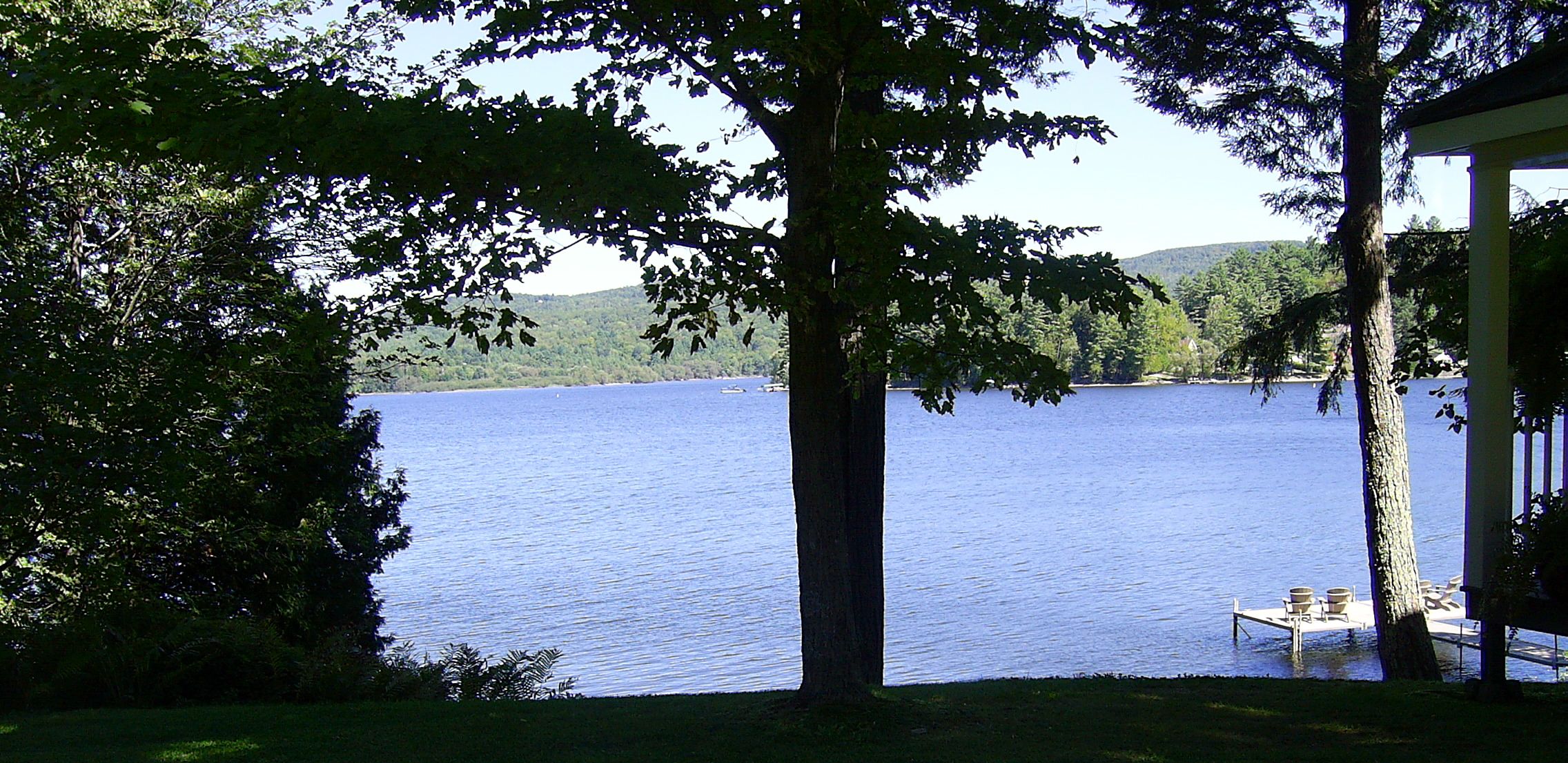
By the time, we round the corner into Ayres Cliff, we have been on the road for six hours. I seem to think I know where the Auberge Ayres Cliff is and I am not wrong, although I hadn’t realized it was right in the middle of town, a quiet tourist town of one main street and side streets leading down to Lake Massawippi. I stayed somewhere near here 16 years ago, but it takes me a full 24 hours to realize it was the same place and when I do, I seriously wonder if senility has crept up on me. It is a hard place to forget. It is said to be 200 years old and while that may not be an exact number, it is certainly very old. (www.aubergeayrescliff)

It has a huge patio at the side, full of expensive wicker seating and those outdoor heaters and little canvas-covered nooks, all on wooden decking. It also has seating on the veranda. We check in at the bar where some of the locals are having lively conversations. I’d like to join them, but we have to go up to see our room. Up is the operative word. We are the only guests, but we have booked two adjoining rooms, which are on the third floor. The second flight of stairs is made up of a large number of steps -each one 14 inches high.

The rooms are furnished with a double bed each, with good mattresses and dressers in a VIctorian style. And a  fan. There are no chairs. There certainly is no television set. No mention is made of this but apparently we were warned on the website. I give Georgia the room that has a more or less level floor, it being her birthday, and allot myself the one that slopes so dramatically that it takes all my tai chi balance to walk across it.

And yes, we want to have our bags brought up, a task that falls to the slim bartender/receptionist/ farmer’s daughter and a guy who gets up from dinner with his family to help her.

It is clear that we would not have got much sleep if we had come a few days before, on Labour Day weekend, but summer is over, the temperature has fallen, the tourists have left.

True to their hype, they have an excellent Angus beef fillet mignon. After dinner and the long slog back up the stairs, I get Georgia set up on the internet to watch Netflix: she is well into season 5 of Weeds and well fed with simple food, I fall fast asleep in my Alice in Wonderland room.

to be continued

Labour Day Weekend: reflections

SAMSUNG DIGITAL CAMERA(And yes, I can spell. It’s just that I follow a different tradition. Stubbornly, it seems.)

The dreaded weekend has come. The end of summer. A cacophony (strictly speaking a ‘murder’) of crows announced it this morning.

Oh, sure, we can assure ourselves that September can be the best of summer still, but that’s bravado, positive thinking gone rogue. Realistically, we know the light is failing. Vegetable gardens started telling us that weeks ago. Here at least, at 43.7° N. where the squash and cucumber vines have died back and the tomatoes are refusing to ripen. I can no longer count on light at 6 a.m. and the evening moves faster into night.

There were more swallows than ever sweeping across the sky two evenings ago, as they fatten up to cross the big lake and leave these shores. This evening, they may be gone. And it doesn’t help that I know they will come back to Capistrano on March 19th next year. It’s at 33° N and the swallows take another 40 days to get here.

Autumnal, that’s the word. ‘An early autumn walks the land/ And chills the breeze/And touches with her hand/The summer trees….’ etc. ( Courtesy Johnny Mercer) I would say it is all the more affecting because I am in the autumn of my life, but that would be false. The autumn of my life, I glimpse only in the rear view mirror. While I sometimes question how many more springs there are left, I never ask how many falls.

This weekend, the skies above are rent by low flying fighter jets, as the annual air show gets underway. While there are those who love the thrill of a group of jets roaring just above rooftop, I am not one of them, although I admit there is no need for coffee and the pumping adrenaline more than offsets the weary wintery-ness of age.

In the spirit of the occasion, let us consider Labour Day weekends past. Here in at 43.7° N., school begins on the Tuesday after Labour Day now as it did over 70 years ago when I started. My mother and I had planned that I would wear my sailor dress, light blue with a navy blue sailor’s collar and a narrow red stripe, and she would walk with me, holding my hand and teach me how to cross the street in our little town. The best laid plans and all that. Turned out my mother was far away in a maternity ward of the hospital that morning when I woke up. I was outraged. How could she? I was fed breakfast by my cousin next door and towed unwillingly to school by the grade 3-er across the street. Very early indeed, in case her friends saw her with my lowly grade 1-self, sailor dress or not.

The upside of this was that every Labour Day thereafter I got to celebrate my sister’s birthday. In addition, my mother’s betrayal led me to bond with Miss Graham, my teacher, to such an extent that I continued returning to school for the next 50 years, as student and teacher.

The year that I gave that up going back to school the day after Labour Day was so traumatic that I could deal with it only by setting out to drive across the continent to Los Angeles. Crossing the border in my heavy laden Tercel I was knocked sideways by the American border guard. (Metaphorically that is.) He was worried about whether I had green apples and where my ex-husband was at the moment. No and don’t know. He successfully banished all first-day-of-school nostalgia quite out of my head.

Driving across the continent by yourself takes a while, the sun streaming in through the driver’s side window, day after day. Mind boggled by the wide rivers and the deep canyons and the endless oppressive desert. Terrified of falling asleep at the wheel, of taking a wrong turn on a freeway. My expensive car phone without service most of the time. Then just so tired, I had to hole up and sleep in a well air-conditioned ‘better’ motel where the furniture wasn’t bolted to the floor. When I finally emerged and drove down off the Santa Monica Freeway to glimpse the Pacific, I had left my school self behind. But what did I discover in my daughter’s house? No not green apples! My ex-husband!  Just what the border guard feared. A reconstitution  of a family separated for 15 years for the purpose of defrauding the U.S. government. Somehow.

This year, I have other plans. My sister and I are going to return to the mountains of Quebec’s Eastern Townships where we were born. Her birthday treat. Not that there is family there any more. Well, maybe one. Eighty eight he’d be, if still extant. And the old house we loved isn’t tidy and white any more. The barn is just a heap, a mound of earth where the ramp to the haymow was. My grandfather’s fields, cleared with such killing effort, have been put back to trees. Unbelievably, actually planted with trees! You can barely see our slope-shouldered mountain for the woods. Nevertheless, we will drive the gravel roads and breathe the spruce air and feel our native earth beneath our feet.

And these two one-upon-a-time teachers will take solace in an excellent hotel on Lake Massawippi where the furniture is definitely not bolted to the floor.

Septuagenarians at Sea: #2

Rick at tiller '12(I’m categorizing this post as humour but don’t get your hopes up.)

So I set off late to meet Blake and go sailing, but since Blake is unlikely to care about punctuality, I’m not worried. What I am apparently is absentminded. I sit at the “punishment” light at the bottom of my street, daydreaming. Four minutes later I wheel left and then right up the ramp to the Gardiner Expressway. No traffic. Great! Soon I am flying by the last exit to the Lakeshore which runs parallel and, oddly enough, along the lake shore. The Gardiner is about to achieve elevation. I realize I should have taken that exit. That last exit! I realize I should, in fact, have turned right at the punishment light and taken Lakeshore Blvd. I am on the wrong road altogether!

Okay, now I’m worried. Surely if I take the Spadina exit, I can turn right, go south and double back on the Lakeshore. I sail down the exit. Absolutely no right turn. Because the Lakeshore eastbound lanes are where the turn should be.The westbound lanes are no where to be seen.  Darn.

I turn left, avoid the first left turn as unpromising, carry on up over the railway tracks and slide into the left turn lane for Front St. Oh good, we have an advanced green. Not so good, we have a driver who is waiting for something better. That’s what my horn is for, tinny though it is. At Bathurst, I catch another punishment light. An orange and green taxi and my red Yaris, wait and wait and wait. Then we are released to turn left and re-cross the railway tracks. Left or right? Left or right, Joyce? Make up your mind. Okay I pick right.

Alas. While it is the right direction- I can see the Tip Top Tailor sign on the top of  a building, I can’t get there- I am on Fleet St, which parallels Lakeshore W, but never the twain shall meet. I have to keep driving west, on the other side of the dedicated streetcar line, well-protected by concrete barriers. I steam on in the direction of the Exhibition, our seasonal adventure in frivolity. Okay finally, an available left hand turn onto Strachan. With an advanced green and a mere 7 cars waiting. The light changes. We’ve got it. Guys! Guys! I am 7 cars back but the only one willing to tell those stupid tourists at the front how to turn on an advanced green.

Since there is a T intersection at the Lakeshore, I make the left turn easily for once. And at last I am back where I should have been 20 minutes ago.

Blake is sitting in the club dining room, over the remains of his late (very late) breakfast, unperturbed, and he orders me a glass of pinot noir to calm me down.

By the time we collect his little dog and take the water taxi out to where Sirroco is moored it is mid-afternoon. Not that it matters. Sailing proceeds on slow time. The bugs have to be swept up. Well, some of them, anyway. The mainsail cover has to be removed and shaken. We have to decide which genoa to use. The wind isn’t quite as gentle as Blake led me to believe, so I vote for the #2. Astonishingly, he agrees. As usual, the main gets caught as he pulls it up.

Rick rigging sailHe starts the motor and hands me the tiller.

Excuse me. Hasn’t there been some mistake? Apparently not for he is off up onto the bow to pull up the gennie. “Just aim for that buoy,” he calls back. “It doesn’t really matter but it makes a good reference point.”

There are two things about steering a sailboat with a tiller. It’s like driving from the back seat of a car and once the sails are up, visibility gets worse. Then there is the fact that if you want to go starboard (right to you landlubbers) you push the tiller left and vice versa. Oh my goodness! There is a motor launch bearing down on us portside and downwind a smaller sailboat. The southwest wind has freshened and there is a nasty little chop. Panic! Panic! Then suddenly, my almost 40 year-old body-memory takes over and I discover, not only that I can steer, but I know who to avoid and who has to avoid us. Once the sails are up, I find it easy to keep them full by nudging the tiller gently. It’s like playing a huge kite high in the air. I am part of the boat.

We sail west to Humber Bay and come about. By now the dog has given up her post as a living figurehead jutting out from the prow and has come back to the cockpit. She is wearing a dog life jacket with a convenient carrying handle on her back. A long line is attached to it. She has on occasion fallen or jumped in, swum about and been pulled back aboard. Never at speed. I once learned a physics lesson while trying to fill a pail with water at 6 knots. I bore the stigmata on my palms for some time.

“Do you want to sail around the island?” Blake asks.

‘Twas ever thus. It sounds like such a good idea.

“Will you get too tired?” he asks.

“I don’t know,” I reply. I seem to have spent my life agreeing to such good ideas. And living to see it was not wise. I imagine that I will be very very tired if we sail around the island, but it is such a good idea. So we do. In my defense, I can only say that we skip jumping off for a swim.

Now that we are going downwind, we seem to be standing still. Only the trees move in relation to the CN Tower. Perspective seems distorted. The people walking on the island seem like ants, but I know we are not that far away. Kayakers and paddlers on boards, miniscule. The freighter at the wharf, not so much. Like Alice in Wonderland, I resort to nibbling – on a cheese tray and handing large chunks to skipper Blake on the knife blade. We forgot the crackers.

The dog has been sitting on me so long that both of us need to stretch. A good time to come about again. But the southwest wind isn’t as strong as it was. Perhaps it is evening coming on or the city moderating its influence.

city from boatBlake decides to put the motor on and take down the sails, handing me the tiller just as we are about to pass in front of the ferry dock. Which is fully loaded, two car ferries straining at the bit. While it is true that we have the right of way over large motorized vessels, it is not a point I want to press. But, hey, I take my ease. I make my own decisions and they turn out to be the right ones. I do draw the line at getting the boat through the gap and hooking the mooring line up over the cleat.

It has been only 5 hours, but 5 hours of the most beautiful water and sky. Five hours of peace that passes understanding. It feels as if I have had a week’s holiday.

And it will only be 2 days before this septuagenarian body gets rested.

Sirroco, taken on a previous voyage

Sirroco, taken on a previous voyage

Starving in the Dark: septuagenarian faces flash flood

Last week, a Calgarian, worn out by the flooded Bow River perhaps, wrote a letter to the National Post in which he invited Torontonians to starve to death in the dark. Alberta has the oil after all. I thought “yeah, yeah” that’s an old one – 40 yrs at least.

On Monday, I am reading with my feet up, worn out by my negotiation with a Toyota salesman. It is all but pitch dark at 4:30 p.m. but I’m used to that. It has rained torrentially at that hour many times this year. It starts to pour. I keep reading – a fictional account of the London blitz as it happens.

On Sunday, I got caught in one of these downpours. I huddled in a doorway for 15 minutes, watching water 4 in. deep race down the street. The rain got steadily worse. I put up my umbrella and set out for my car, two short blocks away. I met a guy with a clinging wet t-shirt, who smiled ruefully. My pants were soaked up to the knee and by the time I got the umbrella down, so was my the car seat. I sat in the car reading, waiting until I could see out the windshield. When I could, I chose my route carefully, avoiding the deep dip in the road to the south of my place where it floods. I’ve learned at least that much this year.

As I read about the horrors of rescue in the London blitz, lightning flashes through the window. Okay, supper time. As I walk toward the kitchen, I observe that I cannot see out my windows.

Full disclosure – I still harbour a 2 year-old within, who found herself with an unconscious baby sitter in the middle of a hurricane. By that I do not mean ‘inattentive’. I mean-down-for- the-count and never-right-again unconscious. It was only one long hungry day before I was rescued, but of course it seemed like forever. I am actually reassuring this hysterical inner-child when the carbon monoxide alarms scream, various things beep and the lights go out.

No problem. Right? It’ll come right back on. GIve it a minute. Fortunately, I do not know that the underground transformer that feeds the west end is now 30 ft. deep in water.

So it begins.

I activate the CBC app on my phone and discover the subway is flooded and shut down. The streets are jammed with wet pedestrians. The traffic lights are out and rush hour is at a standstill.

Frank, my landlord, emerges from his own underground lair to watch the storm through the front storm door. (So that’s why it doesn’t have a screen.) An hour later, the upstairs tenant arrives reporting that she was the last person allowed south on the Don Valley Parkway. She drove through the river, which was already over the road. The cars behind her were turned back, driving the wrong way to exit in the middle of the city. Her trip took twice the usual time, she is all but out of gas and there are no working gas pumps.

I leave my apartment door open and consider food.

Besides the screaming inner-child, I have dietary limitations. The list of things I can’t eat is far longer than the list of those I can. I cannot, for example, eat bread. I can eat brown rice and there is some in the fridge and there is cold chicken and salad mix. No problem. The trick is not to tarry in front of an open fridge door.

I haul the lantern out of its closet and discover the D cell batteries still work. I light the available candles -beeswax of course. Regular candles make my eyes burn. I eat my cold dinner. How I long for tea -herbal- you guessed it. Sitting there, I decide that if civilization starts coming apart, with these ‘refined’ needs, I will be among the first to go. Well, there’s some good news.

The rain has more or less stopped. Using my CP24 app, I find that a train is sitting in the expanded Don River and 120 commuters are awaiting rescue by boat, tiny zodiacs as it turns out. They have had to scramble up to the upper deck and some of them will not get off until 12:30 a.m.

Meanwhile geysers of sewage have exploded out of utility holes. Cars have been abandoned, including one Ferrari. Fireman are rescuing people. Then my fading phone declares that it cannot access the internet. It’s only 9:30 but it’s time to go to bed.

I have a lovely dream. The carbon monoxide alarm has beeped and the room has been suffused with light. I wake up. Not.

In the morning, the second hand Twitter rumour is- power back by noon. This will change throughout the day and I will gradually lose my initial desire to join Twitter. Hope is not a winged thing that perches etc. Hope is a canard, a con. It misleads and keeps you from acceptance and necessary action. It takes me 24 hours to set up a rescue for my freezer goods, e.g., and in the meanwhile I lose over $50 worth of stuff.

How to live now?

Take inventory. There is still hot water. Most of the city has its power back. With all the blinds open, I can more or less see. No paper and the phone can no longer get a signal, too many others already on the system. I warm breakfast up in a pan of hot water, milk for cereal, green soup. I take a hot shower. I drive to the tai chi club where I can make tea, exercise and charge my phone. I even do 2 sets of tai chi. During tea break I go down to the basement restroom. What is this brown residue on the floor? I call for volunteer help and grab a mop. Patty joins me. The other, much younger class members, do not. In fact, one of them waxes outraged because she has to find another toilet. Meanwhile in a search for a pail and hot water, I have stumbled wetly into the downstairs practise hall. The carpet is soaked and a little pool sits in the middle. We give tours hoping to drum up help. Not so much. We phone a report in to an actual employee, wring out the mops and carry on with our lives.

I, for example, have to call on two cats whose mom is away. They are glad to see me and a note on the counter invites me to make tea. What a great idea! I plug the kettle in. I give one cat her medicine. I feed them. Hey, what happened to my tea? I know the power is on up here. But, the thing is, it isn’t. It’s what you call a rolling black-out. These black-outs roll with me as I roll westward. I see the traffic lights fire up behind me and go black in front.

By dinner time, I have been without hot food 30 hours and my weak digestion can’t take any more and besides, the food in the fridge is now inedible. I set out for a restaurant. First, I have to get to a place with power. This involves waiting 20 minutes at just one non-functioning light. Once there, I find the parking meters on the street don’t work and I know our parking officers will give tickets on Judgement Day, so I search out working meters. There are now only 22,000 householders without power and all of them have converged on Bloor West Village for food. Cash only. I found I had raided the hidden money envelope but still had $100 left, so that’s all right. I stand in line for 25 minutes. I can see empty tables. The maitre d’ can too, but he keeps handing out menus and bustling off, leaving us there. Very hungry.

Eventually, I am seated, single and wasteful though I am. I read to keep from raiding adjacent tables and when I finally get food, I nearly weep over the mashed potatoes.

In the evening, Blake, who has never lost power, shows up to take my freezer goods into custody. I serve him a warm beer while we sit in semi-darkness.

By next morning I discover that I get tea and ice at the super market south of me, which must have a generator. I am there by 7 a.m. and soon have an ice chest set up with lunch stuff. Should have done this yesterday. Why didn’t I? No idea. Hope precluded it? Or was it mental dysfunction? I note that we all seem to be suffering it.

At non-functioning traffic lights, you stop, look, take your turn. Do this 10 times and when you come to an actual red light, you start to do it again. The woman upstairs locks her keys in her apartment, fails to pick the lock and decides to kick it in. So much noise! And it doesn’t work. Our door locks have steel plates! I lose my glasses, find another pair and come back to discover the first pair right where I lost them.

We are all suddenly very neighbourly, except to the old guy who brags that he has power just 10 houses away. People share their barbecues, carrying pots across the street. We no longer share the estimated time of (power) arrival. We are cynics, one and all.

On Wednesday afternoon, I get gussied up- poppy red dress, leggings, good sandals and set off for a second round at Toyota. I am just pulling into the parking lot when Frank calls to tell me the power is back on. I can’t say I believe it will last, but I finish the car deal and go to the green grocers and the butcher shop, pretending I believe it.

It is indeed on. I have light and a kettle that comes to a boil. I do manage to set the fire alarm off, having apparently forgotten how to cook, but after two days, it is over.

Thursday morning, I assume it is life as normal. I get to the tai chi club late. I’m still so discombobulated it takes me ages just to do a simple task like get dressed. I go through the club’s back door and an odour like something burnt sends me reeling. I know that smell. Mould! It’s okay, I’m reassured, the water has been vacuumed up. It’s fine. Try the upstairs class.

Listen if you take a canary down a coal mine don’t try to argue with it. If it falls over, get outa there. In this case, it is the canary that escapes.

By now, my head is aching badly, very badly. I can’t go back there, I reason on my long drive home. Maybe never, at least not until cold weather.

At home, I decide to try one thing. I email the location leader, telling him that mould is a health hazard not just a bad smell. Then I call ma soeur, Georgia, who listens to me rail. When I get off the phone, I see the message light flashing. The location leader has called our contractor who said hell yes, the carpet has to come out and the floor has to be treated with fungicide. I call our leader back, full of gratitude. Now my exile is down to a week or so while the place gets cleaned.

Now if only this headache would quit….

The Opposite of Fate: destiny or random chance

I have borrowed the title of Amy Tan’s book, The Opposite of Fate as a focus through which to consider the week’s events, public and personal. This non-fiction book is a series of musings, leaning toward autobiography, in which the Chinese-American writer posits hope as fate’s opposite, according to The Penguin reader’s guide. As I recall, however, the opposite of fate is destiny: fate is something imposed, whereas destiny involves conscious choice. Some cultures, including Tan’s parents’ culture, believe in fate. Some, like the Greek culture, are even called fatalistic. Certainly, the idea of destiny involves more optimism. We don’t like to think of ourselves as being ground down by the gods, anymore than we like to admit that life is just a series of random events. We crave meaning as a way to survive.

Thornton Wilder in his 1927 novel, The Bridge of San Luis Rey, takes a fictional event, the collapse of an Inca rope bridge in 1714, as the starting point from which to examine the idea of fate. Brother Juniper, a Franciscan monk, researches the lives of those who died in the collapse in order to see whether there is “direction and meaning in our lives beyond the individual’s own will”. He produces a large book and, for his pains, he and his book are burned in the public square. Wilder formulates a clear question but leaves the reader to decide the answer.

That question occurred to me as I listened to the 6 o’clock news last Monday, where the bombing of the Boston marathon was reported. Sifting quickly through fate and destiny, I arrived at random chance. Random chance can, of course, lead those so inclined to postulate that such things are tests and it is the way we respond to them that matters. On the off chance that is so, I resolved not be terrorized and demoralized. Living in a relatively terror-free city helped, as did Friday’s manhunt in Watertown and its positive outcome. But the agonizing puzzle remained.

In the very early hours of Tuesday morning, a member of my extended family passed away at the age of 104. He was a distant in-law, long since divorced, but still a part of the lives of his grandchildren and great-grandchildren, my nieces and nephews. They visited him on his birthday and holidays. I had seen the photos of the family gatherings on fridge doors but, until then, I hadn’t really thought about his advanced age. He was 27 years older than I am now, lucky double 7. He was older than either of my parents would be if they were alive. He had outlived my grandmother, who died at 96, a mere 19 years older than I am now. I was still doing the math when a friend phoned to ask me when I had last seen Sally S. A week ago, on Friday, I thought. The caller had seen her on Sunday and so, comparing our answers and others, her daughters arrived, forensically, at her death date, Tuesday April 16th. Unable to contact her, they had found her in her bed on Thursday.  She had apparently died on the same night as the 104 year-old, but there the similarity ended. She was 74. Personally, I’m inclined to go with Sally’s choice, if choice it was. I lack the oldster’s courage.

Meanwhile, I was knocking about asking why. Why did the ancient grandpa live so long?

My grandmother used to ask why she was still alive when she was only 85. Her husband had died 15 years before, but he still turned up in her dreams, telling her, for example, that the potatoes in the woodshed had sprouted blossoms and needed to be put in the ground. She still lived in their farmhouse, out of sight of the next house, surrounded by fields, pasture and woods and without transportation. Selfishly, I assured her, when she asked, that she was the center of the family and that her many grandchildren depended on that. Toward the end, she went to live in a nursing home where the staff was French and she was addressed not by her husband’s last name, which she had had for 78 years by then, but by her maiden name. Her question became ever more valid, but she was too muddled to ask it.

Do we come here with our own scripts and requirements, plans for what we need to do and possible exit dates? My Aunt Mae thought so and she thought there were several possible exit strategies, which we can choose depending on how complete our mission is or how consciously we are living. Did she mean we can avoid fate if we fulfill destiny? I know that she thought a child’s death did not mean a wasted life.

In answer to the question, why did the 104 year-old live so long, someone answered that it was just divinity wanting to experience itself as a very old man.

That darned divinity, I thought, always such a mystery.

Easter Retrospective

I love Easter as a time of rebirth, a resurrection of life. When I was a child, there was always a new outfit, hand-sewn and often cut down and reworked from other garments, new white shoes and a new hat, usually white straw with flowers, chilly to wear when Easter was early as it was this year. To me, it was an unparalleled celebration of light, a miracle – like finding the horse radish root pushing green up out of the newly thawed soil.

In those days, I hadn’t heard about the Easter bunny. He didn’t come to the hills where my family farmed hardscrabble soil. But the hens had started laying eggs again by then and they were served in abundance on Easter Sunday breakfast. It wasn’t unheard of for a farmer like my father to polish off a dozen when he came in from milking and before we all set off for church.

Once we moved to town there were still new clothes at Easter and our growing family might even present itself at church, but that was a special occasion. I would have been the only family member who went for all the Sundays in Lent and right the way through, I would have been looking forward to the exuberance of Easter Sunday.

My love for the Anglican liturgy in the Book of Common Prayer and the King James Bible were enough to keep my child self coming  back for more.

This past Easter Sunday, I revisited some of that poetry as I drove north to Barrie, Ontario for brunch. I fired up my iPhone and listened to the second part of Handel’s “Messiah”, beginning just before the “Hallelujah Chorus”. Handel took the passages from the Bible and set them to his stirring music. One of my favourite pieces is the soprano aira, “I know that my redeemer liveth”, (Job XIX, 25-26) which ends with “And tho’ worms destroy this body, yet in my flesh shall I see God”. The remaining songs are taken from Psalms and the writings of the Apostle Paul, mostly the 1st Epistle to the Corinthians.

I have been lucky in my religious education. I listened to the beautiful King James Bible being read aloud in church and at my grandmother’s, daily in the latter case. I went to church religiously: I sang in the children’s choir. And the university I went to was affiliated with the Baptist Church still when I attended it. Not my church and at the time, I was not happy with the mandatory religious studies, but it gave me a ‘grown-up’ perspective on the New Testament, especially on Paul.

As I listened to “The Messiah” – and drove northward, I remembered reading Tim Harpur’s book The Pagan Christ at Easter in 2004 and I got to thinking about Paul’s letters to the early Christian church. The Apostle’s letters are actually the earliest writings in the New Testament and are “virtually” silent “on the whole subject of a historical Jesus of Nazareth” (Harpur, 166). Paul’s writing predates the earliest gospel, that of Mark, by about 20 years. First Corinthians probably dates from 55 A.D. “Paul was a mystic and he knew only the mystical ‘Christos’, Christ not ‘after the flesh’ but after the spirit. As he says, ‘The Lord is that spirit’.” (Harpur, 172) Paul does not talk about Jesus Christ as a personal saviour, in other words, he talks about redemption through the Christ within. It was the next generation of writers, working from an oral tradition, who wrote about a historical Jesus who died 70 years before.

Harpur, like other scholars before him, noted the similarity between the story of Jesus and the stories of other divine sons of God like the Egyptian, Horus.  He concluded, after much research and soul searching, that the Gospel stories were “true myths” but not meant to be taken literally. This was not an easy conclusion for him to come to. It had unsettled him badly at first, but ultimately, it lent depth to his faith. It meant that he as an individual was responsible for his own salvation, the Bible having shown the way. Jesus Christ had to be born in the cave of his own heart. The stone had to be rolled away from the tomb of his own deadness, the oblivion of being incarnated in flesh, so that the Christ within would be resurrected and true spiritual consciousness be attained.

By the time I read The Pagan Christ, I did not find the idea surprising. I had worked my way around to a similar position reading Buddhist and Taoist writing. It seems to me that all religions come around to that idea. The 13th century Sufi poet, Rumi, speaks of the ecstatic union with the Friend as a sort of drunken abandon. My Aunt Mae dwelt in great joy with her best buddy Jesus. You could hear her singing His praises as you walked up to her isolated, tiny house. I do not doubt that she saw heaven on earth.

At such festivals, I find myself reworking meaning, sorting out the literal from the metaphorical. But in the end, I do not doubt that “my redeemer liveth… and in my flesh shall I see God”.

Septuagenarian at Doggy Bootcamp

What I want is to get on with my post about satire in which I discuss with my usual clear-eyed insight novels by Jo Nesbo and Martin Amis and short stories by George Saunders. What I want is to finish my post about my new way of cooking rice, which is apparently actually old and Persian.

What I want is to be the 27 year-old second ballerina, I dreamed the other night, with a gorgeous male partner, capable of lifting and protectively holding me.

What I’ve got is 50 more years and doggy bootcamp.

Georgia thinks it’s funny. Georgia says write about that. But she’s just a baby septuagenarian, just barely started, so what does she know? Blake and I have seniority. I’ve known Georgia since I was 6, longer than anyone else still extant, that is to say ‘above ground’. Blake I met when I was 16, so he’s the oldest friend apart from siblings. We have had various septuagenarian adventures together, but this one is a solo. (See 115journals.com under septuagenarians)

The crux of the matter is that Blake has gone walkabout or, more prosaically, flown off to the west coast to see his daughter, who is, coincidentally, my daughter. The thing about children, even adult children, is that they cement you together. So when Blake cast about to see who could dog-sit, I came immediately to mind. Why not? He had taken the measure of my mothering skills some years ago. And I had mothered quite a few dogs as well, notably a big black Newfoundland throughout her long, lumbering life, but also a couple of her playmates including a spaniel. A 7 kilo sheba innu would be no problem.

“She’s a zen dog,” he assured me, alluding to her Japanese origin, “and she only needs to be walked 3 times a day.”

I felt better already.

March in the north -can I call Toronto north?- is unpredictable. Last year temperatures got up to 20 celsius, well into the 70s F. This year not so much. It is below freezing, there are brisk winds, especially from the north and a windchill. Okay, no problem. First walk of the morning: undershirt, merino wool long-sleeved undershirt, short-sleeved wool undershirt, ribbed cotton turtleneck, wool cardigan, vest and long down-filled coat, not to mention wool tights and fur-lined cap with ear flaps that tie. What?! Did I say I’m old? Did I say I was born in an unheated bedroom? Did I say God didn’t hand me an internal thermostat?

Right, we’re ready to head out the door. Despite the gear, I can still bend over enough to put the dog’s collar on. True she immediately starts to retch and gag. I still have something to learn there. Out the door. Well, not quite. We have to stand testing the air first. There could be danger. Down the front walk, turn right. Stop dead. There is a tree here and there are messages on it that have to be carefully ‘read’ by sniffing. Boy dog messages no doubt. ‘I was here. Where the hell were you?’ It isn’t a matter of gently tugging on the leash. Her 4 paws are glommed onto the frozen ground. There is no moving her. The bad news is that there is a tree in front of every house. And I have forgotten much in the last 25 years. A quick stoop to mark is not the same as an actual pee. It will take several walks to teach me this.

The second or afternoon walk is meant to be longer. Typically Blake hikes with the dog along disused rail tracks or up hidden ravines that wind under city streets and emerge miles later in its centre. Then they hike back, I make a foray down the bike path beside the woods in the afternoon. We come upon five robins foraging for worms in puddles that are about to freeze over. Initially, there is a strong smell of skunk, but that  doesn’t concern Ms Zen. She moves on inspecting the leave-strewn margins minutely until, finally, she finds exactly the right spot. It transpires that I have a lot to learn about poop and scoop. Suffice to say, I am glad she is in favour of a quick return. I desperately want to wash my hands.

The rest of the afternoon is devoted to rest and recuperation. Yes, I exercise every day but  I don’t go out in the cold and walk up and down hills. After dinner the wind is roaring and another walk is on. I long for the good old suburban dogs who stood in a writhing heap at the back door. I would open it, they would dash out and one of them would shout when they wanted back in.

And how does Blake even have a life? All I can seem to squeeze in is a short trip for groceries. Tai chi class seems to be out of the question. Gear up,walk, take the gear off, collapse.

Days pass. It becomes clear to me who’s in charge. She chooses the direction or rather her nose chooses the direction. There is absolutely no discussion. If I tug the leash too hard, she throws up. Simple as that. One sunny afternoon, we get as far down the paved path as the mown lawn. Having done her ‘job’, as my grandmother used to say, she stands gazing into the woods. These are the woods where she, Blake and I came upon 3 deer last year. She stands and stands. She gazes and gazes. A twitch on the lead. No response.

“Let’s go,” I say, my voice rising, my best kindergarten teacher voice.

She looks at me balefully, as if to say, ‘that voice!’ She looks back at the woods. She wants the lead off. She wants to run up and down those wooded hillocks, following those hidden paths. And if she were my dog I would let her. If Blake were here he would let her, but not and not. (Dear Blake, The weather is getting warmer. Your house is fine. Your roof hasn’t leaked. No one has stolen your car. Yours truly, Joyce p.s. Your dog is lost.)

It is only when a white-haired man comes down the path that she deigns to move. She thinks it might be Blake.

The first 2 nights she sleeps in her bed in the living room near the front door. Surely, he will return for her! On the third night, she accepts a helping hand onto my bed. I’m not keen on a bedmate but, otherwise, she is just going to stand beside the bed and stare at me. Weekends I sleep in the second best bed (See 115journals.com “Consider the Second Best Bed” ), a narrow bed. I sit her bed beside it. No dice. I drop a quilt there. Well maybe. As a septuagenarian I am acquainted with the night and I observe that she alternates between the bedside and the living room couch. In the morning, I discover a wet spot there.

Now Blake has assured me that this former show dog never has an accident. I believe him. I am familiar with an ‘on-purpose’. My Newfie dog once protested the fact that she was not permitted on the couch while the cats were by emptying her capacious bladder in the middle of my bed. Fortunately, I wasn’t in it.

Okay, no problem. Georgia can tell the story of having to change her entire bed at 4 a.m. because her Springer Spaniel did have an accident.

When Ms Zen arrived 5 days ago, I typically got up bent from the hips and shuffling, your standard septuagenarian gait. Ten minutes of tai chi put the spring back in my step. Now I walk like one of those extreme body builders I used to see in Venice Beach. My thighs are so stiff, they can barely scrape by each other. It takes a long hot shower to limber me up enough to do tai chi to limber me up. On the other hand, once it gets going, this old body seems more balanced and functional.

While it’s true, she eats only home-cooked meals, Blake brought them, frozen for easy ‘heat and serve’.

She’s just rolled her body off my bare feet and gazed at me with what looked like adoration.

The Meaning of Life -in three phone calls

Sara was inspecting the garbage when she shrieked, “Who put this in here?” She was flourishing a dirty tissue which she had fished out of the black garbage bin and was now flinging into the green compost bin. At lunch she announced to me and our mutual friend Robin that she no longer gave to ‘people’ charities. People were a blight on the planet, she said. She gave to animal charities and  environmental causes only now.

A few days later, I was talking to Robin on the phone. “The world is not going to be saved by recycling,” Robin said. We agreed that it might be saved by empathy, by caring for others and by extension for Earth.

“But if it isn’t, it doesn’t matter because God is already perfect,” said Robin.

“And God is within us?” I asked, just to make sure she wasn’t talking about that remote, supernatural fellow, the church used to tell me about.

“Of course,” she said.

“So, in fact, we are already perfect,” I concluded. And we  changed the subject to family.

But it began to get to me, that February week. I had shingles. Again! Economic recovery still hadn’t kicked in. I had seen one too many shows about terrorism and torture. And I had shingles.

“What the fudge, is it all about?” I asked my sister, Georgia. “Why are we here, working hard like you, hurting hard like me? What does it mean?”

“It doesn’t mean anything,” she replied. “It’s what Shakespeare said, ‘All the world’s a stage and all the men and women merely players’. It’s when we go off stage, we find our real life. But then, I’m a simple soul.” She didn’t add, “Unlike you who make everything complicated”. Then she did say, “We just do our best. It’s just practical.”

And that is how she lives. She devotes herself to making life better for others.

But she was right in her unspoken assessment of me. I couldn’t drop it.

My osteopath explained to me that the herpes or chicken pox virus that had been lying dormant in my body for these many years was doing its job and attacking the nerves. That was why I had had what I called the achey flu since mid-January, but now that it had surfaced in the form of a rash, I would begin to recover. The aching had already diminished as the itching increased. Recovery would come through rest and relaxation, not through yet more exercise and effort, he said, thus dismissing my default methods.

More time to think. Just what I wanted.

Maybe I hypothesized, we are trying to perfect the material world, to raise its consciousness. Okay, but the maple tree outside my window seems pretty perfect as it is. And the sheba innu I am going to dog-sit next week, ditto. Hum!

How about this? Out of the One came the many. Are we just trying to get back to the One, trying to remember that we are not isolated, victimized, powerless individuals but part of the powerful Whole?

So I posed the question to Julia in a long, long-distance phone call.

She said, “We are God experiencing Itself.”

“Well, why does it have to be so painful?” I demanded.

“That’s the nature of perception,” she said. “The nerves are part of the mind.”

I had a fleeting thought that as soon as there is mind, there is pain. That brought my mind back to torture.

“Someone like Thomas More,” I mused -I was thinking about how he was portrayed in A Man for All Seasons– “is invulnerable to torture because he is at one with God’s perfection.”

Perhaps during my relaxed and restful recovery, I could take short excursions there.

Isn’t there a liturgical blessing, “May the peace of God, which passes all understanding, keep your hearts and minds in the knowledge and love of God…”?