Prologue to Never Tell ( a memoir)

I'm the big sister here, but the story is about a younger me.

PROLOGUE

Until my father died, I had almost no memory of my childhood.  My remote past was like a country landscape after a heavy snowfall.  There were a few barely recognizable humps and bumps around which I embroidered fragmentary anecdotes, but no extensive narrative. 

I thought this was normal.

It’s true that from time to time my present life made no sense either.  There was, for example, a conversation with my mother when I was in my thirties.  I was with her in her and my father’s bedroom.  The jewellery box was open and I saw a tiepin lying on their dresser.  I picked it up and read aloud, “Knight of the Temple Mater”.

“It’s your father’s of course.  From his club.  Rod can get Blake into his club, but you can’t keep putting it off.”

Putting it off, I wondered, since when.

“Blake doesn’t join clubs,” I replied.  I knew that much about my husband.  He hated what he regarded as the herd mentality.

I put the pin down and passed on to the beads hanging out of the jewellery box, more or less oblivious to my mother’s urgent pleading that it was now or never and did I know what I stood to lose.

I had no idea and continued to have no idea until thirteen years after her death and six months after Rod’s.   I was fifty-one by then.

Suddenly the past unrolled from my subconscious in high definition and Dolby sound, scene after scene, complete with word-by-word dialogue.  And it wasn’t just me.  My two sisters and my nieces were also in the grip of inner horror movies.  My son had less specific flashbacks although no less disquieting.  Only my daughter in Los Angeles and my brother in Brussels seemed immune.

At the time, none of us was in therapy and we seldom saw each other, so no one was planting ideas in our heads, but when desperation drove us to consult each other, we discovered that we had separately remembered the same scenes.  Ultimately four of us had our heads read.  That is we were tested at great expense by a clinical psychologist and pronounced sane.  Eight years later six of us received compensation from the Ontario Board of Criminal Injuries.

The Temple Mater – the Mother Temple – apparently, was incapable of continuing the mind control that its knight had so effectively wielded while he lived.

I have set down what I remembered of my life until I was eighteen.  My amnesia did not end there, for there was much about my adult life that had been lost to me as well.  Indeed, it became apparent that my alter ego, Delano, conducted a whole other secret life in the middle of the night, in which she served the old mother temple as assiduously as Rod ever had if more benignly.  But that is a story for another time.

Epilogue

I am talking to the hens in bright sunshine in the barnyard, barely taller than they are in my three-year-old body.  They are big and white and full of chatter as they step around me, sometimes raising their voices as if they were asking me a question.   I call them by the names I have given them inquiring about their health and whether they have laid an egg today and they answer me when I speak to them.  The little brown banty hens are too busy hunting for corn I have scattered to speak.  The rooster is otherwise occupied up on the roof of the henhouse.

Then I hear my name and looking up, I see my daddy at the barn door, beckoning me.

“He’s here, Joy.  He’s here.  Come quick.”

I drop the corn and rush to the barn.  My father takes my hand and leans down to whisper, “Be very quiet and move slowly.”

He walks with me slowly and softly down the aisle behind the empty cow stalls.  I crane my neck to see.  We stop when we can see the dish on the floor beside the cow door.  It is put there, filled fresh after every milking, for the cats. 

There, flicking its long tongue into the milk is a little green garter snake.

I Trust You to Kill Me
Set in 2120 In Colombia, this tale of survival as the climate worsens, this story of a functioning
family will warm your heart in the holiday season. Available in hard cover, paperback and e-book from Kindle.

To win a free e-book of Never Tell or I Trust You to Kill Me, please go to joyce@joycehowe.com and leave your email address

Never Tell
a memoir of a cult daughter shows how resilient children can be.
e-book available. paperback and hard cover coming soon

Good Eggs: John, Burt and Me

Blake, on his perch

It was a medium white Omega 3 egg with a best by date of August 26/18. When I cracked it open on Sept. 7th, it had an enlarged air pocket, characteristic of an older egg, but it smelled fine. I made pancakes with it.

Dear Divine Pancake Maker, please consider I may still be useful, if only for hard boiling and decoration.

I’m seriously concerned. John McCain and Burt Reynolds have been called home in the past few days and we were all born in the same year, 1936. It’s usually tough being 82, but right now it feels downright perilous. Hands up if you are 82 and feel that way.

My good friend/ex-husband, Blake, who has had stage 4 cancer for eight years, is generally well and aiming to match Roberta McCain, John McCain’s mother, and live to be 106. I have no such ambition. Yes, I want to go home sooner than that, just not yet.

Another friend, whom I used as model for Clara in my mystery Hour of the Hawk  https://www.joycehowe.com has reached the august age of 89. She lives alone in her own house and some chores are getting to be too much for her. (She is still an excellent sleuth of course.) Fortunately, she has a handy daughter-in-law who is happy to pitch in.

I myself have a handy cleaning woman, daughter-in-law being neither handy nor happy.

You see Divine Pancake Maker, I’m valuable for snark alone. (Oh, you don’t do snark!)

So here we are, we 82-year-olds who remember the Second World War, who were taught to read by Dick and Jane, who had to do long division by hand and memorize hundreds of lines of poetry, some of which we can still recite. (This was important in case we got trapped for days deep in a coal mine.) Not all of you have been as lucky as me. My first car ride was in a Model A Ford. But most of you can remember when 5 wire coat hangers could hold your entire wardrobe. I hesitate to say we are a dying breed.

Imagine, you young’uns, what a miracle it is for us to fly across the continent in half a day, to share thoughts instantly with others and, not only, talk to them but see them as we talk – my brother going out the dutch door of his house to sit on the bench in Bois Fort (Brussels) to smoke.

Brother et moi on a bench in Bois Fort

Were you born in 1936 or do you love someone who was, please comment, say something to keep us 1936ers hanging on to our perch.

Blake still perching

‘Am I in your book?” – The Worst Kind of Thief

The mountain village of PMC in Kern County California, which served as the prototype for Bear Mountain Place.

Awake, I lack imagination. Asleep, I dream whole new worlds. Unfortunately, I do my writing awake. And so, I identify with Sheryl Crowe’s ‘worst kind of thief’.

In her song, The Book, Sheryl Crowe (from her 1996 self-titled album) sings that she read the book and discovered she knew that girl in it ‘a little too well’. She’ll always remember three days in Rome. She got “written down, sliced around, passed down among strangers’ hands”. She ‘laid her heart out, laid her soul down’. She learned that ‘the love you once made/can’t be undone’. ‘Will I get revenge?’ Well yes. By writing this song.

I longed to find proof that this was autobiographical. It seems too heartfelt to be fiction. But I didn’t.

Why do I care? I “carry a pen and a paper” and “no words I waste”.

I started writing my mystery Hour of the Hawk, when I spent several months in a California mountain village waiting out a family problem. My amateur detectives are two elderly women who set about finding out who is terrifying the town with acts of ecological terrorism, which steadily grow more deadly. I modeled one of them on a friend.

Clara was a disarming little old lady, cute, with flashing blue eyes and a lovely smile.  She had a great schtick. She could seem charmingly helpless-a girl just out in the world, or alternately, a slightly confused elder. The first week she was in Bear Mountain Place, a woman stuck $10 in her purse and told her to buy herself a decent meal.
“Why did she do that?” Clara asked me.
“Generosity,” I said. “But next time tell her you need $20 for a decent meal up here.”

I shamelessly stole other identities as well. Two of these people read the manuscript, and, although they both offered advice, neither objected to the theft. ‘Clara’ still had not read the book when I published it as an e-book on Amazon. Since she didn’t have a tablet, she still couldn’t. Then in February, I published Hour of the Hawk through Amazon’s Print on Demand. Now she could read it.

I’m such a coward that I tried the indirect approach. None of her close relatives would hazard a guess about how she’d react. Fictional Clara is hard of hearing and sight, so much so that the villain of the piece – or one of them at any rate – is able to sneak past here while she is watching television. Real Clara has had her vision corrected, but has also fore-sworn her hearing aids on the grounds that elderly fingers can’t handle tiny, tiny batteries. Would my friend resent these handicaps being used for humor?

The other amateur sleuth, Joanna Hunter, can’t recognize faces, a disability I am familiar with.

So I found my courage and wrote Clara a long letter, explaining my concern and enclosing a sample or two.

Then Jesus, the cable guy, arrived.
His card read Jesus Morales, Direct T.V. He pronounced it for me, Hesus.
“Hesus, Hesus,” I kept repeating to myself. I wasn’t used to Jesus as an ordinary name. I wasn’t used to Hispanic accents. I could understand Chinese or West Indian accents, and, of course, South Asian, but not Spanish.
He wasn’t used to Canadian accents. He didn’t understand ‘rooof’, so I had to say ‘ruf’. We kept asking each other to repeat. I held the record. I just didn’t get Hesus.
“Sit down. Why don’t you sit down?” Reg/Doug called to me.
Clara could tear herself away from them only for a moment. “Joanna can show you whatever you need,” she told Hesus.
He turned on the new 70-inch television set. It hung on the wall in front of the couch where Clara and her company sat. We were all jammed into a ten-foot wide space, crowded with unpacked boxes. When the sound came on, Clara cried out, “I’ll never be able to hear that.” So Jesus turned the volume up and up, until Clara was satisfied. The screen told us the volume was 87. Then she and the ‘boys’ resumed shouting.
Jesus showed me his work sheet, and began to ask questions. A bald guy on the screen was yelling about the shoddy workmanship on a renovation. Jesus was shouting questions at me. The boys and Clara were splitting their sides at some long ago anecdote. I grabbed the remote control, and turned down the volume.
“It says one box here,” said Jesus.
“No, no. We were promised two,” I said. “There’s another set in a bedroom. Colin talked to the company several times. There are to be two boxes.”
Then I moved Jesus over near the utility room, so I had access to the landline.
“Oh, Jesus-with a J-God, I’m going to lose my mind,” I thought.
Once I’d got hold of Colin, I handed the handset to Jesus, and locked myself in my bathroom.
It didn’t work. I had to come back out into the din. Jesus called.
When I came out, he assured me everything was all right now. The bedroom set was working as well. I dragged Clara away from the boys, explained what had been done, and asked her to sign her name. Suddenly, she decided she should take charge, and began to ask questions that had been answered an hour ago. Jesus tended to mutter in his thick accent.
“Do I have two boxes? Colin said I would get two boxes.” She went into my bedroom and came out. “There’s just this tiny thing in there, no real box.”
Jesus began to reassure her that both sets worked, independently of each other
“You’ll have to speak louder,” I told him.
He started shouting. I searched frantically for the remote control, found it at last on top of a pile of boxes and pushed mute. I gestured at the boys who were laughing with each other. Now there were only two voices shouting.

It took a week for the letter to escape the confines of Canada Post and the U.S. Mail and end up being released into Clara’s California post office box. Yes, she wanted to read it, I heard. A mutual friend handed her a print copy. I waited for her verdict.

“I’m so flattered,” she said when she called.

I have started writing the second Joanna Hunter mystery and Clara, who will soon be 90, will be part of it.

joycehowe.com

The e-book version of Hour of the Hawk is free to download on Mother’s Day May 13/18 and May 14/18. If you decide to read it, please leave a review on Amazon. The print edition is also for sale.


Winter Mind Games

It’ll soon be Christmas and New Years. I’ll meet family and friends. I’ll be all right.

It’s past the winter solstice (Dec. 21), now the days are getting longer. There’s more light. I’ll be all right.

It’s a new year. I’ll eat better, exercise more, read better books and get in touch with long lost friends. I’ll be all right.

It’s the first of February. The worst of winter is over. I’ll be all right.

It’s the first of March. It’s still deep winter. I may not be all right.

PS. Every time it snows, an unknown stranger cleans my car off in the parking lot. I’ll be all right


Bulletin from Shangri-La: the boxcar house

boxcar house #2

Shangri-La, here in the Sierras at the bottom end of Kern County has a type of house called the boxcar house.

This is the possible view from the back of the boxcar house.

mountain view from boxcarmountain view #2This is the actual view.

actual viewThere are no windows on the long side, except around the front door. There are sliding doors at either end, but we are enjoined not to leave them open, in case of bears. THey are the only windows that open.

During the day when we are out, the temperature inside soars. It is still about 90F/33C when we return. There is no AC. Someone used to live here full-time. How?

My room-mate and I have 163 years between us. The bathtub is two feet off the floor. Tai chi and a well-anchored bar makes it possible for me into it to take a shower. The other gal showers elsewhere.

Our first night is amusing. It is about 60F/15C inside. We have been told there are wall heaters. And yes there are. I turn on the one in the living room. It heats well enough, but not as far as the open kitchen and certainly not to the bathroom or the bedrooms, which are at either end. I turn on the heater in my bedroom. The fan powers up. A little guy inside is hitting heavy metal with a sledge hammer. I actually try to bear it. After three minutes I shut the heat off. I prefer silent cold.

The phone will not make long distance calls. The owner lives in Ventura. My cell phone gets no reception at this spot. Who carries a phone card these days? Next day, we learn that the noise will quit after the first five minutes. That proves to be true.

I start to make my bed. Like all rental cottages, this one does not provide linens. We have brought linens from the house in the pines, over the way. The bed is queen-sized. My sheets are not. If you turn the top sheet crossways and tuck it in at the sides, it more or less covers the mattress. Then the fitted sheet can be tucked in at one bottom corner to serve as a top sheet. I pile the five blankets, I find in the cupboard on top.  Quite a heavy load. I wrap what turns out to be a padded baby crib mattress cover around my shoulders and endeavour to read in bed.

In the morning, I decide to boil water for tea. I search all the cupboards. No kettle. For a few dizzy moments, I can’t find any dishes at all, until I spy the narrow cupboards built into the front wall. I find a pan to fill with water. How to turn the ceramic top burner on high. I take a guess. Ten minutes later the pan is still cold. My room-mate is an outgoing, former actor, a famous joker, but with less salty language. I stand there in exasperation and hear myself exclaiming, “Bad word, bad word, bad word.”

But here’s the best part. It is silent. No railway trains, no traffic noise. One jet – overhead in two weeks -a fighter from Lompok. No light pollution. Great beds. Excellent water pressure. Lots of hot water. And it is costing less than $60 a night. I have the address.


The Hare With Amber Eyes: Iggy and Edward no

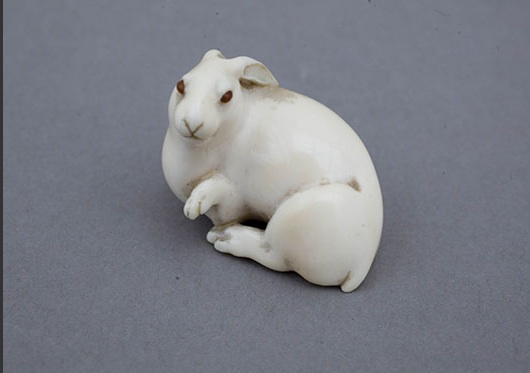
hare finallyAs I consider what to say about parts 3 and 4 of The Hare With Amber Eyes, I remember my daughter, Julia’s christening in early spring 1961. At the reception in our Don Mills apartment, her fraternal grandfather made a casual anti-Semitic joke. My objection was all but drowned out by laughter. What exactly he said, I have mercifully forgotten, but I have the satisfaction of knowing that the genes he handed down to my husband Blake and on to Julia got blended with Warsaw Jewish genes to produce a son, not strictly speaking Jewish since Julia is not, but good enough for Hitler. Even so, I mostly don’t let myself feel anything like the full force of what I could feel about the Holocaust which destroyed all but two members of that middle class Warsaw family. Until I read this part of The Hare With Amber Eyes. Oddly, it is the pillage and loss of beauty, which is irresistibly affecting to me, the netsuke sitting vulnerable in their glass cabinet while the mob breaks in and then the Nazis seize the palace and force Viktor to sign it over.

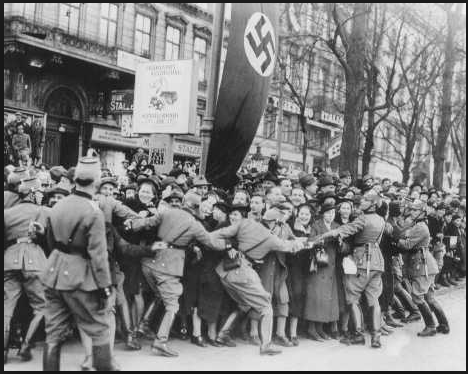
after anchluss palaisThis photograph was taken after the Anschluss. I imagine this crowd is waiting for a celebratory parade.

Unlike his children, Viktor does not have the instinct to flee. By the time, it is necessary, he has great difficulty doing so. It is true that none of the immediate family is deported to a camp, although one does not survive. On balance, the Ephrussis of Vienna, like my grandson’s Warsaw family, could be seen as lucky. Strange luck to survive in the face of such grief, of so much loss. The great advantage the Ephrussis have is Elizabeth, the lawyer and the author’s grandmother. Thus Viktor finds himself sitting by the kitchen stove in Tunbridge Wells, reading news of the war and Ovid’s poems of exile, while Elizabeth learns to cook. In December 1945, she goes back to the Palais Ephrussi, no longer a Nazi headquarters but an American one. Almost nothing is left, except Anna and, amazingly, the netsuke.

Then the story switches setting. Iggy, former fashion designer, and American Intelligence officer, returns to England from a year trading grain in the Congo and receives the collection from Elizabeth. It is as if the netsuke settle what he should do next. He takes the collection with him when he moves to war-torn Tokyo. Ironically, he will work as a banker there. “Iggy had a small attache case filled with ivory monks, craftsmen and beggars, but he knew nothing about the country.”

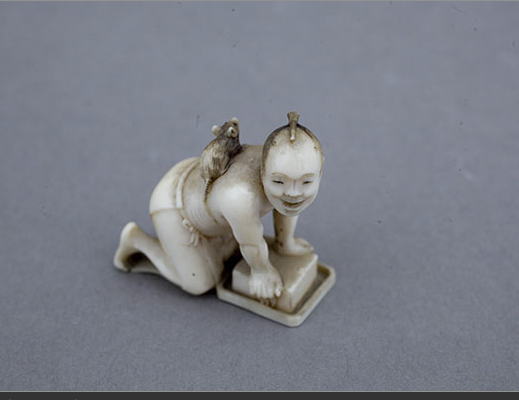
netsuke floor cleanerAbove, a floor cleaner has a surprise.

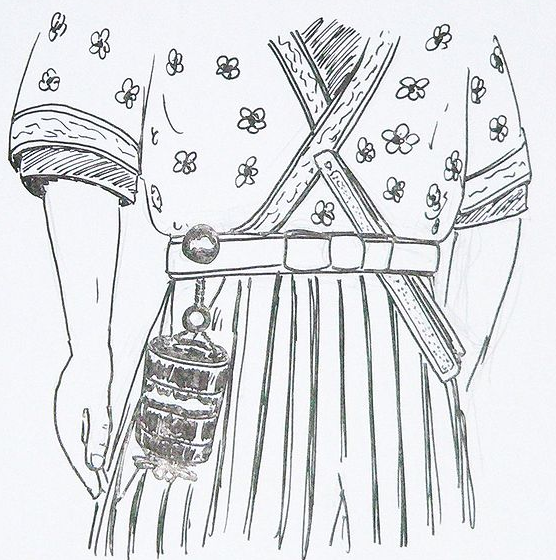
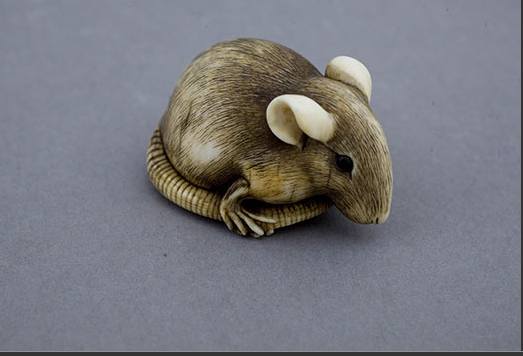
netsuke as wornThe netsuke is the bauble that is on the belt and attached by string to the purse or pocket below. It seems to be a rat pattern in this case.

Edmund De Waal gets to know his uncle when he goes to Japan as a teenager to study ceramics. By that time, Iggie has added Japanese to his German, Russian and English. He lives in a home with fewer objects, but nevertheless rare, Japanese antiques. He is successful and shares his life with a male friend, Jiro, some years younger. So there is beauty there and happiness, but this part feels elegaic. After Iggie’s death, De Waal stays with Jiro when he visits Japan.

iggy with netsukeFinally, the author goes to Odessa where he joins his younger brother and they discover clues of the Ephrussi brothers presence there before 1870, not only in stories but also in a school and an orphanage they founded.

The netsuke are in London now in a vitrine where they can be taken out and played with by children.

netsuke rat

The Hare With Amber Eyes: Viktor and Emmy Ephrussi

ringstrasse above(The second in a series of posts about Edmund de Waal’s book The Hare With Amber Eyes)

In 1899 the collection of 264 netsuke (net-ski), tiny Japanese carvings, arrived along with their black lacquered vitrine at the Ringstrasse in VIenna, a gift from Charles Ephrussi to his cousin Viktor on the occasion of his wedding to Emmy. They were uncrated at the Palais Ephrussi and began life anew in Emmy’s dressing room.

palais ephrussi colourThey were destined to live in the Palais Ephrussi (above) for the next 48 years, although the Ephrussis did not.

The palace was built soon after the street itself, the Ringstrasse, in 1865, a boulevard made for imperial parades and stood near other magnificent homes of wealthy Jewish families – the Libens, Todescos, Wertheims, Gutmanns, Epsteins. By 1899, Freud had his office around the corner. The 145,000 Jews in Vienna had had civic equality since 1867, including the right to teach and own property. The Ephrussis, like many others, were secular Jews and did not attend synagogue. They were Viennese, citizens of the Austro-Hungarian Empire and loyal to the Emperor Franz Joseph, who had granted them their rights.

Baron Ignace von EphrussiThe great house was built by Ignace Ephrussi, who arrived in Vienna from Odessa in 1865 when his son Viktor was 3 years old. Eventually, Ignace was ennobled by the Emperor and became Baron von Ephrussi.

De Waal, the author and present owner of the netsuke is a renowned potter of simple modern forms and his reaction to the palace, now Casino Austria, is much like my own would be. He notes the gold trim on the exterior, the many half-clad Grecian maidens in the niches. He feels smothered by the smoothness of the omni-present marble, as if he can not get a purchase anywhere – on the shallow wide steps of staircases, on the slick floors.

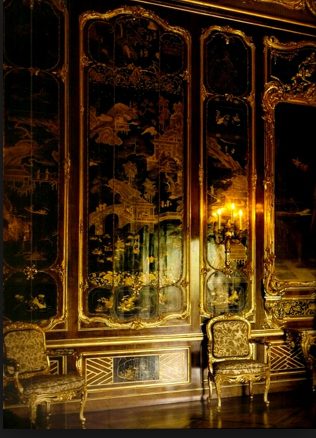
panneled wall palaisThe “implacably marble” interior was lavished with tapestry and ceiling murals.

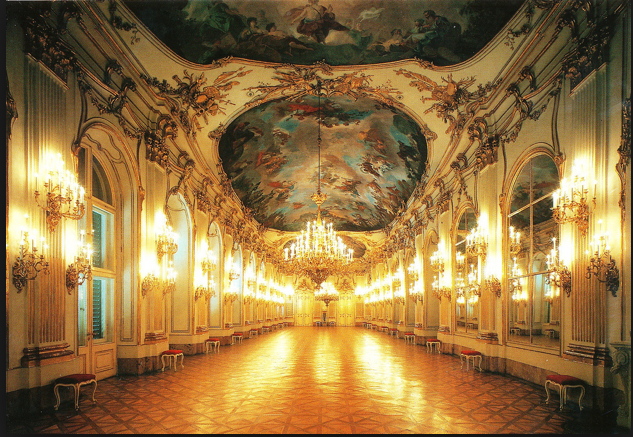
ballroom palais ephrussiMost of the paintings told classical stories, except oddly, the one on the ceiling of the ballroom, the only room that the Viennese, as opposed to Jews, would see. It told the story of Esther. De Waal says, “It is a long-lasting covert way of staking a claim for who you are.”

Viktor, like Charles in the Paris branch of the family was the spare son, so he too was spared bank training. Viktor preferred reading history and sitting in cafes with his friends – until, alas, his older brother Stefan, eloped with his father’s mistress and was disinherited. Suddenly the unprepared Viktor found himself working in the Bank Ephrussi, untrained, and, as it turned out, without a banker’s instincts.

Ignace died only 10 weeks after Viktor and Emmy’s wedding. They kept their apartment on the second floor, the Nobelstock, which Emmy had initially announced “looked like the foyer of the opera”. De Waal takes us into the palace where Ignace had had a a private staircase only he could use, servants’ rooms on a “secret” floor, one with no windows, tunnels to neigbouring houses, ways for naughty children to access the roof, and the glass-covered court yard where the carriages and horses and later the automobiles stood ready beside a statue of Apollo..

It was not a “cozy” place in the way that Charles’s home, opulent as it was, might have seemed. The netsuke vitrine evidently did not suit it except in the smaller more intimate surroundings of Emmy’s dressing room. Here her children gathered pre-dinner to watch her maid Anna dress her for dinner. Here Elizabeth, Iggy and Gisella were allowed to open the glass case and take the netsuke out to play with them.

But of course there was something secret and malignant, the worm in the rose, gnawing away beneath the surface beauty. Marble halls were not proof against it.

Even in Paris Charles was subject to anti-semiticism. Renoir turns against his patron when Charles buys paintings by Gustav Moreau.”It is ‘Jew art’ Renoir writes, galled to find his patron, the editor of the Gazette, with this gout Rothschild stuff on the walls..” Not only is Jewish artistic taste criticized, as bankers Jews are held to be exploitative and responsible for every economic setback. De Waal forces himself to read the newspapers, pamphets and books that target the Ephrussi family with hatred, and parody them as individuals, not only Charles, but others like Maurice, who has married Beatrice Rothschild. The Dreyfus scandal, in which the Jewish officer Alfred Dreyfus was accused of treason, effectively divided the nation into two parts, Semites with their few supporters and anti-semites. It was almost 10 years before he was exonerated and released from Devil’s Island.

But, if the French, in that era, were capable of anti-Semiticism, the German speakers had a positive gift for it. Elizabeth and Iggy, for example, found themselves shut out of a guest hut at the end of a long day’s mountain hike because they were Jews.

Franz Joseph knew a good thing when he saw it and courted the newly arrived Jews who brought wealth with them and soon made more. Viktor regarded himself as a loyal Austrian and, consequently did not follow the advice of his friends who spirited their money off to Switzerland when war was in the offing. In fact, he sunk his wealth into Austrian bonds. Just how reckless this was beame clear to me when I read Margaret MacMillan’s The War That Ended Peace. Austria-Hungary was a pasted together country, a collection of territory assembled by the Hapsbergs. Its soldiers spoke so many languages that units were divided accordingly and orders were sometimes issued in English. There were two parliaments and the Hungarian one erupted physical violence at one point. The heir to the throne was Franz Ferdinand, however, who had a sensible attitude that going to war was not a good idea. Then he and his wife were assassinated, the ostensible cause of the war’s outbreak.

By the end of the Great War in1918, Viktor’s branch of the Bank Ephrussi had to be bailed out. He still had the palais and personal money, but he had lost his fabulous wealth. And like every other family in Austria, his was almost starving because of food shortages. Emmy had just given birth to a fourth child, Rudolf, the Spanish flu was raging across Europe and it seemed as if mother and child might not survive.

They did survive as did their home, although there were half as many servants. Gradually, things improve. Elizabeth earns a doctor of law degree, marries and leaves the country. Iggie studies finance in Cologne. He is the only male Ephrussi in both branches of the family, but in 1933 wisely runs to Paris, giving banking up for a life in fashion eventually in New York City.

In 1938, there is the Anschluss. But this is part of the next section of the book, part 3, “Vienna, Kövecses, Tunbridge Wells, Vienna 1938-1947”.

The Urban Woods in Early November

Nov woods hillsideThis week I stuck to the bike path for brisk walks rather than rambling up into the woods.

Nov woods near wallI passed the culvert where the path into the woods begins.

Nov woods maplesI continued on down the paved trail covered with yellow and brown leaves that sent up the acrid smell of fall.

NOv oaksEventually the oaks came into view. This small wooded parkland contains the remanents of an oak savannah.

The sky above them was dramatic.

Nov oaks and clouds(Click on pictures to enlarge.)