Las Vegas: a non gambler’s perspective

palms #2

I’m not a gambler. That’s because my father was. Even a little bit of his meagre income squandered on the ponies had a significant impact on that week’s meals and the one time he won more than a week’s wages did not make up for that.

I was once the owner of sailboat, which, they say is like standing in a cold shower tearing up hundred dollar bills. The difference between that and gambling, in my mind, is that with gambling, you skip the shower.

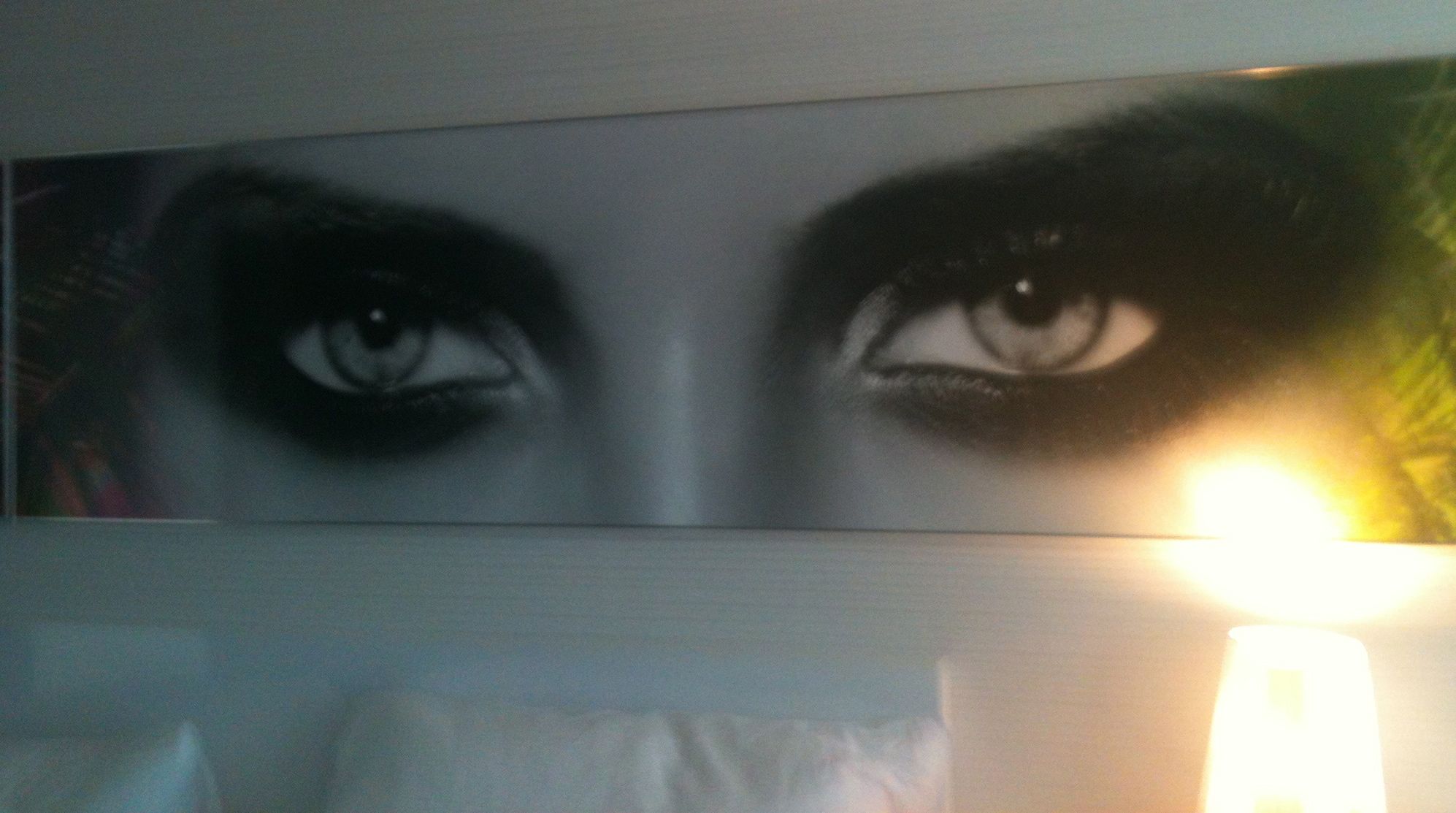
And yet I find myself in Las Vegas from time to time, staying in a hotel. On Christmas Eve it was the Palms. We had chosen the Palms because one of us had stayed there last Christmas and reported that with wood panelled rooms it had a warm vibe . Besides the rooms were going cheap. How surprised we were to find there had been a total renovation. Now the tigerlike eyes of a woman, framed by palm fronds gazed down over every bed. The bathtubs had been removed and replaced by showers big enough to accommodate a small crowd behind transparent plexiglass. The coffee makers had gone the way of the bathtubs. This meant that whenever I wanted tea, I had to travel down to the cafe to get hot water. On Christmas morning at 5 a.m., I made my way there to discover that the usually crowded casino had only three diehards, eyes glued to their slot machines.

For as you may know, the casino in any Las Vegas hotel is unavoidable. You enter through it. You cross it to get to the front desk. You recross it to get to the elevator and every time you want to buy a bottle of water or get a meal or go out to visit a relative. Initially, the noise drove me crazy, but I have found that it’s like traffic when you’re driving. Pay attention only to what’s relevant.

The Las Vegas that I know is not party central. It is a more suburban experience where neat Spanish-style bungalows line curving streets. Twice we have rented houses big enough to accommodate the extended family gathered from across the continent. The first one could have slept about 20, but it had a few disadvantages. One of the toilets roared when flushed and on the wedding day, the city turned off the water for non-payment. The other was smaller although it still had room for 10 and a pool where you could escape the summer heat. You could escape it in the house as well, but the air conditioning was so fierce that you risked frostbite. Some of us devised a strategy: we stayed inside until we got chilled, then we sat outside until we got fried even with pool breaks. The kids of course just stayed in the water until about 10 p.m. Party central, yes, but….

We did stay at the Monte Carlo on the strip one year and I was bowled over by the Babylonian opulence of it all. I sat waiting for kids to get off the rides in New York, New York. The fountains at the Bellagio alone were worth the trip, not to mention the buffet despite the line-up.

Ah, the buffet! Las Vegas has cheap buffets, breakfast, lunch and dinner. Like the reasonably priced drinks you can get at the casino bars, the food and even the room is just a ploy to keep the gambler feeding the machines money. Meanwhile feast your eyes on a glass pyramid, an Eiffel Tower and other bizarre edifices that delight a playful heart, never more than when the lights come on at night.

We go there for weddings and funerals and, sometimes, for Christmas. Thanks to the bold imagination of 2 family members who upped stakes and moved there in their retirement and who never played more than the nickle machines, Las Vegas has a homey feel.

The Fortunate Fall: a further exploration

Recently, I posted “The Fortunate Fall: change the future in a blink” and that led me to think about the fortunate fall in general.

“Felix culpa”is the Latin for “happy fault” or fortunate fall has its origin in Roman Catholic theology. The fall of Adam and Eve and their expulsion from the garden of Eden was interpreted theologically as the source of original sin, but good came out of this loss of innocence. Without it, humanity would not have the hope of redemption. In particular, according to the church, we would not have the salvation of Jesus Christ.

In Paradise Lost, the 17th century poem by John Milton, explores this idea  beginning:

Of Mans First Disobedience and the Fruit
Of that Forbidden Tree, whose mortal tast
Brought Death into the world, and all our woe,
With Loss of Eden, til one greater Man
Restore us, and regain the blissful Seat,
Sing heavenly Muse…

He and his Muse continue singing for 12 “books” and 200 pages in my barely worn, but 50 year-old, university text. First, of course, Satan has to revolt and refuse to submit to the will of God, falling with his host of rebel angels to land at last in the burning lake of hell. He consoles himself that
The mind is its own place, and in it self
Can make a Heav’n of Hell, a Hell of Heav’n.
He gets his revenge by seducing Eve, convincing her to eat of the forbidden tree and she, of course, gives the apple to Adam.

In Book 12, Adam has a long conversation with the Archangel Michael before he is cast out to the east of Eden and learns more or less the whole history of humanity at least as the church sees it. Finally, Adam declares himself to be at peace, for something of great good will come out of his grievous error. He is about to be driven out of paradise by an angel bearing a flaming sword, but he seems quite convinced that, as Michael has told him, “thou shalt possess a Paradise within Thee, happier far”.

Juggling free will with the will of God proves to be an on-going theme in English literature. Theologians like St Augustine tell us that “God judged it better to bring good out of evil than not to permit evil to exist.”

That is one model for understanding the nature of life, but one which many of us may not find comes easily to us these days. Certainly, there is much evil in the world, much hardship and heartbreak. We struggle to come to terms with it. We cannot accept it as just random. We want to give our struggle with it meaning and significance.

Some of us conclude that we are paying karmic debt collected from deeds we have committed in this life or previous ones. This belief suggests that there is a natural law like gravity that makes it necessary to re-balance our moral selves by suffering what we have caused others to suffer, not as punishment, but as loving and necessary correction – a riff on the idea of “forgive them for they now not what they do”. Ah yes, now they do!

Another way to look at it is one that I prefer – at least at present. That is the idea that we are on a path of evolution here and what we are changing is our mind, our soul, our spirit. The hardship that we encounter is the instrument by which we progress. It is true that we can regress as well, but in general, our direction is a positive one. We are becoming more aware of oneness, for example, and connectedness. We are understanding that what we do as individuals affects others. We are becoming more empathetic. We are even beginning to see that God is not an autocratic, ancient of days who makes outrageous demands, but rather an indwelling loving essence. Which makes outrageous demands.

The poet Rumi uses the image of a tanner scouring the hide of an animal until it becomes a beautiful piece of leather to illustrate how the hardships of life render us more spiritual “Physically”, he says, “the world is grief, but within there are many kinds of laughing.”

One night when I was living in the hamlet of Zephyr, I watched northern lights nearly this beautiful.

hovercraftdoggy's avatarhovercraftdoggy

Aurora Borealis in Swedish Lapland, popular, physical phenomenon, arctic poles, snow, aurora, light particles, electrons, atmosphere, north pole, Sweden, Norway, Scandinavia, colourful

Photograph of a beautiful curved band of aurora over the snowy Swedish Lapland. The phenomenon of  Northern Lights (also called Aurora Borealis) occurs when large numbers of electrons stream in towards the Earth along its magnetic field and collide with air particles. The air then lights up rather like what happens in a fluorescent light tube. The resulting colors of the Northern Lights reflect the gases that we find up there. The charged particles originate from the sun, and the weather conditions on the sun decide whether or not we will see the aurora. Photography by  Antony Spencer

View original post

She’d Come Undone

IMG_0194

“She’s come undone,” the Guess Who sang. “She didn’t know what she was headed for… She’d come undone.”

http://www.youtube.com/watch?v=VLMF5GM0Kt8

Indeed she had. I found her on the top shelf of the closet I was cleaning, in a sturdy, brightly coloured box. When I opened it, I found she had fallen to pieces. She was dismembered. She had lost her head.

Still I recognized her of course. She had come into the house under the hill one Christmas time. She was by no means a new doll even then. She had been found by grandma at an antique sale. She was made of composition. She had blue eyes and red hair and she was dressed in a silky pink dress over petticoats. She was more my age than my daughter’s, although she had been so well cared for that she seemed like new, except she was missing one joint on her left pinkie. She had come originally from Eatons catalogue, my mother told my seven-year-old. Her name was Anne Shirley, of Green Gables fame.

I was deeply affected by her condition and I started calling doll shops. No, there were no more doll doctors, I was told by one and all. What, then, happens to sick dolls, I wondered. Listen, I thought, I’ve watched my own grandmother repair my dolls. All it takes is a button hook and new elastics. Just a minute. That sounds familiar. I had already tried to fix her years ago, but I couldn’t get the right tension: doll limbs suddenly became ballistic missiles.

This time, however, I didn’t give up. I searched the internet and began sending emails. Of course there were doll hospitals and medical personnel if I would pack her up and ship her miles away. I decided against cross-border medical care. I didn’t want some customs officer peering in at her. I wrapped that sturdy, bright box in plain brown paper and sent her off to Ottawa.

It was a long convalescence, without visiting hours, just emails of reassurance. Then I found myself in a people hospital far across the continent, sitting beside the doll’s mother, holding her hand, willing her back to us. She did come back and so did Anne.

Last Friday, a big box arrived. I cut the tape as excitedly as the 7 year-old had all those years ago. There she was, all her limbs in place and her head firmly attached to her shoulders. Her complexion sparkled, her blue eyes glowed. Weren’t her lips redder than before? Carefully I unwrapped her clothes. The silky, pink dress, the petticoat, the bonnet, the stockings, even the knickers had been cleaned and pressed. I couldn’t get her boots back on. Had her feet swollen in transit?

So she sits now in the child’s rocking chair that my great grandmother gave me when I was 2, the chair my wood-working son repaired for me.  She surveys the room serenely.

New Year’s: Ring Out Wild Bells

“Ring Out Wild Bells” by Alfred, Lord Tennyson is traditionally read in Sweden on New Year’s Eve, in translation of course. I woke up on this first day of 2013 with the first three lines running through my mind. The “he” referred to is Arthur Hallam, an eloquent, enthusiastic, high spirited young man who died, leaving Tennyson to his own more gloomy, introspective devices. The poet wrote an elegy in sections like this one over 17 years.

It isn’t necessary to know that to enjoy the poem, however, for, like all great poetry, it manages to suit the time in which we read it. Nevertheless, to me the poem is a call to let go of past grief and misery and to press forward with a hopeful heart.

Ring Out Wild Bells

Ring out, wild bells, to the wild sky,
The flying cloud, the frosty light;
The year is dying in the night;
Ring out, wild bells, and let him die.

Ring out the old, ring in the new,
Ring, happy bells, across the snow:
The year is going, let him go;
Ring out the false, ring in the true.

Ring out the grief that saps the mind,
For those that here we see no more,
Ring out the feud of rich and poor,
Ring in redress to all mankind.

Ring out a slowly dying cause,
And ancient forms of party strife;
Ring in the nobler modes of life,
With sweeter manners, purer laws.

Ring out the want, the care, the sin,
The faithless coldness of the times;
Ring out, ring out thy mournful rhymes,
But ring the fuller minstrel in.

Ring out false pride in place and blood,
The civic slander and the spite;
Ring in the love of truth and right,
Ring in the common love of good.

Ring out old shapes of foul disease,
Ring out the narrowing lust of gold;
Ring out the thousand wars of old,
Ring in the thousand years of peace.

Ring in the valiant man and free,
The larger heart the kindlier hand;
Ring out the darkness of the land,
Ring in the Christ that is to be.

To hear bells try http://www.youtube.com/watch?v=Q00Nw8HSE-8

The Miracle of Return

Time to fly home. Twenty eight years of lifting off from LAX, 2 or 3 times each year, you would think it would be routine by now.

In one way, it has actually got better. Having printed my boarding pass at home, I find myself only third inline to check my bag – my one bag, which cost an extra $20 + tax. The pull handle on my suitcase has taken the opportunity to lock down, so that it has to be towed from a crouching posture, but I have help schlepping it, up and onto the scale and back to the X-ray machine.

“Next stop, there where the sun is shining on the green plants,” sings out the x-ray guy.

That, of course, is the farewell spot, a narrow gate, guarded by a familiar dragon who does the second of six boarding pass and ID checks. I make for the escalator with tears on my face. Once upon a time, my Children, farewellers could go with you through security and share a farewell coffee.

There is no line at security either and it is an exciting challenge to fill 3 plastic tubs, about the size of kitty litter pans while standing on one foot. I persist in wearing lace-up low boots. It seems like defiance: I will be darned if I’ll lower my fashion standard. As if. Finally, I have much of my clothing -the guard kindly lets me keep my cardigan on – and all my possessions, some of which, I value dearly, into the trays. The nice surprise is that I do not get “wanded”, patted down nor given a full-body scan. We must not be in an Orange alert. Or maybe my number didn’t come up. Septuagenarian women are, of course, notorious hotheads given to radicalism and acts of terror.

You get used to these absurd assumptions and things really aren’t worse than the good old days. In 1971, my 10 year-old daughter was “wanded” and patted down under the eagle eye of a soldier in camouflage holding a sub-machine gun at the ready. This was in peace-loving Switzerland.

And in those days, there always seemed to be a plane crash in the news. I used to invoke angels to get us off the ground and help us back down. Now I’m usually half asleep. Airlines seem to have learned how to build and fly planes that stay in the air until time and place dictate descent.

With notable exceptions!

It is true that I no longer have the luxury of complaining about the quality of my pre-ordered special meal. I can buy a reheated pepperoni pizza or a sub sandwich from the vending cart: credit cards only, please, but most of us buy our lunch and our water before we board the plane. Starbuck’s smoked turkey and cheddar on multigrain bread turns out to be edible, but not much more. I expected stuffing, cranberry jelly.

My individual entertainment screen is not working. My seat, I am told, should not have been sold. I can move into the middle seat instead. The window guy and I look at each other. We prefer to keep a civilized distance. I do tap its screen so that I can follow our journey on the map and see what towns we are passing over. The captain announces then that we are presently over the Grand Canyon.

And so, another return. There have been returns from weddings and divorces and new babies and new houses and plenty from just ordinary family life. This is a return from what I called in an earlier post a fortunate fall. (See 115journals.com), a return after great shock and fear and grief and then great joy and renewal of love. Rebirth. A chance to start again differently.

Yes, there are still miracles.


Dance Class and Tai Chi

Tai chi-er

We are waiting for barbells. The resident teenager is reconciled to waiting. If the poor delivery guy/girl struggles through the gate with the 105 lb. package before Christmas so much the better, but meanwhile this health-nut proclaims there are many ways to exercise, a towel apparently comes in handy. I didn’t ask.

I packed fast for this trip. I brought only one pair of pjs. (Hello washing machine.) And I’m getting sick of these 2 outfits and the sweat pants. BUT, my exercise equipment did not get left behind. It is not heavy or forgettable. My tai chi is portable.

I ported it to a dance studio yesterday. Well, a masonic hall really, at least an ex-masonic hall, on Venice Blvd., where dance class is held. There is no instructor leading dancers through prescribed choreography, just a DJ with his computer hooked into what seem like the world’s most powerful speakers and a roomful of people moving however they please. Or lying on the floor as they please or lying in a pile on the floor as they please. So no one notices or cares about the mostly linear moves I’m making in the corner.

Loyal readers will say, “How Hollywood!” But no, I’m told that if I look it up on-line, I will find similar classes in my home town, Toronto. If your town is big enough, you might as well. And they will no doubt feature the same creatively dressed crowd -tights and tank- tops, sweats and baggy pants, floating silks of vivid colour, long skirts on guys and girls,- weaving out of their own imagination the beauty or anguish they feel.

They dance alone or with each other or in groups. One fellow danced with a bright red apple. A woman danced with a long white pillow with a heart embroidered on it. The sweatiest fellow in the room gave me a very looong, sweaty hug. It was déclassé  of me to notice any of this, although I carried away something of the sweaty guy’s essence.

My kind of tai chi -taoist.org – is never done to music. Master Moy, who brought the art of tai chi to the west in the early 70s, taught this silent technique so that we would learn to listen to our bodies. So it’s quite a shock to be practising, as I did yesterday, to tribal drums, as the “class” stomped through something like a solstice ritual.

Yet it is curiously liberating. I am so distracted by the whirling colour and the floor-shaking rhythm and even the occasional melody that I find my body moving unself-consciously. Suddenly I feel it accomplishing some refinement that I haven’t been able to get before. My  weight is well and truly in my feet. My belly soft, no longer trying to do the lifting. My hands, full of intention, but the push coming from the back foot. There is a real internal massage going on.

I had arrived here knotted up. Life will do that, as you know. I am away from my usual supports -osteopath, acupuncturist, massage therapist. Then I slipped on a rock, crossing a stream and added a spiral twist -and a good deal of temporary wetness- to the mix. (Incidentally, it was a beautiful fall, I’m told. I would expect no less after all that tai chi.) What to do? You guessed it. More tai chi. I tripled the number or jongs or standing exercises and came unwound. Now, of course, I have to keep that up for the interim or this 76 year-old body will revert or at least stiffen up.

There is usually someone in an electric wheelchair at dance class. One chap moves his chair in dancing circles with his chin. A woman dances with her upper body. Taoist Tai Chi has a sitting set as well as sitting jongs. I have done these while stricken with H1N1 flu when I would have otherwise just languished in bed for weeks.

So here’s the thing, “Dance, dance, wherever you may be.” (“I am the Lord of the dance, said he.) You don’t need any training for that. Or if you won’t dance, (Can’t make me!) take the training route so you never have to pack your exercise equipment. Learn tai chi. Look it up. Taoist Tai Chi is found in 25 countries. It could be in your town and if not, there is some other kind.

Or just get out your towel!

Merry Christmas!