Richard III: lost and found

On Monday, February 4, 2013, a team of archaeologists and scientists announced the bones found last September under a Leicester parking lot were those of Richard III.

Richard, Duke of Gloucester, ruled England from 1482 to 1485, having deposed his 12 year-old nephew, Edward V, whose guardian he was. He was killed at the Battle of Bosworth Field at the age of 32 by Henry,  Duke of Richmond, who succeeded Richard as Henry VII, the first Tudor monarch.

The story was that Richard’s naked body flung over a horse was hurriedly taken to the Greyfriars Monastery for an ignominious burial, but the monastery had long since ceased to exist and the Richard’s last resting place was lost to memory. Members of the Richard III society researched the location of the monastery and came up with its location in the council car park in Leicester. Excavation revealed two bodies, one in a cramped grave showed signs of severe scoliosis and a fatal wound at the base of the skull. Richard III was known to have suffered a spinal deformity, which caused him to be hunch-backed and so, excitement grew.

Carbon dating of 2 ribs indicated that the bones were roughly 500 years old and further examination that they were of a man in his late 20s or early 30’s. Richard died at 32. A tooth was extracted for DNA testing and proved to have a rare mitochondrial DNA sequence, found in a very small percentage of people. Painstakingly, the chromosome sequence was restructured and eventually tested against 2 of Richard’s relatives, one of them a Canadian 17th-great nephew.  The results identified the bones as being Richard’s.

More of the story emerged as the week went on, somewhat to the discredit of Henry or possibly of his ill-controlled soldiers. A halberd, a long pike-like weapon with a spear-like point and an axe below it, had sliced through the base of his skull. (source National Post, Thu. Feb 7, 2013) There was a dent in his skull, probably resulting from a fall while wearing his helmet. A smaller cut at the base of his skull, also a fatal blow, was caused by a sword. There was a knife cut on his lower jaw, possibly caused when his helmet was lost. (He had, famously, already lost his horse: “A horse, a horse! My kingdom for a horse”.) A small hole in the top of his head was probably caused by an arrow. There was a knife wound on his cheekbone. A cut mark on a rib may have been caused by a knife post mortem. He seems to have been stabbed in the right buttock, an insult injury after his armour was removed.  His hands were crossed suggesting that they had been tied. The feet bones were missing possibly because a 19th century outhouse had been built close to the grave and almost destroyed it. There was no evidence of a shroud or other covering.

The article in the National Post cited above speculates that the spinal deformity may have originated at puberty. My Encyclopedia of World History (Ed. Wm. Langer) describes Richard as able, a good soldier and skilled at winning public support. Evidently, he was also good at losing it if the pile-on at his death is any evidence.

There are 2 views of Richard. Shakespeare gives us one, painting him as an assassin and manipulator who killed Edward and his younger brother in the Tower of London. Had them killed, that is as well as his own brother Clarence who stood between him and the throne. A more positive view is presented by Josephine Tey in The Daughter of Time. I will consider these 2 views in an upcoming post.

Winter Storm Warning Makes Good: frightens small inner child

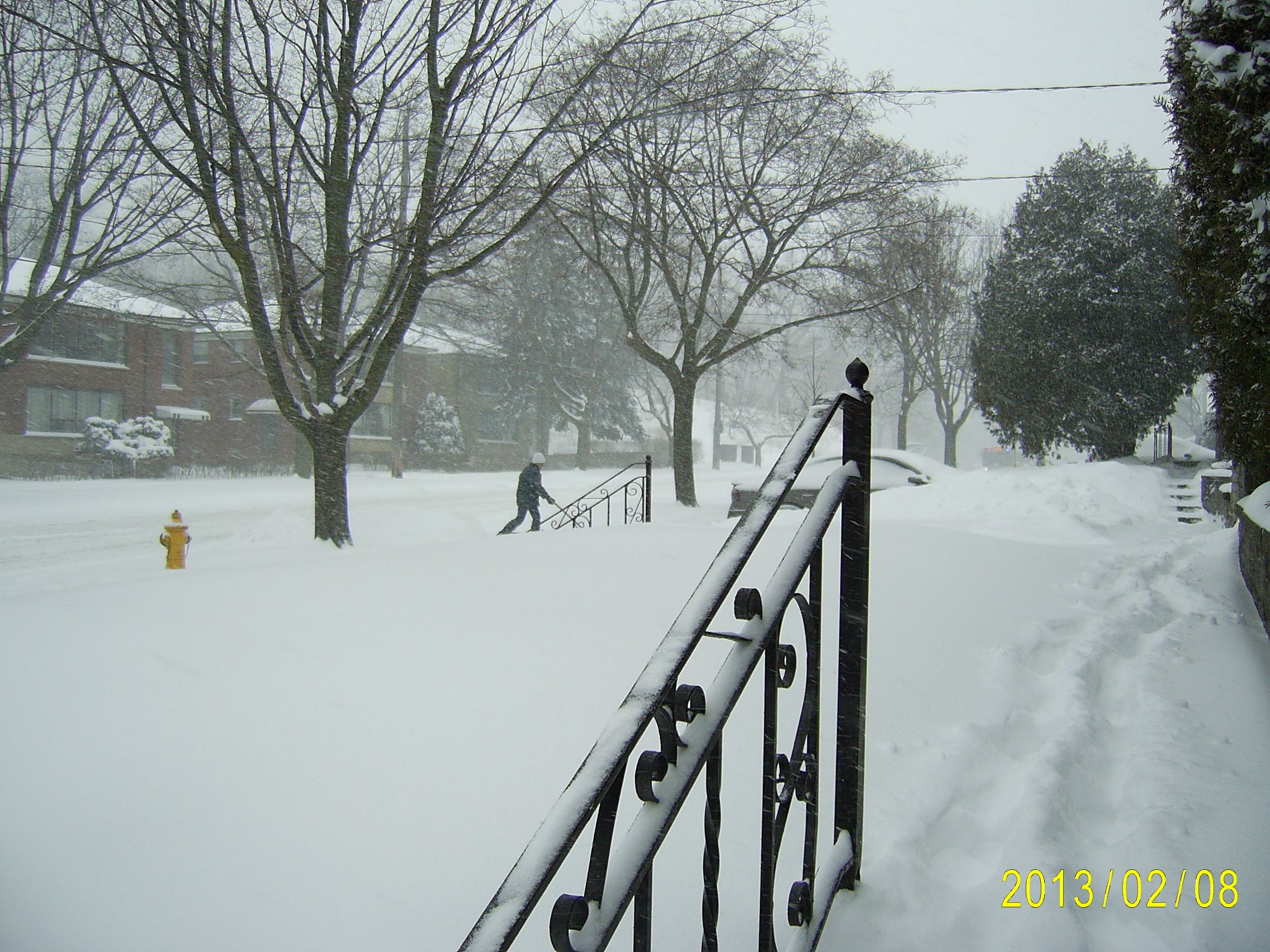
SAMSUNG DIGITAL CAMERAWe are having a winter storm. Actually, we are being pummeled by 2 cowboys, an Alberta Clipper and a Texas Low. Being on a Great Lake, we are probably getting some lake effect accumulation as well, but being inland, we are escaping the Nor’ Easter, which is going to hit Boston and the Maritime provinces. There and in New York, they have blizzard warnings, that is to say high winds up to 100 kph as well as heavy snow. In other words, we could have it much worse.

Okay, I admit it, I have storm-phobia. I come by it honestly. A long, long time ago, I lived in a poorly insulated, poorly heated farmhouse with a hysterical mother and a father off working in the woods. I’m afraid of early autumn windstorms for a slightly different reason. Absent mother, hurricane and caregiver down for the count. It is astonishing that I have managed to drag these conditioned terrors after me for 7 decades. My first instinct is to castigate myself. I remember my then husband, the redoubtable Blake (of Septuagenarian fame (115journals.com) and his impatience with this fear, but really that is not productive. We are dealing with a very young child here and censorious judgement will not work.

Yikes, she notes, there is a car stuck on the hill in front of the house!

Yes, Little One, but you are here in a warm house. The furnace has just come on. There is food in the pantry. There is beautiful music on the radio. The cedars outside the window are laden with snow like out of season Christmas trees. And safe and secure, you can watch the windblown snow drift down though weather-proof, floor-to-ceiling windows. You will have chicken soup for lunch.

SAMSUNG DIGITAL CAMERA

Exit Dragon: the Chinese New Year and Feng Shui

2013_snake_year_of-1-700x700

There’s a black water snake sneaking up on us, chasing the dragon away. Not to worry. If you are turning 24, 36, 48, 60, 72 or 84 this year or next January, you are probably yourself a snake. I would hesitate to tell you that if I did not also confess to being a rat.

Sure others have the dignity of being dragons or horses or even rams, while we labour under the burden of more lowly creatures. Our Chinese horoscope, nevertheless, will reassure us. Rats are very family oriented for example, although they should stay out from under the feet of a horse. Snake people are complex, clever and silent, although also prone to be stingy and arrogant. Whoops! (www.hanban.com). There is something to recommend every one of the 12 animal signs in the Chinese zodiac, but people don’t generally plan babies to be born in snake years as they do in dragon years.

The 12 animal signs in the Chinese zodiac are the dragon, the snake, the horse, the sheep or ram, the monkey, the rooster, the dog, the pig, the rat, the tiger and the rabbit, each recurring every 12 years. In addition, there is an over-lying and bigger cycle of the 5 elements: water, wood, fire, earth and metal, which recur every 60 years. The previous water snake year was 1953 and the next water snake will be in 2073.

The year of the snake is due to arrive Feb 4th, according to the Chinese solar calendar, Feb 10th by the lunar calendar, which most people go by.

I have just finished the feng shui changes recommended to me for the year of the snake. These recommendations were based on my birth year as well as the year the house where I live was constructed and its exact orientation in terms of direction. I had to go to the city archive and pore over elector lists and when they didn’t tell me exactly, I looked at aerial photos of the area. Finally, I came up with a year, 1956. The house seems to face directly east, but I had to verify that with an accurate compass. All of this I emailed to Kartar Diamond in Los Angeles. Because it was a long-distance consultation, I also sent a detailed, scale diagram of my apartment on graph paper and emailed several pictures of every room. (kartar@fengshuisolutions.net)

I had had feng shui done on a previous dwelling by someone in my town, but I didn’t like her recommendations, for example using metal colours instead of real metal. And that turned out to be a bad luck house when the sewer backed up and left me without heat in winter. Having met Kartar in L.A., I decided to go for the long distance analysis. So far, apart from minor and manageable problems, this place seems to enjoy better luck.

SAMSUNG DIGITAL CAMERA

This year’s changes, predicated on my birth year, year of construction and direction, were fairly minor. I was told to move metal out of the small front foyer in the SE, so I hauled the 2 10 lb. weights out from under the mail table. I was supposed to add fire, but since there is no electrical outlet there, I couldn’t plug in a lamp and leave it burning. The malfunctioning overhead light does stay on 24/7 so that may count. So does using the colour red, so I put a red running on the table and added a red Fu dog I got for Christmas and a red vase. I confess that the explanation of why is beyond me, involving as it does a 4 wood star, which is doubled here in 2013.

I moved the metal weights, one at a time – I’m old after all – into the bedroom where the SW had need of them. Unfortunately it -the SW – didn’t want any fire this year, so I had to take off the red pillow covers and move a picture my sister had painted for me. No problem. These could go back onto the Second Best Bed in the den. (See 115journals.com), which had looked rather dowdy in the last year. I also moved the living room fountain onto the bookcase that holds my journals because the W needs moving water. In the dining room, I added a lamp to the buffet where,once again, fire was needed.

red in den

This year’s changes didn’t involve any expense apart from paying for the annual update. I was already the proud owner of 125 lbs of heavy metal, bought over the 3 years I have been doing feng shui as well as the red table runner, which was languishing at the bottom of the linen cupboard.

light on buffet

Do I actually believe it works?  Who knows? It’s an interesting diversion at this wintery time at least. And it focuses my attention. In the end, I recall what media guru Marshal McLuhan said: I don’t necessarily agree with everything I say.

The Life of Pi and Spoilers

As I said in my post on Downton Abbey, I never mind spoilers. Knowing how a story ends doesn’t detract from my enjoyment of it. Rather the opposite. But I know not everyone shares that point of view and, whereas, I didn’t actually say how season 3 of Downton Abbey is going to end (115journals.com), I am going to tell how The Life of Pi ends. Here be spoilers!

I read Yann Martell’s novel, The Life of Pi, shortly after it was published, probably  in 2002, the year it won the Man Booker prize. It wasn’t an easy book for me. I found the suspense hard to take: 227 days in a lifeboat with a Bengal tiger! And the long sojourn on the island that turned carnivorous at night tired me out. But it was the ending that left me gobsmacked.

I was lured into seeing the movie by the main ad image – a young man in white at one end of a boat facing a huge tiger at the other (http://www.imdb.com/title/tt0454876/) – and the fact that it was directed by Ang Lee who had made Crouching Tiger, Hidden Dragon. And, I suppose, some chauvinism. Yann Martel is Canadian like me.

Pi of the title is Piscine Molitar Patel, a boy living in Pondicherry, a city in French India, who was named bizarrely after a swimming pool in France, and who was, naturally enough, known as Pissing by the other boys until he took matters into his own hands. He memorized pi, the ratio of a circle’s circumference to its diameter, 3.14159 – , to many of its infinite digits and demonstrated his mastery while explaining to one class after another that henceforward, he was to be called Pi.

He spends his childhood, which apart from the teasing, seems idyllic, hanging around in his father’s small zoo and exploring the major religions, Hindu, Christian and Muslim. By the time political and economic changes uproot his family, he has practised all three. His family is en route to Canada on a Japanese ship, some of their animals in the hold, when the ship hits a vicious storm and sinks. Pi finds himself in a life boat with a zebra with a broken leg, an orangutan and a hyena. The hyena soon dispatches the zebra and the orangutan and has set its sights on Pi, when suddenly, a Bengal tiger rushes out from under the tarp and kills it.

What made me think that I was up to watching that action in 3D?

Of course it was very beautiful, even the underwater scenes when the storm was in full fury were beautiful. The more peaceful zoo scenes at the beginning were exquisite. The flowers practically tickled my nose. The tiger was just amazing, huge and vivid, but very loud and scarey. I felt a little like I had when I saw my first movie, The Wizard of Oz, when I was 6. I had to be taken to the restroom and assured it was just pretend.

In fact, we know from the beginning that Pi survives because middle-aged Pi is telling his story to a writer. Pi assures him that his story will make him (the writer) believe in God. Now this in one of those devices that doesn’t work well with me. It reminds me of Marlowe in Heart of Darkness saying that he is going to tell a story that will change the listeners. Just hearing about Kurtz and the evil he did up the Congo River will do the job. What the heck? I was a little more convinced when I read the critics who talked about cannibalism (the king must die sort) and after I saw it visually in Apocalypse Now. Mostly, I just say, “Okay, I believe you or I’ll suspend my disbelief.”

So Pi recounts how he conditioned the tiger- Richard Parker is his name- using a whistle and seasickness. Eventually, Richard Parker puts up with having Pi on the lifeboat and is glad of what Pi catches and feeds him. Pi, himself, eats canned biscuits from the well-stocked larder. The stay on the flesh-eating island seemed mercifully shortened in the film and eventually after 227 days, Pi and Richard Parker wash up on a beach in Mexico. Richard Parker walks off into the jungle without a parting glance, to Pi’s dismay.

While he is recovering in hospital, two investigators from the Japanese shipping company come to interview him to try to find out why the ship sank. He tells them his story. When they seem disbelieving, he tells them another story.

In this story, the ship’s nasty cook is on the lifeboat with Pi as well as a Japanese sailor with a broken leg and eventually Pi’s mother, Gita. The cook kills the wounded sailor and uses his flesh as bait and food. Then he kills Gita. Clearly, Pi is next and so Pi attacks the cook while he is sleeping and finishes him off.

The Japanese interpret the animal story as follows: the zebra is the sailor, the orangutan is Pi’s mother, the hyena is the cook, and the tiger? why of course, Pi himself or the savage part of him that made it possible to survive.

Pi asks which story they prefer and they reply the animal one.

My sister had asked me the same question a few weeks earlier, although she asked which one I believed. I made the same answer. But really, I meant only that I liked it better. In fact, it is much more likely that the other story was true.

Pi believed that in extremis, God answered his prayers and sent visions, schools of flying fish and edible islands, with nasty side-effects, to save him. It is a beautiful way to see things. And it may be true. It may be that an exterior divine force gets us through what the world throws at us. And/or it may be that we each have our inner Bengal tiger that roars fiercely to life when we are in dire straits.

http://screenrant.com/life-of-pi-movie-ending-spoilers/2/

If Not Now When?

I am battling the flu, if such a passive activity can be called battling. To mix metaphors, it is the aching flu with a side of severe muscle spasm. I seemed to have beaten back (that old battle image again) the spasms, but when I went to get out of bed, I nearly fell over from dizziness. How is that fair? A new symptom when I’ve already had this flu for a week?

I long to be unconscious. I long for major pain-killers and Gravol, none of which I can take because, if I do, my stomach will kill me. I dream of liquid morphine, but those liquid morphine stores are so hard to find these days.

I was sitting with heat on my lower back, massaging my right shoulder, trying to ease my neck, when suddenly it occurred to me: if not now when.

This now is mine, whether the gift of providence or the hard-won achievement of my own spirit. And it is a precious gift that I should not waste. Moreover now, is all I have.

The past, which I do not long for and dislike revisiting, no longer exists. The future does not even have as much reality as that hazy, disowned past. The future is unpredictable and therefore, unimaginable.

So here’s to now,an unseasonably warm day, given to sudden downpours of window- tapping rain. Now in a well-heated room with a prospect of lunch. Now where my periphery is aching, but my centre is perfectly at peace.

Downton Abbey and Spoilers

I never mind finding out the ending of a book I am reading or a series I am watching. Doing so takes the pressure off. I can relax and enjoy the journey. If you do mind, take note that while there are no explicit spoilers here, beyond the discussion of events in the episode broadcast by PBS on Sun. Jan. 27, 2013, there are hints.

The third season of Downton Abbey, which many of us are watching on PBS on Sunday evenings, included in its British run a Christmas Day special that elicited cries of outrage. People declared it had ruined their Christmas. Julian Fellowes, the series creator, took most of the heat, but really he wasn’t to blame. He can only working with actors that are available to him and within the logic of the plot so far.

I had heard a rumour that an important actor was quitting, but I had ignored it, until last Sunday’s episode in which Lady Sibyl died in childbirth. I began digging around on-line and, among tearful comments about Sibyl’s all-to-realistic death from eclampsia, I chanced upon the December news from Britain. Clearly, we do not like to have our favourite characters cut down before our eyes. Our response in this case has been to grieve. I wonder if North Americans will be as angered as the British by the remaining episodes (two, #6- 2 hrs long and #7-90 min. long, ending on Feb. 17).

The ruling class is in decline in England in 1921. The war has made inroads into the capital of the wealthy and made the people, who fought and won the war, less accepting of that  power. The sheer boneheadedness of that patriarchal system is apparent when Lord Grantham, Sibyl’s father, insists on employing a noted obstetrician from London instead of local Dr. Clarkson. It is Dr. Clarkson, who has known Sibyl all her life and knows, for example, that she has not always had fat ankles, who sounds the alarm that Sibyl is in trouble and needs a caesarean section. Grantham convinces Sibyl’s husband that the noted and knighted specialist is right. And, at first, after a baby girl has been successfully delivered, it seems so. Unfortunately Sibyl starts to have seizures, as Dr. Clarkson predicted she would. By the end of the episode, Grantham has been exiled to the dressing room by his wife and it seems unlikely, he will that he will ever get back into Lady Grantham’s bed.

Meanwhile, his son-in-law Matthew, whose money has saved Downton Abbey is about to tackle Grantham about his mismanagement of the estate. In short, the old power structure is beginning to crumble. Patriarchy is doomed.

Only a few of the great houses survived that second excursion into democracy, World War II. It and the subsequent heavy taxation of the wealthy ended them. They became residential schools or eventually found themselves in the hands of wealthy Americans. A few of them like Chatsworth survived because the Duke and Duchess of Devonshire turned it into a tourist attraction.

Baron Fellowes of West Stafford is a life peer and, therefore, a member of the British House of Lords. His wife is Lady-in-Waiting to Princess Michael of Kent. He knew Highclere Castle, the house where Downton Abbey is filmed because he had been a frequent house guest there. Highclere, itself, needs the tourist dollars of Downton Abbey fans to keep going. It seems likely that it will continue to be in the public eye for another one or two seasons at least.

Cold Snap: reflections on winter and its clothes

So we’re having a cold snap. According to the news, we are all in a dire situation. The city has declared an extreme cold weather alert as well it should. More beds have been made available to the homeless. I hope the guy I saw crossing Queen’s Park, wearing two t-shirts, got one of them. I felt like jumping out of the car and taking him somewhere to buy a jacket. Maybe he had one in that pack he was carrying on his back, but I doubt it. It looked more like a sleeping bag. So I’m not against cold weather alerts. I’m against hysteria. I’m against it mainly because I am susceptible to it.

In actual fact, it isn’t that cold in Toronto, not compared to North Bay, for example, where it is -22C/-5F going down to -27C/-17F that’s -40/-40F when the windchill is factored in. Here it is only -11C/-9F with a windchill of about -17C/0F. True the snow sounds crunchy and most of us move snappishly out of doors. Still construction and road repair goes on, although I notice that they are rotating the sign guys faster than usual. Even those hardy souls need to get warm after an hour or so.

But now that we have 24 hour news, every weather event gets hyped out of all proportion. It’s hard to say whether it actually rains harder or we just think it does because of the news. Gone are the days of my childhood when a hurricane could sneak up on us. All to the good of course, but …

Today when I checked my local 24 hour news channel for the weather, I was told how to dress – my warmest coat, hat, gloves, scarf. Makes you wonder who they think they are talking to. Maybe the teenagers who won’t listen to mom.

There have always seemed to be those who can’t bear to wear a hat. They probably started out life as toddlers who tore their hats off and threw them down as soon as possible. Some of them, paradoxically, grew up to be teenagers who got their wool toques confiscated in class because they refused to take them off.

In general, I observe, that people dress more warmly these days. probably because they can. Long ago, long before you can remember, the warmest fabric you could buy was wool. Well, of course there was fur but since you couldn’t afford it, it might as well not have existed. Even the cheapest fur, euphemistically called Persian lamb, was out of the question. It was actually just a dolled up, reverse version of my grandfather’s barn coat, a sheepskin with the sheep’s wool turned in and the hide itself out. When you bought a coat in those days the most you could hope for was a chamey in the back, between the lining and the wool, to cut the wind. That is chamois, which my dictionary tells me is soft, pliable leather from sheep, goats or deer. You had to turn the coat upside down and fish around inside the lining to make sure it was there. Such a wool coat, a kerchief and galoshes over shoes did not provide much protection from fierce cold and snow.

As a child, I had worn rubber boots in the winter which, despite thick hand-knitted socks, were fearfully cold, but they wouldn’t do for a young lady on her way to Central High. One of my early purchases from my first job at 15 was a pair of snow boots.

It was children’s wear that saw the first widely produced quilted fabric. My children’s snow suits were padded with cotton and they had hoods. Still the only adult wear of that sort were snowmobile suits, one of which I acquired at the earliest opportunity even though I rode on a snowmobile only once. I still had it nearly 20 years later when I moved to a country town in the snow belt. I wore it on my long drive to work on bad days. I am happy to say that I never did need it, never having found myself stranded on a deserted road.

Then down-filled ski jackets came onto the market, but they had a very sporty look and women especially stayed with the more decorous dressy wool coat. I found a long down-filled coat in an outdoor outfitter store, which filled me with joy. It would take courage to show up at work wearing this big puffy garment but I was up to it. As I approached the women’s cloak room the first day I wore it, I met the teacher down the hall. She was wearing the exact same coat.

Now, there are sleeker, lighter, longer coats with “fur” trimmed hoods that extend beyond the face to shield it from the wind. They have zippers and snaps. Even the pockets zip. And many women are wearing them. Suddenly, being warm seems to trump looking dressed up. Not that such coats aren’t elegant in their own way. And washable to boot.

Then there are the fur-lined aviator caps with ear flaps and ties under the chin. The fur, like the coat fur, is fake or sheepskin. For a few years, I was the only one wearing such a hat, but this year, I see them everywhere. Like the coats, they are made in China, where such hats and quilted garments are nothing new.

When I hurriedly left for Los Angeles last month, I wore such a coat, not having time to consider the question. To my credit, I left the aviator cap at home and grabbed a red wool tam instead. I needn’t have worried about looking out of place. Southern California has mountains after all and down coats don’t merit a second look.

It occurs to me that somewhere people are collecting that down the way my grandmother used to collect the feathers from the barnyard chickens she plucked, hoarding it away to be stuffed into ticks to make feather beds.