I am reblogging this post about the Burlington Lift Bridge which played an important role in my life for several years when I was a young adult. I enjoyed getting reacquainted with it, but I could have sworn the wait for a ship to pass was way longer than 5 minutes. Before the Skyway was built, traffic backed up for miles especially on warm weekends when people were driving to Niagara Falls.

Opalla's avatarOpallaOnTrails

1-IMG_0401

The Burlington Canal Lift Bridge is the icon of the Industrial Revolution that took place in Canada in the 19th century. I have therefore chosen it to represent the theme Industrial for this week’s A Word A Week Photo Challenge in response to Skinnywench (aka Sue).

Built in 1826 with the opening of the Burlington Canal, which links the waters of Hamilton Harbour (also known as Burlington Bay) to Lake Erie and Lake Ontario to the Atlantic Ocean, the lift bridge is a tower-driven, moveable and vertically lifted bridge. It raises on demand to big vessels year round and hourly or half-hourly to smaller boats or pleasure vessels in the summer.

According to government statistics, the bridge is 116 metres long, weighs 1996 tonnes and lifts 33.5 metres high as in the photo above. Seen from the picture, the height is similar to the Skyway Bridge (36 metres high) behind it. The…

View original post 321 more words

January, Muscle Spasms, and All That Good Stuff

The first 3 weeks of January went swimmingly. A molar had to have its cap removed, be re-drilled and re-covered with a brand-new $800 crown. Then I had a colonoscopy. Mention that and someone is sure to intone -‘It’s the prep that’s the worst!’  These people evidently skipped the actual procedure. Meanwhile the pump on the washer quit and the Sears man had to come back 3 -count ’em ladies and gentlemen 3- times. Each visit required a generous window of time and no one in the house could devote 6 hours every Wednesday to this pursuit except me. By the time the washer doctor pronounced the 2 year-old front loader healed, I didn’t remember what clean clothes smelled like.

Then things got rough.

I wake up at 3 o’clock to a terrible racket and stumble to a window. Outside large tree limbs writhe in the wind, the rain flies horizontally, lightning flares and thunder crashes. In January!! As I turn back, my right leg begins howling in pain. By 5 a.m. I have written a long journal entry, downloaded Michael Connelly’s, Black Box on my kindle and got well into the story. Only then does the leg let me go back to sleep.

Painkillers? I would lament the fact that I can’t take any of them (tender stomach), but since they don’t seem to kill my pain anyway, I won’t bother. Actually I lie, liquid morphine works very well, but as I’ve said before, it’s so hard to come by.

As for the leg, nothing a little exercise won’t cure, so I go for walks. I take up the rug and do tai chi in the living room as I wait for Sears. The right hip gets stiff and sore. As I take myself off to a tai chi class, the agony has spread to my lower back. But I am still working on the theory that it’s nothing I can’t work through.

By the time tea break arrives, I have been disabused of that notion. My right hip is beginning to set like cement. A minute too long and I won’t be able to bend to sit down to drive home. I turn the heat on in the Obus Form car seat. I crank up its massage feature to high. I resort to prayer.  In my driveway, I sit studying how best to get out of the car. I discover there is no best. There’s only pain.

Okay, no problem. I have ways to deal with pain. First the castor oil pack, lots of castor oil on a flannel and a heating pad. An hour later, look at that! I can walk. Only problem is I need a derrick or a crane to get me out of bed. Right, let’s try patches, lots of those patches embedded in this case with Chinese herbs, guaranteed to relieve pain, or so my past experience says. But no, not so much and, apparently, not wise to apply them on oily skin. Why not just pass out and sleep it off. An hour later, the pain wakes me up. Let’s try the tennis ball. First lie on the floor, wedge the tennis ball under the tight spot and relax into it.OMG!!!! Does the CIA know about this? It could be way more effective than water boarding! But I keep at it and a few minutes after I get up, a blessed relief floods over me. The spasm has eased.

I am so happy! And blissfully unaware that this will be the pattern of my life for the foreseeable future with one surprising twist. The spasm travels. While it seems most at home in the right hip, it is content to visit the right calf, the right knee and the right thigh, especially as I try to go to sleep. (How is that fair, I ask you.) Just for a change of venue, it zips up to the right shoulder blade, flashes along the neck and zooms down the backbone. At the moment, it has wandered right out of home territory and is visiting my upper left back.

The only time I leave the house for the first 2 weeks is to see the massage therapist and the acupuncturist. The treatments work wonders – for about 24 hours.

I get hysterical. Well, of course I do. I whine on the phone. I up my already high dose of calcium and magnesium. I meditate. I examine my soul to see what darkness lurks there.

Gradually, almost imperceptibly, the pain diminishes. I still have the travelling spasm, but I can head it off, so that it doesn’t become full blown.  I go back to tai chi class, only half of it at first. I find that one move, Creeping Low Like Snake, if done very, very gently, opens my back and softens it.

Instead of a marauding tiger tearing at my flesh, it’s more of a domestic cat now. Trouble is, I’m not much of a cat person.

Richard III: evil or good

In a previous post, “Richard III: lost and found” (115journals.com), I described the recent discovery of the bones RIchard III who was killed by Henry Tudor in the Battle of Bosworth Field in 1485. Henry then became Henry VII, the first Tudor monarch in England, followed in turn, by Henry VIII and Elizabeth I. The question I promised to address at the end of my previous post was whether Richard deserved the reputation that has come down to us, citing Shakespeare’s play, on the one hand, and Josephine Tey’s novel, The Daughter of Time, on the other.

Shakespeare’s play Richard III was probably produced in 1594, during Elizabeth’s reign, over 100 years after Richard’s death. The playwright drew on Holinshed’s history which in its turn drew on Thomas More’s account of events. More was solidly in the Tudor camp, having served both Henry VII and Henry VIII. In any case, according to Tey’s research, More did not actually write the history of Richard that is attributed to him, but rather re-copied in his own hand an account actually written by one John Morton, a participant in events. This re-copied account was found in More’s papers after his execution and published as his own work. The Tudors -namely Henry VIII- repaid More’s service by beheading him.

Josephine Tey’s novel, The Daughter of Time, was published in 1951 and is not the first debunking of the evil Richard legend, which held that he was a usurper of the throne, guilty of fratricide and regicide, and a man without honour who proposed to marry his own niece. Other writers – Buck in the 17th century, Walpole in the 18th and Markham in the 19th – also contradicted that legend. Indeed there is something called the Rickardian Society devoted to that same task since 1924.

I came to love Shakespeare’s play when I saw Alec Guiness play the lead at Stratford, Ontario as a teenager. It was a brilliant portrayal of a villain who rejoiced in his villainy. Like all school children I had learned that Richard was the boogeyman who had killed the poor little princes (Edward V and his younger brother) in the Tower of London and it didn’t occur to me that might not be true.

I’m not sure when I first read The Daughter of Time, but it would have been probably 15 years or more after it was first published. A few days ago, I loaded it onto my Kindle and read it for the 3rd time. It is just not possible, for me at any rate, to keep its complex ideas in my head. The daughter of time, by the way, is truth.

Shakespeare’s play begins with a long monologue by Richard, Duke of Gloucester, who was depicted by Guiness as hunchbacked and twisted, drabbly dressed with greasy hair sticking out from under a red cap. He begins by asserting that he was
Deformed, unfinished, sent before my time
Into this breathing world scarce half made up –
And that so lamely and unfashionable
That dogs bark at me as I halt by them –
And yet, so skilled is he at seduction that by the end of the scene, he has talked Anne Neville into marrying him despite the fact that she began by hating him. She has good reason: Richard has murdered her husband, the Prince Of Wales, and her father-in-law, the deposed king, Henry VI, to secure the throne for his brother. Richard carries on throughout the play murdering his way to the top. He kills his brother, Clarence, who is next in birth-order to Edward IV, and therefore, an obstacle to Richard’s inheriting the throne. He pins the murder on Edward thereby accelerating his illness and when Edward dies, he imprisons his sons in the Tower of London. He kills the nobles who support the child Edward V although he (Richard) has been appointed Regent to rule until Edward is of age. He kills his wife, Anne Neville in a plan to marry his niece, Elizabeth. Then, infamously, he hires James Tyrell to kill the little princes by smothering them. When Richard’s horse is shot out from under him at the Battle of Bosworth Field, Henry of Richmond finishes him off and becomes Henry VII, the first Tudor king. Shakespeare counted Queen Elizabeth, Henry’s grand daughter as the chief patron of his theatre company, plenty of reason to seize on the dramatic possibilities of Richard’s villainy.

Now, even before we turn to Tey’s refutation of these charges, it is worth noting that Richard’s hired hands are supposed to have dispatched his brother the Duke of Clarence by drowning him in a butt of Malmsey, that is a large barrel of wine. This was actually a Cockney expression indicating that Clarence died of drink, although, in actual fact, he was executed for treason.

Josphine Tey’s novel is constructed like a mystery. The detective, Grant is lying flat in a hospital bed recovering from injuries sustained while he was chasing a suspect. To pass the time, he is trying to solve the riddle of whether Richard deserved the reputation that Shakespeare hung on him. He has the help of a “research worker”, Brent Carradine, who looks things up at the British Museum. Those were the quaint old days when sitting in a library was the only way to do such research. By this time, Grant has figured out that More’s account was highly suspect and not even his own. Curiously, even the historians who castigate Richard, have to admit that he was devoted to Edward IV throughout his life and that he was an admirable administrator, an excellent general, and a brave soldier. Yet they also picture him as suddenly becoming willing to wade through blood to get to the throne, even though he is already safely ensconced there as the Regent. Grant and his researcher decide to focus not on such accounts, but on actual documents from the time – accounts, letters, decrees, court records, legislation.

It quickly becomes clear that  Richard’s rule of 18 months was not only orderly but progressive, the people being granted such things as the right to bail and freedom from intimidation as jurors. Richard dealt with those charged with treason in an even-handed way returning confiscated property, for example, to the family to be administered. In the light of future events, when the Lancasters and their Woodville allies rose against him, he would have been better to be a tyrant. Yet he seems to have been a decent fellow who was popular with the people.

The research In The Daughter of Time turns up information that, just as Richard is planning Edward V’s coronation, one Bishop Stillingham announces that he had presided over a marriage of Edward IV  to   another woman prior his marriage to Elizabeth Woodville. As a result, Edward V is deemed illegitimate and the throne passes to Richard.

In the matter of the princes in the Tower, It is true that Richard sent them to live there. It was a royal residence at that time and to live there was not a punishment unless you were in the dungeons. The princes were not. They lived royally as their mother did once she came out of hiding and they were taught by their tutor. Their sisters attended events at Richard’s court and the mother, Elizabeth Woodville, accepted a pension from the man historians say is her sons’ murderer.

After he killed Richard, Henry VII moved to get an act of Attainder, declaring Richard was never entitled to be king, but in the posthumous charges, there is no mention that Richard has murdered his nephews. Indeed there is no mention of them again in any documents until James Tyrell is charged with their murders 20 years later and executed. True they have vanished. The documents that the research worker uncovers indicate that Tyrell is granted a general pardon by Henry in early June 1486 and another one a month later. What has he done during that time that makes the second pardon necessary? Shortly thereafter, Henry makes him Constable of Guisnes and Tyrell goes to live there near Calais. (England still had sovereignty over part of what is now France.)

Why would Henry want the princes dead? He has married their older sister and set about restoring her legitimacy, but if she is legitimate, so are her brothers and they have a much more lawful, hereditary claim to the throne than Henry. The researcher in Tey’s novel finds an abundance of evidence that Henry also eliminated anyone else who stood in Edward IV’s line, including Clarence’s son, whom Richard had made his own heir. Henry VIII carries on executing those who seem to threaten the Tudor claim to the throne.

Shakespeare’s Richard is a brilliant portrayal of an evil person who rejoices in his evil and his final end while tragic, is richly deserved. Tey’s Richard, the more historically accurate one, in my opinion, is an altogether more honourable fellow; moreover, apart from one shoulder being higher than the other, he does not seem to have been disfigured.  I regret that Richard’s reputation has been thus sullied for the past 500 years.

Richard III: lost and found

On Monday, February 4, 2013, a team of archaeologists and scientists announced the bones found last September under a Leicester parking lot were those of Richard III.

Richard, Duke of Gloucester, ruled England from 1482 to 1485, having deposed his 12 year-old nephew, Edward V, whose guardian he was. He was killed at the Battle of Bosworth Field at the age of 32 by Henry,  Duke of Richmond, who succeeded Richard as Henry VII, the first Tudor monarch.

The story was that Richard’s naked body flung over a horse was hurriedly taken to the Greyfriars Monastery for an ignominious burial, but the monastery had long since ceased to exist and the Richard’s last resting place was lost to memory. Members of the Richard III society researched the location of the monastery and came up with its location in the council car park in Leicester. Excavation revealed two bodies, one in a cramped grave showed signs of severe scoliosis and a fatal wound at the base of the skull. Richard III was known to have suffered a spinal deformity, which caused him to be hunch-backed and so, excitement grew.

Carbon dating of 2 ribs indicated that the bones were roughly 500 years old and further examination that they were of a man in his late 20s or early 30’s. Richard died at 32. A tooth was extracted for DNA testing and proved to have a rare mitochondrial DNA sequence, found in a very small percentage of people. Painstakingly, the chromosome sequence was restructured and eventually tested against 2 of Richard’s relatives, one of them a Canadian 17th-great nephew.  The results identified the bones as being Richard’s.

More of the story emerged as the week went on, somewhat to the discredit of Henry or possibly of his ill-controlled soldiers. A halberd, a long pike-like weapon with a spear-like point and an axe below it, had sliced through the base of his skull. (source National Post, Thu. Feb 7, 2013) There was a dent in his skull, probably resulting from a fall while wearing his helmet. A smaller cut at the base of his skull, also a fatal blow, was caused by a sword. There was a knife cut on his lower jaw, possibly caused when his helmet was lost. (He had, famously, already lost his horse: “A horse, a horse! My kingdom for a horse”.) A small hole in the top of his head was probably caused by an arrow. There was a knife wound on his cheekbone. A cut mark on a rib may have been caused by a knife post mortem. He seems to have been stabbed in the right buttock, an insult injury after his armour was removed.  His hands were crossed suggesting that they had been tied. The feet bones were missing possibly because a 19th century outhouse had been built close to the grave and almost destroyed it. There was no evidence of a shroud or other covering.

The article in the National Post cited above speculates that the spinal deformity may have originated at puberty. My Encyclopedia of World History (Ed. Wm. Langer) describes Richard as able, a good soldier and skilled at winning public support. Evidently, he was also good at losing it if the pile-on at his death is any evidence.

There are 2 views of Richard. Shakespeare gives us one, painting him as an assassin and manipulator who killed Edward and his younger brother in the Tower of London. Had them killed, that is as well as his own brother Clarence who stood between him and the throne. A more positive view is presented by Josephine Tey in The Daughter of Time. I will consider these 2 views in an upcoming post.

Winter Storm Warning Makes Good: frightens small inner child

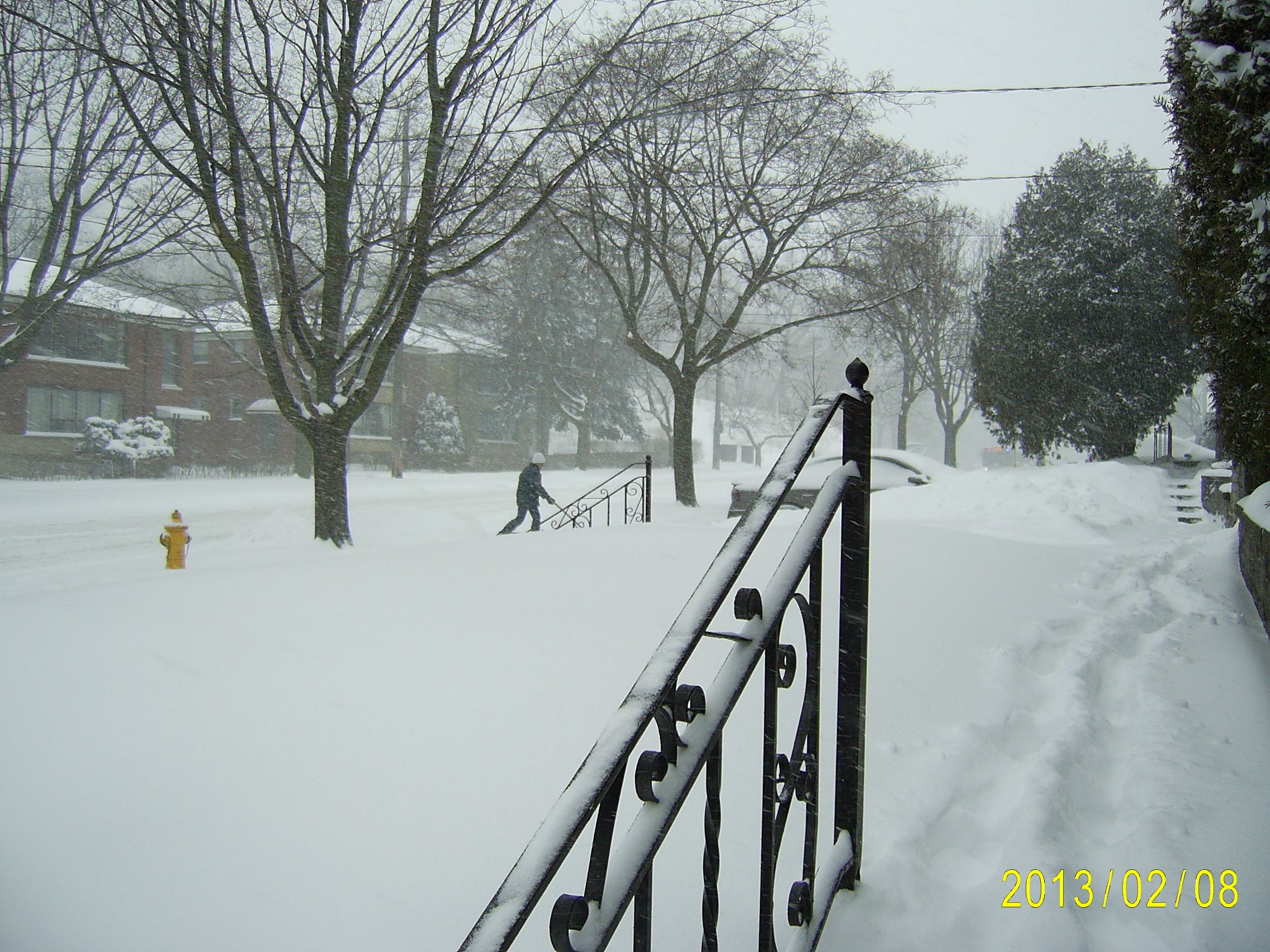
SAMSUNG DIGITAL CAMERAWe are having a winter storm. Actually, we are being pummeled by 2 cowboys, an Alberta Clipper and a Texas Low. Being on a Great Lake, we are probably getting some lake effect accumulation as well, but being inland, we are escaping the Nor’ Easter, which is going to hit Boston and the Maritime provinces. There and in New York, they have blizzard warnings, that is to say high winds up to 100 kph as well as heavy snow. In other words, we could have it much worse.

Okay, I admit it, I have storm-phobia. I come by it honestly. A long, long time ago, I lived in a poorly insulated, poorly heated farmhouse with a hysterical mother and a father off working in the woods. I’m afraid of early autumn windstorms for a slightly different reason. Absent mother, hurricane and caregiver down for the count. It is astonishing that I have managed to drag these conditioned terrors after me for 7 decades. My first instinct is to castigate myself. I remember my then husband, the redoubtable Blake (of Septuagenarian fame (115journals.com) and his impatience with this fear, but really that is not productive. We are dealing with a very young child here and censorious judgement will not work.

Yikes, she notes, there is a car stuck on the hill in front of the house!

Yes, Little One, but you are here in a warm house. The furnace has just come on. There is food in the pantry. There is beautiful music on the radio. The cedars outside the window are laden with snow like out of season Christmas trees. And safe and secure, you can watch the windblown snow drift down though weather-proof, floor-to-ceiling windows. You will have chicken soup for lunch.

SAMSUNG DIGITAL CAMERA

Exit Dragon: the Chinese New Year and Feng Shui

2013_snake_year_of-1-700x700

There’s a black water snake sneaking up on us, chasing the dragon away. Not to worry. If you are turning 24, 36, 48, 60, 72 or 84 this year or next January, you are probably yourself a snake. I would hesitate to tell you that if I did not also confess to being a rat.

Sure others have the dignity of being dragons or horses or even rams, while we labour under the burden of more lowly creatures. Our Chinese horoscope, nevertheless, will reassure us. Rats are very family oriented for example, although they should stay out from under the feet of a horse. Snake people are complex, clever and silent, although also prone to be stingy and arrogant. Whoops! (www.hanban.com). There is something to recommend every one of the 12 animal signs in the Chinese zodiac, but people don’t generally plan babies to be born in snake years as they do in dragon years.

The 12 animal signs in the Chinese zodiac are the dragon, the snake, the horse, the sheep or ram, the monkey, the rooster, the dog, the pig, the rat, the tiger and the rabbit, each recurring every 12 years. In addition, there is an over-lying and bigger cycle of the 5 elements: water, wood, fire, earth and metal, which recur every 60 years. The previous water snake year was 1953 and the next water snake will be in 2073.

The year of the snake is due to arrive Feb 4th, according to the Chinese solar calendar, Feb 10th by the lunar calendar, which most people go by.

I have just finished the feng shui changes recommended to me for the year of the snake. These recommendations were based on my birth year as well as the year the house where I live was constructed and its exact orientation in terms of direction. I had to go to the city archive and pore over elector lists and when they didn’t tell me exactly, I looked at aerial photos of the area. Finally, I came up with a year, 1956. The house seems to face directly east, but I had to verify that with an accurate compass. All of this I emailed to Kartar Diamond in Los Angeles. Because it was a long-distance consultation, I also sent a detailed, scale diagram of my apartment on graph paper and emailed several pictures of every room. (kartar@fengshuisolutions.net)

I had had feng shui done on a previous dwelling by someone in my town, but I didn’t like her recommendations, for example using metal colours instead of real metal. And that turned out to be a bad luck house when the sewer backed up and left me without heat in winter. Having met Kartar in L.A., I decided to go for the long distance analysis. So far, apart from minor and manageable problems, this place seems to enjoy better luck.

SAMSUNG DIGITAL CAMERA

This year’s changes, predicated on my birth year, year of construction and direction, were fairly minor. I was told to move metal out of the small front foyer in the SE, so I hauled the 2 10 lb. weights out from under the mail table. I was supposed to add fire, but since there is no electrical outlet there, I couldn’t plug in a lamp and leave it burning. The malfunctioning overhead light does stay on 24/7 so that may count. So does using the colour red, so I put a red running on the table and added a red Fu dog I got for Christmas and a red vase. I confess that the explanation of why is beyond me, involving as it does a 4 wood star, which is doubled here in 2013.

I moved the metal weights, one at a time – I’m old after all – into the bedroom where the SW had need of them. Unfortunately it -the SW – didn’t want any fire this year, so I had to take off the red pillow covers and move a picture my sister had painted for me. No problem. These could go back onto the Second Best Bed in the den. (See 115journals.com), which had looked rather dowdy in the last year. I also moved the living room fountain onto the bookcase that holds my journals because the W needs moving water. In the dining room, I added a lamp to the buffet where,once again, fire was needed.

red in den

This year’s changes didn’t involve any expense apart from paying for the annual update. I was already the proud owner of 125 lbs of heavy metal, bought over the 3 years I have been doing feng shui as well as the red table runner, which was languishing at the bottom of the linen cupboard.

light on buffet

Do I actually believe it works?  Who knows? It’s an interesting diversion at this wintery time at least. And it focuses my attention. In the end, I recall what media guru Marshal McLuhan said: I don’t necessarily agree with everything I say.