Winter Solstice

Winter solstice occurs this year on Friday, December 21 at 11:12 UTC around 4:15 p.m. here on the west coast.

This poem was written nearly 20 years ago, when I was living in an apartment on Venice Beach. I brought a copy with me on this trip and it feels applicable now as we approach the longest night, a time when physical light has reached its lowest ebb and now will begin to grow again, a time when inner light is at the full and can be accessed.

images

Winter Solstice

Such deep dark
so long sustained
should smell of balsam,
cedar, pine,
should have a canopy of icy stars,
of Northern lights,
shifting panes of white or green.

-A child under a buffalo robe
watching a sleigh runner
cut through blue
moon-shadowed snow
sees a rabbit track running off
into deep woods.-

Waking in the depth
of this longest night,
thirsty for sleep,I hear
the pounding surf,
an angry wordless shout
one floor below
and the reverberating slam
of a dumpster lid.
The sky at least is quiet:
a star hangs
above the flight path.

In my long sleep,
I have been following
that track back
into the woods
breathing sprue pitch
and resined pine,
lashed by boughs of evergreen,
until I have arrived at this
secret place
which only wild things know,
a place to shelter
while things end,
time unwinds,
the circle turns.

When we awaken,
shouting, homeless,
single and bereft,
we will go forth
into the growing light,
a light
we creatures of the dark
must yet endure.

This is the place,
now is the time
for the birth of the Child
in the cave of the heart.

The Fortunate Fall: change the future in a blink

Aunt Mae could see the future. It wasn’t a big deal to her. She didn’t tell most people. Only a few family members like my sister and I knew. Some outsiders knew and she got letters with strange postmarks and stamps in her mailbox that sat beside the main road 2 miles from where her tiny home sat under the mountain. Once in a while a big expensive black car swayed and bumped up the narrow dirt track and neighbours wondered why. Chances are it was a politician, a leader in government, a big business man maybe. She had those contacts, but she never took money. She did take a bottle of brandy, just as a house gift and purely medicinal, of course. She told us, Georgia and me, that if we had the gift, we must never sell it.

Anyway, it- fortune telling- wasn’t all it was cracked up to be. Sure she saw the mushroom cloud 2 years early and knew that nothing was going to stop that horror. She could live with it because she also lived with her Lord and her best buddy Jesus. When it came to individual fate, however, it was changeable. Sometimes she told what she saw in order to prevent it. Telling might galvanize the person into changing and changing it in the process.

So, yes, the future is changeable because human beings are. But sometimes change doesn’t happen until circumstances force it.

So she had seen this particular family crisis coming and cackled with glee. “It ain’t much.” But a woman of her faith could say that about the deluge, probably about the apocalypse, so I didn’t trust her. “You got to let your chicks out from under your wing. Let them out into the barnyard. They got to deal with that old fox theirselves.” And then I forgot. I put this “dire” warning out of my mind. Wouldn’t you? Besides she was very possibly just a batty backwoods hillbilly who’d made one too many trip to the brandy bottle and was stoned on Jesus.

Then last Thursday the event began to unfold. I booked passage. All our crises are transcontinental. Yes, there were enough airmiles. Yes, there was a direct flight. Yes, I could do 3 days planning and packing in an afternoon and leave in the early morning.

Of course I couldn’t sleep even after word came back that there was breath and life and a reasonable hope of complete recovery.

Sitting in a hospital room on the west coast, reading out loud to the patient from Malcolm Gladwell’s book Blink, I remembered something else Mae had said. “You can change your future in the blink of an eye.” She meant one moment’s inattention, one sudden impulsive decision. She warned Georgia and me about that. That’s how people drive in front of buses. Reason, logic, all our careful rules and practices can fall away and we act suddenly and dangerously.

Now here’s the miracle. There is a whole support system that can catch us in our fall. And it always works even though in the process we leave the physical plane. We felt this last year when a family member passed away, long before her time, and seemed to open a door into a great love when she went.

Neither Georgia nor I were able to sustain faith in Mae’s God so we pretty much knock about without that security and yet more times than we can count, we have felt that unfailing support as we do now.

There was no logical reason why things should have turned out so well. Coincidences maybe. Lucky breaks perhaps.

It has turned out to be a fortunate fall.

Aunt Rosa: how to quit worrying

Reblogged from a few weeks ago to remind myself how futile worry is.

I have just finished reading Christopher Hitchens’ book, Hitch 22 where I came upon a quotation from Nabokov’s New Yorker short story entitled “Signs and Symbols”. (Nabokov’s story is available online.)

The mother in the story is looking at her photograph album and comes upon a faded picture: “Aunt Rosa, a fussy, angular, wide-eyed old lady, who had lived in a tremulous world of bad news, bankruptcies, train accidents, cancerous growths – until the Germans put her to death, together with all the people she worried about.”

I had to stop reading.

While I don’t look fussy, angular or wide-eyed, I do qualify as old and I could give Aunt Rosa a run for her money in a worrying contest. In fact, apart from train accidents, we even worry about the same things. And of course, age, my own and my friends’, and the present economic climate are providing ample opportunity.

I had to stop reading because I was gobsmacked, (Great word isn’t it: my gob or face had been smacked.) by the sheer dreadfulness of the idea, its absolute finality, but much more than that, by the relief I suddenly felt.

I could save myself all that anxiety and trouble. Life is carrying me and my loved ones forward, just as it bore Aunt Rosa and hers along and neither one of us can change that by fussing.

I wouldn’t call it fate or destiny and certainly not the will of God. For one thing that would be insulting to any self-respecting deity and for another, because I don’t believe in such a thing, except as the direction our own spirit wants to move us in.

Life as it carries us along feels more like the continuous cycle of change that the I Ching is predicated on. What is empty becomes full and what is full will not always be so.

True, the worst may happen, whatever that may be. On the other hand, it doesn’t really matter. Hitchens says in the last chapter of Hitch 22, ” The clear awareness of having been born into a losing struggle need not lead one to despair”. What matters is facing life’s challenges without sentimentality.

What matters is our true nature.

The Right Mistake

Thelonius Monk, the jazz pianist, had a “unique improvisational style” Wikapedia tells us. He once said, after what he thought was disappointing performance, that good jazz consisted of making the right mistakes.

Robbie Robertson (late of the Band) borrowed that idea for his song, “The Right Mistake”. http://www.youtube.com/watch?v=09KF2GX2qtM

We can call to mind scientific discoveries that resulted from mistakes or were at least accidental: small pox vaccine, penicillin, insulin, the Pap smear, as well as inventions including X-rays, the microwave oven and, apparently corn flakes. But, in addition to music and science, can making the right mistake be a good thing personally? Should we be trying, like Robbie Robertson, to make the right mistake?

Shakespeare’s King Lear did that. In his eighties, he decided to divide his kingdom, the ancient kingdom of Briton among his 3 daughters. Then he got annoyed at Cordelia, the only one who really loved him, and gave her share to the other two. They immediately set about curtailing his privileges.  He had a retinue of “an hundred” men that followed him as he sojourned first with one nasty daughter and then with the other. One of them ordered him, “a little to disquantity your train”. He bargained for 50, they cut him down to one and then to none. In despair and rage, he left the castle and went out onto the shelterless moor just as the storm of the century bore down upon it. By the time, he stumbled across supporters and rudimentary shelter, he was soaked to the skin and raving mad.

What he said made little sense, but already he had changed. He was no longer the autocratic egotist who demanded that his daughters compete in a contest to see who loved him best. He was humbled to such an extent that he sat at the feet of a homeless derelict, calling him a philosopher. By the time he was rescued by Cordelia, he was ready to live out his life in prison, if need be, so long as he is with her:

As if we were God’s spies. And we’ll wear out
In a walled prison, packs and sects of great ones
That ebb and flow by the moon.

His great mistake has allowed him to learn to be a loving human being. He does not get his wish to live such a life. He is one of Shakespeare’s great tragic heroes and he must pay a price. That is really irrelevant because he has accomplished a much greater goal by becoming more completely human.

We perfectionists can relax it seems, for even our most egregious mistakes can lead us where we need to go.

Tuesday September 11:

Tuesday September 11, 2001, I was getting a late breakfast, liquid as usual for the past two weeks, when the phone rang. I was waiting for bowel surgery for a non-life-threatening bowel tumour. We turned on the tiny kitchen television set and watched the second tower, and the world as we knew it, fall.

Last night I watched the first half of Extremely Loud and  Incredibly Close, the film story of an autistic boy coming to terms with his father’s death on the 105th floor. I stopped half way to cry. It was not my grief, of course. No one I knew died there. And I recovered from my bowel problem, thirty pounds lighter. But still I grieve.

When I was six, a bad thing happened – I almost died. The bad part was that the person I loved the most almost killed me.

Can life be this “bad”. Yes, my heart, but we can still, somehow, be all right.

Sage Baby: Bad Titles follow-up

A couple of posts ago, I ruminated about titles that get outdated by time, including George Orwell’s 1984 and my blog 115journals. I imagined that the three journals I have written since are seriously put out and I rashly promised journal 118 that I would mollify it by posting its highlights. Today I reached page 215, the last page. Journal 118 started on July 8th is now retired from active duty.

Let’s see what’s there.

Oh. My. Goodness. Anais Nin would have relegated its first part to her diary of pain. When she was mortally ill in Big Sur, as I remember, she divided her journal in two and kept the unpleasant stuff separate. I haste to add that my “pain” was more mundane and much alleviated by simple means such as a new regimen of supplements to replace the minerals I was short of.

Then I come to a dream I had in which I was a young doctor just beginning my residency when I learned that I was pregnant. The dream was suffused with love, warm, nourishing love for and from my husband, and a quickening sexual desire. I went out for a walk by myself on a rainy Sunday evening to relish this feeling. Oddly, I came upon my actual/ non-dream-life son in the course of this walk. He was working as a blacksmith -not of course in real life -outside his forge and raised his head only briefly to ask if I had written another book.

I seemed to be living an alternative past and seeing an alternative future.

When I looked at what the dream meant, I saw that I was dreaming of healing myself. The Sunday night walk could be seen as a sign I was now complete enough in myself to do so. Someone I told the dream to said I was dreaming about my “sage baby”, that gestation is a symbol of spiritual cultivation.

So I looked on the internet for “sage baby’ and found it was the name of a company that produces baby blankets, a name given to both boy and girl babies and the name of a musician. Not helpful. I imagined people sitting in a shamanic circle fashioning tiny doll babies out of sage leaves. Then I finally realized she meant “wise” baby.

Ah, a familiar idea. One of western civilizations most important festivals centres on the wise or sage baby, born in a manger. But it has seemed to me for some time that this is better understood as the birth of the Christ in the cave of the heart, in other words, our own soul discovering itself and knowing it is one with the divine creative spirit.

A book is another kind of sage baby and my real son was/is fashioning his own sage baby, in iron with fire.

So there you go, Journal 118. That is surely your highlight, an actual insight.

Isn’t it curious that in our dreams, we can be any age, possibly because we are not actually age-specific.

How’s your sage baby coming on?

The Look of Love: paying attention

I am sitting beside him in La Veranda Osteria, when he seizes my left hand in both of his  calling me, “Sweetheart” and gazing intently into my eyes. No wonder he has had women on several continents and the odd island falling for him. My brother has had this ability to charm ever since he ran away to Europe with a backpack at 17. At the moment, he is trying to convince me of something, some better way to live, perhaps, but I am too overcome by his undiluted attention to take it in.

Great to find this in a dinner date, even if he is your brother, but much more important in a doctor or medical practitioner. I remember sitting in a sound-proof third-floor office near LAX and being the focus of the undivided attention of my acupuncturist. She asked questions of such insight, listened with such concentration and considered me so deeply, that I felt entirely and absolutely loved. The interview itself was healing: there was no real need for needling. In fact, I have had a profound feeling of change for the better, just from talking to her on the phone. That was her goal – to be so present and available to her patients that they felt connected, not just to her  but to the power that animates us. Having felt that connection and felt it repeatedly, it became easier for us to make it on our own.

Actors and self-proclaimed gurus, who project charisma, attract us because they make use of this kind of focus although not perhaps with such benevolence. I once met an actor unexpectedly on my way down to his wife’s yoga studio and almost suffered third-degree burns from the radiance of his projection. I was gobsmacked, but I did not feel better for it.

I do feel better when I can master the trick myself. The 108 moves in tai chi give me that opportunity especially when I find myself acting as Corner. (A Corner, as you might expect, is at the end of a line and so in a leadership role.) There is a lot of repetition in such a set, but repetition with variations. For example, there are 3 sets of  “Wave Hands Like Clouds”, one of 5 of this sideways step with soft arm sweeps, one of 7 and one of 3. All of them begin from the position of “Single Whip” or “Whip to One Side”, but between the set of 5 and the set of 7, just when the sleepy Corner has zoned out, the move suddenly switches to “Fair Lady Works Shuttles” or “Four Corners”, an altogether more complicated move. I have often been embarrassed when I have missed that change, dissociated or planning dinner or gazing out the window. I was not in the now, not really present.

When I do hit that groove, I experience a mental rest, like a moving meditation from the one-pointedness. It is easier than meditation for me. The kind of meditation I practise when I am able is mindfulness, just being aware of what is going on, especially internally, observing  without attachment, as my acupuncturist would say – letting each thing go -each thought, feeling or sensation.

It’s a useful technique when I am beset by anxiety or depression or pain. If I sit down, just sit, not cross-legged or full-lotus nor even necessarily straight-backed, but easily, and observe what is going on in me, I gain some distance. I am watching what my mind is doing and so I am now in the role of observer, not sufferer. I am no longer my discomfort. I can stop spinning. I have heard that the goal of meditation is to still the mind. I don’t aim that high. But if I pay attention to it, it stops screaming in agony, like a crying child when her mother holds her and gives her her attention. It may well be that there is no solution. The grief cannot be assuaged. A fearful situation cannot be resolved. A physical pain is intractable. No matter. All these things are more bearable when looked upon steadily.

It doesn’t even have to be a look of love. Did my acupuncturist actually loved each of the parade of people who sat before her? (Of course, she did me.) She became absorbed in them so that there was no longer a separation between her and other. No other in fact. In the same way, I can reclaim my anger and self-loathing, my fear of ageing and death, whatever negativity is plaguing me. Once reclaimed, these parts of me seem to shrug and get on with life.

It is these negative feelings that prevent us from focusing, both on others and on our own mental health.

Eckhart Tolle has written several books, including The Power of Now to extoll the virtues of focusing. Jon Kabat-Zinn has told us how to heal ourselves through mindfulness in Coming to Our Senses. I have read these and others and found them inspiring, but it is simple practice that gives results. Like tai chi. We don’t really need to read more. We just need to do it.

“Attention must be paid,” Arthur Miller said in Death of a Salesman. “Pay attention,” our parents and teachers admonished. Yet we seldom do. We need something like the little bell that Buddhists sound during meditation calling out, “Be here. Be now. Wake up”.

Love is just that: being conscious.

The Hungry Ghosts: Chinese All Souls Festival

As we approach the temple building in Chinatown, we can see smoke rising from the tiny courtyard, smell strong incense and feel a fine spray on our faces. Through the filagree of the metal fence we catch glimpses of red-robed figures and hear their chanting. My friend peels off at this point, allergic to such strong incense and smoke. Entering by a side gate, I come upon other chanters in light blue robes, coming down from the temple on the third floor.

Inside the tiny office area, I am pointed toward the English list. The Chinese list looks to be more sizeable. The man before me is busy adding a folded package containing a paper sports jacket, paper dress shoes and a paper cell phone to his bag of paper money. I know these customs having attended a Chinese funeral, although the deceased also received genuine Scotch whiskey to help her on her way. When it is my turn, I am greeted happily. “We didn’t know you would be here to burn your own!” But I eschew extras. I am sending only these ersatz silver and gold bars to my parents.

For weeks, we have been rolling this paper money at our tai chi club and sending it down here in huge green plastic bags. The money has been redistributed into the small parcels, such as the one I hold with my parents’ names and their memorial plaque number on the label.

“You know what to do?” asks the volunteer in charge of the English list and she proceeds to remind me, but I do know what to do. This is the sixth year that I have burned an offering.

“Why don’t you do it for Aunt Mae?” Georgia has asked me. Aunt Mae got us through our tough young lives.

“Aunt Mae doesn’t need any help,” I reply.

Perhaps our mother doesn’t either, for when she left, she never looked back. She went so completely and utterly that her leaving left me questioning my beliefs, questioning them all the way to a two-week hospital stay.

My father, on the other hand, hung around, offering, for example, financial advice: buy lottery tickets. Those who have read my memoir, Never Tell, will understand that he was the sort of parent, one is better off without.

I climb to the third floor, clutching my paper sack. Through the door to the temple I can see more blue-robed chanters moving about among what surely must be “graven images” of the Quan Yin and Confucius and other Buddist, Taoist and Confucian “saints” or holy beings. They are large and colourful and delight me, but today my business is in the anteroom where the memorial plaques are posted. Mine is #588 and easily found.

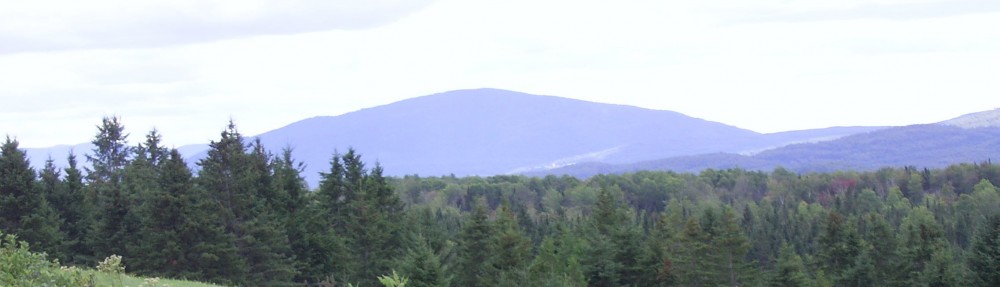
I stand gazing at this innocuous slip of yellow paper, bearing my parents’ names and the name of their native town -Hereford. How strange to see it here, amid these gaudy red and gold trappings, above this altar covered in dishes of food: fruit, pastries, rice, tea, pots with many sticks of incense, and beautiful flowers. Hereford of rolling green hills and low mountains, Hereford Hill that lies under slope-shouldered Hereford mountain and looks down over the Indian and Connecticut Rivers, a wooded place that is turning its back on cultivation now, turning back to dark and tangled forest.

I bow, the parcel tucked awkwardly under my arm. I choose a joss stick, light it on a candle, bow and stick it in the sand of an incense pot. I bow again. I don’t want to leave.

I am 76 years-old, but I am also 2 and 4 and 5. I am living through the Great New England hurricane and watching my parents build a load on the hay wagon and walking the dirt road with my mother and fishing the trout stream with my father.

If they were alive my mother would be 95. Her mother lived to that age. And my father, 98. But they have been gone for 44 and 24 years. Most of the family is profoundly grateful and it certainly has made life easier. No one else, Georgia or my visiting brother, wants to be here with me.

Downstairs, I am waved toward the back parking lot where a small iron burner stands ready. Two of my favourite instructors are there to feed the fire. They are my age, perhaps, although their wiry small bodies are in such good shape, it’s hard to tell and they are teaching another Chinese man how to do the tor yu as one of them pokes my bundle into flames.

I stand watching it burn, leaping up in bright gold and red flames, dying back to black ash and leaping into flame again. My eyes are watering. Must be the smokey wind.

I am feeding the hungry ghosts, my father who waited his whole life for a windfall, my mother who loved beautiful things -cranberry glass, cow pitchers (!), my father who sought some adrenaline high to fill the emptiness of his orphaned heart, my mother who sought solace, a gift to soothe her battered soul. And my own. My ghost is still more or less grounded here for the time being, but I know its tendency to wander, howling in the wilderness.

It’s all about me as usual.

Measured against the forests and the granite, the myriad lakes and waters, the un-reckonable ages, I am just a flame. These steadfastnesses support me, not I them. I can flicker and go out and reignite. I owe my life to Something greater.

When the fire has died down to black, I thank the men and walk through the back gate to my car, which still has a lot of time on the meter.
“Your Immense Heart”

Quote

A jar floating in the river
Has river in it. The city lives in the room. Think of the world
as the jar and your immense
heart as the river.
Rumi – Coleman Bark’s translation in The Soul of Rumi p. 295

Apparently, Rumi is currently the best selling poet in America. He is the 13th century Sufi, born in Afghanistan, who fled Genghis Khan and went to live in Persia. Coleman Barks, his translator, has brought him to our attention. There are other translators certainly, but I am familiar with this one and came across the lines I have quoted high above the blue Pacific on my way to Maui. I kept running them through my mind so that, by the time, I saw the double rainbow over the ocean on the Hana road, I had committed them to memory. It seemed a wonderful thing that, instead of being carried along by the current of the world, my heart was the great river that bore the world along.

Well, easy enough to know the immensity of the heart when it is full of joy as it was then. Not so easy in times of fear and loathing. And disappointment and frustration, and loss and failure and recession and depression and so on until we end up with Grinch-sized hearts, hearts that need the jaws of life to pry them open. Little tiny hearts such as Connor  (“Why I Will Never Sleep Again”, posted May 30) must have had in the end.

Open-heartedness like a river accepts everything and sweeps it up in its embrace. It does not hold back to assess a situation, deciding perhaps that here, compassion is called for or there, that empathy is in order, that this is just and right and valuable whereas that is not. It doesn’t involve effort or reason. It isn’t deserved. It is more like grace.

Big-hearted people, the Falstaffs that we meet, give us a glimpse into open-heartedness although we may dismiss them as tiresome good-time fellows. But the open heart is not necessarily ‘Hail-fellow-well-met’.

The open heart sees things in a positive light. What seems negative is just misunderstood, for always life is carrying us on in the right direction, the direction our soul is seeking in spite of where we think we ought to be or go.

But how to come to such an inclusive, accepting, positive frame of mind can be a difficult question. We each have to find our own way. Someone might begin with gratitude. Someone might arrive by being in love. Some by family love. Some by love of a pet, some of nature. To be truly open-hearted will always mean expanding beyond those beginnings and, for example, including everyone in that beloved family, loving your mother-in-law as much as your cat, for example, your political opponent as much as your child.

It is not a way of being that comes naturally to us yet, but I believe that technology is coming to our assistance. The internet can serve as one immense heart as well as mind. We share our thoughts instantly and spontaneously now and we have the opportunity to be more empathetic.

In another poem, Rumi says we are cups floating in the ocean and we should strive to wet our lips.