Changing the Future: Atkinson’s Life After Life

SAMSUNG DIGITAL CAMERAIs it possible to change the future? If it is, is it wise?

First, you would have to know the future needs to be changed, I suppose. You might have a strong sense that the immediate future is not going to go well as a friend of mine did as she listened to a buzz bomb overhead in 1942 during the London blitz. She heard the telltale silence announcing the bomb was about to hit and prayed very hard that it would miss her and her infant son. It did. It landed on a house in the next street, killing another mother and her  baby.

(Did she change her fate? Certainly, she thought she did and still suffered over it 60 years later.)

You might have received a prediction that you believe to be true. It is hard to disbelieve an oncologist and even your future-telling Aunt Mae can have a convincing track record.   The latter believed that the only reliable way to change fate is to change character, an infinitely harder task than waving a wand. People do outlive their doctor’s prognosis, often by making drastic changes and summoning up reserves they did not know they had but most people are disinclined to make such fundamental changes or so Aunt Mae said.

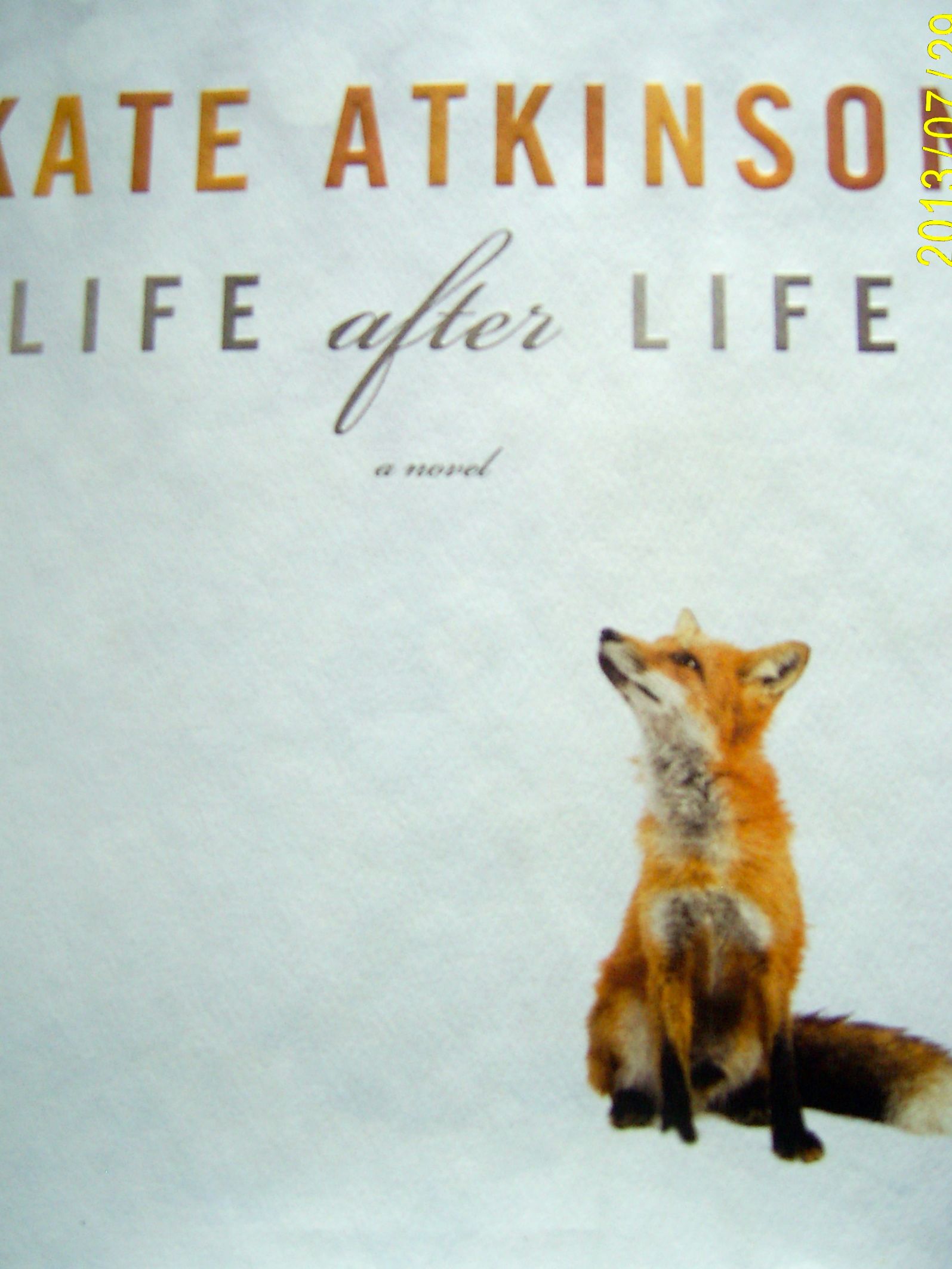
Ursula Todd, the protagonist of Life After Life by Kate Atkinson, dimly senses her past-life misfortunes and tries to avoid them. Past lives’ misfortunes would be more accurate. She is, for example, born several times on February 11, 1910 always to Sylvie and Hugh Todd. The first time a snow storm prevents the doctor’s arrival.  She does not even take a breath. “Darkness fell.”, we are told as we will be many more times. The next time Dr. Fellowes gets there and cuts the cord that is around her neck. There are 8 chapters all called “Snow” that describe Ursula’s birth day. Eventually, even her irritatingly numb mother, Sylvie, has figured out that she needs to keep scissors in her night table drawer.

Some reviewers have, erroneously, suggested that Ursula is reborn into the next life at, say, 16, the point at which the subsequent narrative begins. This is wrong. Kate Atkinson explained in an interview with Eleanor Wachtel on CBC Radio 1 (available as a podcast, CBC app free) that Ursula starts over on February 11, 1910 in each case: it’s just that so much repetition would have bored readers.

The earliest opportunity Ursula has to change the future occurs at the end of the First World War in 1918. Bridget, the Todd’s maid, goes off to London for the celebration and brings the Spanish Flu home to infect Ursula and her beloved little brother, Teddy. Darkness falls. Next time, Ursula has a vague presentiment that Bridget should not come into the house when she comes back and tacks a note on the kitchen door and locks it. Sylvie outwits this plan. Next time, Bridget ends up with a sprained ankle but hobbles, gamely, off to London. “Darkness and so on.” By this time, Ursula is learning what déjà vu is, but Slyvie tells her not to dwell on “these things”. The Irish Bridget is more sensible, declaring that Ursula has second sight. For her thanks, this time, Ursula pushes her downstairs and finally prevents the Spanish Flu from carrying off Teddy and of course herself.

Sylvie takes Ursula to a Jungian therapist, who has not treated a child before but turns out to be eminently qualified. He teaches Ursula such Buddhist ideas as that of the eternal return, of dying and being reborn. And he accepts her strangeness.

But Ursula’s returns are not about learning to be a better person through lessons of retribution in successive lives. They are about getting things right, so that at least some of the harm life can do gets mitigated. The opening chapter in which 20 year-old Ursula takes her father’s Webley pistol to a Berlin cafe where she meets the Fürhrer for tea and struesel, for example, just might have prevented World War II.

This is one of two death-and-misfortune scenarios that she repeatedly tries to correct: death by bombing or attendant war trauma and sexual assault when she is 16.

The sexual assault by her older brother’s American friend on her 16th birthday initially leads to dire results, including loss of her mother’s affection in every iteration and death at the hands of an abusive husband in one. Gradually, however, Ursula perfects her punch

World War II is a more complex problem. Initially, Ursula is haunted by a feeling of flying out a window. She is living in London in November 1940, enduring nightly German bombing raids. Night after night presents an opportunity for “darkness” to fall. Initially, she lives in the same flat on Argyll Rd., sometimes still in a relationship with a high level man from the Admiralty, sometimes not, but in every life the place gets bombed and the residents killed. She might be in the basement shelter or upstairs, retrieving someone’s knitting, but her life ends there. Finally, we come to a life in which she is an air raid warden, no longer living in a flat on Argyll Rd. but attending to its bombsite. The baby Emil, who had driven her crazy crying, is now part of the debris she stumbles over doing rescue and recovery.

But the Germans are not just the enemy.  Ursula’s cousin, Izzie’s son, given up for adoption in one life, has been adopted by a German family and is of an age to be flying a bomber over London. In another life, Ursula has made yet another bad choice in husbands, marrying Jurgen while she is travelling in Germany. In one life, the mother in the family that she stayed with introduces her to Eva and in another she sets out to befriend a woman in a photo shop who turns out to be Eva Braun and so gains an entré to Hitler and the Berg, Hitler’s mountain retreat. She is invited there by Eva when her daughter, Frieda, becomes ill. At the end of the war, we watch as Ursula and Frieda starve in bombed out ruins in Berlin. That chapter ends with the observation that she had never chosen death over life before.

Then as a kind of muscular solace we are treated to Ursula, back in London, an air raid warden. Gradually, her obsessive thoughts and compulsions have shaped her choices so that she has avoided her own death, but she has witnessed many others. The detail and realism of these chapters is astonishing and makes for a rousing climax.

As the author says, there is never really a moment when Ursula sees clearly what is going on, but in “The End of the Beginning”, she does gain a measure of clarity. She has learned to shoot a gun by the way. Finding herself in a sanatorium, she observes to her psychiatrist that time is a palimpsest. The canvas can be painted over again and again. She has wasted precious time, but now she has a plan. And she knows that she must “become such as you are, having learned what that is”.
Jackson Brodie

8557197Fictional detectives used to be unattached aristocrats or poets whose lives have been touched by tragedy -Rendell’s Adam Dalgleish, George’s Thomas Lynley- or no-nonsense suburban curmudgeons -Rendell’s Wexford. Nowadays they tend to be ex-army often special forces – Connelly’s Harry Bosch, Ian Rankin’s John Rebus, Lee Child’s Jack Reacher, Jo Nesbo’s Harry Hole  – and of humble origins – Peter Robinson’s DCI Banks, . They tend to be outsiders and pariahs in their police departments like Rebus in his last appearance, retired and a cold case investigator. Often they are semi-destroyed by what they have seen, struggling with addictions -smoking, booze, hard drugs – and clinically depressed or worse – Henning Mankell’s Kurt Wallender. Some of them are music lovers – Banks, Rebus – and have picturesque cottages as  they strive for peace -Banks, Wallender. Generally, they have failed marriages and single daughters who tend to follow their fathers into police work – Bosch, Wallender, Rebus – although Banks also has a musical son. Jack Reacher stands alone, never having married and pathologically unattached to home.

Then there is Kate Atkinson’s Jackson Brodie.

So far, Jackson Brodie has appeared in four of Atkinson’s novels: Case Studies; One Good Turn, A Jolly Murder Mystery; When Will There Be Good News? and Started Early, Took My Dog. He is typical of these latter day literary detectives in that he came from a mining family, quit school at 15 and joined the army. He is divorced, although his daughter is too young yet to join the police. Does he also have  a son? He takes solace in music of the female country hurtin’ kind. Initially he longs for a country place in France but lately he’d be happy to find one in Yorkshire. As his surname suggests, his family came from Scotland, and, in some ways, he is what the Scots call a hard man – Rebus, Harry Hole, Jack Reacher, Harry Bosch.  Note that I have called Jackson by his first name. Rebus is almost never called John; Reacher is never called Jack, although Harry Hole is often called Harry. Thank goodness. Otherwise, I would have had to keep reminding myself that in Norweigian, it is pronounced Whoolay. Jackson is quick to raise his fists, but he often gets the worst of the fight. One of Jackson’s appeals to this reader is his haplessness.

When it comes to detecting chops – he doesn’t have Wallender’s skill at group think and analysis, nor Rebus’s and Harry Hole’s instinct. He quit the police force before Case Studies begins, so, as a private eye, his inside information, is compromised. Fortunately, he has formed a sort of partnership with DSI Louise Munroe in Edinburgh and he has his own private sources. It has to be said that the best thing about Jackson is his commitment, especially to lost girls. There was such a girl in his youth and that has made him what he is, doggedly persistent in his effort to help others who have lost girls, but sometimes as in Started Early, he doesn’t even know what’s going on. When he meets with success, it seems almost accidental. His sudden acquisition of wealth, a case in point.

When I saw the first television series starring Jason Isaacs as Jackson, I didn’t get the humour. Somebody was trying to kill him in Case Studies, braining him from behind and moving on to arson and finally to vehicular homicide. As it turns out this maniac has a  ‘justifiable’ motive, but it is totally baffling to Jackson and me. It is random and absurd, and it was only when I read the books that I began to see that it was also darkly funny. He had just been punched in the face by two different people before he was mugged, for example. One Good Turn begins with a minor rear-end accident in a narrow street in Edinburgh during the Fringe Festival and quickly escalates to attempted murder by baseball bat. The hero of the day stops that with a lucky throw of his laptop, but finds himself inextricably bound to the questionable character he has saved. Passing by, Jackson casually offers the ‘hero’ his card. Both are now on the ‘murderer’s’ to-do list. Mistaken identity adds yet another person to the list.

Okay, I can see that you need to read the books to get the humour.

One of the peculiar things about these books is that in the beginning, Jackson isn’t even mentioned. Whole chapters are given over to narratives about people he has never met, but who will eventually bring their cases to him. Atkinson is very good at bringing characters alive in all their complexity. We get into the minds of Amelia and Julia who lost their little sister when she was 3, into Theo’s mind who lost his 16 year-old daughter on her first day of work at his law firm and into the mind of an obsessive new mother, whose husband meets a grisly end involving an axe. It took me a while to learn to enjoy this method and not rush over them to get to Jackson.

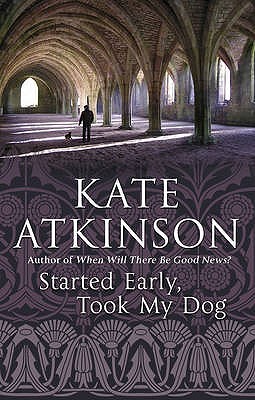
Jackson’s women are more than glad to tell him his faults and  to take advantage of him, sometimes with what seem like dire results. Dire to the reader. Not to him.  He has bad luck with women and trains. Accidentally, boarding the train bound for Scotland instead of the one for London turns out to be the least of his problems that day. At one time or another, he loses his wallet, his money, his car, but carries on with his original plans, although losing his actual identity does slow him down. Certainly he learns that old truth that no good deed goes unpunished. At least he ends up with a dog, which he takes to see the ruins of Fountains Abbey, as we can see on the cover of Started Early, Took My Dog.

June: inconsequential moments

sunny bike pathIt rained heavily all morning while I read the weekend papers, all lights on to brighten the gloom. Then the rain grew lighter and at some imperceptible point, stopped altogether and the sun began to break through. By late afternoon, it was a real June day. I knew it would be too wet to go up through the woods to my favourite walk on the ridge trail, so I chose the paved bicycle path instead.

It turns out that I don’t need to go into the woods because it is breathing out on either side of the path, a moist, woody, green exhalation like a blessing. A stiff breeze draws my eyes upward. I have not realized how tall the trees are until now nor how many of them are poplars. The wind catches the tops, tossing them first one way and then another, moving wave-like across the height. The poplars sing as they stir. Poplars have always spoken to me. They stood close in by the first home I remember and danced in slight air currents when all else was still.

poplars in the windThe path emerges from the shade of the woods to a crescent of mown lawn lying open to the sun. I go as far as the culvert that carries the little brook under the path. The brook edges the woods here, dividing it from the lawn, flowing under ferns and low branches. Today it is babbling busily with the runoff. I wish I could capture its bubbling music.

One cardinal has been singing as I walked and I catch a glimpse of his vivid red and his crested head as he leads me away from his nest. I cannot follow him. I do not fly.

The half hour’s walk has been quiet and contented, easy and relaxed.

Earlier in the day, I listened to author James Lasdun being interviewed mainly about his recent memoir Give Me Everything You Have, the story of his 5 year ordeal at the hands of a cyber stalker, a writer and former student whom he calls Nazrin. Initially Lasdun helped her by sending her novel of life in repressive Iran to his editor, but then Nazrin turns on him, accuses him of stealing her book and selling it to other Iranian writers who publish her stories. She goes on to accuse him on “Comments” of drugging and sexually assaulting women. She caps this by emailing him increasingly violent anti-Semitic threats. None of it is apparently bad enough to merit police action, particularly since Nazrin has left New York City for Los Angeles and is outside of Lasdun’s available police jurisdiction.

Lasdun’s mind is more and more taken up with the harassment. He becomes obsessed with it.  He begins writing an account of what is happening as documentation and the account morphs into a book.

One of the central images he uses in the book is that of Sir Gawain and the Green Knight. The Green Knight rode into the dining hall and challenged the Knights of the Round Table to cut off his head, promising that in a year and a day, he would in turn, cut off his beheader’s head, a give-me-everything-you’ve-got challenge if ever there was one. Sir Gawain beheads him. The Green Knight takes his head under his arm and rides away. Now the real story begins.

Since Lasdun published his book, several other people have contacted him to say that Nazrin has also stalked them. Meanwhile she has stopped communicating. Now there are moments, Lasdun says,when he realizes that life can be inconsequential.

He means that life does not have to be full of high drama and desperate struggle. It does not have to be full of significance and fraught with conflict. Moments can be ordinary and forgettable. He did not have to explain what he meant. You could hear the relief in his voice

Having had an interesting life and having spent a good deal of it dodging and weaving in expectation of the Green Knight’s revenge, I was grateful to be reminded that life can be peacefull and I carried that comfort with me as I took a walk on a breezy late afternoon in mid June.

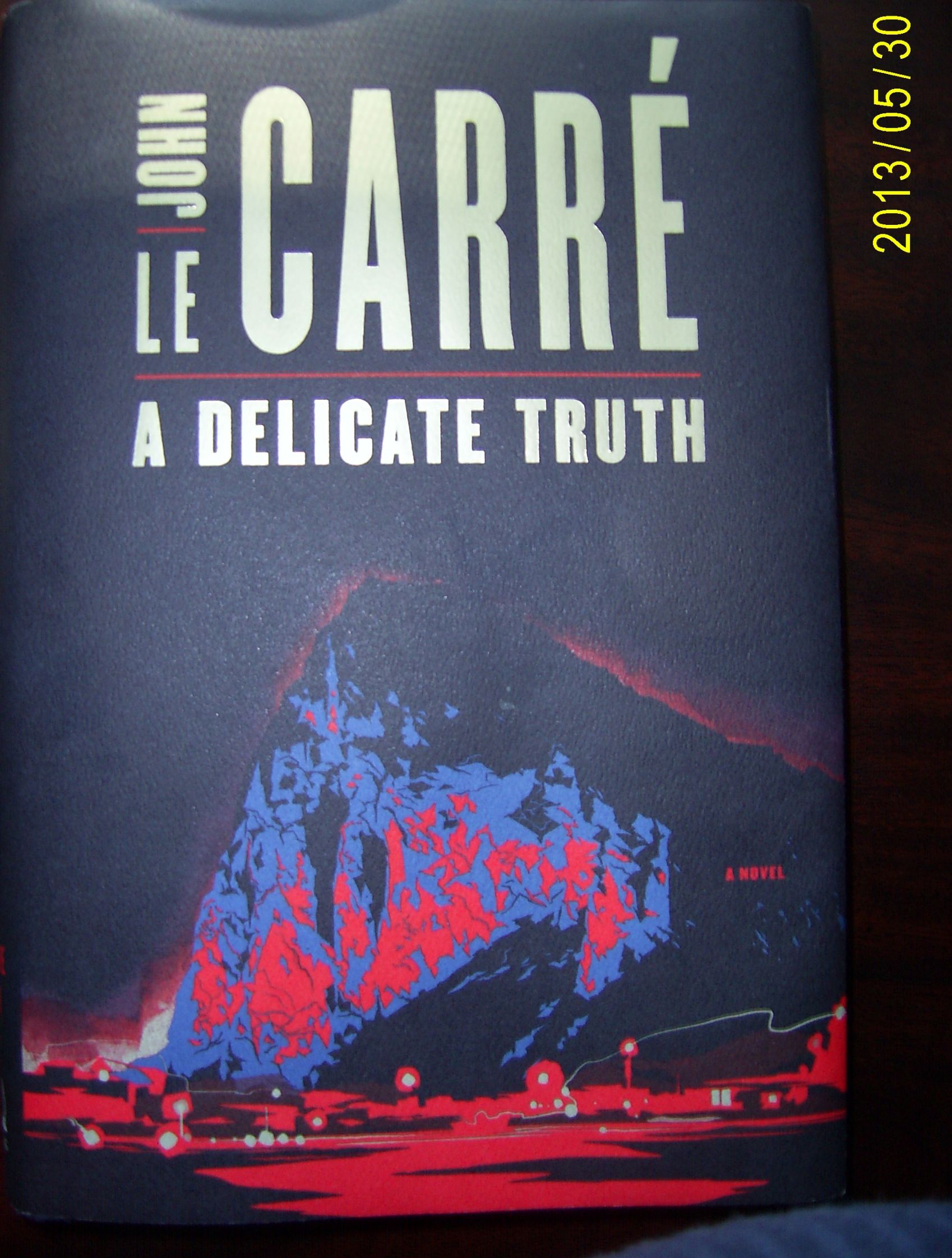
The Truth about Le Carré’s A Delicate Truth

SAMSUNG DIGITAL CAMERAOn Sunday May 26/13, I heard John Le Carré interviewed about his new novel A Delicate Truth. (free CBC app, Arts/Writers and Company podcast May, 26, 2013.) He agreed to do this interview because he had been interviewed by Eleanor Wachtel in 2010. He told her, once they were off the air that he would not be doing any more radio interviews. (This was a decision based on prior consideration and not a reaction to this interview, which he greatly enjoyed.)  So I consider myself fortunate to have chanced upon it as I drove home.

Indeed, I consider myself fortunate that he published this his twenty third novel, so fortunate that I tried to buy it several days before its release. Le Carré can be trusted to tell a good story and to do so with elegance and wit. But, looking over reviews of the novel, I found that not everyone agreed.

Most reviews began by referring to George Smiley, the protagonist of Le Carré’s breakthrough novel, The Spy Who Came in From the Cold as well as Tinker, Tailor, Soldier, Spy, the recent Gary Oldman movie. Once the Berlin Wall fell, readers wondered what Le Carré would write about. But, of course, there are always enemies, big pharma – The Constant Gardener, arms dealers – The Night Manager, unscrupulous bankers –Our Kind of Traitor. Spies were replaced by whistle blowers, but there was still intrigue enough for readers as well as plots that twisted and turned toward ambiguous endings. Yet some discontented reviewers lamented that these later novels lacked the subtlety and complexity of the earlier ones. The Globe and Mail reviewer of A Delicate Truth, Richard Poplac, declares that Le Carré “has reduced himself to writing a series of screeds”; he says about the writer’s recent protagonists, “not a word out of their mouths rings true” and calls the novel “a clunker”. Set against Poplac’s rant, were more positive comments; from the LA Times, “While some fans will miss the ambiguity of earlier books, A Delicate Truth delivers plentiful intelligence and thrills”.

George Smiley’s conundrum was whether or not he could preserve a modicum of humanity while serving his country or whether the compromises he would be forced to make in its service would make such inroads into his soul that he would be as bad as the enemy. Indeed those Cold War novels depicted the Western Intelligence Agencies as more or less morally equivalent to the KGB.

A Delicate Truth focuses on two men in the British Foreign Office who face the same challenge. We meet the first one in a hotel room in the British Crown Colony of Gibraltar under the name of Paul Anderson, going slowly mad as he awaits a phone call to tell him that the mission is underway.  “Paul” is a low flyer in the foreign office, a few years from retirement, “a violet by a rocky brook” sort of person: he has never attracted attention. The mission, once it gets underway, turns out to be the extraction of one code-named Punter who is about to buy missiles, “a jihadest equivalent of the Scarlet Pimpernel, an even wilier version of Osama Bin Laden” (National Post – 13/05/03). The land operatives are British soldiers, temporarily demobbed so as to be deniable, and the sea operatives are employees of an American private military outfit called Ethical Outcomes. Paul is there to act as “red telephone”, the eyes and ears of Fergus Quinn M.P. At the moment when the attack has to go or be called off, Paul heeds the advice of Jeb, the British soldier in charge, and refuses to give the go-ahead. Other, rasher heads prevail and, according to reports, the mission is a brilliant success. Punter, apparently, is spirited off to the American ship lying off-shore and suffers Rendition.

After that long first chapter, we find ourselves back in London witnessing the moral struggles of a younger foreign office minion named Toby Bell, who has bugged the office of his boss Fergus Quinn, and is about to retrieve the tape. Before we get there, though, we get Toby’s background. He is a thoroughly decent fellow who wanted to resign when Blair took the nation to war in Iraq under the false pretense of weapons of mass destruction. His mentor, Oakley, tells him, “Hyprocisy is the tribute that vice pays to virtue, dear boy. In an imperfect world, the best we can hope for.” Toby finds himself summarily shipped off to Madrid and the Cairo, rising with each step, until now fluent in Arabic, he returns to London to be Quinn’s private secretary, with a mandate from superiors to keep the Minister out of trouble.  Only thing is, Quinn never gives Toby a glimpse of what he is up to, hence the bugged office.

Of course Toby finds out something very troubling that has to do with a vaguely British operative named Jay Crispin and the American outfit, Ethical Outcomes.

Then we find ourselves years later in Cornwall, Le Carré’s home territory, watching Sir Christopher Probyn settle into his retirement as a benevolent lord of the manor personage. Wait a minute, isn’t this Paul! And doesn’t he magically run into Jeb, disgraced and reduced to “tinkering” and doesn’t Jeb have some awful here-to-for repressed information about what really happened in Gibraltar! What to do? Kit Probyn aka Sir Christopher aka Paul knows just the thing. Call that number he called before he met Fergus Quinn. The number belongs to Toby.

Thus the forces for good or at least for the truth begin to assemble. The third member of the group is Kit’s daughter, Emily, a doctor who treats the poor and needy in London’s east end. There we have the essence of the book: who will stand up for the individual who has been deemed unimportant, an acceptable loss in the face of the war on terror. And can the delicate truth be brought to light in the face of bureaucratic duplicity? Will the well-meaning opponents of officialdom find themselves declared traitors?

In a world where “War’s gone corporate” and intelligence is purchased from private spy agencies, truth becomes relative.

It is true that A Delicate Truth, like the other post-Cold War novels, lacks the irony of the Smiley books. Something changed so that Le Carré could no longer afford that detached point of view. Certainly 9/11 and the resulting War on Terror and the 2003 invasion of Iraq played a part in that. I find it hard to regret that.

A novelist is not a made-to-measure workman. He writes out of his soul and conscience. And I am very grateful to have yet another brilliant novel from Le Carré’s pen.

The Great Gatsby: a personal response

Jay Gatsby and I go back a long way. No not to that hot summer of 1922, but to the hot summer of 1952. Having cycled to Burlington beach by myself, I lay in the sun reading Scott Fitzgerald’s The Great Gatsby for the first time. The 18 year-old boy I had given my heart to had, apparently, thrown me over, so I fell for Jay Gatsby instead. And got sunstroke. Next day, I was invalided home from my summer job on the ladies’ blouse counter and spent 3 days hallucinating lightshows, green and otherwise, and longing for a cool, blue pool.

That was just the beginning. Even after the boy came back into my life, became my husband and the father of my two children, Gatsby and I carried on and not clandestinely. I taught the novel to my grade 12 classes throughout most of my 35 year career as a high school English teacher. My husband and I began by believing Fitzgerald’s dictim that “living well was the best revenge” and ended by revising it to “eating well is the best revenge”. That was after the energy crisis and subsequent recession in the 70’s.

Meanwhile we lived in a house under a hill, where springs bubbled to the surface and pheasants called. We built rock gardens and planted bushes and trees for the birds. We planted a cedar hedge and built fences and dry stone walls. We sunk a pool beside the house. We bought a sailboat. We lived in a cul de sac and walked to work. We holidayed in Europe en famille.

Then Robert Redford’s Great Gatsby came out on film just in time for me to show it to my classes as my dream came apart.

It is many years later now, so many that I wasn’t sure I even had a copy of the novel. Not that I really need it since after so many repetitions I have virtually memorized it. But there it was beside Zelda’s novel Save Me the Waltz and Scott’s This Side of Paradise. I searched it out when I came home from watching Baz Luhrmann’s Gatsby.

In his Los Angeles Times review, Charles McNulty begins by remarking that from reading some reviews of Luhrmann’s Great Gatsby, “you’d think that the Australian… would be facing extradition for his crime against an American classic”. McNulty begins by calling the movie “relentlessly bouncy” and the CGI-enhanced opulence eye-tiring, but very soon, he concludes that it is a “diverting pop-culture riff that has as much to say about Fitzgerald’s novel as it does about the connection between two decadent eras, the Jazz Age and our own”. He goes on to illustrate how our perception of a classic, such as Hamlet, changes as we age and as the times we live in change.

I found myself an audience of one in a huge auditorium and absentmindedly wandered back out to pick up my 3D glasses. But no, this theatre was not equipped for 3D. Just as well, I got dizzy anyway. Yes, it was dazzling; yes, the party scenes were fantastic and overdone; yes, their effect was shallow and empty. (Wasn’t that the point?) True some of the music was Twenties -Gershwin’s ‘Rhapsody in Blue’- but much of it showed Jay Z’s hiphop influence, startlingly vital. For a brief moment I caught Beyonce singing Amy Winehouse’s ‘Black to Black’. And frankly, the window sequence at Myrtle’s Manhattan apartment was worth the price of admission.

Robert Redford in the 1974 movie was never my idea of Jay Gatsby. Too cool. Of course, Gatsby played cool but locked inside was James Gatz, the desperate poor boy and the bootlegger, the fellow rumoured to have killed a man. Di Caprio has more of that inner tension, so that when he strikes out at Tom Buchanan, it is not entirely unexpected. Daisy is hard to get wrong. Be beautiful and vulnerable and Carey Mulligan can do that. Indeed, Fitzgerald’s characters are not deep. Gatsby is mysterious, but not complex.

Christopher HItchens said that The Great Gatsby “remains great because it confronts the defeat of youth and beauty and idealism and finds the defeat unbearable and then turns to face it unflinchingly”.

Nick Carroway, the narrator, strengthened by his father’s midwestern upbringing, goes back to Chicago to work in finance, sobered but unbowed, Mr Luhrmann. He does not end up writing out his pain in a rehab centre. Just sayin’.

Spoiler alert: Gatsby and his creator died young. As indeed did Zelda Fitzgerald, Daisy’s prototype. At least Gatsby did not fall victim to alcohol, madness or fire. Having outlived his dream, that was probably for the best. But even to the last, Gatsby lived in hope, waiting for Daisy’s call. It was that hopefulness that made NIck call out, “You’re worth the whole damn bunch put together.”

Much to my surprise, I survived into old age in spite of opportunities not to. I survived loss and grief and illness that, each in its turn, felt unbearable. Gatsby has gone with me through the years, the real one in the book. Screen Gatsby’s are just for an afternoon.

Farewell to Old Filth: Jane Gardam’s Last Friends

SAMSUNG DIGITAL CAMERA

“You have to buy this, my friend said, thrusting Jane Gardam’s Old Filth at me.

We were standing at a table full of donated second-hand books, a fundraiser for our club.

“Why would I want to read a book called Filth”?

“Because it is very funny and a terrific read. Filth stands for “Failed in London Try Hong Kong. It’s about the Brits who went East to manage the British Empire.”

I read Old Filth and loved it. I searched out its sequel The Man in the Wooden Hat, and when the last of the trilogy, Last Friends, came out a few weeks ago, I devoured it. Then I started at the beginning and read them all again.

Sir Edward Feathers QC, a renowned judge by the end of his career, begins by “failing” in London and ends as a wealthy lawyer in Hong Kong. He is tall, good looking, always immaculately turned out – the first paragraph of the first book establishes this – and invariably called Filth, even to his face. He began life as a Raj orphan, a child of a Brit in the foreign service, sent home to England at 5 to live apart from his parents and to go to school. Like his cousins and the woman he eventually marries, Elizabeth Macintosh, and many other such children, his personality is shaped by that experience. Eddie and his cousins have a particularly bad start because their foster mother is such a sadist that the children wish her ill- with spectacular success.

These children know duty and loyalty but very little warmth and affection. The third main character, Terry Veneering, comes from a “lower” class, is brought up by loving if poor parents, is capable of love and spontaneity and is, of course, universally looked down upon as crass, despite the fact that he is every bit as successful as Filth both in Hong Kong and England. He is also Filth’s arch rival in love and law, but by a quirk of fate, ends up living next door to him in retirement. When he finds this out, Filth thinks to himself, “Well, thank God, Betty is gone.”

So it is not a spoiler to report that the novels end in death. Indeed they begin with death and only then go back to report the anarchic beginnings before World War II -Eddie’s childhood – and shortly after the war – his marriage to Betty in Hong Kong with a few glimpses of life at the height of his career and retirement to Donheads St Ague, in Dorset, southern England.

How can novels that begin with death be so entirely upbeat and genuinely funny? A secret known only to those of us like Gardam who have reached a certain age? (80 is the new 50!)

Gardam writes in episodes and flashbacks and uses incremental repetition. Some events like the wedding and Betty’s sudden death in her tulip bed are described more than once, sometimes in the same words but always with additional insight and variations on the initial telling. Old Filth tells Edward’s story, The Man in the Wooden Hat is more from Betty’s point of view and Last Friends is mostly Veneering’s although two peripheral characters, Dulcie and Fiscal-Smith, survive the other three and it is they from whom the novel takes its title. Or perhaps not. Perhaps in the end, even enemies are friends, at last.

The reviews for Last Friends are a mixed bag – some raves, some forgiving and some absolute pans – but personally, I wouldn’t take tea with those who panned it. Courtney Cook in the Los Angeles Review of Books (April 18, 2013) “Read Jane Gardam”, began by introducing readers to Gardam’s Queen of the Tambourine (1991), Crusoe’s Daughter (1985) and God on the Rocks (1978), before she gets to the trilogy. She calls Gardam’s books “a taxonomy of madness” by which she means “extreme confusion due to circumstances you can’t understand, can’t control and can’t possibly have foreseen”. Eddie Feathers, for example, is evacuated from wartime England to safety with his father who is serving in Shanghai. It takes months for his ship to near its destination just in time for the fall of the colony and, so, Eddie finds himself England-bound once more. Before he is carried off on a stretcher, he has spent the better part of a year on one ship or another. There are all sorts of dire happenings referred to – Japanese internment camps, bombing raids, ships torpedoed -if not actually depicted, but always with Gardam’s sure touch. Courtney Cook says one of the writer’s strengths is the way she handles death: “People die left and right in her books … and it’s horrible and it’s funny in that way that makes you feel badly and then all right again.”

Whenever I am reading a Jane Gardam novel, I feel optimistic and even happy about life.

I loved Last Friends because it gave me more of three characters I had come to like. I learned about Veneering’s early life in Herringfleet and the series of miraculous choices and interventions that kept him alive and prosperous into his old age, and, I suppose, because the trilogy muses on aging, an experience one finds oneself caught up in willy nilly despite the eternally youthful inner self.

Jane Gardam said, “What I don’t want is to be called an octogenarian. I saw ‘Octegenarian Jane Gardam’ and I thought ‘Blow me!’ I mean I am but that’s not the point.”

Guess What Came Up at Dinner: Herman Koch’s novel The Dinner

SAMSUNG DIGITAL CAMERA

(If you plan to read The Dinner and you hate any kind of spoiler, walk on by. But if you don’t mind knowing a little, read on.)

A week or so ago, I got bent out of shape by the ending of Jo Nesbo’s The Phantom (115journals.com -Is this the end of Harry Hole?) This week it’s Herman Koch’s The Dinner, which has recently been translated from Dutch and published in English and has, from all reports, become a runaway best seller. In the first case, my reaction arose out of affection. Not so, with The Dinner.

The newspapers I get were coy in their reviews. One review in the National Post, recommended that potential readers should read nothing about the book, not even that review. Apparently, there was a surprise that we should not spoil. As I later found out other reviewers were more straight-forward, even allowing that Koch was true to his usual depiction of humanity. I wish I had read them first or had some prior knowledge of Koch’s other work. What I wanted badly when I finished was someone to talk to about the book. So far, I haven’t found anyone.

You’re it, I guess.

A reviewer for the Toronto Star called the narrator, Paul Lohman, “fairly reliable”. Excuse me? It is true that initially, I assumed the narrator and I had some opinions in common, a distaste for contemporary food pornography for one. The novel’s action is set in an upscale Amsterdam restaurant and each section is titled after a dinner course, ‘Aperitif’, ‘Appetizer’, all the way to ‘Digestif’. Reviews tend to quote the same sentence to illustrate what Paul (and I/we) disdain: the maitre d’ points with a bent pinkie finger and says, “The lamb’s-neck sweetbread has been marinated in Sardinian olive oil with rocket…the sun dried tomatoes come from Bulgaria.” (Alan Preston: The Observer) Makes you remember when your mother told you about the little children starving in China. In spite of the initial “civilized” opinions with which the reader can agree, it soon becomes evident that Paul is not as he portrays himself. As a history teacher, he has been placed on the non-active list. And, under stress, he is not to be trusted around a burning pan.

Two couples, Paul and his wife, Claire, and his brother, Serge and his wife, Babette, have met for dinner to discuss an extremely serious family matter. The only reason they have been able to get a last minute table at this exclusive restaurant is that Serge is a political rock star, about to be elected prime minister. According to Paul, Serge is a hypocrite, an egotist, a man without taste in food or holiday home. Certainly it would appear that Serge has used very bad judgement in locating this sensitive discussion in such a public venue, but I suppose, both families are trying to avoid their 15 year-old sons who are the subject of the discussion. A first person narrator requires the reader to agree to see events through that narrator’s eyes and this gets creepier and creepier as the novel moves on.

Suppose you are a parent. Suppose your child has done something morally wrong. How do you handle it? Do you consider your primary loyalty to lie with your family unit or do you take the wider human family into account? Do you consider the impact on your child’s future education and career or do you consider it necessary to right a wrong?

Once upon a time, my 7 year-old son pocketed his friend’s dinky toy at show-and-tell. He showed it to me saying his friend had given it to him. I questioned the culprit briefly and marched him to his friend’s door where son returned the toy and said sorry. I didn’t even wait to ask Dad his opinion. In my opinion, that was my son’s education. But of course, I am not labouring under Paul’s difficulty, an unnamed genetically caused anger-management issue. A number of reviewers thought that weakened Koch’s examination of our present day tendency to violence.

So what am I saying? Am I disgruntled that a whole book is taken up with a fruitless discussion of the sort of problem I think most parents would resolve in a heartbeat? Well, even I might have needed a few heartbeats given the viciousness of this deed. But what kind of people handle things as Paul and Claire do in the end? Is this what we have become?

Serge has his own idea with which the other three do not agree. While it is indeed better, he might have been more persuasive – he is a politician after all – and he pays a terrible price. Let’s just say that this is the last time he will get a table at this swanky restaurant and that will be the least of his problems. There is no nemesis, no natural justice, no neatly tied up ends in The Dinner. The female of the species turns out to be more monstrous than the male and their 15 year-old son is bound to become a monster of an entirely different order.

*****

I need to note that I felt compassion as I made my 7 year-old return the purloined toy. It was humiliating for him. But one of his best qualities now is his integrity.

For an update about the movie see https://115journals.com/2013/09/16/guess-what-came-up-at-dinner-update-on-kochs-the-dinner/

Is This the End of Harry Hole? – Jo Nesbo’s The Phantom:

(Of course there is a spoiler of sorts for The Phantom as well as for The Snowman.)

Yikes! as they used to say in the funny papers, is this the end of Harry Hole?

I get to page 440 of The Phantom and have to stop to phone Georgia, who gave me all the Jo Nesbo books for Christmas.

“Tell me it isn’t true!” I demand, but she doesn’t have time to talk. She has to rush off. “Yes or no, doesn’t take long”, I grumble as she disconnects.

I had listened to an interview with Nesbo, in which he conceded that Harry wasn’t going to go on forever, but not yet, I’m not ready to let him go yet.

It’s way past time to get dinner, but I can’t go on. I sit down, reread that page carefully, read the next ten pages very carefully, cogitate, examine and finally, go on line. Dinner is very late.

If you have read any of Nesbo’s series about the Oslo detective, Harry Hole ( sounds like whoole with the e sounded), you know that Harry is not sufficiently hardboiled. He can take any amount of physical abuse and pain, but he suffers from the emotional aftermath of his cases. The ghosts that haunt him in his dreams make his alcoholism worse. At the beginning of The Leopard, he is living in Chungking Mansions in Hong Kong. The name belies the sordidness of the accommodations. He has fled there after The Snowman almost succeeded in killing Rakel, the woman Harry loves, and her son, Oleg. He is controlling his drinking by using opium. Kaja Solness has been dispatched by the police department to bring him back to catch a new serial killer, The Leopard. Harry would not have returned if she had not also brought news that Harry’s father is very ill.

Return he does and fights his way doggedly through a labyrinth of scant evidence and best guesses, taking the usual wrong turns in his search for a murderer who uses a bizarre weapon only available in the Congo. He accumulates ever more angst, including another recurring nightmare, and new physical scars and, having solved the case, flees back to Hong Kong.

Where he gets a job although it’s just as well not to inquire what his mandate is as long as you are clear that it requires wearing a suit, linen for the climate. He is neither drinking nor getting high. This time, he returns to Norway at his own behest. One of his ghosts is in trouble. The one causing the trouble is an invisible figure who gives rise to the title, The Phantom but not one who deals the blow on page 440.

So what did I conclude after all that pre-dinner research and careful rereading? It’s a matter of interpretation, no doubt. Mine prefers to err on the optimistic side. Who is that “poor man” the priest gives a twenty krone coin to as he muses about the beggar’s “innocent blue eyes of a newborn baby that needs no forgiveness for sins as yet”.

http://literarytreats.wordpress.com/2012/04/26/review-phantom-jo-nesbo/

Is That Supposed to Be Funny? – consider satire

Satire, like irony, gets misunderstood, especially when delivered deadpan. Deadpan artists find themselves harangued by the serious-minded at home and in the boss’s office. More than once, I have found myself explaining this difficulty to irate parents and the principal. I have taken a vow then and on other occasions not to “joke” with maturing minds or in emotionally fraught situations. To no avail.

Satire can be dreadful.

Think of that awful man – what was his name?- Jonathan Swift, who made a “modest proposal” that the babies of the Irish, who were being starved out in the eighteenth century, should be served as Sunday roast to their English landlords. Now I ask you is that an essay to teach to young minds?

Several things made me think about satire: my post “Zero Dark Thirty: lessons in self-love” http://115journals.com, reading Jo Nesbo’s novel, Headhunters and Martin Amis’s novel Lionel Asbo: State of England as well as George Saunders‘ Tenth of December.

My post on Zero Dark Thirty considers the dark subjects of torture and family abuse, not amusing, indeed deeply unsettling, not to say anguishing, so dreadful that my instinctive response was to resort to satire, to treat them flippantly. I depended on the reader to work it out that since it was apparent that I know the dreadful effects of such brutality, I was not actually treating it lightly. My words grew out of deep compassion for suffering, just as Swift’s did. He portrayed the monstrous behaviour of the English landowners by proposing a solution that mirrored that monstrosity.

Martin Amis’s novel, LIonel Asbo: State of England is about a lottery lout, a recidivist, so often in and out of jail for petty crimes that he has changed his name to ASBO, naming himself for The Anti-Social Behaviour Order, a distinction that he claims to have won at a younger age than anyone before him. Basically, he was society’s enemy long before he started school. He is a brutal low level thug who keeps vicious dogs and feeds them Tabasco sauce to render them meaner and more effective help in his loan-collecting business. He has taken in his orphaned 15 year-old nephew, Desmond Pepperdine. They live in a 2 bedroom council flat high above Diston Town, a fictional suburb of London,, and the dogs live on their balcony. Desmond has a small secret: he is having sex with his 35 year-old Nan, Lionel’s mother and Desmond is certain that Lionel will kill him when he finds out. Meanwhile Lionel goes back to jail and while there wins millions in the lottery and emerges a media darling.

The novel covers a number of years, during which Desmond is able to give up incest, get an education, marry and have a baby, all while still living in the flat – Lionel having risen above it or being back in jail- the dogs still on the balcony, still scoffing down the Lionel-mandated Tabasco sauce, still ravening monsters. The question is does Lionel learn about Desmond and Nan. The question is not who let the dogs out.

British reviews were not flattering. The Brits themselves were deeply offended. What does he mean ‘The State of England’? They said it was Amis’s final insult as he moved to New York City. Which only goes to show that his satire succeeded brilliantly.

What is the target of Amis’s satire? The ever younger age at which the disadvantaged are having sex and getting into trouble. Being famous for being famous. Lionel’s girl friend, “Threnody” is a glamourous model who insists that her name be spelled in quotation marks. But it is the absolute despair of Diston Town, the unemployment, the complete lack of opportunity, Amis takes aim at. Culture and beauty and interesting ideas don’t even come into the picture. And the absolute lack of humanity: Lionel who has more than enough money to help out, does nothing, on principle, even for his own family. His mother dies in poverty of extreme old age before she is forty. Exaggeration is a tool for satire and of course these things are grossly exaggerated. Aren’t they?

Jo Nesbo’s  satiric novel, Headhunters, is a surprising change of pace for a writer who specializes in mystery thrillers. Set in Norway, Nesbo’s home territory, it is narrated by Roger Brown, headhunter par excellence. He begins by detailing an interview with a potential placement for a job as CEO of a well known company, a man who is 14 centimeters taller than himself. Roger is a relatively short man, 1 meter 68, about 5 ft. 8 as near as I could figure out. (I know, I know – I live in a metric country, but I still do height in- what- imperial.) Like Nesbo’s detectives, Roger conducts the interview according to the FBI nine step interrogation model -submission, confession and truth are its basic principles. Roger rejects the candidate but outlines how improvement can be made.

Roger Brown is a driven man, financially over-extended in an effort to please his beautiful wife Diana, who, he is afraid, will leave him for a taller man. He moonlights as an art thief, stealing valuable paintings off the walls of the wealthy, including this client and replacing them with photocopies. Into his life walks a taller man, Clas Greve, who shows up at Diana’s art gallery and charms her into getting him an interview with Roger. Turns out Greve is even better at the FBI’s nine step method than Roger and soon gains the upper hand in the interview. Turns out Clas has found a hitherto unknown Rubens while renovating his apartment. Turns out Greve takes advantage of his height differential. The self-assured Roger soon finds himself out of his role as master of the universe, the mere tool of the more masterful Greve.

There are genuinely funny scenes, which had me laughing out-loud, not least of which occurred in an outhouse on a remote farm. Let’s just say that Roger finds himself in reduced and unsavoury circumstances.

Headhunters like Nesbo’s detective stories includes the grotesque and unexpected but it differs in allowing a measure of redemption.

On one level, Nesbo is satirizing the Gordon Geckos of the business world. He carefully itemizes their designer suits and ties and their Italian shoes, carefully calibrating the nuances of the hierarchy. He is attacking ego and greed and the lust for power with his considerable wit and insight. But on another level, he is satirizing our human propensity for trying to control life that is fundamentally chaotic and beyond control. Even if we are 6 ft. tall.

George Saunders’ Tenth of December is a book of short stories that Saunders says reflects the good fortune of his life at this point. (These are far from his own words and he could have fooled me.) Saunders is referring, I assume, to his commercial success and his contentment with his creative writing professorship at Syracuse U. One of the stories is set in the near future when drugs are capable of resolving any inconvenient emotional state while, in reality, creating others equally problematic. In “Escape from Spiderhead”, convicts are serving their time in a research facility. Initially, the experiments deliver drugs that heighten pleasure and even include what every writer dreams of – “pepped up” language centres. They move on to include extremely good sex with an inmate of the opposite sex and then they morph into something much darker, something which tests the subject’s willingness to harm another. In “Exhortation”, a boss writes a memo encouraging those under him to do their jobs with a more positive attitude; otherwise, he and they will be replaced by a team that will. It might well have been written for those doing the experiments in “Escape from Spiderhead”. In “The Semplica Girl Diaries”, a father who is fast losing his middle class status, seeks to gain status by filling his garden with Semplica Girls. Gradually, Saunders reveals that these are not cute garden gnomes but living women, from third world countries, who have contracted to be strung together and displayed in fetching arrangements. In “Victory Lap”, a teenaged boy, an only child, who has been warned never, ever to put his precious self in danger, watches the kidnapping of a neighbour girl in conditioned paralysis, until he can’t. My favourite story is “Tenth of December” in which a boy lost in a fantasy world in rural New England, comes upon the trail of an older man, dying of a brain tumour, who has decided to commit suicide by freezing to death. In the ensuing and hilarious chase as the boy tries to catch up and save the would-be suicide, a sudden turn of events proves heart-stopping and redemptive.

Saunders’ stories, published in New Yorker and the Atlantic between 2000 and 2011, deal with contemporary situations, including returning veterans, who have lost their families and their way. They deal with the hollowing out of the middle class and the on-going economic downturn. They satirize parents who try, despite their reduced circumstances, to give their children nothing but the best. “Victory Lap” takes aim at health food nuts and ecological freaks who attempt to stunt empathy. “Puppy” is a darker look at the gap between the well-to-do and the poor. Suicide crops up in 2 other stories, which do not have such positive outcomes as “Tenth of December”. Yet, in one case, it represents a moral victory and “Tenth of December” seems like a reminder that life, with all its pain and despair, is worth living intensely right up to the last second.

Will Harry Hole Stop Drinking? – Jo Nesbo’s crime novels

Jo_Nesbo©Arvid_Stridhphoto by Arvid Stridh

Jo Nesbo has lightened my long, flu-ridden winter. I received 7 of his Harry Hole detective novels for Christmas and his thriller The Headhunters.

Jo Nesbo is Norwegian and so his first name is not actually pronounced Joe but rather Yu, if you can imagine pursing your mouth Norwegian-style. His detective’s name, Harry Hole,  is an embarrassment to Harry when he goes to Australia in The Bat, so he tells people it is pronounced Holy. In Norwegian, it actually sounds more like Whoole, with a short ‘e’ sound accented at the end. Having said that, I have read it as plain Harry Hole in 5 novels and suffered no ill effects.

Nesbo’s CV implies he is a Renaissance man – musician, songwriter, economist and author. His band is called Di Dirre, which means, Those Guys, and is successful in Norway. He worked for many years as a stockbroker, but he doesn’t need to anymore. His latest novel The Phantom is a bestseller in England, Sweden and Germany. The Headhunters has been made into a movie and NBC is going to release the pilot of a series for I Am Victor. His novels have been translated into every conceivable language. The English translator is Don Bartlett.

Nesbo’s detective, Harry Hole works for the Oslo police department and, as one reviewer says of The Phantom, Oslo itself is like a second main character. All of the novels have its map at the front, so that the reader has some idea of where Harry is when he is wandering the streets, the names of which an English speaker will be unable to pronounce. If I were dropped off at Oslo’s central railway station, I could find my way to police headquarters at this point.

Nesbo regards Harry as quintessentially Norwegian – a man of few words with a dark sense of humour who prefers to work alone. Harry doesn’t care much what rules he breaks and tends to disregard his superiors when they make rules to rein him in. He is not, to use Nesbo’s words, a moral superman. Far from it. His work has all but destroyed him. There was that car accident in which his young assistant died. The question of who was driving haunts Harry. And two other partners have been murdered. Harry  deals with the ghosts that visit him in nightmares by drinking. He easily outstrips Ian Rankin’s Rebus and Henning Mankell’s Wallender as a booze artist. And my spies tell me that he adds hard drugs to his addictions in The Phantom, which I have not yet read.

I don’t like stories about drunkenness. I find them tiresome, so I got impatient with The Bat when Harry, after a serious emotional blow, goes on a long bender. I was glad when he went back on the wagon, falling off only briefly from time to time.

Nesbo says that character is more important to him than story. Nevertheless, his books are carefully plotted and often take sudden unexpected turns. More than once I have been only two thirds of the way through and thought that the murderer had been uncovered. Then, lo and behold, something altogether new, and sometimes quite bizarre develops.

The main question Nesbo is trying to answer is whether Harry will make the right moral choice or more generally, whether characters will save their immortal soul. Nesbo has a gift of showing us the mind of his villains, at times, so we come to care about the state of their souls. And, at least in one case, Harry shows more mercy than vengeance.

There is an ongoing narrative of Harry’s life, professionally, in relation to his department and personally, in his relationship with Rakel and her son, Oleg. I read the books slightly out of order because I went by the date of publication of the English translation rather than the original Norwegian publication date. I would have preferred to read them in order. The person who assembled the collection for my Christmas gift, suggested I start with The Redbreast because The Bat, which was published earlier, is not, in her opinion, as strong. I can see her point.

I liked The Redeemer (2005) best so far because of the decisions Harry makes in it are unusual and satisfying to me. I liked The Red Breast (2000), which deals with the division in Norway during World War II, when some people, like Nesbo’s mother worked in the Resistance, and some like his father, fought for the Nazis and how this past impacts on neo-naziism in the present. Nemesis (2002) is about a bank robbery, which becomes a murder, or is it the other way around, and it has Nesbo’s trademark twists and turns. The Devil’s Star (2003) lead me to say as I finished it that it was the product of a diseased mind, by which I guess I meant that it was creepy. The Snowman (2007) is brilliantly plotted, but now snowmen as well as waterbeds creep me out. I am reading the stand-alone thriller (i.e. not a Harry Hole book) The Headhunters at present and I still have The Leopard as well as The Phantom on the shelf, waiting to be read.

Reading thrillers is itself an addiction and I can hardly wait to get back to Harry. Will he ever stop drinking?