The Miracle of Return

Time to fly home. Twenty eight years of lifting off from LAX, 2 or 3 times each year, you would think it would be routine by now.

In one way, it has actually got better. Having printed my boarding pass at home, I find myself only third inline to check my bag – my one bag, which cost an extra $20 + tax. The pull handle on my suitcase has taken the opportunity to lock down, so that it has to be towed from a crouching posture, but I have help schlepping it, up and onto the scale and back to the X-ray machine.

“Next stop, there where the sun is shining on the green plants,” sings out the x-ray guy.

That, of course, is the farewell spot, a narrow gate, guarded by a familiar dragon who does the second of six boarding pass and ID checks. I make for the escalator with tears on my face. Once upon a time, my Children, farewellers could go with you through security and share a farewell coffee.

There is no line at security either and it is an exciting challenge to fill 3 plastic tubs, about the size of kitty litter pans while standing on one foot. I persist in wearing lace-up low boots. It seems like defiance: I will be darned if I’ll lower my fashion standard. As if. Finally, I have much of my clothing -the guard kindly lets me keep my cardigan on – and all my possessions, some of which, I value dearly, into the trays. The nice surprise is that I do not get “wanded”, patted down nor given a full-body scan. We must not be in an Orange alert. Or maybe my number didn’t come up. Septuagenarian women are, of course, notorious hotheads given to radicalism and acts of terror.

You get used to these absurd assumptions and things really aren’t worse than the good old days. In 1971, my 10 year-old daughter was “wanded” and patted down under the eagle eye of a soldier in camouflage holding a sub-machine gun at the ready. This was in peace-loving Switzerland.

And in those days, there always seemed to be a plane crash in the news. I used to invoke angels to get us off the ground and help us back down. Now I’m usually half asleep. Airlines seem to have learned how to build and fly planes that stay in the air until time and place dictate descent.

With notable exceptions!

It is true that I no longer have the luxury of complaining about the quality of my pre-ordered special meal. I can buy a reheated pepperoni pizza or a sub sandwich from the vending cart: credit cards only, please, but most of us buy our lunch and our water before we board the plane. Starbuck’s smoked turkey and cheddar on multigrain bread turns out to be edible, but not much more. I expected stuffing, cranberry jelly.

My individual entertainment screen is not working. My seat, I am told, should not have been sold. I can move into the middle seat instead. The window guy and I look at each other. We prefer to keep a civilized distance. I do tap its screen so that I can follow our journey on the map and see what towns we are passing over. The captain announces then that we are presently over the Grand Canyon.

And so, another return. There have been returns from weddings and divorces and new babies and new houses and plenty from just ordinary family life. This is a return from what I called in an earlier post a fortunate fall. (See 115journals.com), a return after great shock and fear and grief and then great joy and renewal of love. Rebirth. A chance to start again differently.

Yes, there are still miracles.


Dance Class and Tai Chi

Tai chi-er

We are waiting for barbells. The resident teenager is reconciled to waiting. If the poor delivery guy/girl struggles through the gate with the 105 lb. package before Christmas so much the better, but meanwhile this health-nut proclaims there are many ways to exercise, a towel apparently comes in handy. I didn’t ask.

I packed fast for this trip. I brought only one pair of pjs. (Hello washing machine.) And I’m getting sick of these 2 outfits and the sweat pants. BUT, my exercise equipment did not get left behind. It is not heavy or forgettable. My tai chi is portable.

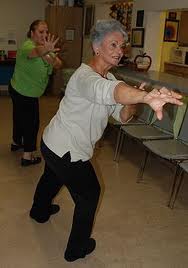
I ported it to a dance studio yesterday. Well, a masonic hall really, at least an ex-masonic hall, on Venice Blvd., where dance class is held. There is no instructor leading dancers through prescribed choreography, just a DJ with his computer hooked into what seem like the world’s most powerful speakers and a roomful of people moving however they please. Or lying on the floor as they please or lying in a pile on the floor as they please. So no one notices or cares about the mostly linear moves I’m making in the corner.

Loyal readers will say, “How Hollywood!” But no, I’m told that if I look it up on-line, I will find similar classes in my home town, Toronto. If your town is big enough, you might as well. And they will no doubt feature the same creatively dressed crowd -tights and tank- tops, sweats and baggy pants, floating silks of vivid colour, long skirts on guys and girls,- weaving out of their own imagination the beauty or anguish they feel.

They dance alone or with each other or in groups. One fellow danced with a bright red apple. A woman danced with a long white pillow with a heart embroidered on it. The sweatiest fellow in the room gave me a very looong, sweaty hug. It was déclassé  of me to notice any of this, although I carried away something of the sweaty guy’s essence.

My kind of tai chi -taoist.org – is never done to music. Master Moy, who brought the art of tai chi to the west in the early 70s, taught this silent technique so that we would learn to listen to our bodies. So it’s quite a shock to be practising, as I did yesterday, to tribal drums, as the “class” stomped through something like a solstice ritual.

Yet it is curiously liberating. I am so distracted by the whirling colour and the floor-shaking rhythm and even the occasional melody that I find my body moving unself-consciously. Suddenly I feel it accomplishing some refinement that I haven’t been able to get before. My  weight is well and truly in my feet. My belly soft, no longer trying to do the lifting. My hands, full of intention, but the push coming from the back foot. There is a real internal massage going on.

I had arrived here knotted up. Life will do that, as you know. I am away from my usual supports -osteopath, acupuncturist, massage therapist. Then I slipped on a rock, crossing a stream and added a spiral twist -and a good deal of temporary wetness- to the mix. (Incidentally, it was a beautiful fall, I’m told. I would expect no less after all that tai chi.) What to do? You guessed it. More tai chi. I tripled the number or jongs or standing exercises and came unwound. Now, of course, I have to keep that up for the interim or this 76 year-old body will revert or at least stiffen up.

There is usually someone in an electric wheelchair at dance class. One chap moves his chair in dancing circles with his chin. A woman dances with her upper body. Taoist Tai Chi has a sitting set as well as sitting jongs. I have done these while stricken with H1N1 flu when I would have otherwise just languished in bed for weeks.

So here’s the thing, “Dance, dance, wherever you may be.” (“I am the Lord of the dance, said he.) You don’t need any training for that. Or if you won’t dance, (Can’t make me!) take the training route so you never have to pack your exercise equipment. Learn tai chi. Look it up. Taoist Tai Chi is found in 25 countries. It could be in your town and if not, there is some other kind.

Or just get out your towel!

Merry Christmas!

All Will Be Well

That is the way I remember these words of Julian of Norwich, a nun who died in 1415. “All will be well and all will be well and all manner of thing will be well.” Using those words as a mantra calms my anxious nature. More correctly, it should be, “All shall be well and all shall be well and all manner of thing shall be well.”

When I repeat this saying as I go about whatever I am doing, I know that things are going well, no matter how they seem and they will continue to do so.

Winter Solstice

Winter solstice occurs this year on Friday, December 21 at 11:12 UTC around 4:15 p.m. here on the west coast.

This poem was written nearly 20 years ago, when I was living in an apartment on Venice Beach. I brought a copy with me on this trip and it feels applicable now as we approach the longest night, a time when physical light has reached its lowest ebb and now will begin to grow again, a time when inner light is at the full and can be accessed.

images

Winter Solstice

Such deep dark
so long sustained
should smell of balsam,
cedar, pine,
should have a canopy of icy stars,
of Northern lights,
shifting panes of white or green.

-A child under a buffalo robe
watching a sleigh runner
cut through blue
moon-shadowed snow
sees a rabbit track running off
into deep woods.-

Waking in the depth
of this longest night,
thirsty for sleep,I hear
the pounding surf,
an angry wordless shout
one floor below
and the reverberating slam
of a dumpster lid.
The sky at least is quiet:
a star hangs
above the flight path.

In my long sleep,
I have been following
that track back
into the woods
breathing sprue pitch
and resined pine,
lashed by boughs of evergreen,
until I have arrived at this
secret place
which only wild things know,
a place to shelter
while things end,
time unwinds,
the circle turns.

When we awaken,
shouting, homeless,
single and bereft,
we will go forth
into the growing light,
a light
we creatures of the dark
must yet endure.

This is the place,
now is the time
for the birth of the Child
in the cave of the heart.

Ruth Rendell’s The Saint Zita Society

Image

Ruth Rendell

Ruth Rendell, (aka Barbara Vine) the 82 year-old British novelist

Saint Zita, Ruth Rendell tells us, is the patron saint of servants. The Saint Zita Society is spearheaded by June, the 80 year-old companion to the Princess. June gets little or no respect and starts the society to improve working conditions on Hexam Place, an upscale London address. Attendance is never high, the chief draw being that meetings are held in the local pub, the Dugong. (You could look that word up in a myth dictionary.)

I would call it an ensemble novel because it has so many characters all more or less of equal importance. Only one of them, Rabia, the Muslim nursery maid to Thomas, a banker’s son, engages our sympathy. She has had a tragic history as mother and wife and she has attached herself to her charge with ferocity.

Two of the others fall into the doormat category: Thea, who rightly claims that she is not actually a servant, nonetheless, is admitted to the Society because she fulfills that role to her landlords, a gay couple planning a civil union ceremony and to the angry widow who lives in the first floor flat of the 3 flat house. She would qualify for sainthood herself if she wasn’t filled with furious resentment. The other pushover is Dr. Jefferson, Hexham’s resident paediatrician. The doctor does not, of course qualify as a member, nor do, the gay couple, the Princess or Lord and Lady Studley.

There are several drivers, Jimmy, Beacon and Henry, easily distinguishable by their differing morality and who they drive for – Dr. Jefferson, Mr Still and Lord Studly, respectively. They do not indulge in alcoholic beverages at the meetings, although some of them indulge in other vices on their own time.

Several people entertain the idea of marrying persons they do not love, but these plans don’t always pan out. In fact love gets a bad rap in this book, with the exception of Rabia’s love for baby Thomas.

There are those ready and willing to take advantage of the pliant nature of others, including the gay couple and the Still’s au pair, Montserrat, who lives in the Still’s house and collects a salary but apparently has no duties.

There are 2 nasty old girls, the afore-mentioned Mrs. Grieves and the Princess, although the Princess’s dog Gussie may have the inside edge on nastiness.

The novel is not a Whodunit nor even a Whydunit, nor even a Will-they catch-em. It’s inciting event is an accidental death, which gets mismanaged, so to say. There are, I hasten to add, additional, actual murders. A red-headed detective wanders ineffectually  into the drawing rooms and bedsits of Hexham Place. Nevertheless things get wrapped up nicely, including the St. Zita Society. No one is left out of this denouement. And there is a measure of what my history prof called natural justice in the end.

I read this book on my Kindle.