

Hapless Human VS Pressure Cooker: if at first you don’t succeed, repeat

Image

Bright sunshine and the fragrance of spring drew me out of bed at 7 am on holiday Monday. (We Canucks like to get the jump on ‘mericans by having some of our holidays early.) How could this not be a great day!
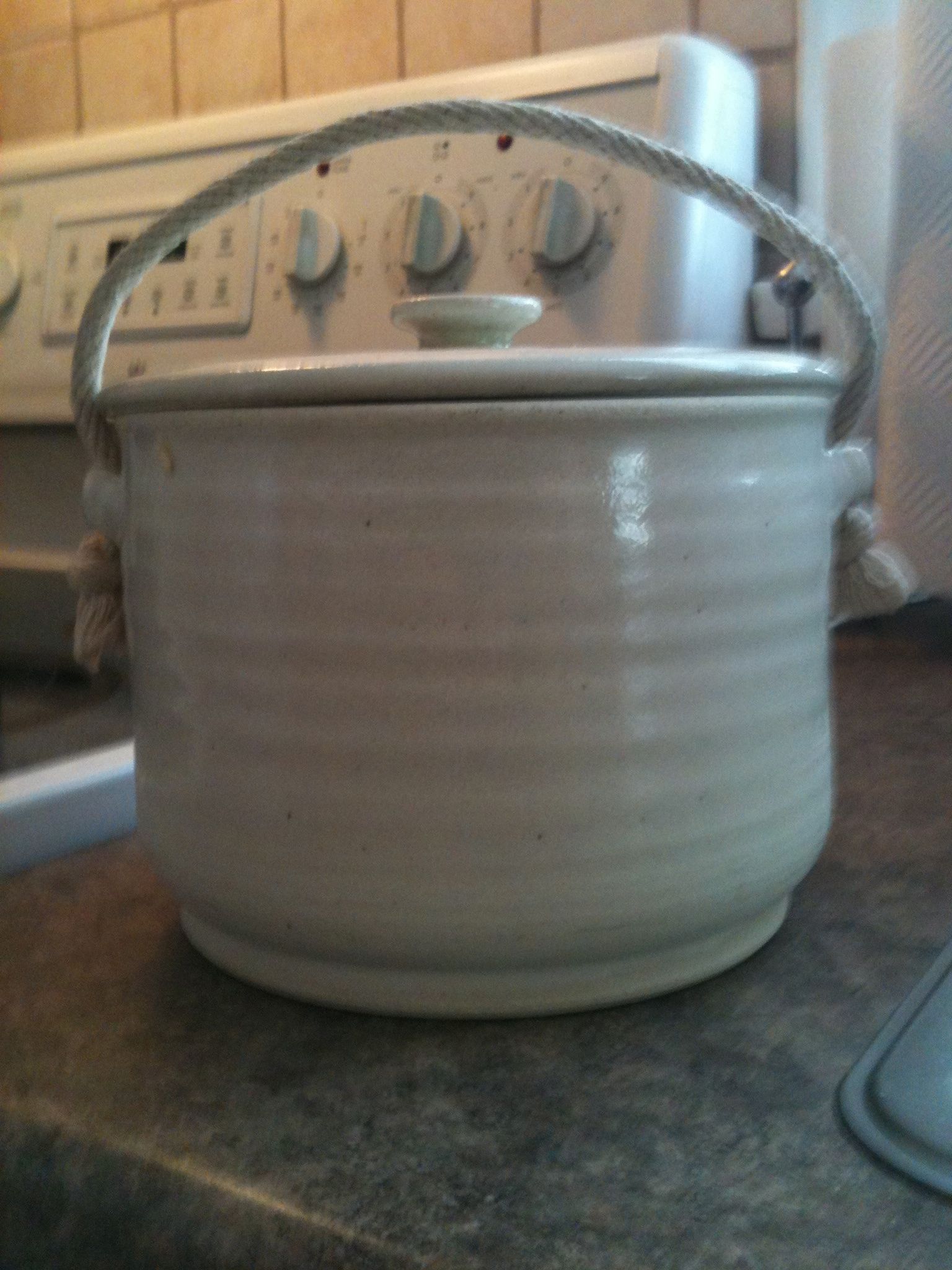
I turned on the burner under the pressure cooker to high. In it, inside an Ohsawa pot, brown rice had been soaking overnight. (another story – hingeing on weak digestion). I walked away. And thus the saga began.

A violent hissing, like six angry adders drew me back to the kitchen. Six streams of steam were jetting out from under the front handle in every direction. Clearly pressure was not building.

Fine! I’m not afraid of a pressure cooker.  I have heard the story of a young woman who fled her exploding cooker across her loft, head down, in a brilliant display of broken field running. She escaped but the ceiling did not. Not me, boys! I’ve been handling one of these for 30 years. I grab the back handle, move it off the burner and turn off the heat.


A little background: my old Lagostina pressure cooker, the one with the bendy lid that was such a pleasing puzzle to insert, served me uncomplaining and without maintenance for 30 years until last Feb 8th. I had a brief, unsatisfactory relationship with a model called Fresco. I say ‘brief’ but it felt interminable. Every morning was a new battle: the rice remained hard, the rice was swimming in water and half done, the lid wouldn’t go on, the lid wouldn’t come off. I grew crazed. I took it back for a  full credit. Then I looked up where to buy another Lagostina, but of course, it was not at all like the good old reliable bendy lid one. It was a new, improved model. In fact, it looked like the Fresco, but I had faith because it was a Lagostina.

Still I had a kind of residual post traumatic stress around the issue so I tackled the new problem warily but with confidence.

1. Removed lid, carefully aligned arrows, pressed down firmly with left hand, turned lid with right. Put pot on burner, turned heat on high, walked away.

Result: jets of steam, no pressure built.

2. Examined lid carefully, studied flanges of metal that were supposed to interlock, pressed yet more firmly, shut lid, turned heat on, walked away.

Same result.

3. Removed lid. Noted that the front handle seemed loose. Looked in vain for screws to tighten. Moved the Ohsawa pot more to the centre thinking it might be preventing a seal. Repeated #1.

Same result.

Vaguely remembered that human failing: if something doesn’t work, keep doing it, but try harder.

4. Maybe the inner pot was the problem. Removed Ohsawa pot, got out an old one, which isn’t as tall. Transferred rice, inserted in cooker and repeated #1.

Same result

Well, at least, I had eliminated one hypothesis.

5. Removed lid, took out gasket, studied situation, pressed it carefully back, repeated #1.

Same result.

6. Pulled out old bendy lid Lagostina, transferred rice pot. Glanced heavenward. Turned heat on.

Different result.  This time water bubbled out instead of steam. Well, what did I expect? The old thing was fatigued and told me so last Feb 8th.

7. Picked up the lid of the new cooker, shook it in admonition. It rattled. Took out the gasket. Ah, there they were -2 screws about half way out. Pulled out the heavy red tool box from under the sink, found the screwdriver with the star-shaped head, tightened those darned screws within a millimetre  of stripping them. Repeated #1. Leaned over the stove. Never mind the “watched pot” rule.

Result: a few seconds later, a soft sigh, the red-knobbed pressure indicator floated upward, I had 13 psi and in 50 minutes, I would have edible rice.

I also seemed to have fairly high blood pressure, but there was relief for that. I fired off an email missile-I mean missive- to Lagostina advising them to include a small screwdriver with their pressure cookers and clear instructions regarding loose screws.

Then, wouldn’t you know, turns out that other pressure cooker adherents of my acquaintance already knew that.

A Poem a Day Keeps Blues Away: Dickinson and Amherst

I dwell in Possibility –

A fairer house than prose –

Emily Dickinson

It was a family wedding that took me to Amherst Mass. last weekend. I had never been there before although I felt as if I had because I had read so much about its famous poet, Emily Dickinson. She is the one who wrote those enigmatic four line stanzas beginning with such lines as “A narrow fellow in the grass” or “Because I could not stop for death” or “I taste a liquor never brewed”. Her poems turn up in high school and college anthologies and seem at first glance simple enough, but they are full of surprising insight. The lines I have just quoted, have a hopeful sweep upward at first glance. Ok, it’s a dull day, rain forecast, I’ve got that emotional hangover from a glorious event, but -look- here is a little poem that reminds me that the “prose” of this morning is not the whole picture, that I too can “dwell in Possibilty”. (Yes, grammar check, I do want a capital “P”.) Dwelling is not visiting.

Dickinson goes on to describe the beautiful house that Possibility gives with its fairer windows, more numerous doors, and gambrelled roofs that the ordinary house of prose cannot provide. She is talking about poetry, of course, but you don’t need to know that at first. You may figure it out after a few readings but you don’t have to.

Dickinson didn’t title her poems. An early editor Mabel Loomis Todd, did put titles on them and “corrected” the quirky punctuation -dashes- We don’t approve of that now, we Dickinson aficionados, and in modern texts, we have to look up poems by their first lines. The “right” books of her poetry are published by Harvard University. Amherst College has many of the original manuscripts, but Harvard holds the copyright.

We made the long drive -almost 10 hours, what with traffic- from Toronto to Amherst while others were flying in from the west coast, Texas, Arkansas and the Yukon or just skimming up the throughway from NYC, arriving on Friday night. The wedding was scheduled for Sunday afternoon. What now? Five of us met for breakfast in the Lone Wolf, across the road, more or less, from the Dickinson museum. What to do became obvious.

The docent led us to past the dining room to the library.”Isn’t this where Austin used to meet Mabel..” I began enthusiastically and bit my tongue. It was too late. The docent pegged me for a know-it-all who was spoiling her story by getting to the scandal too soon. Dickinson’s brother, who lived with his wife in the Evergreens next door, met his mistress here in the house where his sisters lived. Since he supported both houses, he presumed such rights apparently.

As our little group followed the leader from room to room listening to her stories, she kept throwing questions at me. Did I know that the Dickinsons had lived in another house in Amherst as well? I nodded.  They fell on hard times early on, she said, but bought this house back eventually. At least, she didn’t demand an answer from me. Later the others laughed at that. I was too busy melting into the background to care at the time. When we came to the last room with its display of how Emily experimented with different words -“gables of the sky” for example, instead of “gambrels”, the docent asked one of us to volunteer to read the poem posted on the wall. Silence fell. Well, it needed to be read aloud. “I will,” I said. What have I done, I wondered. I have no idea what this poem means. I began and the most surprising thing happened. “I dwell in Possibility,” I began and the poem read itself through my mouth until it closed with “spreading wide my narrow Hands/ to gather Paradise”.

Here’s an idea: read a poem. If there’s no book of poems beside your bed – an excellent sleep aid -it’s easy enough to find one on the internet. Better yet, read it aloud. Better yet, read an Emily Dickinson poem aloud. It will surprise and delight you.

Report back.

It’s Your Funeral

At a church funeral, the departed person’s first or ‘Christian’ name gets mentioned often. If it happens to be yours every mention is like the bell used in meditation or the little wooden gong struck while chanting. It wakes you up.

In this case, the shared name is unusual now, having dropped out of fashion and so, no doubt, both she and I regarded it as ours alone.

I did not really know her, although I had met her several times, but I knew her son. I see him several times a week and he reminds me of my own son whom I haven’t seen in too long. His mother and I were about the same age.

My initial reaction to her sudden and unexpected death was to rush home and put my own affairs in some better order. There I was nodding along in the fond expectation of another ten years or so when her death woke me up.

By the time, I had found parking and arrived at the church, it was jammed to the rafters. I know this because that is precisely where I sat, the high last row of the balcony where I had an excellent view of the wooden arches of the vaulted ceiling as well as the high stone- edged windows above the side aisles. The organ pipes were above my head and the audio control equipment was at the end of the row.

We rose as one as the processional music began. I was familiar with the order of progress: cross, clergy-four of them, choir, coffin and pallbearers. As a child, I had been part of the white robed choir. I recognized the rank of the clergy by their robes and I still remembered not only the melodies but also the words of the Anglican service. (Episcopalian, it would be called in the U.S.) And this church like the church where I sang was high Anglican.

“More Catholic than the Catholics,” my neighbour whispered.

It was an altogether beautiful experience musically and visually. The Bible readings were chosen to contradict death’s power and even included the well known line, “Death where is thy sting?” And the tribute was full of loving detail about my name sake’s life. Almost the entire congregation took communion, although I remained seated with two lapsed Catholics and a Jew.

I was struck by two things. One of them was that our lives had been very different. She had gone to the same church for probably her whole life and that meant that she had lived near it all her life. I had had over twenty addresses and I stopped going to church as a young mother. She had drawn hundreds of people to mourn her passing. Our family is given to memorials at a convenient date some time after cremation, modest gatherings, but someone is sure to bring a guitar.

The other thing that struck me was how my perspective had changed. When I was a church-goer and heard reference to God the Father, I accepted that a paternal eminence existed capable of granting protection and grace. Indeed He had graciously sent his only begotten son to ransom our souls. As I sat and listened, I was able to see this through the lens of the indwelling divinity I now understood. ‘Salvation’ has become more personal for me of late. That insight, which I cannot apparently articulate, made me happy.

I am very grateful to my name sake and wish her well on her journey. Through her, I got to have a funeral full of pomp and ceremony and exquisite beauty.

Transcendent Moments

I went to the woods to see how the trilliums were doing.

It has been an exceptionally early spring here in Toronto after an unseasonably warm winter with very little snow. They say things are about a month ahead. The magnolias paid a price for early budding when the temperature suddenly fell below freezing, but many of them just marked time in the bud stage and opened up in pink glory, only a little brown at the edges, when things warmed up. Now light green leaves are feathering out on some trees, so the trilliums, I reasoned, should be blooming before the trees cut off their light.

They were.

Trilliums have a sort of magic about them. They are highly regarded here because they are Ontario’s floral symbol and school children are taught NEVER TO PICK THEM because they will not grow back.

I had walked down the paved bicycle path into the park but left it to cross a culvert over a brook and climb up into the woods. The woods grows on sand dunes left here by an ancient lake, so there are sunny hillsides under the trees and it was on one of those that I found the trilliums. The lily of the valley leaves had also pushed up and were waiting their turn to unfurl with their heady perfume and a few violets lined the path.

I followed a freshet on a rough path, climbing over tree trunks, which on a warmer day would have tempted me to sit and stare. I came to an open field, already mowed, where families like to come to picnic. Then I turned east and began the climb onto a high ridge. Here the trees were still bare, but the bushes were green and there were masses of white flowers, which I have yet to identify.

There has been a tidal wave of butterflies this spring, mostly red admirals. One report told of a backyard covered in 2000 of them (How did they figure that?) Some of them were sunning themselves on the ridge path and as I approached they flew up and chased each other in circles. I was still wearing a huge grin when I met a man and his dog.

On one side, I looked down into the woods and on the other out at the city -street, railway, freeway, high rises, and beyond them Lake Ontario, deep blue for the nonce.

The week had brought a weight of difficulty as weeks often do. There were unresolved problems and uncertain outcomes. There was negativity to be processed. But here there was a sanctuary in the woods. Here there was stillness that comforted. Here there was peace.

Have you found such a place lately? Perhaps it was not even external. Perhaps you found it within. Tell us about it.


The Knights Templar

Recently the Knights Templar are back in the news again as they have been for about eight centuries. The self-confessed Norweigan mass murderer, Anders Breivik, fancies that he’s one, apparently. Here is what I learned about the Knights Templar when I was writing my memoir, Never Tell: recovered memories of a daughter of the Knights Templar.

The Knights Templar was founded in 1199 to protect pilgrims in the Holy Land and became the most important force in Palestine. There are persistent rumours that, digging deep under the ruins of the temple in Jerusalem (that would be the temple that replaced Solomon’s original, destroyed by the Romans), they came upon a great secret that they carried away. Returning home, they became wealthy and powerful and either did or did not originate Freemasonry, according to your source, and brought about a rebirth of art and literature in Europe. The Hospitaliers, a rival group, campaigned to discredit the Knights, charging them with irreligious practices and egging on Philip IV of France to launch simultaneous attacks on a Friday 13th in 1307 to destroy them. Thus Philip took the opportunity to seize their wealth and power. The pope then finished them off outside of France.  Myth and legend and Dan Brown (The Da Vinci Code) tell us that remnants  survived and went underground.

It is very doubtful that a Norweigan mass murderer is privy to the arcane secrets of the Knights Templar, but it seems as though there are esoteric levels of the Freemasons and other “secret” societies that also feel connected to that tradition. My father, for example, had a pin which read “Knight of the Temple Mater”, that is Knight of the Mother Temple. Certainly his club, as he called it, had a number of curious practices and at the very least tolerated, if it did not actually sanction, his unusual parenting style.

Journaling as Zazen

Zazen just means sitting, but we usually think of it as sitting in meditation. The idea is to quiet the mind in order to be with a deeper part of self, to gain a measure of peace.

Eckhart Tolle in his book The Power of Now describes it as being in the now, not anticipating the future or regretting the past, not planning, worrying, or processing, just being. Here we contact eternity, which is not, after all, in the future. Here we can find ourselves in heaven, which is not, after all, in the sky.

No doubt it is possible and in the forty years I have been at it, I may have actually got there a few times. Nowadays, there’s stuff in the way – wasn’t there always? – obsessive thoughts, runaway feelings, aches and pains. So I begin with the journal to give the mind a free rein, let it think all it wants and report back. It does run on, usually for half an hour and 4 or 5 handwritten pages. Then it’s the body’s turn to do the jongs or exercises associated with tai chi. This takes 15 minutes or so and leaves me limber enough to sit, but not, alas, to sit in full lotus position. Only now do I find it possible to let go of the racing mind. For whole seconds at a time!

Spiritual practice is always an individual choice, don’t you think? Whatever we do on a regular basis with concentrated focus can lead to self cultivation.

In his book of daily meditations, 365 Tao, Deng Ming-Dao says “Followers of Tao frequently use writing, art and even poetry as tools for self-discovery By articulating their experiences, it helps them to understand the stages they are going through. Once they can do this, it satisfies and neutralizes their rational minds.” (p. 63)

Journaling can be a meditation.

Blogging Makes Me Smart (and gets me a new Mac)

WordPress made me do it.  Well, strictly speaking it was Gravatar that gave me the final push. My WordPress dashboard urged me to upgrade Safari. I couldn’t. I had gone as far as I could go with the Snow Leopard, 10.5.8, operating system. Then Gravatar went into a loop when I tried to upload an image. I went off and sulked for a few days.

Blogging was way too hard for this old girl.

Anyway, I had actually published an ebook (my memoir, Never Tell, recovered memories…) on Kindle and Smashwords, so why complain about a few hitches? The Mac iBook G4 was just fine. All it needed was a better operating system. Hang on. Didn’t I buy a better operating system last year? Didn’t I buy a new battery last fall? Isn’t it time to stop sinking money into a 6 year-old computer?

You’re wondering why it took me so long. I could say thrift, but probably it would be more truthful to say fear. What was there to be afraid of, after all? These may be lean times but my bank is still unafraid. It longs to lend me money. And if I prorate what I spent buying the old computer, it works out to about $20 a month.

The Apple sales woman’s first response when I carried in the iBook, was, “Oh, that’s really old, but I’ve seen one before.”

Using her fine deductive skills, she spoke in terms of the Mac Book Air lasting me 5 years. I sought to establish a little more street cred by producing my iPhone and mentioning my iPod. What was less impressive was the fact that I couldn’t remember my Apple password.  I almost had it, but almost doesn’t make the grade.

So I came home with the beautiful slim laptop still in virgin condition and managed with my great nephew’s help to “migrate” all the stuff on the old computer. (Who knew “migrate” could be a transitive verb? Come to that, who knew what transitive is?)

The next day, I lost the dock, the Safari bar, every single page I tried to read and WordPress menu that runs down the left of this page on which I am writing this post. I could not scroll up or down by using 2 fingers on the trackpad or using the keyboard. (What happened to the up and down arrows on the right? What happened to the bar you could pull on?) Around dinner time, I lost it.

I raved on the phone to two sympathetic friends. Well, initially sympathetic. One kept saying, “why did they change it?” (She needs a new Mac Book.) The other one kept laughing at Apple and its overpriced products.

Before I opened the chardonnay, I phoned the store. Yes, I could still buy the 1 to 1 tutoring service and yes, they could probably squeeze in a few unbooked minutes of emergency help in just so I could finish this post.

What did I learn? Keep your fingers far away from the trackpad! Scroll by separating 2 fingers, holding the others aloft and pushing up or down and  put the cursor way up to the top to find the Safari bar-without clicking, good grief. And other good stuff that all you other Mac users already knew and all you young users were born knowing.

They say the brain forms new neural pathways when we challenge it. So I’ve worked it out, blogging makes me smart!

Easter/Passover and Journal 108

Every Easter, my mother outfitted me in new clothes, a coat she had made, a new hat, new shoes. Not to do so, in spite of our poverty, would have been shameful. Eventually, this led to a good deal of work as the family expanded. The clothes were to be worn to church of course. Today she would have shuffled us off to Walmart no doubt, but the closest she could get to that bazaar of economic necessity was the catalogue. That’s where the hat and shoes came from.

For Easter breakfast, she would fry up a dozen eggs and my father would tackle the lot.  The hens had started laying again by then, whether Easter was early or late.

Quaint customs that indicate advanced age.

We moved away from that rural community and found ourselves more or less lost in a city. The rest of the family gave church up, but I kept on, partly because they didn’t. I sang in the children’s choir in a long black skirt and a brilliant white surplus that had to be washed and ironed far too often. On Good Friday, I went to the somber morning service and on Easter Sunday, I rejoiced at all three services, Matins at 8 a.m., Eucharist at 11 and Evensong at 7. I found the experience beautiful, calming and comforting. Little by little, I found myself thoroughly assimilating the traditions of the “high” Anglican church I attended.

At a certain point, I stopped attending church. It was shortly after my children were born and baptized. My husband had started tutoring on Sunday morning and could no longer do childcare.

Yet the habits of that background persisted: Good Friday inevitably lead me to self-examination and grief over my shortcomings, while Easter Sunday was filled with light and grace.

Time moved on. The family grew, broke in pieces, reformed, grew again.

Some years, I found myself at a table where we were asked,”How is this night different from all other nights? I listened to the Passover story, which was not entirely new to a Bible reader after all, but now I was seeing it from inside, so to speak. And eating different food.

One year, when I was on my own, I read Tom Harpur’s The Pagan Christ in which he documents the parallels between Christ and the pagan sun gods to urge us to regard the story in a more metaphorical way. Toward the end of the book, he mused that we will never be more dead than we are now. By that, he meant here in what we call life, we are so thoroughly emersed in the material world that we are deeply alienated from our spiritual selves.

This is a time when we instinctively ponder questions of death and resurrection if only because nature is modeling the latter. (Well, not the poor magnolias here in TO. They got carried away by early March warmth, burst into bud and then got frozen by a cold night. The fruit trees ,however, are setting a blooming example.)

I don’t consider myself an Anglican nor even a Christian at this point, much as I respect the tradition. Buddhism and Taoism also seem to have much to teach, as does Rumi, the great 13th century Sufi poet. But the Easter child lurks within and wants the holiday honored.

This year, oh my goodness, the odd bits of family we can still gather has chosen to gather on Friday. A party on Good Friday! What would Aunt Mae say? Actually, she’d probably say she wouldn’t mind a bit of that brandy and settle down to enjoy herself.

So this leaves me rattling around by myself on the big day. What to do? Last year, journal 108 tells me I went for a walk down through the park to the river and then cooked up a rack of lamb and asparagus. This year, I will take myself out in my best duds to my favorite restaurant for an early dinner.

And eat chocolate.

Reading and Empathy

The other night on television I saw a horse whisperer train a wild Dartmoor pony to reins in less than three hours. In actual fact, he didn’t whisper or talk at all. He just used body language, standing sideways near the pony’s head at first so as not to frighten the animal with his full on frontal energy. He didn’t use fear or domination at all, yet he was able to put  a rope over the pony’s head within an hour of first approaching him. (The program was an episode of Edwardian Farm, the one set in March, a British production.) It was a far cry from the bucking bronco method that tames a horse by breaking it. It seemed like evidence that as a civilization, we are learning kindness and becoming more empathetic.

Not that many of us are developing Star Trek’s Deanna Troi’s ability to feel other people’s emotions, but that we are more willing now than we once were to convince rather than control, to understand members of our own species and others and to relate to them less cruelly.

A few months ago,this idea led me to Jeremy Rifkin’s The Empathic Civilization in which the author explores the idea that we are not by nature aggressive, materialistic and self-interested, but rather fundamentally empathic. We “seek companionship and use empathic extension to transcend ourselves and find meaning in relationship to others”. (p. 21).

Whenever I talk about this idea, someone objects that there is still a great deal of cruelty in the world and there is never a scarcity of recent examples in the news to prove that. Too true and Rifken discusses that paradox. But that is not my point.

In general, society as I experience, it is growing  kinder. Certainly it seems to be as far as parenting is concerned. My own grandchildren attended an alternative school where the child’s needs came first to the extent that they planned their own lessons and misbehavior was subject to discussion and negotiation rather than discipline. This was in sharp contrast to the way I was taught and parented.

(Is it possible that that great cataclysm World War I and II grew out of the hands-off-unless- disciplining approach to childcare that characterized the time?)

Children learn to be empathic by having kindness and understanding modeled for them. Thank goodness there is more of that happening. But there is another route to empathy and that is narrative.

I realized this when I was teaching English, especially once we began asking students to write response journals about what they were reading. I observed their growing understanding, for example, of the children in John Wyndham’s The Chyrsalids or Harper Lee’s Scout and Jem in To Kill a Mockingbird. Because these children were learning empathy for the other, the students learned it as well.

I taught Shakespeare from that point of view. Teenagers identified readily enough with Romeo and Juliet and suffered their tragedy. Hamlet was more of a stretch, but they could be hooked by his grief and his sarcastic cynicism.  Lear was a big stretch because he was so old, not to mention arrogant at first, but by the time he carried his dead daughter on stage, he too had won their sympathy. I could see their feeling for others expanding as they read.

My grandson, Leo, convinced me all over again. He started out with a core group of four: parents, half brother and family friend/care-giver.  Then his half-brother chose to go far away to live with his own father, the family friend moved back to Ireland and his parents separated. By the age of three, Leo was an angry, “difficult” child. He did play therapy. He attended a school that addressed these issues.  Both helped, but it was being read to that seemed to help most.

His mother started with Captain Underpants, no doubt, as she had with her older son and moved on to Wind in the Willows and other childhood classics. She read the entire series of The Lion, the Witch and the Wardrobe, The Hobbit and then began The Lord of the Rings. Once when she was on holiday, when he was seven, I was reading The Return of the King to him and he said, “Wait, wait, who said that?” How he usually kept all the characters straight in his seven-year old head is beyond me, but he did and he grieved when Boromir died.

In short, hours of being read to, night after night, not only established a steady bond, it also lead him out of his angry isolation into an understanding of others.

As a society, we are emersed in narrative more than we have ever been. We still dream stories at night, tell each other stories and read them as we have for centuries, but we also listen to stories on the radio and on ipods and watch them in our living rooms and movie theaters. Each of these stories invites us to expand our self-centeredness and embrace others.

This enriched narrative may well be producing a more empathic civilization.