Lovely!

Cottage on an island near Nora, Sweden / photographed by Jonas Loiske.

Lovely!
Cottage on an island near Nora, Sweden / photographed by Jonas Loiske.

Of course I saw Skyfall, the latest James Bond movie, as soon as I could, just as I had the other 22. So far as you no doubt know, it has been a 50 year project. The one that stands out in my memory is Thunderball and that has more to do with the way I got there than the movie itself. We set out in our new racing green 1965 MGB with the top down on a pleasant evening. We were cruising along the freeway, happily anticipating the film. As we drove under an overpass, the driver of the semi next to us pulled on his air horn, elevating us out of our seats -no seat belts back then- and setting our hearts racing. I could see him laughing madly as he passed us. Thunderball could only be an anti-climax.
Skyfall I liked much better than Quantum of Solace although I’ve never met a Bond movie that I didn’t like. As the usher assured me, Skyfall is old-fashioned Bond.
The movie begins with Bond’s death and when that proves, unsurprisingly, greatly exaggerated, we see a battered, unshaven Bond wearing jeans and drinking —- beer. Back in harness, he is expected to re-qualify as an agent and is assured by one and all that he is past it, that, in fact, the concept of agents going out into the field is itself passé. Computer nerds can do all that work now without getting out of their pyjamas.
M, Bond’s boss, played by Judy Dench, is of course, even older and appears to have lost control of MI 6. Eventually, she is called before a parliamentary committee to face the music. In answering the badgering chair of the committee, she quotes from Alfred Lord Tennyson’s poem “Ulysses”.
The poet imagines the great adventurer Ulysses, the ancient Greek commander who defeated Troy by using a wooden horse. In the poem, Ulysses old and bored with his home island of Ithaca, exhorts his men to join him on one last great adventure from which they will not return. The poem ends with the lines which M quotes:
We are not now that strength which in old days
Moved earth and heaven; that which we are, we are;
One equal temper of heroic hearts,
Made weak by time and fate, but strong in will
To strive, to seek, to find, and not to yield.
Sun on a window pane.
In my childhood home, it paid to have excellent hearing, not that it would necessarily stop a blow, but it would at least lessen the shock. And so, I cultivated mine. Now I’m stuck with it.
Prospective tenants do not see the drawbacks of the duplex I live in now. They see, as I did, the light flooding in through the floor-to-ceiling windows. They see the large main bedroom. They cannot see how insubstantial the floors are. They don’t stick around long enough to learn that every footfall above registers like an earthquake below.
So here I am with my vigilant hearing learning much more than I want to know about other tenants’, shall we say, intimate lives.
The 3 year-old next door has bedtime issues, by which I mean he is punishing his mother for bringing home a baby sister, by screaming at an octave only dogs and I can hear, between 10 p.m. and 11. The fellow downstairs goes to work at 5 a.m., a few hours after the tenant upstairs comes home from a night shift.
I have tried floral remedies, urgent pleas in pjs, music called Delta Sleep, which promised to change my brainwaves, ear plugs, running the air filter non-stop and pharmaceuticals. To little avail. But, wouldn’t you know, there’s an app for that.
The app in question cost peanuts at iTunes and is called “White Noise”. (Not “White Noise Ambience”) It gives a choice of 52 different sounds including white, blue, red, pink, grey, and purple noise, as well some rather mundane sounds such as a shower, floor fan, vacuum cleaner, dryer, projector and restaurant. It has nature sounds like ocean waves, a stream, a sandstorm, a waterfall, and my favourite, heavy rain.
I downloaded the app onto my iPhone and I set it going on my bedside table when I’m ready to go to sleep. So far, “heavy rain” seems to send me off to sleep. Rain on the window pane has always been one of my favourite sounds. I find it very soothing, especially since the app doesn’t come with the threat of flooding.
See what I mean? Hyper-vigilant.
This week, I read another pronouncement by a Book Lover that he, bibliophile that he is, would never consider reading an e-book, he being Joe Queenan, who has written a memoir One for the Books. Robert Fulford, critic for the National Post calls the memoir “a funny, fractious and ecstatic book about his (Queenan’s) life as an obsessive reader.”
Queenan spends 2 hours a day reading and claims to have read 6,000 books since he was 7 when he began reading to escape his violent, alcoholic father and emotionally distant, manic-depressive mother.
Well, good for you, Joe, and la-dee-da. Who hasn’t? Who didn’t? And I swear I have already given away that number of read books while still retaining a couple thousand more. You can see Joe has rubbed me the wrong way and I haven’t read his book yet, but I intend to enjoy it nevertheless.
In addition, Fulford reports that Queenan refuses to read any book in which the character attends private school, including Catcher in the Rye, self-actualization books, books described as “luminous” and he considers To Kill a Mockingbird a historically suspect novel about Just the Nicest White Man Ever. That is not the end of the list of what he will not read.
Queenan enjoys the sensual experience of the book as object, the feel of it in his hands, the visual impression of print on paper, the smell, the memories evoked of where and when he got it.
Fulford, himself, recounts the 3 life rules he taught his daughters: 1. never fold down a page, 2. never leave a book open face down, 3. never leave the house without a book.
Once we have enjoyed the irony of the fact these are supposed to primary life rules, we can evaluate them. Number 3 is – it goes without saying – undeniably a prime directive. You can endure the interminable waits that transit companies, airlines, hospitals, doctors, and city hall throw at you with your mind buried in a book. Today I watched a young woman walking up from the main bus route reading every step of the way. And I have a friend who got a ticket for reading in a traffic jam. Well, they weren’t going anywhere!
Personally, I do not regard books as sacred. They are too important.
I do not turn down corners except in dire emergencies. Having said that, dire emergencies do arise, times when the bookmark has vanished and there are no available sales slips, transit tokens and certainly no dollar bills, here in the Great White North, to make do as markers. Since many of the mysteries I read are 3rd or 4th hand or more, I spend time straightening other people’s dog-ears. I would never dog-ear a library book nor would I underline or write in one and more than once, I have wanted to hunt down someone who did. Their comments are without exception puerile. (Look that up, desecrator!)
My own books are a different question. I write on the back flyleaf reminding myself of ideas that struck me as interesting and noting the page number. I generally don’t underline but I might note a word at the top of the page to help me find the idea later. Of course, I read in the bathtub, although not in the shower. Of course, I read at my solitary table at home and in restaurants. Of course jam gets involved and grease, but never ketchup. I hate ketchup.
Once my young daughter came home indignant that her school librarian had told her that never, never, under any circumstances, should she read, even her own books, in the tub or at the table. Daughter and I just shook our heads in pity: librarian was not a true reader.
A true reader is omnivorous and will find books wherever possible -in discard bins, big box bookstores, second hand stores in mouldy basements and, of course, in e-readers. Even Robert Fulford, Queenan’s reviewer, confesses that he read One for the Books on his Kindle.
I have an old Kindle that my sister, Georgia, gave me. She has its twin. Mine is still in her name, so whatever book she buys also downloads to mine and vice versa. I bought Lee Child’s new book A Wanted Man and she also downloaded it. She did wait until I had finished; otherwise, we would have got confused. It would have automatically gone to the last page of whoever had used it last. Note to Lee Child: if I had bought the hardcover, I would have loaned it to her.
I love the Kindle for that reason and because I can hear about a book and have it in my hands in seconds. (Full disclosure: I have also published an e-book Never Tell: recovered memories of a daughter of the Knights Templar. See 115journals.com) So if I am snowed in or too sick to go out, if I can’t get to sleep, if I need to consult a book I don’t have, I can find it easily on Amazon and download it. It all goes on Georgia’s charge card!
Apparently, it is now possible to download e-books from our library, but I haven’t got there yet.
I can’t write notes on the back flyleaf of an e-book. I can’t even keep a record of page numbers -there are no page numbers, just % of book read – and ideas, but I am dealing with 5 year-old technology and I’m betting other tablet users can. It is annoying to go back and search for a reference as I had to do when writing the post “Jack Reacher: a long way from Virginia”. But it was not impossible and was no doubt instrumental in building me new neural pathways, so necessary in one of such advanced years.
Will Jack Reacher ever get to Virginia? That’s the burning question.
Lee Child’s novel 61 Hours (March, 2010) opens with Reacher being involved in a bus accident in the middle of a South Dakota winter. Reacher, a former major in the military police, has, as I pointed out in my post “Jack Reacher, Wandering Taoist” no home and travels constantly across the United States, with nothing but the clothes on his back and a toothbrush. His theory is that buying new clothes every fourth day is way cheaper than a mortgage and laundry facilities.) He either hitches rides or takes a bus.
He sets off at the end of 61 Hours, having managed to figure out the truth about what was down there in that strict time frame. Of course, he did, although you might, like me, have entertained the idea that he had vanished in the final mayhem. You could have guessed he would uncover the truth, so it isn’t exactly a spoiler. How could he not? He’s Jack Reacher huge of body and mind, expert in hand to hand combat and pretty good with a rifle. Why is he bound for Virginia? A woman’s voice is luring him there, the voice of a woman major, the voice that helped him through.
Worth Dying For (October 2010) finds Reacher in the corn country of Nebraska, a day or so later, having hitched a ride and ended up in a kind of feudal kingdom where most people keep their heads down and try not to remember the child who vanished many years ago. Reacher gets hooked once again and stays to help the woman who has the courage to stand up against the local oppressor.
The Affair (September 2011) doesn’t advance the journey to Virginia because it is a flashback to Reacher’s adventures in 1997.
But this fall, along came A Wanted Man, which finds Reacher still in wintry Nebraska with the broken nose he got the day before, but it was worth it presumably, since it was Worth Dying For. Given that he has taped his nose up with silver duct tape, it is surprising that he managed to get a ride, but now he’s dropped off at a cloverleaf. He waits there in the bitter cold as car after car slows, takes a look at his size and his smashed-up face and speeds away. Finally, he tears off the duct tape and after 93 bitterly cold minutes gets picked up by a car with three people, wearing identical, ill-fitting blue shirts and claiming to be business cohorts returning from a conference. Reacher thinks things are not as they seem. He is right.
Jack Batten in his review in the Toronto Star, Sunday November 5, 2012, says “What follows adds up to the most satisfying of all 17 thrillers in the series. The secret to its superiority is a matter of pace. The unfolding of events nudges along at just the right pace -deep into the book – things speed up as Reacher pulls toward an authentically gripping climax.”
Reacher makes it into Kansas at one point, but then has to back track to where he first caught the ride. By now his nose is beginning to heal and in the end, he is back at the side of the road, looking for a lift to a bus station where he can get a bus for VIrginia. And no that woman there has not aged greatly – it’s only been a few days in Reacher time.
Just as addendum: Lee Child was in my town and in answer to a question, saw nothing wrong with Tom Cruise playing Reacher in the movie, One Shot. Dismayed listeners cited height. Didn’t seem to bother Lee Child that Cruise, who is shorter than most of his wives, should play 6 ft. 5 in. Jack. Well, fine, but I will watch that movie only if it is the last one on earth and I need the distraction.
Connor was dead. I was the one who found his body. It was lodged at the bottom of a paper cup in what looked like latte foam. I knew he was dead when I poked him with a straw and he didn’t move.
Normally, Connor stood six feet tall, but lately he had been getting shorter. I was surprised a few days ago when I realized my eight year-old was looking down at him. Still discovering how tiny he had become was almost as bad as discovering he was dead. For a moment, I considered pretending that it was just an empty paper cup and tossing it in the garbage. But that wouldn’t be right.
The cup had been sitting beside his bed, his night-time drink, I supposed. How he had managed to fall into it, I could not imagine. Still I knew what I had to do: call the police for it was a sudden and unexplained death no matter how miniscule. I only hoped they would not think I had murdered him. After all I had poked his body with a straw and my finger prints were on it. I would just have to take my chances.
My call was transferred to female officer. I said someone had been found dead. I didn’t specify the size. She said she would be right over.
By now the household was stirring and I needed to inform the others. “Connor has died,” I said. Out of the corner of my eye I caught the horrified look on the face of my 8 year-old son. I turned my attention to him. It was some time later that I realized the officer was in the house talking to my daughter who had, apparently, provided her with coffee. I went to greet her, trepidation in my heart. How to explain?
“What lovely paintings you have,” she exclaimed and set about examining the artwork. “Did you paint these?” I could tell what she was doing, building background, which would be useful in case the death involved foul play.
“No,” I replied, indicating which of my family had painted each. “Well, I painted this one,” I admitted, “but I’m more of a writer.”
And then, as my creative writing students used to say where there should have been a climax, I woke up.
I am reblogging this from Hovercraftdoggy in honour of a redwood I love in L.A., not as big yet, but promising.

Photograph of two gigantic redwood trees, by Alex Cretey-Systermans
My upstairs neighbours made me a generous gift of time between “The First and Second Sleep” (http://115journals.com), 1:45-3:10, that would be in the A. and M. After an initial, “What the …..”, I settled down and pulled out journal 120. I had the luxury of writing a really long entry.
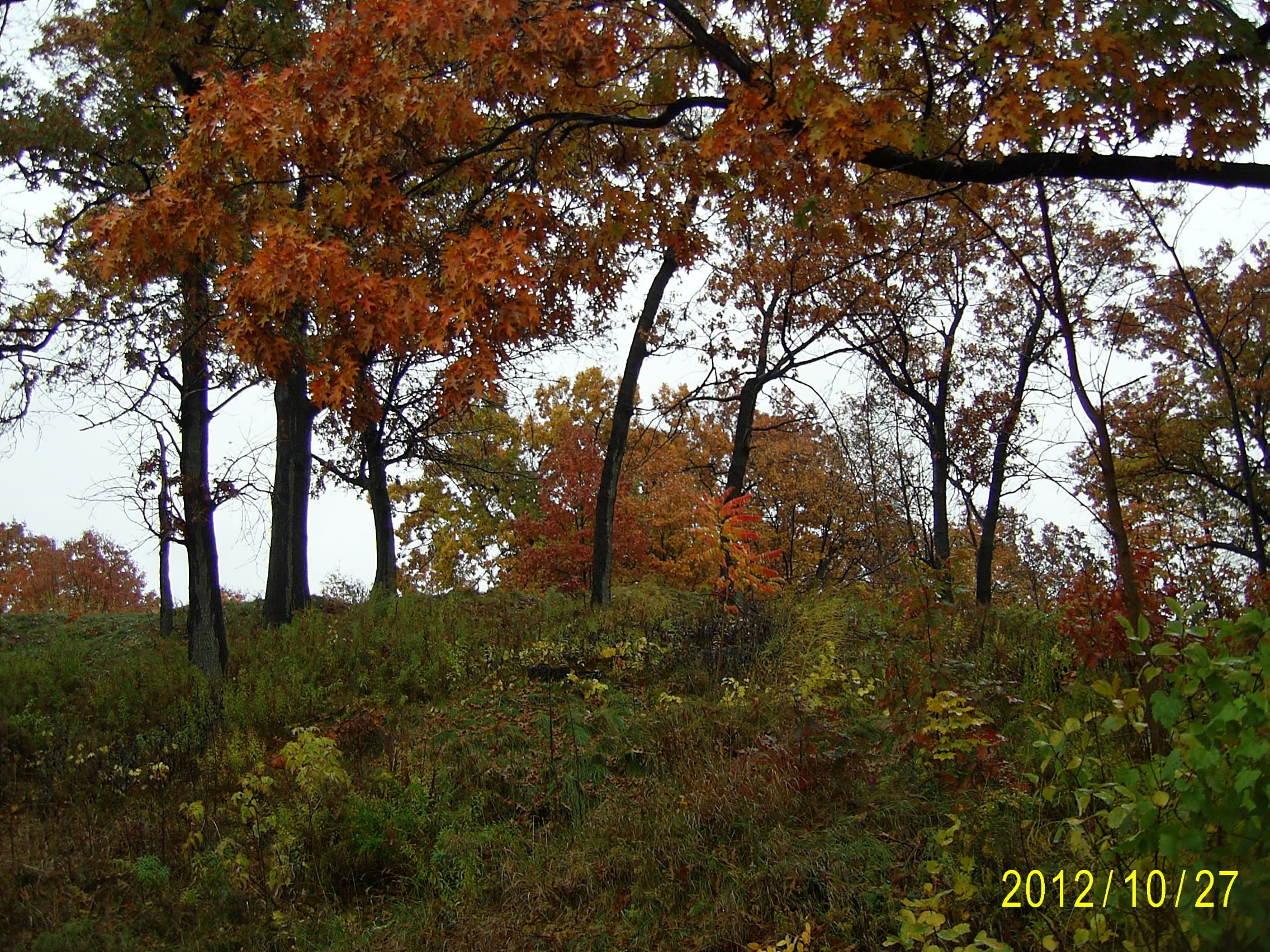
When I went out this morning, in my wellies, to take pictures of the autumn leaves in the rain, one of them apologized. “Everyone has the right to live a life,” I heard myself say. It did sound as if there had been a special circumstance -very late arrival of a house guest- but not all of me agreed with what I said.
Among other journal observations, I had blogged about how our attitude to fall has been changing in the last few weeks, from melancholy at the way summer was threatening to fade away (Summer’s Almost Gone:Jim Morrison and I Lament) to putting a positive spin on the season in Early October and a celebration of its colour A Tribute to Autumn, reblogged.
Today there is no possibility except acceptance. It’s over. We are bound toward the dark time. We aren’t going to be able to glue all those leaves back on the trees.

 115 journals