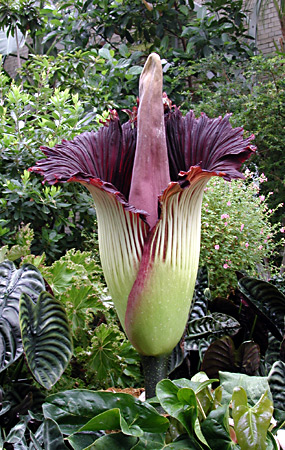
Last week ( Sun April 21) an Amorphophalus titanum or corpse flower bloomed in Edmonton, a noteworthy event. There are only about 5 such cultivated blooms a year, world-wide, and an individual plant does not bloom for several years. In its natural habitat, the jungles of Sumatra, there are probably more.
The one at the Muttart Conservatory in Edmonton, Alberta was the first to bloom in western Canada. It grew from a dormant 225 lb tuber flown up from Boston last fall. The bloom lasted for a little over 24 hours, attracted 3,500 visitors and smelled like rotting flesh.
It was my privilege to be in the right place -within driving distance of the Huntington Library- at the right time -August 6, 2002 – to see the Amorphophallus titanum in full bloom and redolent of corpse.
People actually do fly great distances to witness this miracle. One of those was Jen Gerson, the National Post reporter, who wrote “Thousands Come for Rare Bloom”, (Wed. April 24, 2013) But, alas, Jen arrived Tuesday by which time the flower had wilted and its perfume abated. I can attest to that short life span. I went back to the Huntington on Saturday, August 10, 2002 and found the 6 ft spadex or”phallus” wilted and even more amorphus (ill-shaped).
The tallest specimen on record appears to have been 9 ft. tall. Even the one I saw dwarfed all viewers as they huddled leeward.
My encounter with the Stinky Flower occurred at a low point in my life. I had fallen into one of those black moods where you can’t remember how to put one foot in front of the other. It did seem like a reckless plan to keep my 8 year-old grandson, Leo, out of school and set out from Culver City. It’s easy to get there I was told: go to the end of the 110 where it turns into South Arroyo, turn right onto California and then Allen. This advice for a person who could no longer master left, right, left.
Leo’s safety seemed to concentrate my mind, however, and we found ourselves waiting in a long line in the hot sun, being plied with free bottles of water. Leo was very excited by the prospect of a really bad smell. The Huntington had thoughtfully called it a Stinky Flower so as not to upset childish sensibilities by calling it Corpse Flower. Sir David Attenborough had invented his own name when he featured the plant in his series “The Secret Life of Plants”, feeling that repetition of Amorphophallus titanum would be inappropriate. He called it titan arum.
As we waited, we boned up on why it smells so bad. It’s all a question of the birds and the bees, wouldn’t you know or, more precisely carrion beetles and flies which pollinate the plant. These flies, children were told, fed on decaying meat. Leo, being Leo, got the straight goods out of me by careful questioning.
The Post report described the smell as a diaper pail that’s been left out in the garbage in hot weather or minnows forgotten on a boat. The closer we got, the more people covered their noses. Even Leo began to wonder if he was up to it. Despite the still hot air, the porch where the plant stood seemed to have an air current and we kept circling until we could stand the putrid odour. It was definitely trial by smell.
The spadex apparently has a velvety texture, is shaped, according to one report, like a French loaf and is purple, a visual imitation of putrefying flesh. The huge cup-shaped flower is also purple inside and green outside.
When we had had all we could take (and out of deference to those out there waiting in the sun) we retreated to a cafe table with an sun umbrella. By chance the docent who had given the “tour” talk sat at the next table. Where, demanded Leo, could he get some of those seeds. A lively discussion ensued about possible places where he could grow such a plant.
He was not so interested in the HUntington’s other offerings – a first folio edition of Hamlet, a Guttenberg Bible or Chaucer’s Canterbury Tales.
That night, I dreamed I was a young woman, very depressed, and I had been asked to a formal dance by Blake. I knew he would get me a floral corsage and that in the course of the evening, it would die and get repulsive so that I would have a hard time wearing it. Indeed when we met for the event, he was no longer the tanned, trim, athletic boy he actually was but slightly over-weight, soft and -how did I know- hopelessly behind in technology. When I woke up, I felt as if I had created something of great scope and beauty, which had morphed into something noxious and ugly. And that was before I went back and saw the wilted titum arum.
I said I was going back to peer at the old books, but I made for the stinky flower right away and while I spent time with the books, I also spent much time just sitting in the garden.
Our Stinky Flower had previously bloomed in 1999 and an offset seedling from that plant gave rise to a new plant that bloomed at the Huntington in 2009 and again in 2010.
Then last week, as depression lapped around my edges, I came across the Post article. Amorphophallus titanum had come back into my life. Things are greatly changed. I am far from the Huntington. Leo is as tall as the spadex of our Stinky Flower, an adult and very much his own person, but then he always has been. He did not follow through on those early biology interests. He’s more of a troubadour. What hasn’t changed is that, what Churchill called the Black Dog, is still dogging some of us.
Well, so be it. The Stinky Flower has its own amazing beauty and its stink can be endured.

 Half a century ago, it was still possible to amble across a hayfield on the hill where I was born and come upon the stone-walled cellar hole of a house that had been burned down or had been abandoned and had fallen in. Always you found these simple roses growing there. The cellar holes are still there but the woods has taken over the fields now, and roses do not grow in shade.
 I go through the woods in the park half a block from my home and wend my way up to what I call the ridge trail.
 It must be an abandoned road that the parks people mow. I know that at one point before the place became a municipal park, it was a golf course. I have literally stumbled over the water pipes that watered the greens, But this road seems to go even further back than that. In the early spring, I would pass lilac bushes in bloom at intervals, which suggest that once there were houses dotted along it. One late spirea is still hanging on.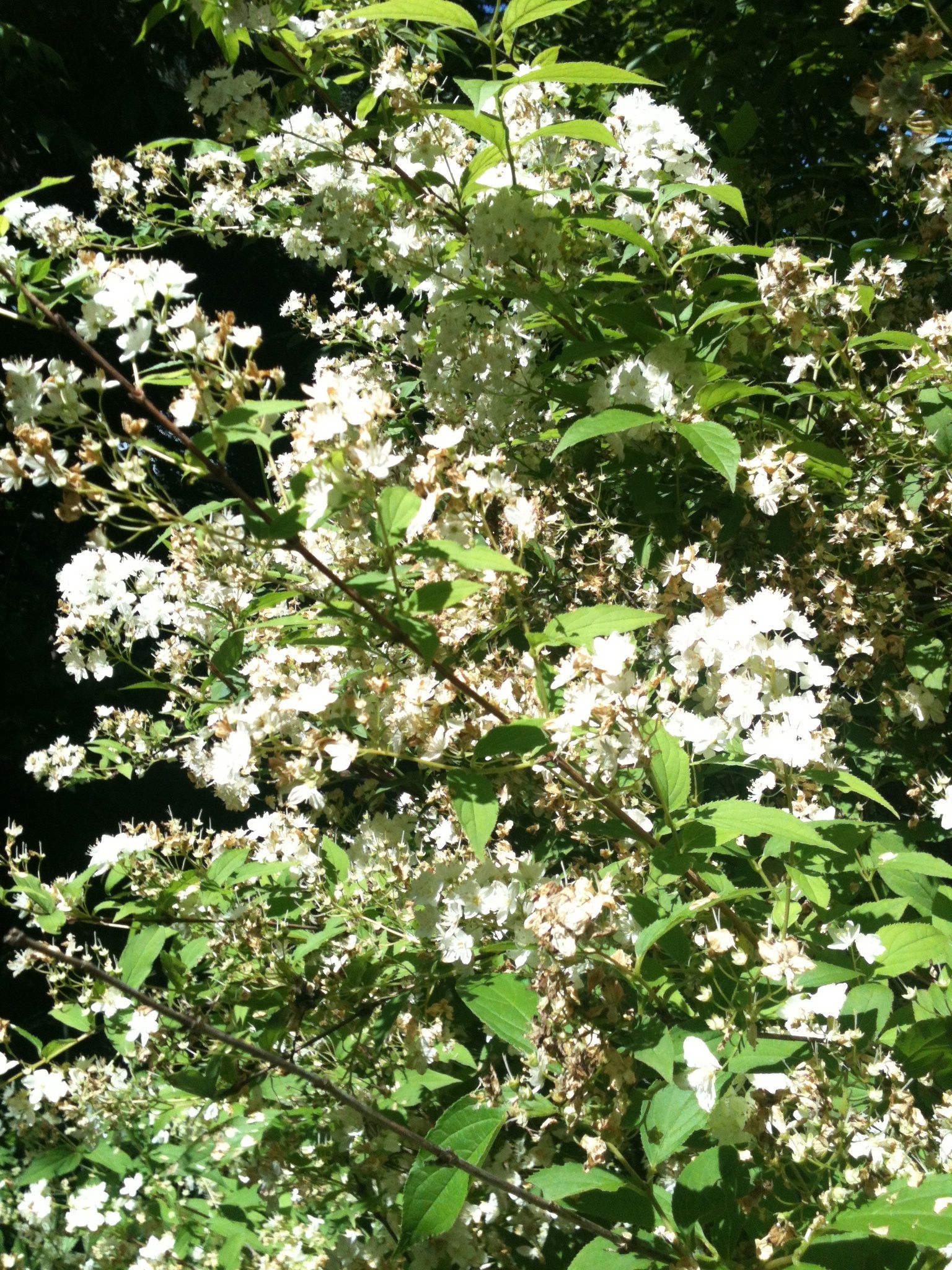
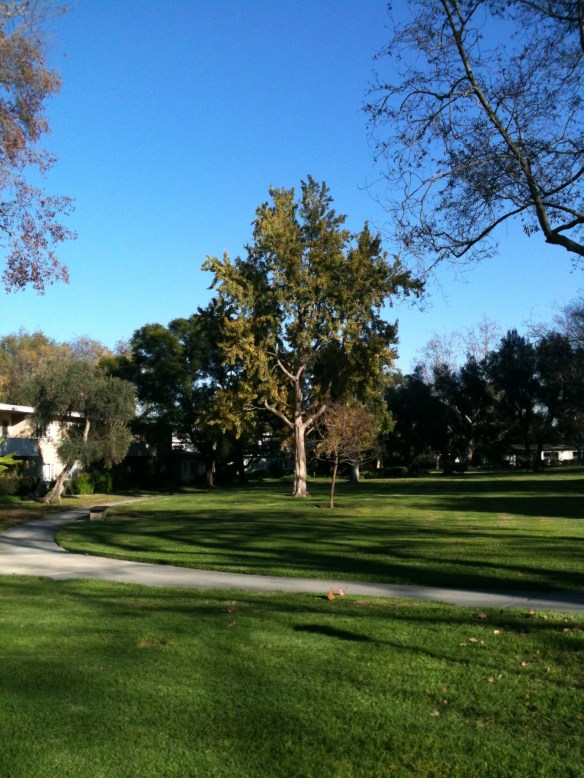
 And there are honey locusts that were covered in white flowers last week.
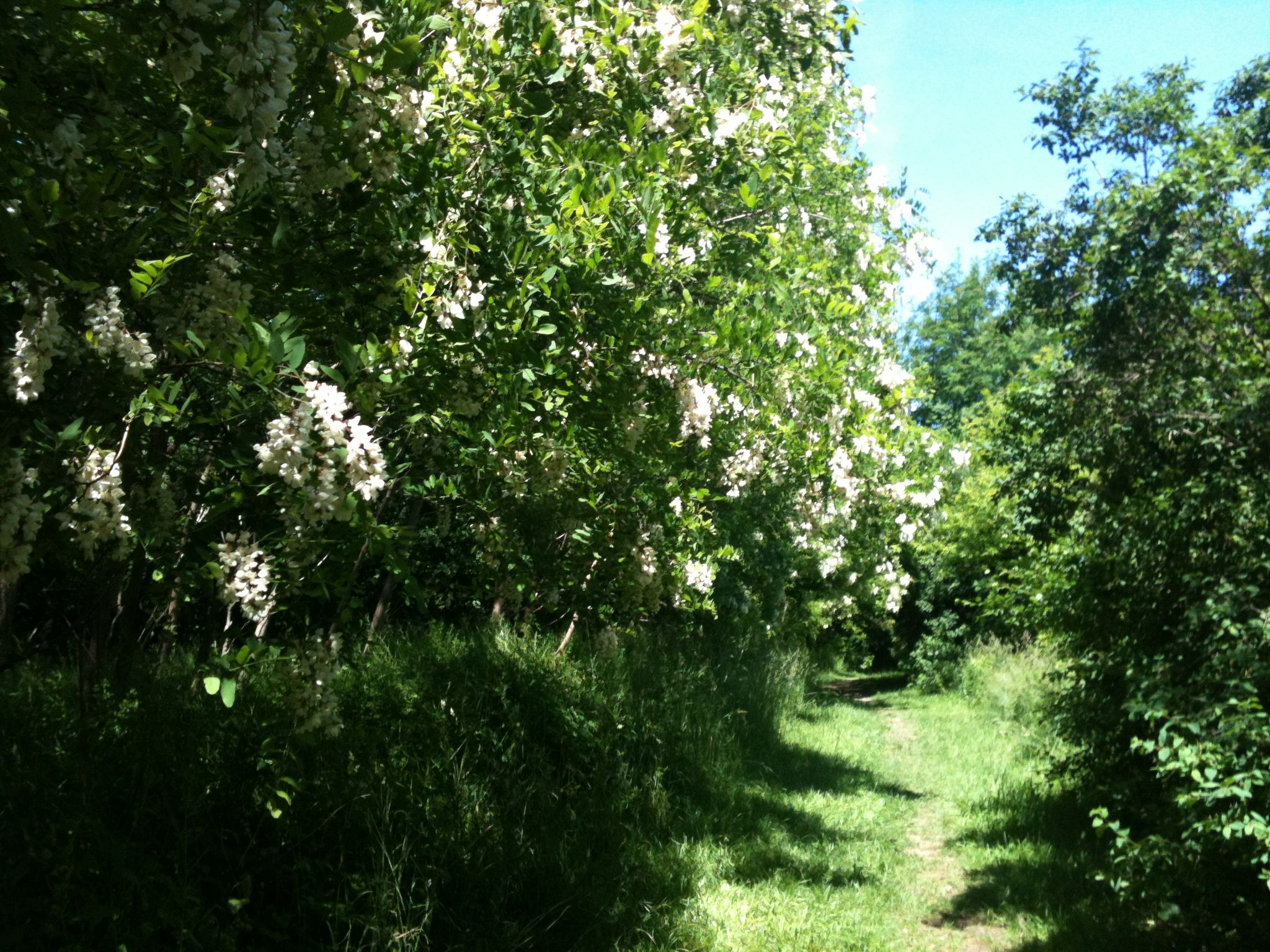 They are young trees, so they are puzzling. Locusts are not native to these parts, but we planted one in the yard of that house under the hill I talked about in my post on Gatsby. (115journals.com) And I see very tall ones on Davenport Rd, maybe 70 ft. high. Perhaps they are evidence of the golf course, but it has been gone for 50 years, in which case they would be taller. They must have self-seeded as most of the woods did once it was let to grow.
 Eventually, the trail leads to a small stand of pine trees and just past them a monument to the early European explorers, including Etienne Brulé, who was the first of them to sight the big lake. Then it is down a steep hill to the river, a story for another day.













 115 journals