I Dream of Etherica: life changing dream #2

People who say that life is short are generally not old. Although I have not yet achieved old old age, that apparently starts at  85, I sometimes feel like Virginia Woolfe’s Orlando who started out as one of Queen Elizabeth’s courtiers and ended up as a Victorian mother. I seem to have had that many lives since I was born, although they have all been uni-sex.

One of my lives was esoteric. I meditated twice a day and joined in group meditation at the full and new moon. Every day, I visualized three lighted triangles in partnership with two others (per triangle) in far reaching places -Texas, England, France, South Africa, Australia- to bring light and peace into the world. I read the works of Alice Bailey, submitted essays to the Arcane School and attended conferences in New York City at the full moon in Taurus . We were concerned about world events and considered them in the light of the truth that Alice Bailey had channeled from the being we called the Tibetan.

Now it is true as time went on that I wondered why I never got published in the school’s monthly magazine, whereas my friend, who could afford to donate much more than I, often did. Clearly, I was a poor judge of my own worth. And as I observed the thin, harried, quarrelsome people running the conferences, I wondered if that was what enlightenment looked like.

This was the me that arrived in Los Angeles one August morning about 20 years ago. In the rose-patterened journal, # 23, in my backpack, I had just been making notes: “Tension of heart energy expressed in terms of giving to others- expenditure of spiritual energy can overcome fatigue…”

But not in this case.

My brother, Rob, was supposed to be there to meet me. I hadn’t seen him for seven years. He was flying in from his home in Paris. My daughter met me instead and told me he had been delayed. I was disappointed, I was hot and I was exhausted.

“Take a nap,” Julia said and her husband seconded the motion.

I had my 5 year-old grandson’s room while he was with his father. I lay down on his little futon. I listened. Good. The Buddhist woman next door, who assaulted our ears with her loud, angry chanting, was silent. I breathed deeply and fell asleep.

I dreamed I was on a plane on the way back to Toronto, but something was wrong. We made an emergency landing in a high desert airfield. I was looking out the window at something like snow that was blowing up into dirty little drifts.

I turned to the man next to me and said, to my surprise, “Do you think we are dead?’

“Yes,” he said.

We were herded into the airport waiting room, the walls of which were alternately plum, fuchsia and orange, each one edged with the colour of the wall next to it. We were at loose ends, milling about in vague expectancy. I was frankly appalled at the sheer tastelessness of what was, by all accounts, heaven.

Above us, an LED sign fired up, telling us that our first class would be at 10 p.m. Great! Just what I longed for! Heaven is an evening class!

It was 10:10 already. All I wanted was a shower and some rest. Resentfully, I followed the crowd up a curving, adobe staircase. (Don’t ask me. The journal says “adobe”.) Resentfully. The others were chattering merrily as if they were on a cruise. I was thinking how summer-camp, how awful. I didn’t fit in here either.

At the top, I heard joyful greetings. Each person was greeting an assigned teacher, whom they instantly recognized because they looked alike. A swarthy Mediterranean man had met his Spanish-looking teacher. A bull of a man with a short neck had met a broad-shouldered teacher who could be his twin. Each pair withdrew to a plum-colored banquette to begin orientation. They were all talking animatedly.

Except me. I was standing all alone. Bereft again.

What karmic debt was this? What failure of positivity? I had clearly not tried hard enough. I wanted to cry. And I was very angry. I wanted to clean myself up. I wanted to lie down. Lay my burden down. Oh damn.

Then someone clattered down the stairs that curved up to the third floor. She was running. She was smiling ear to ear – thin, pale, intense woman dressed in flowing, flapping, filmy prints of plum and fuchsia and orange.

“Hello, hello,” she cried, “So sorry I’m late. I’m Etherica. I’ll be your instructor. You can call me Dea, that is “of God”.

Her draped arms were held out, ready for an embrace. She was beaming, smiling broadly but more than that. Her eyes were wide and bright and intensely focused on my face, as if she were beaming light and love as she bore down on me. LIke one of those TV preachers or self-help gurus.  But she was also tripping on her gown and, unforgivably for me as a teacher, she was late.

My stomach revolted. I thought I would vomit. This was my  angel! This was how I seemed to others! Flighty, incompetent, ungrounded, and showering a blaze of brightness that made them want to wipe it off. She was not genuine. She was not …what…. She was not real. She could not, please God, be what I was meant to be.

GAAA!

I struggled awake, tangled in the wet sheet. I gasped for air in the stifling room. I stood straight up. Oh bad idea. Low blood pressure. I sat back down. Put my head between my knees. I could hear Julia treating a patient in the next room. I was in Los Angeles.  I was still alive. Etherica might be waiting for me, but she’d have to wait a while yet.

When I was able to get to the kitchen and had blurted out the whole sorry story to my son-in-law, he found it vastly amusing. “Sambo’s”, he chortled. “You died and went to a Sambo’s.”

He had to do a footnote for this uninformed Canadian. Sambo’s, he said, was a franchised restaurant that specializes in pancakes. Ah, as in the story of Little Bl….., how non pc.

“You’re really spooked. Don’t want to die?”

“It’s not the dying. That’s bad enough, but is that what I am – desiccated, flakey, ineffective, nervous…”

An unwise question to ask a son-in-law but at that moment the phone rang. He picked it up. I could hear the person at the other end, saying, “This is North West Airlines. Mr Hood’s bags have arrived and will be delivered before five.”

“And Mr Hood?” my son-in-law asked.

“Yes?”

“Mr Hood has arrived as well?”

“Good” said the man and hung up.

Where, I wondered is Rob. How could his bags be here and he not? I cursed Air Canada for showing that movie about Judgement City on my flight down.

My son-in-law took his shaken mother-in-law out, down to the beach apartment to make up a bed for Rob. My urgent need to prevent myself from ending up in Sambo heaven with Etherica had to be put on hold.

When we arrived back home on Washington Way, a van labelled  AirServ stood in front of the house and a delivery man with his phone to his ear was pounding on the door, yelling, “Pick it up. Pick it up. I know you’re in there. Well finally… I’ve got your bags here. Where am I? Right at your door. Your single storey brown house..” He turned to look at us as we came up the walk and Julia threw open the door.

“I think you have our bags there,” my son-in-law said pleasantly.

In the evening, the front room changed from a consulting room back into a living room and we were there watching television when I suddenly got to my feet and opened the door. Rob was getting out of a car across the street.

“Hi there, Sis,” he yelled. “I lost somebody. I’ll be right back”.

Back in the car. he made a U-turn and vanished up Abbot Kinney. We stood shivering in the cool desert air until he came roaring back followed by another car. He stood in the middle of the street speaking rapid French at the people in it. We must meet his friends, hear the story of the lost bags, of being questioned in Amsterdam as suspected terrorists because they were bagless and much, much more.

He had blown back into my life, this force of nature, he who had been stabbed on a train platform in Bombay, spent a week in jail in Turkey and as a camera man had had compartments that no one could ever find.

While Julia and her husband were working we walked on the beach and Rob talked, “And so I said to him, ‘Monsieur Godard, films are not made with trucks. Films are made with people – directors and actors.’ quel triumph…”

We drove north up the Pacific Coast Highway to Big Sur, where there was no room at the inn but he conned the hostess into letting us have a table. I had been a vegetarian for ten years but I ordered chicken.

“I remember you, Sis,” he said. You used to laugh. You could laugh at anything. You had a root canal that went wrong. You were in agony for weeks and you had people splitting their sides. You’re the one who taught me how to laugh.” He put down his fork. “What happened to you?”

Probably only Rob could have said that to me. Even so, a list of what had happened unfurled  in my mind and I started to cry.

“It’s okay to cry,” he said, taking my hand, “but, when you get around to it, it’s better to laugh.”

And so it was that what Etherica started, Rob finished, and I gave it all up. I gave up esoteric study and triangles of light and group meditation and terrible earnestness. I gave up flowing prints. I gave up a whole bunch of friends who didn’t laugh either. I ate meat.

That night after he had registered us at the Carmel Motor Lodge, he came out and said, “I told her you were my sister. I think she believed me,” and he fell over the steering wheel in gales of laughter.
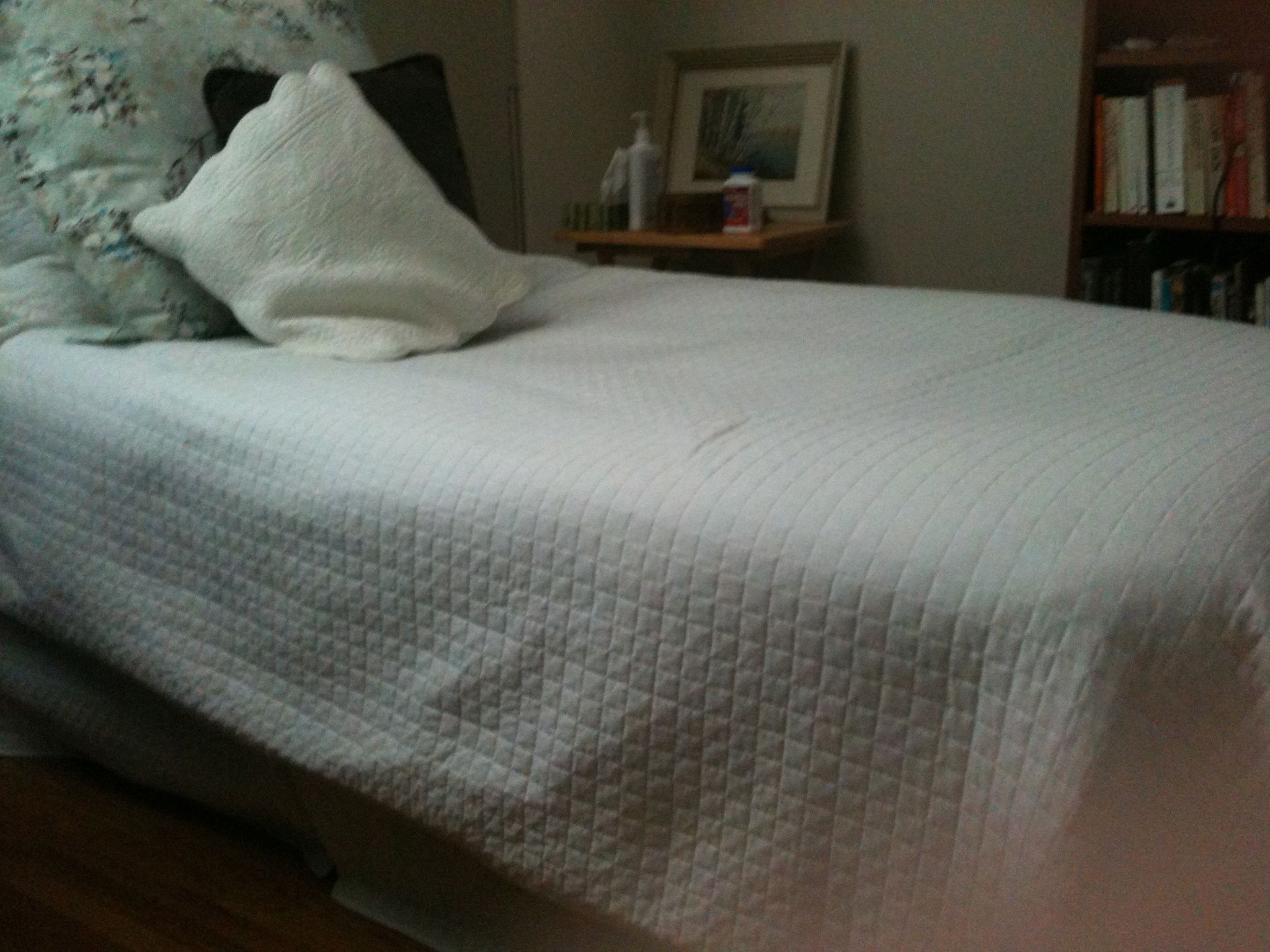
Consider the Second-Best Bed

Image

Shakespeare famously left his wife, Anne Hathaway, his second best bed. Period. Biographers have explained this. Most of his estate went to his daughter Susanna including the best bed, which would have belonged to the master bedroom, but to quote Anthony Burgess in his book Shakespeare, “She (Anne) had her widow’s dower at common law, and her place in the great house that Susanna and her husband took over, She was content to live with Susanna and she got on well with her son-in-law. The second-best bed was installed in a particular chamber and this chamber was inalienably hers.”

Will was not, after all, expressing his feelings for the older woman he married in a hurry and left asap to pursue a career in London. He wasn’t a miserable tightwad either. Having lost his son Hamnet when the child was 11, and being estranged from his daughter Judith who had married unwisely, he was laying his money on Susanna to produce a male heir. Didn’t work. Susanna had a daughter who married twice but had no children. Judith had three sons but none survived to produce children. Pas de heir!

Whew! Good to get that settled.

We all have experience of the second-best bed – at holiday time, on vacations, in cheap hotels, as children at grandma’s – the deep-valleyed ones, the plastic pull-out couch, the couch itself, the hard-as-cement beds, the mat on the floor. We have stubbed our toes on the metal legs of the pull-out and ruined our backs on the ones with blown springs and woken up aching all over in the hard ones. Our host’s query “How did you sleep” has been met with a bald-faced, not entirely convincing lie.

Or we have found ourselves in the best bed, a comfortable place to be, and discovered in the morning that the host and his wife somehow managed to coil together in a narrow cot. Discovering such a carefully concealed secret is a humbling experience.

These days, we have boxed beds that can be blown up with an all-included foot pump and provide our guests with a waterbed experience, long after the death of waterbeds, which was, as you know, watery and unexpected. Whether these air beds leak with rude noise in the middle of the night, I do not yet know.

My own second-best bed sits in the den, rather awkwardly I must admit, because of feng shui demands. It is narrow, has a metal frame on casters and no headboard. It is prone to surprising trips across the floor. In its defence, it has a good mattress -should be for that price- if somewhat too hard. When I realized that I would be sleeping in it myself, I remedied that by topping it with a feather bed. Odd that we think a night in a semi-comfortable bed won’t hurt a guest, but don’t want to spend one ourselves. Then I decided that the thread count of the sheets had to be upgraded to the best bed’s standards and a requisite number of pillows added. I overdid the duvet and find that it works well in mid-winter but after that, the quilted duvet cover is enough.

And why do I sleep in my second best bed about a third of the time. Neighbours. Thin floors. Don’t ask. There’s only so much I want to know about other people’s personal lives.

I’ve got used to sleeping there and never wake up disoriented, wondering why things are in the wrong place. This is handy since those mandatory trips in the dark would otherwise prove disastrous.

One of the advantages is better brain plasticity. Thanks to Norman Doidge (The Brain That Changes Itself) and others, we now know after years of being told that once brain cells die, it’s game over, that in fact new neural pathways can be established and for example, stroke-damaged limbs can learn to move again. To maintain neural plasticity or brain change, however, we need to be learning constantly. One of my tai chi instructors harps on about moving your kettle to a different burner to avoid rigidity and stagnation. The kettle, in this case, is me and the new burner is the second-best bed.

Twas there “I dreamed the latest dream that ever I did dream”. It wasn’t a police procedural with noir overtones nor was it a lucid dream. (See previous posts.) But it was one of two dreams that have been life-changing. Someday I’ll write about the first one, which I call Etherica and which I had while napping after an exhausting trip to  Los Angeles. The latest one isn’t ready for publication yet, but I can give you the highlights.

It was suffused with love, the kind of love that I felt as a young woman for Blake, my high school sweetheart whom I married, and which I saw reflected in my grandson and his fiancé whose wedding I recently described. This nourishing, accepting and all-encompassing feeling made me not want to wake up, but stayed with me once I did. The dream began with me in my early twenties but looked forward in my dream thoughts many years and actually incorporated someone from my real future. As I pondered over its meaning, I understood the “future” person as I never had before. That was instructive, but more important was a shift that had happened.

Like many people who have had abusive childhoods, I have felt like an orphan, bereft of care, human and divine. As I did the dishes the evening after the dream, I knew that this was over. My heart felt as if it were shattering. Not breaking. I wasn’t sad although I cried. It was opening up. It had to be bigger to accommodate what it would now have to hold – another part of me, repossessed at last.

How can I break the news to Best Bed, the black Hemnes bed from Ikea, so solid, so high, so comfortable, that its second-best Sleep Country cousin has bested it in dreaming?

Blue Now – how not to be

The designer of the website for my book, sent me an email headed, “Blue Now”. My first response was how does he know. What he meant was that he had done some html magic so that the links on the “Buy” page showed up blue. My mood had nothing to do with it.

In fact, my mood began to lift after I got my nephew who is a WordPress genius to help me with irresolvable problems, irresolvable by me that is. I had actually found the solutions to most of my problems in “Help”, but either I couldn’t understand them or I couldn’t implement them. I am, after all, the woman who had to try 8 times to get her pressure cooker to work. (See “Hapless Human vs Pressure Cooker” posted May 22) I began to climb back up out of that pit of low self-esteem that not being able to centre a picture or single-space poetry had dumped me into. I know -too sensitive for my own good.

Later I spent an hour or more with the delightful people at my satellite company rebooting my PVR so that it would actually record instead of just telling me it was doing so.

The rejection of my appeal of my income tax is not so easily handled and has to go down under the category of “things I cannot change.”  I can, however, rejoice that I had the wisdom to know the difference.

Meanwhile, I received in the mail a new shipment of supplements from Endomet in Arizona and the report based on a hair sample I had sent them. The report confirmed what I had begun to suspect that the blues can be primarily physical -tired adrenals, sluggish thyroid, poor metabolism of nutrients. As it turns out I had won a trifecta of low scores. I got much advice among other things to eat more protein and less sugar. Not sure I am up for 12 oz. steaks and giving up maple syrup on porridge may put me off brekkie, but I promise to try. In addition, they tell me that the supplements they sent may make me feel tired. They are intended to get me to slow down. There’s a slower gear!!!!

Nevertheless, I had already decided to incorporate relaxation in my recovery program. One of the advantages of age is that you’ve already done most workshops, including the one where you learned to relax. It has been a stressful 6 months in our family, but things are settling down now and it’s time to let go of constant vigilance. That strategy seems promising. It will lead to a more comfortable life.

I think that these strategies added to the techniques I usually use -reading Rumi, listening to music-rock, classical and jazz (where does she get the time?), walking in the woods, having flowers about the place, counting my blessings- will make the persistent inner editor who tells me how flawed I am and how I have failed myself financially and in so many other ways just shut the you-know-what up.

Lucid Dreaming – sort of

Carlos Castaneda introduced the idea of lucid dreaming to me in one of his Don Juan books many years ago, but I confess I never quite got the knack.

Once or twice, in the middle of a truly scary dream, I have said, “This is just a stupid dream” and woken up, thereby saving myself from certain dream death. As a result, I have never tested that theory that if you die in a dream, you really do die.

As far as I understand it, lucid dreamers can change the course of a dream according to their will. Apparently it is a skill you can teach yourself. As I recall, I actually tried it, using techniques I have long forgotten but must be written down somewhere, for I certainly did not learn them from a guru. I gave it up I because it was just too much effort.

From time to time, I wake up with the feeling that I cannot stand one more completely banal dream, so, perhaps, there is an argument to be made for lucid dreaming after all.

Early this morning I had a sort of lucid dream.This was a morning when I did not have to get up at 6:30 a.m. and it was just after that that I had the dream.

Generically, it was a sub-class of what I call school anxiety dreams. In these dreams, I suddenly realize that I am late for school. Usually, I know exactly what time it is, 8:30 a.m. for example, but I am miles from the school where I teach and have no car. The school anxiety dream takes off from there. Sometimes, I actually manage to get to school, but I don’t have my time table, don’t know where I’m teaching, what class, what subject and if I can guess where, the stairs turn into ramps or they don’t lead to the floor where my room is. Or I realize that I haven’t checked my mail box since school began weeks ago and that my time table, placed there in August, is still there unread. Sometimes, I realize I have to teach something I know nothing about, some book I have never read. This isn’t such a stretch. I am actually qualified, for example, to teach economics, having “successfully taught” it at some time, but never having studied it and certainly, having little understanding of it.

I know other ex-teachers who have this same dream.

This morning’s dream was different in that I had to be at a polling booth since it was election day and I had snagged some sort of paid employment, which I badly needed. It was just after 6:30 dream time and I began looking for a green file folder that had the details of where to go and when. I searched and searched to no avail. I seemed to be a young woman, still living at home. My mother was around somewhere and my room, it must be said, was a mess. Eventually, my sister who also had a job at the same place, produced her paperwork. We were to report to a hotel called Dakota at 7:59.9 a.m. I looked at the clock, it was 7:07. The hotel was in a suburb, many freeway miles away. It was rush hour. Traffic would hold us back. What to do?

I decided I needed to make a phone call. I’m not sure to whom. Probably, I intended to plead for leniency because I really needed the $200 I would earn and so did Sis. I picked up the phone. I studied it carefully.

Now it is a peculiar thing. In my dreams, phones are tricky things. The numbers turn into letters or half of them are missing or my fingers are too big for the little keys. I can remember receiving phone calls in dreams. Once shortly after he died, my father called me in a dream, but all he had to say was that he was fine. But I have never succeeded in making a call. This ran through my mind as I looked down at the dream phone and I said, “I can never use a phone in a dream.”

Then I woke up. Of course I did, that was the whole purpose of this irritating dream and probably always is.


Septuagenarians at Sea

Here continueth the adventures of the septuagenarians who were previously on the road.

The sail past on Sat. June 2nd didn’t happen. The lake was too rough for all those sail boats to bob around in close formation. Instead I got a lesson in where and when I was permitted to wear a hat. (See “Dress Code” June 6th post)

But this Saturday, June 30th, Lake Ontario is calm and the sky is bright blue as we wait for Blake, who buzzed away on the water taxi, to bring the 29 ft. Sirocco in from its mooring. And wait and wait and wait. Sailor’s time. How could I forget? Everything slows down once you put yourself at the mercy of “canvas” and wind and people like Blake who just naturally move at that speed.

There are four of us waiting, all of us female. The other three amuse themselves by raiding the snack bag. I sit on a curb in the shade, listening to the marimba-like clang of halliards on masts.

Eventually, Sirocco putts up on its engine. Blake throws us the blue lines and we walk the boat up to the wall and tie it. But wait, it’s not that simple. Blake has promised to teach the youngest of us, a fifteen-year old, how to sail and instruction begins with knotting the line around the bollard.

“You can’t tie up here, not on Regatta Day,” a moustached gentleman in regulation white declares.

Blake greets him merrily and continues loading the many bags of snacks, lunch, ice and beverages.

“He’s kidding,” I tell the other women.

Well, he is and he isn’t. That’s the rule, but the regatta boats are all out on the water racing. And this is Blake’s old friend who is wearing a devilish grin as he does his official duty.

So here I am back on Sirocco, which was once mine, well, half mine, for four glorious sailing seasons. I’m sure a forensic expert could still find evidence of that. Certainly any decently good clairvoyant would find my psyche print all over it.

A thunderstorm was raging overhead when our 14 year-old son called up from the cabin, “What does it mean when the mast glows.” “It means don’t touch it,” I screamed back.

Here is the safety line, he had fallen backward over in a raging sea and I had grasped him by his wrists and held on until a wave tilted the boat and threw him back.

Here is the tiller that my 15 year-old daughter had gripped as she drove the opposing boat up and up until it lost the wind. “That little guy has sure got nerve,” we heard some one on it mutter.

Down in the fore cabin, I find the personal flotation devices and lace one on over my windbreaker.

How can you tell I am one of the septuagenarians? So is Blake, but he can still swim the way he always did. Lake Ontario is dark and deep and cold and I never could swim well.

So we putter on the motor out of the basin through the breakwater, Blake’s stepdaughter on the tiller while he reefs the main up the mast, all the while instructing his aspiring sailor. It is the first time, the main has been up this season so there are kinks that have to be worked out.

I zone out, recalling soft evening sails through dove grey water, moire-patterned, lying on my back on the bow reading, running before the wind with the rainbow spinnaker bowing out ahead.

Once the engine is off, we do sail before the wind with just the mainsail into the bay, where a tight circle of dingy sailors is racing and where the ferries and tour boats and speedboats are supposed to give way to us. Blake is busy updating his stepdaughter as to which sailboat has the right of way. I don’t have a task to perform, unless sitting and staring can be considered one. On our port, there is the city, on the starboard the islands, one green and natural, the other an airport from which largish planes and helicopters are landing and taking off. You have a wide variety of vistas. Choose your pick.

By the time we get to the end of the harbour, the wind seems to have died down, so we break out lunch. Blake takes the tiller, saying he will eat later. Lunch is leisurely.

Then it seems as though more sail is required. I hear Blake and his student down in the fore cabin debating which jib to choose. A few minutes later they have pulled up the  genoa.

“Couldn’t you find anything bigger?” I crack.

Then the wind hits. It hits with all the vehemence of a line squall. Suddenly, we are moving, the big sail is catching the wind and billowing out over the water, the boat gains speed and begins to heel. It goes on heeling and heeling. Those of us sitting on the starboard scramble up to the other side, hanging on hard. Those on the bow shriek as water comes in over them. The rail is almost underwater.

Blake is of course laughing delightedly, but even he remarks that he might have too much sail up. He starts to take the genoa in. It luffs and flaps as he lets it off, just a fraction too late for the boat is no longer moving forward. We are aground.

Soft aground. That’s as opposed to hard aground. I have been hard aground in Sirocco. It hit a rock in the St. Lawrence and came to a thunderous, terrifyingly sudden stop that seemed likely to be fatal. This was more like a scuff up onto a sandbar, but no less fixed.

Blake takes the tiller, does NOT vent the fumes from the bilge and turns on the engine. Once it catches, he begins to rock the gears. No movement. He isn’t worried. I can see that – just full of adrenalin. I’m worried. I can barely make myself stand up and go with the others to stand on the narrow edge of the deck around the cabin, our weight leaning out over the water. It is not easy to stand on a narrow ledge of a pitching boat and lean over the water. This is not necessarily a function of being a septuagenerian. I found it was equally true when I was 39. Eventually, Blake says, “We’re off”. Not that I would have known.

I descend to the cabin to get him a beer.

Meanwhile a siren sounds and a police boat races by. It passes the upturned catamaran with its wing well under water and makes for a sailboat slightly smaller than Sirocco. And there is another police boat advantageously placed to observe beer drinking skippers. It is suddenly clear that apart from these five boats, no one else is on the water. Even the ferries are docked. Now I don’t want to read too much into this and I’m sure the ferry captains are not afraid of a little wind, just saying.

“That’s what happens when you’re sailing, ” Blake explains. “One minute there’s no wind and the next, there’s a gale.”

We sail back on just the main, the 15 year-old on the tiller with Blake giving patient, generous instruction.

Yes, he made a great sailing father, but, I swear, he has a deep need for adventure that calls these things up, if he does not actually cause them.

Thank you, Poseidan, I have survived another sail with Blake.

Dress Code #2

In the list of search terms that brought viewers to my blog post, Dress Code, I found “panty hose worn with short shorts”. I cringe a little wondering whether this was a search by a girl seeking sartorial instruction or a guy with a fetish. Nevertheless, it spurred two of us to come up with the rest of the outfit. The shorts have to be white and the shoes white, high-heeled strappy sandals. A tube top in hot pink and yellow stripes is the perfect addition to this outfit, which will be just the thing for a summer funeral.

Black Humour: Despair young and Never Look Back

We were laughing. I remember that. It was Mother’s Day, wedding day. The hotel room was suddenly full of people. We oldsters were waking up from our nap and the youngsters had descended on us, bearing greetings. The last to arrive was Leo, 17, my grandson. And we were laughing.

It had been a bad year really. Someone was very ill, awaiting  surgery. Some, still getting  hit hard by this recession. Someone was grieving the lost love of his life. Someone else, heartbroken. But here we were from both sides of the continent, together at last. We were laughing. Blackly!

And then I said to Leo, “Despair young and never look back.”

How could I? He was a fresh-faced seventeen year old. How could I lay Samuel Beckett’s bleak advice on him?

Leo laughed.

It’s hard to be fresh-faced and seventeen under the circumstances, but, more to the point, Leo shares that black sense of humour. He figured out as a much younger person what life can be and he, like the rest of us, in that room had decided to laugh.

I first came across Beckett’s advice in MIchael Ondatje’s The Cat’s Table, the story of a 10-year-old’s voyage from India to England on his own. He befriended two other children also on their own and ate with them at the lowest table, the one farthest from the captain’s table, the cat’s table.

I knew Samuel Beckett, having taught Waiting for Godot to puzzled teenagers for many years. (Why were the tramps waiting? Was Godot God? Why didn’t he come? etc.) It was impossible to say. Beckett had pared the language down to the point where the audience had to decide. But it was clear that, apparently abandoned and betrayed, they suffered in their waiting. Whether that suffering was comic or tragic was harder to say.

Beckett’s advice in response to a young fan’s letter was equally hard to decipher, but it came down to that: figure out early how bad life can be and accept it, then you’ll get along fine. Okay, I added that last bit, but Beckett must have agreed I figure: he kept on.

Why is it so comforting to find people who share this black sense of humour? Why does my sister find my post “Why I Will Never Sleep Again”, a useful indicator of whom she can relate to? (Those who think it’s funny – yes. Those who just look puzzled – not so much.)

Beckett’s advice will be interpreted as terribly bleak and totally inappropriate by some of us, and so absolutely true as to be mundane by others.

When I sit down to dinner, I enjoy the company of the second group. How comforting to know that they have been there too, that they know how absolutely awful life can be and they can find that funny. That doesn’t, by the way, necessarily mean that they are drunkards. Beckett was indeed Irish and they are famous for their black humour. They are also famous for drunkenness, although Beckett was not. It is possible to be drunk without alcohol. It is possible to be drunk on life, to rise up from whatever disaster is trying to put you down and laugh.

No, not in its face, not defiantly, cynically certainly, but not bitterly. “I see you for what you are, Life and I am not impressed.”

And so in that hotel room, on Mother’s Day, before the wedding, I added words from Beckett’s play, absurd in their resilience, in case Leo didn’t get it : “I can’t go on. I’ll go on.”

And there is barely a pause between the two thoughts.

Dress Code

“What should I wear,” he asked. It was a hot day. We planned to take the dog for a hike through the woods before dinner and Blake preferred shorts, the shorter the better.

Many years ago, he had cut off a pair of jeans, rather, it must be said, too short and had worn them for many years to every family gathering from Mother’s Day to Thanksgiving, thereby, scandalizing his mother-in-law.

“Bring a pair of long pants,” I suggested. La Veranda Osteria took reservations so perhaps it was somewhat formal.

I was loathe to say that. For the most part no one tells us what to wear anymore. Mostly but not entirely.

A  week earlier, he had asked a few of us to the Sail Past at his yacht club. “The invitation calls for dress whites and navy blazers,” he added, “but people ignore that.” I had planned to wear white and navy anyway, seeing it as an occasion to play dressup.

Wearing white pants on the deck of a sail boat is a challenging affair at the best of times, what with winding wet sheets around winches, but that Saturday turned out to be rainy: you step into the sailboat by stepping onto the seat cushion with your muddy shoes. At the skippers’ meeting, the decision was made to cancel the sail because the lake was too choppy for dozens of boats to sail in close quarters past the commodore’s boat to salute him.  All the more time to hang out, waiting for the reception, dinner and dance, and so we found ourselves in the bar. Strictly speaking, it was not the bar, but the dining room and “strict” is what I am speaking about.

The air conditioner was running full tilt despite the cool weather, pouring cold air down onto the top of my head and my neck. I can’t abide that. I reached over, picked up my hither-to-unnecessary straw hat and put it on my head. It had barely settled my hair when the waiter appeared at my elbow and whispered something unintelligible. I needed translation. She was telling me to remove my hat.

She was telling ME to remove my hat. But I am female. I have a licence – just a minute, it’s here somewhere. I got it when I was born into this western society. Not only am I allowed to wear a hat anywhere I want, there are still places where it is mandatory. Aren’t there? I spent the first half of my life, travelling with a kerchief (a square scarf which is folded into a triangle- oh, just picture Queen Elizabeth with her dogs on a wet day) in case I wanted to visit a church or cathedral. And now  I’m being told not to. Apparently, I had walked right by that sign that said so.

I took it off. I didn’t want to make a scene, pull out my six shooter, so incompatible with the genteel chapeau.

I could just imagine that oh-so-politically-correct discussion where it was deemed unfair to tell men to remove their hats in the dining room if women were wearing theirs. The rule was a great leveller. I had been levelled!

What if I were Muslim, I wondered. I fantasized coming in wearing a headscarf. Then let them try to tell me what to wear!

 Wait a minute, wasn’t that more or less what France had just done and Quebec was threatening to do?
Who gets told what to wear these days? Hapless bridesmaids are probably still suffering in ugly dresses and bearing their expense. My Californian grandson unwrapped a red toque with genuine gratitude; his science teacher had just seized his last one. Catholic girls have to remember to roll their skirt bands back down before they go back to class. But from the looks of red carpet fashion and the girls in the club district, dress codes have gone the way of boned corsets and farthingales.
At the age of 22, weighing all of 120 lbs. I set off to teach my first high school class encased in a girdle. No rule book mandated this, but a well-bred young woman knew she shouldn’t jiggle. On extremely hot days, pre-air conditioned schools, I was mortified to have to slough it off in favour of garter belt and stockings.
Those were the days, my friends, we thought they’d never end!
Boys were not yet suspended for wearing baseball hats. They knew better than to try. It was several years before they were suspended for wearing shorts. I remember one who demonstrated the resolve of Thomas More, defying Henry VIII. It was reasonable in his opinion to wear short pants in the June heat. As soon as his suspension was over, he came back to school – in shorts. I passed him coming down the up staircase.
Blake recalls arriving at that school’s first ever staff meeting in a pink shirt and forever sealing his reputation as a renegade by so doing.
In the depth of sub zero winter, my small daughter set off for school wearing pants under her wool skirt, permitted to do so only if she removed them in the cloakroom. We saw that women were beginning to wear what we called slacks to work on television, but always with a jacket. Eventually, word came down from on high, that female teachers would be permitted to wear “pant suits” so long as the jackets were of a modest length. (Code for over the bum, babes)
By then someone had invented panty hose. You didn’t need all that rig and tackle to hold up stockings after all.  There was a new and dangerous freedom in the air.  GIrls as well as boys wore jeans. GIrls started wearing short shorts. Bras became optional. My favourite anecdote on that score concerns the vice principal who, in his role as inspector, evaluated a fellow teacher and wrote in his report that she was wearing false nipples. She, of course, was not, but she had a good idea what he had been inspecting.
In the larger world, the smelly wool jacket loaned out to men who arrived at, say, Honest Ed’s Steakhouse, improperly attired, got retired from duty. Blake stopped sending five dress shirts to the laundry every week. We relaxed and let it all hang out, even at the prom, well, especially at the prom. There even came a time, when some of us vowed never again to encase ourselves in pantyhose like a nyloned sausage. And even that was doable.
Dinner at La Veranda Osteria was excellent, really fresh greens in the salad, mouthwatering lobster stuffed pasta and  Blake remarked he was glad he had changed into his pants. It was that sort of place. And I wore my hat throughout.

Jack Reacher -Wandering Taoist

In my last post “How I developed ‘Low Tastes’ in Reading, I mentioned that I was hooked on Lee Child’s Jack Reacher thrillers, to my dismay. Then, wouldn’t you know it, I found a justification: Jack Reacher is a wandering taoist.

It was reading # 156 in Deng Ming-Dao’s 365 Tao:Daily Meditations* the one for June 5th that clued me in to what I should have realized before.  (* Available at Amazon.com)

Inseparable: The trunk is hollow,/But the branches live./The void is fundamental,/But the ten thousand things are diverse./ Therefore wanderers free themselves of cares/And follow Tao in great delight.

In the ensuing explanation, Deng tells us that we can know all of Tao’s manifestation by travelling through the world. All experience is the experience of Tao. Those who follow it, divest themselves of ego and ambition and follow its flow throughout the land, moving from place to place as they sense the direction of its vital flow. “These wanderers have glimpsed the void that is in them and in all things. They delight in life but never see more than the void.”

As a volunteer, I once took a phone call from a very serious young man who wanted me to tell him what Taoism was. I replied civilly, I hope, that to answer would take longer than the average phone call and, besides, it was beyond me. Short answer -Tao is the stuff of life, the energy that animates it. Taoists believe in the supremacy of nature and the necessity of living by its laws, in particular the cycles of change. They understand that whatever is full and rich will decline in time and whatever is empty and poor will rise in turn. Taoists don’t talk about God in spite of reverence. Should they search for God, they would look, not in a book, but within.

I would say they are practical and work things out as they go along rather than adhering to doctrine. This story illustrates that: a Buddhist, a Confucian and A Taoist were meditating when mosquitoes began buzzing around their ears. The Buddhist let a mosquito bite him without protest. The Confucian slapped and killed his mosquito. The Taoist waved his mosquito away. When that didn’t work, he moved to another room. When the mosquito followed him there, he killed it. Taoists  prefer not to interfere unnecessarily but act instinctively when necessary.

It seems to me that many people are Taoists at heart, although they never identify as such. Joseph Campbell, for example, warned against being co-opted by the system. Systems prevent us from personal assessment and self-determination. They also enable us to succeed in our careers, attain wealth and social standing. Opting out has rather the reverse effect.

The fictional Jack Reacher attained the rank of major as U.S. military police officer. Then in 1997, he left that system over a moral disagreement, just short of being deployed to outer Thule or its equivalent. His pension is paid into a D.C. bank and accessed on the road. He doesn’t own a car, drives badly and flies only when he can’t take a bus or hitchhike, across the Atlantic, for example. He travels the United States according to whim, once deciding to follow a diagonal line from the north east to San Diego. He carries no baggage, except that folding toothbrush, I mentioned last time. When his clothes need washing, he buys new, cheap, sturdy shirts, pants etc. and throws the old ones away. he reckons that when you factor in the cost of a washing machine, dryer and the dwelling to contain them, not to mention the soap, he still comes out ahead. Nevertheless, he is a clean person, showering thoroughly in the cheap motels he chooses, although when he still wore his Class A’s complete with Purple Heart and Silver Star, he was not above cadging first class digs at the army’s expense.

Wherever he goes- Mississippi, Kansas, Colorado, he finds trouble or it finds him. Often all he does is step down from his ride, when the locals take agin him and try to run him out of town. Usually it is a very small town with its own ingrained and deeply corrupt system. But at 6’5″ and 250 lbs. and with some serious brawling smarts, the system’s minions don’t have much success throwing him out. Pretty soon, he has identified the nature of the corruption and its victims. He believes as he was taught that the best fight is no fight at all, but when a fight is necessary, he strikes first and dirty. In The Affair, he chides the rednecks who take him on for bringing only 6 men and takes them down readily. And they aren’t even the real enemy, just wrong-headed and misinformed.

I gave up watching boxing when I was 20 and now it just makes me think ‘concussion’, but Lee Child’s fight descriptions are choreography on paper. I would love to know how he knows all this stuff. Does he practise it the way I practise tai chi?

Jack Reacher can be counted on to right some wrongs before he blows out of town and to  leave behind more wisdom than he found there, that is for those who survive. The guiltiest may meet sudden ‘accidental’ ends, which cause Reacher neither remorse nor even a backward glance. He bids goodbye to his latest woman just as readily.

Now the purists among you may object that he also has sex on a regular basis. I counter, never indiscriminately and always on the basis of respect and affection as well as healthy desire. Besides Taoists are not purists. If they claim to be, that’s your first clue.

Jack Reacher looks into the void. The void looks back. That’s okay with him.