
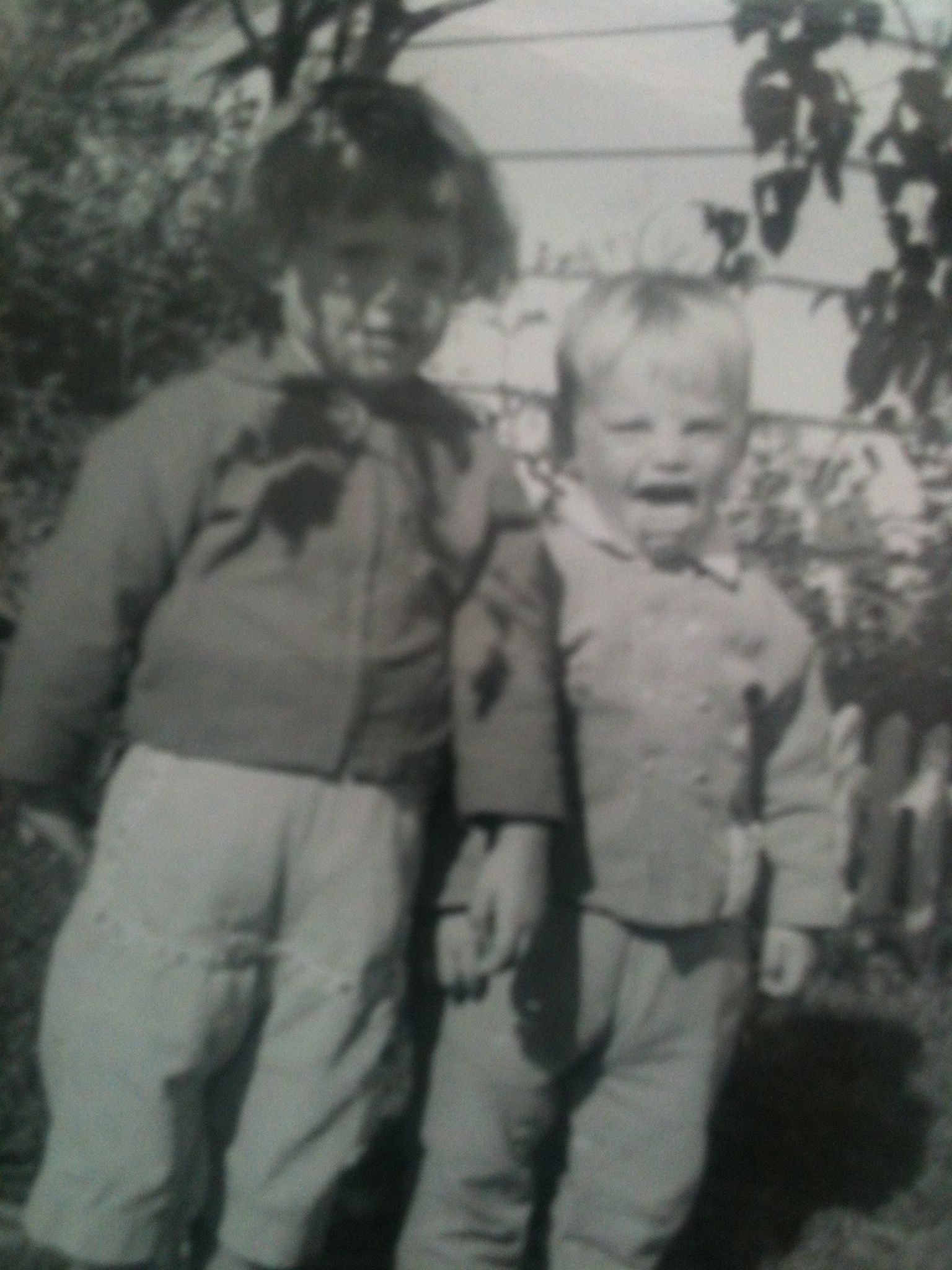
Daniel’s World: what made him

kids(One of a series of posts about my estranged son, Daniel)

So we moved six-month old Daniel and his eighteen-month old sister to a rented house in the summer of 1962 – three bedrooms, more space, our very own washer and dryer, nobody thumping around overhead and a fenced backyard waiting for children. Blake still had three jobs going on, so we could make ends meet – maybe.

The sewing machine had pride of place in the living room in the front window, just as my mother’s had for years. The bookcase sat next to it, filled with our university texts and a 12- inch black and white television set, mostly wooden cabinet, a hand-me-down.

People were poorer then.

I made drapes for the front window out of burlap, tape with pockets sewn in for a heading and wire hooks that pleated the fabric. Sort of. I had also made the baby overalls that were passed from Julia to Daniel, pounding in the rivet-like snaps that ran up the legs for diapering access. One pair lost a snap. I couldn’t fix it. Too bad. The garment got worn anyway.

I had been trained for this. Along with Latin and French and algebra, 18th century literature and Kant and logic, I had been taught home economics. I had even passed -with a little help on those blouse sleeves. I knew how to price out individual portions of a balanced meal -not that I actually did – and set a table. I could mitre bed sheets with the best of them. I didn’t need to be taught how to clean a house within an inch of its life. My mother drummed that into me. Literally.

But what was I thinking?! I absolutely hated home economics. I loved Shakespeare and Samuel Johnson and thinking about whether a tree falling in the forest really did fall if nobody was there -subjective or objective reality. (Well, okay, nobody loves Kant.) I wanted children and I wanted ideas, but I was finding the two mutually exclusive.

Television was no help, even if we could actually make out the shadowy forms our rabbit- ear aerial pulled in. The radio was better because we got CBC. And, of course there was the library, even if reading had to wait until bedtime when I was worn out.

Meanwhile Daniel learned to crawl. Whereas his sister had humped along on one hip, he used an inch-worm or caterpillar method. Such mobility began his differentiation. Julia soon discovered that he wasn’t just an audience. He wanted that toy too and could grab and hang on for dear life.

To get things done I let them play together in their child-proofed room with a baby gate across the door, but I could hear them as I scrubbed the kitchen floor – on my knees of course, my mother’s injunction ringing in my head: mops don’t work. I let them work things out until murder seemed imminent and then I would fly up the seven steps to the bedroom level. Daniel would have to go in the playpen and Julia sit in the high chair, but, hey, that was fine with them. They could watch me scrub and talk about it in baby-speak.

The evenings were hardest, especially during teething. I remember one such evening. We had moved them to separate bedrooms by then; otherwise, they never went to sleep. They stayed up chatting from crib to crib. The big green rocking chair had found its home in the middle bedroom with Daniel’s crib. He couldn’t get to sleep, so I sat him on my right knee and Julia climbed up on my left. We rocked and rocked. I sang. Everything I knew. All the old country songs from my childhood, all the camp songs, all the love songs – Smoke Gets in Your Eyes, After You’ve Gone.. Still they were awake. Then I cried.

I cried because I was lonely. My husband was never home and when he was, he was marking papers or studying. I had no friends. Moving hadn’t helped, of course, but I had never had many. The neighbour women treated me warily. I spoke like the English teacher I was. I cried because I was depressed. I cried because I was bored. The kids knew that instinctively, no doubt, but now they knew it because my tears ran down their faces as they comforted me. Something had to be done.

But first …. we had the Cuban Missile Crisis. October 1962, suddenly there really was going to be World War III. The new twist was none of us were going to survive. They say it lasted only 12 days and yet I had a stock pile of canned goods down in the crawl space as well as a can opener, so the run-up to the crisis must have been menacing. I actually convinced myself that we could survive down there until the radiation blew itself off, if only Blake could figure out how to tap the water heater. We were all terrified, but I seemed to have a special gift for hysteria.

John Kennedy fixed it. My babies were not going to die for the present.

At some point, by some miracle, Blake and I were able to sit down at the kitchen table to address the situation, a grey card table, I might add.

“If you could do anything you wanted right now, what would it be?” Blake asked.

What an amazing idea! But I just sat there, stunned into silence.

“Come on,” he said. “say what comes into your head.”

“I’d go up to the bedroom and put on my navy suit,” I said.

“Then where would you go?” he asked.

“To Cedarbrae Collegiate,” I said.

“You want to go back to teaching,” he said.

The blood rushed away from my head. I almost fainted.

“Well, I can’t do that,” I replied.

“Why not?” he said.

“What would happen to the kids?”

So we began to sort it out. Someone could be hired to come in and look after them. Even if it cost half of my salary, it would be worth it. I would have no problem getting a job. Teachers were in such short supply now. All I would have to do would be to show up at the job fair in the spring.

The next day and for the next week, I kept deciding this was a crazy idea and then deciding that I had to do it. My anxiety level got pumped up almost to Missile Crisis levels. The deciding factor was the money. Among other stresses, I was being pestered by bill collectors for the landlord’s debts, including mortgage payments. Our rent money was just disappearing apparently. If we had two incomes, we would be able to buy the house.

I got a job at Thomson Collegiate, a few blocks away. As it turned out, it was the worst job there, consisting of three different subjects, six classes and a different classroom for every class, but I would be paid the same as Blake.

I hired a housekeeper strictly on instinct. I watched her interact with the children. She was a Scots woman from Glasgow who had worked in a Canadian munitions factory during the Second War. She was tiny and feisty, smoked like a chimney and turned out to be a secret drinker. In other words, she was so wrong, but she was also so right. She was happy as a clam mothering and keeping house, and in my defense, in 1963, we didn’t know second hand smoke was bad.

In retrospect, I’m not sure whether Daniel got a worse start than his sister because I abandoned him when he was eighteen months old or whether he got a better start for the same reason.
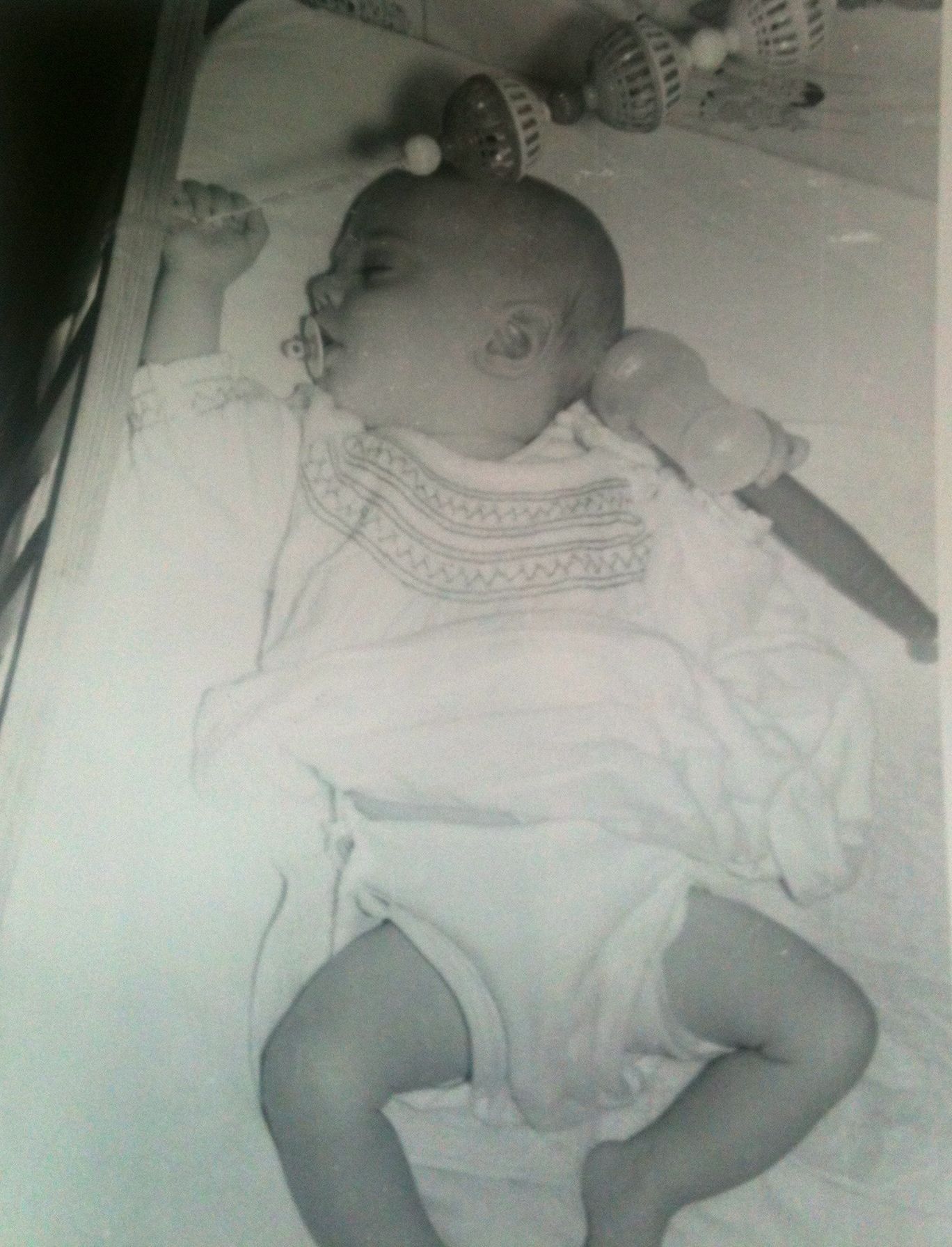
Daniel – unknowable infant

(Part of an on-going series about my estranged son.)

Babby D.So we came home from Mt Sinai Hospital, Daniel and I and the red roses. Blake went off to collect Julia from the babysitting friend’s house and I put the sleeping baby into the baby carriage that served as a bassinet and lay down to rest close beside it. I had missed one-year-old Julia badly and wondered how she would react to this little rival.

In a few minutes, I had my answer. Her father put her down on the bed and I picked up her brother. Her face was suffused with joy. In her excitement, she leapt to her feet, over-balanced on the mattress and crashed to the floor, hitting her head and howling in pain. Blake rescued her and sat down to comfort her. She really was hurt.

Daniel barely flinched at the noise. He slept on. Evidently, this was a different sort of baby, a calm infant, not given to nervous response.

In a few minutes, Julia got over crying and leaned her tear-stained face in to kiss her brother’s round face. The next minute we were all laughing. As far as she was concerned, I had brought home a living, breathing doll for her to play with.

And he happened to be a boy. In those days, there was no way of knowing that before hand. Older women would whisper,”She’s carrying low. Must be a boy.” They had said that throughout my first pregnancy. That worked out! Boys were scarce on the ground in both families. Although Blake’s father had been one of many boys, Blake was the only one carrying the Durant name in his generation. Now there was Daniel Durant. And the only male member of my family was my little brother, Rob. My father was a man who wanted male heirs, hence my sister, Georgia’s name. Blake was pleased as well, although lineage meant little to him.

And me? I was intrigued and a little unnerved. But it didn’t take me long to learn to take evasive action while changing diapers. One face full of pee was enough.

The thing about little Daniel was that he was quiet. At first newborns don’t seem to realize they’ve been born, but even when he got past that sleepy stage, Daniel was quiet. For one thing, he was well-fed. Bottle-fed. Not from choice. Not many mothers breast-fed in those days – 1962. I had been determined to, a year before, but it hadn’t gone well. The head nurse had screamed at my left breast’s in-turned nipple and then screamed at my doctor’s incompetence. My own mother and mother-in-law just shook their heads silently over my outrageously old-fashioned idea. My grandmother seemed to have forgotten the “unpleasant” experience. I had no friend, no group support. And Julia lost weight in the process of a session of nursing and screamed in starved protest. When she was a week old, we boiled up the bottles and began to give her formula. Now, a year later, she climbed on the traitorous mattress, sat beside me and watched me feed her brother his bottle.

She adored him. We all adored him. He was adored.

He had to be Danny because Daniel was too big.

He had big blue eyes and when they began to focus, they sought out his big sister. She was delighted to entertain him and he was delighted to be entertained.

D watches sisterMy idea of heaven was to get them both down for a nap at the same time although, of course, Julia was often busy pulling every pot and pan out of the kitchen cupboard and bashing them about while he slept. I was considered a very liberal mother for permitting this kind of kitchen chaos.

There were two baby cribs in the bigger bedroom and a second high chair standing ready. There was a playpen for containment of joyous energy when necessary.

Mostly we three were alone. Blake taught math in North York, 40 minutes away and returned there two nights a week to teach night school. On Sunday mornings, he went out to tutor an adult student. We were trying to make ends meet. So as I worked I listened to the CBC, especially from noon to 1:30 when books were read aloud. We listened to popular music as I worked or I sang to them. I loved singing and still had a voice. They seemed to like the singing and danced as small children do. Once he got into his high chair, Danny waved his arms and jumped on his seat. Or he bounced in the Jolly Jumper which hung in doorway. Later, Jolly Jumpers like bottle feeding, got a bad rap, but what did we know?

We moved when Danny was six months old. Long story there – adult only apartment building, furious neighbours….. Besides we reasoned, children need a yard. So we rented a house and moved to the Bendale subdivision in Scarborough. It had only 600 square feet, but it also had a finished basement room, with good big windows. Once again, we kept them together in the biggest bedroom, so they could keep each other company. One of the things I have stood charged with as a mother is not providing visual stimulation for these budding visual artists. Apparently, the only wall decoration was a blue thing, that I was able to identify to the adult complainers as a thermometer.

We had had to leave Dr Anchelson behind since I didn’t drive. We had only one car anyway. So I found a new doctor around the corner on Lawrence Ave.

One day, I loaded them both in the buggy and cut through the walkway beside the Catholic Church and School to his office. All morning Daniel had been crying and pulling at his ear. Holding him in my lap, I told Dr. Isaacs that he had an earache. Carefully, he examined Daniel’s ears, first one, then the other. Then he turned to Julia, who was standing beside us, and examined her ears. “This one has the earache,” he said, pointing at her.

In a nutshell, that explains why Daniel, as an infant, was unknowable. He and his sister acted as one organism.

Writing About Daniel

It’s three years and more since Daniel spoke to me privately. That is to say, he speaks to me readily enough when there are others present, at a reception, for example, or a family dinner when his sister Julia visits from California, infrequent though these events are. Then he acts as if things are normal between us. Otherwise, he doesn’t call and has specifically forbidden me to visit him at the shop where he works. At a certain point, he invited me not to update him about the family by email, saying he needed peace. What mother could argue with that? On the other hand, what mother could bear it? So, to make the unbearable bearable, I decided to write about him because that will be a way to open the flow of my dammed up love for him.

As soon as I made that decision, I said to myself, “But I don’t know him.” It’s been a long time now, for one thing, and he has always been an enigmatic character. “Proceed on a path of discovery then,” I sagely advised myself. Begin at the beginning.

The Beginning

Daniel is a second child, born almost to the day, on his sister’s first birthday.  (See Daniel’s Birth Day  https://115journals.com/2014/02/07/daniels-birth-day/ ) Just this week, I learned that this makes him an Irish twin, either a scathing and racist judgement on those who have their children close together or a tribute to the Irish lust for life and vitality. Certainly, my mother-in-law greeted the news that I was “expecting” again negatively. It wasn’t wise in her opinion. But, even though it was 1961, he was planned and not an accident.

His father and I decided as teenagers to take control of our lives, although it entailed the embarrassing process of journeying to the main library branch and signing out the books on birth control that were kept behind the counter. Study and a basal thermometer had done the trick.

(The oral contraceptive, whose imminent arrival had been toasted by madcap pre-med students at a New Year’s Eve party I attended in 1957, was on the market by 1962. I did not share their faith that such a miracle was possible.)

We decided to have our first child when I was in my second year of teaching. I knew I would be required to give up my job, but by then Blake had a teaching job of his own in another city.  Obviously, pregnant women were frowned upon in the classroom then. There were a few married women on staff, but none with children as I recall.

(At the end of Christmas vacation in my first year of teaching, I came into the women’s staff room -yes, segregated staff rooms- and someone asked rather archly, “And what did you do for your holiday, Miss Hood?” I had been the object of pity all fall as I struggled with discipline. “I got married,” I replied. The sharp intake of breath around the entire table was deeply satisfying.)

Once Julia was born, the question was when, not whether, there would be a second. Blake was an only child and I was the one for those “My sister was an only child” people. In other words, I was six when my first sibling was born. Such children are regarded by psychologists as “only” children. Not a good thing, Blake and I had concluded. My reading led me to believe that waiting until Julia was two would make the adjustment harder for her. Age one or three, were easier, I had read. The trouble was that I had been terribly nauseated for the first trimester, nauseated for the second and still able to vomit right to the end. If I didn’t get going, I would lose my nerve.

Was it a wise decision? Probably not. Health-wise, for me, at any rate although Daniel has turned out to be healthy. But it would have been a better idea to give my body a rest, especially since I was actually even more nauseated during the second pregnancy and of course tired from looking after baby Julia and lugging her increasingly heavy self around.

And those were the days of cloth diapers. The diaperman showed up twice a week with 72 diapers, which I had to fold. One of toddler Julia’s favourite games was grabbing the  freshly folded pile and throwing it on the floor. When I heard hysterical laughter from the kids’ room, I knew I had to get there fast.

So it was way too much work and not the kind of work I was good at. Which may have been the reason I had them close together. I was bored by it, so doubling it at least challenged me.

(I know, I know, I’m a terrible person, incapable of settling in and enjoying the  miracle of childhood -its slowness, its playfulness, its repetition. I think that takes more mental health than I have ever had at my disposal.)

The why of it eludes me. Blame it on those selfish genes, wanting to replicate, seeking immortality.

Next time: the unknowable baby Daniel