Deconstructing The Luminaries: #2 the gold trail

panning for gold

Once again this post is for people who have already read Eleanor Catton’s The Luminaries.

See also https://115journals.com/2014/04/05/deconstructing-the-luminaries-a-timeline/

Those who have not yet read the novel, see https://115journals.com/2014/03/27/the-luminaries-eleanor-cattons-booker-prize-winning-novel/

In this post, I will examine what happened to the fortune in gold (£4000 or about $300,000 in today’s money).

pre 1865 – Crosbie Wells discovers gold while prospecting in the highland gold field of Dunstan and stashes it, without smelting it or going through the mandatory registration with a bank; he stashes it in his wife Lydia’s safe in Dunedin

Lydia and Francis Carver steal the gold dust/nuggets and Crosbie’s papers; Lydia sews the gold into the seams of 5 dresses; having established the practise of shipping of trunks of dresses to Melbourne to be fashionably altered in Lauderback’s name, they pack the 5 dresses with the gold in them in a trunk (since Lauderback was having an affair with Lydia, this seems reasonable)

May 12, 1865 – in Dunedin, Francis Carver, using the name Wells, hires Emory Staines to watch the trunk one afternoon (labelled with Lauderback’s name, it is due to be shipped on the Godspeed; at night Crosbie Wells flees for his life and is told about the trunk Carver is shipping in Lauderback’s name and diverts it from the Godspeed to the Titania; seriously wounded by Wells, Carver misses the departure of the Godspeed and does not know the trunk has gone missing;

June 14, 1865 – Carver takes over the Godspeed when it returns to port and sails it to Hokitika

June 18, 1865 – Hokitika – Staines tells Crosbie Wells about guarding a trunk for a man who used the name Wells; using Crosbie Wells’ birth certificate as identification, Carver places an ad in the paper to try to find the trunk;

July 28, 1865 – Hokitika – Anna buys a trunk full of dresses sold by the salvagers of the wreck of the Titania and begins to wear all but the orange one, while plying her new trade as prostitute;

pre Sept – Clinch, Anna’s landlord discovers the gold sewn into the dresses and assumes Anna knows about it; Anna thinks the weight is caused by lead inserts that are meant to hold the skirt down; when Clinch checks the dresses, he mistakes the lead Ah Quee has used to replace the gold for the gold itself and goes on assuming Anna knows about it;

Sept 20, 1865 – Ah Quee who has discovered the gold sewn into Anna’s dresses, removes the last of it while she lies in a drugged stupor; he smelts all the gold and stamps it with the name of the mine he is indentured at, ‘Aurora’; he hands it over  to the mine’s owner Staines: Staines ‘steals’ it, thus not registering the find or paying half of it to his partner Carver or Ah Quee, his stipend; Staines buries the fortune on Maori land;

Oct 11, 1865 – Anna tells Crosbie’s story to Staines; during an altercation with Carver, Anna suffers a blow that leads to the loss of her unborn child; she blames Carver and says it was his child; outraged and knowing the child was Wells’, Staines  asks Crosbie to draw up a deed of gift giving Anna half the buried fortune but passes out from drink before he signs it;

Having learned from Staines about his buried fortune and realizing it is actually his, Wells finds it buried on Maori land and takes it home where he hides it in his kitchen (the gold is now restored to its rightful owner but it is stamped Aurora so cannot be spent;

Jan 14, 1866 – wearing her orange dress Anna visits Staines and later takes opium, passes out on the road and is arrested for attempted suicide; Crosbie Wells dies from an overdose caused when Carver put opium in his drink; Carver finds the gold stash and attempts to burn the unsigned deed of gift; he then sends word to Lydia to come to claim it as Wells’ widow;

Jan 15, 1866 – Anna finds the gold in the orange dress and she and Gascoigne get her bailed out; they remove the gold and hide it under Gascoigne’s bed; Clinch buys Crosbie’s estate; Nillsen discovers the gold in Crosbie’s house; £400 is paid to Nillsen as finder and £30 to Frost, the banker who splurges it all away;

alerted by Balfour’s questions, Frost remember that Crosbie’s hoard was originally stamped Aurora – since resmelted – and tells Mannering that Crosbie had stolen it

Jan 17, 1866 – Clinch pressures Anna to pay him her rent, (he still thinks she has access to the gold in her dresses, but she can’t even get access to the gold under Gascoigne’s bed); as a result Anna falls back into Lydia’s grasp for Lydia has arrived to claim her husband’s fortune;

Feb 18, 1866 – Shepard, the gaol governor has blackmailed Nillsen into loaning him the £400 to get started on building the gaol before Lauderback can be elected and build roads instead; now this has  come out and Shepard publishes the idea that it was a gift from Nillsen;

Mar 20, 1866 – Anna forges Staines signature on the gift of deed that Devlin, the clegryman, has shown her; (he found the unburned document in Crosbie’s stove);

April 27, 1866 – Moody, defense lawyer, proves that Anna is illiterate and could not have forged Staines’ signature; the gold is awarded to Staines, but he ends up paying out half of it to Lydia, now Carver’s widow, as well as legal fees, money to buy Anna out of Mannering’s control, a bonus to Ah Quee and Frost’s £30, but Staines, ever the optimist doesn’t care. He gets nine months hard labour and Anna at the end of it.

Once again please leave a comment so I can correct errors or add omissions.


Deconstructing The Luminaries: a timeline

As the title implies, this post is intended for those who have read Eleanor Catton’s novel The Luminaries as it contains significant spoilers.

If you haven’t read the novel, try this reviewhttps://115journals.com/2014/03/27/the-luminaries-eleanor-cattons-booker-prize-winning-novel/

Feb 1839 – the Sook warehouse in Kwangchow, China is raided, opium is found hidden in tea cartons and the elder Sook is executed; Sook Yongchen turns to Carver for help;

pre 1865 – After winning at the wheel in Lydia’s gambling establishment, Crosbie Wells accepts her hand in marriage instead of the payout money – which Lydia doesn’t have and never thought she would need since the wheel is crooked. Crosbie discovers a fortune in gold in the  highland gold field of Dunstan – £ 4000 (about $300,000 in today’s money)

1853 – Ah Sook arrives at Port Phillip, Australia, is robbed of all his money, tries to contact Carver, is beaten by Jeremy Shepard, takes refuge, is found by a buck-toothed woman -Margaret Shepard, given opium, begins to recover, goes to kill Carver, instead comes upon Jeremy Shepard, Margaret manages to save Sook by killing her husband; Sook is tried but found not guilty when Margaret testifies Jeremy killed himself; Carver is arrested for smuggling and sent to Cuckatoo Island for 10 years, hard labour;

July 1864 – Sook learns the released convict, Carver, has sailed to Victoria, Australia to look for gold

Jan. 18, 1865 – Carver meets Pritchard in Hokitika, NZ and offers to sell him opium, which he smuggles in, in tea cans;

April 27, 1865 – Anna Wetherell and Emery Staines meet briefly on their ship and arrive separately in Dunedin. Lydia Wells takes Anna under her wing. Lydia ascertains that the two, Anna and Staines- share the same birthday

Carver, posing as Frances Wells, starts a long con on Lauderback, threatening Lauderback that someone thinks he- Lauderback- was an associate of a man called Carver who committed a murder and this someone is out to take revenge on Lauderback. As a result, Carver/Francis Wells gets a position on the crew of Lauderback’s Godspeed. Carver and Lydia start shipping dresses to Melbourne, Australia in Lauderback’s name, ostensibly to be fashionably altered. Since Lauderback has been having an affair with Lydia Wells, this is a reasonable ruse.

May 11, 1865 – Crosbie discovers that the fortune he left in the safe at his wife Lydia’s is gone along with his papers and knows she has stolen them;
-May 12, 1865 – Lydia burns the morning paper so that Crosbie will not learn of the arrival of the steamer Active in port along with someone Crosbie has been waiting 12 years to see. This seems to be Lauderback who has previously always come when Crosbie was away. (Lauderback has come to figure out who is shipping in his name);
-a bottle of laudanum arrives and finds its way surreptitiously into Crosbie’s booze at Lydia’s hands;
-Carver, posing as Francis Wells, tells Lauderback he has cuckolded his ‘brother’ Crosbie Wells and forces him to sign over the Godspeed to him;
-Lydia prepares for a party for ‘gentleman with naval connections’ in her home/gambling house ;
-Staines spends the afternoon watching over a trunk labelled with Lauderback’s name, due to sail on the Godspeed, ostensibly for a man named Wells, but actually Carver;
-A Chinese man is looking for an ex-con who did time on Cuckatoo Island, i e, Carver:

-in the evening Crosbie Wells escapes Carver’s attack cutting Carver’s face in a c-shape from eye to mouth, while Anna’ sleeps’ nearby in Crosbie’s bed (the origin of her addiction?);
-Crosbie flees to the docks, discovers Carver’s efforts to ship a trunk to Hokitika in Lauderback’s name, diverts it and takes passage to Hokitika;
-the Godspeed leaves without the wounded Carver, still under Phillip’s command because Carver has not yet claimed ownership.
June 14, 1865 – the Godspeed returns to port in Dunedin and newly scarred Carver takes over as owner/captain and sails to Hokitika

June 18, 1865 – Staines meets Crosbie Wells in Hokitika, tells him about watching the trunk for Carver and the fact Carver is his partner, having stood him £ 8 for supplies; Staines cashes Crosbie’s nugget at the bank for him and is rewarded;
Carver begins his search for Crosbie Wells and for the missing trunk in Hokitika by placing an ad in the name of F. Crosbie Wells;
Anna and Staines are surprised and delighted to meet. (See cosmic twins theory in comments.)

July 28, 1865 – George Shepard (governor of the gaol, the late Jeremy’s brother and now Margaret’s husband) sees Sook Yongsheng; Anna, pregnant with Crosbie’s child and exiled by Lydia, arrives on the Godspeed and is taken under the wing of Clinch, who runs the Gridiron Hotel; she doesn’t know Crosbie is living an hour outside town; she is actually working for Mannering; a trunk full of silk dresses is salvaged from the wreck of the Titania and Anna buys them from the salvagers.
-Staines buys the Gridiron Hotel from Mannering
-Staines tells Anna Crosbie is in Hokitika

Anna begins plying her new trade as a prostitute and taking opium at Sook’s place in Chinatown in Kanniere

Sept 20, 1865 – Ah Quee having discovered the stash of gold in Anna’s dresses while she slept off her opium, removes the last it, except for that in the orange dress, which she never wears while working; (previously -Ah Quee smelts all this gold, stamps it with the name Aurora, Staines’ claim, which was initially salted by Mannering and is actually worthless; Ah Quee expects his boss to bank it and pay him his paltry share: Staines takes it instead and buries it on Maori land)

Oct 11, 1865 – Anna tells Crosbie’s story to Staines; Anna loses her unborn child having suffered a blow, ostensibly from Carver who did hit her, but the serious injury was caused by his horse rearing; she gives the impression Carver was the child’s father and accuses him of killing her child;  Crosbie, at Staines’ instruction, draws up a gift of deed assigning half the fortune in gold to Anna and signs it, but Staines does not, having fallen asleep;
Crosbie (p.673)- digs up the gold bars and stashes them in his home;

Jan 12, 1866 – Lauderback’s shipping container, containing his books, letters and the deed of ‘sale’ of the sailing ship Godspeed to Carver arrives on the Virtue but is misdirected and does not arrive at Balfour’s office;

Tauwhare betrays Crosbie Wells to Carver, telling him where Crosbie lives

Jan 14, 1866 – Wearing her orange dress, Anna goes to Staines’ home for the night; while he is sleeping, she goes back to her room at the Gridiron Hotel to take opium, intending to return to Staines;
-while she is gone Staines wakes up, goes out, falls and hits his head;
-extremely high, Anna falls, hits her head and ends up collapsed on Christchurch Rd: -Carver uncorks a phial of opium (again see cosmic twin theory in comments); Crosbie drinks half a phial of opium on top of a good deal of alcohol;
-after finding the stash of gold bars in Crosbie’s cabin, Carver puts a piece of paper in Crosbie’s stove; next he needs to alert the widow, Lydia to claim it;
-Lauderback arrives from his trek over the alps to find his half-brother, Crosbie dead; -Lauderback finds Anna lying on the road; unconscious Anna is put in jail;
-Staines, also suffering concussion, falls on Gibson Quay and is nailed into a shipping crate;
-eventually Tauwhare reports having seen Lauderback and his 2 men arrive at Crosbie’s cabin on this day, after another man has also visited;

Jan 15/16, 1866 – Annie gets bail, leaves jail and she and Gascoigne remove the gold from the orange dress and hide it under his bed; Crosbie is buried by Devlin; Nillsen discovers the fortune in gold bars  after being hired to clear the dead man’s cabin and gets paid £400;
-Balfour tells Lauderback his container has not yet arrived instead of telling him it is lost; -Lauderback discovers that he ‘sold’ Godspeed to Francis Carver, not Crosbie Wells; previously he had thought that Carver (Francis Wells) was Crosbie’s half brother, extorting Godspeed as retribution for Lauderback’s cuckolding Crosbie; Lauderback knows now that he has been conned by Lydia, Wells’ widow, and Carver.

Jan 17 – Lydia arrives and makes a claim on the fortune at the bank; Frost tells Mannering the fortune was stolen; Mannering and Frost visit Ah Quee to force the truth from him; Balfour visits Lowenthal on the Sabbath;
Clinch buys Crosbie’s property and gives Frost £30 finder’s fee; Lydia arrives in Hokitika and lays claim to the fortune;

Jan 17, 1866 – Pritchard confronts Anna about the opium she took on Jan 14th. her gun goes off and Staines, now an opium addict, hiding behind the drapes is shot (or locked in a crate on board ship, he suffers a bullet wound thus preventing injury to Anna -cosmic twin theory); Gascoigne agrees to bring Anna to meet Lydia, but becomes angry when Anna asks him for help to pay her rent from the gold found in her orange dress and in G’s keeping, so does not; Lydia goes and gets Anna and takes her under her wing again; Staines gets away unseen but gravely wounded;

Jan 27, 1866 – Walter Moody sees a bloody apparition start up at him from a container, saying Magdalena; Moody arrives in Hokitika, but the ship he was on has to remain anchored beyond the reef because of bad weather; Moody meets the 12 worthies in the smoking room of the Crown Hotel and listens to their stories, which are bits and pieces, scrambled and misunderstood of the above events:
-the Godspeed is wrecked;

Feb 18, 1866 – Gascoinge advises Carver how to claim insurance for the wrecked Godspeed;  Lydia holds a seance to summon Staines’s ghost and instead “speaks” in Cantonese Sook’s words vowing revenge on Carver for causing his father’s execution; Ah Sook learns Carver is in Hokitika and forms a plan to kill him; Shepard writes a letter to the newspaper admitting he has used private money to build the new jail and lies that it was a gift from Nillsen; Lauderbank’s trunk is delivered to Moody by mistake and Moody learns Crosbie was Lauderback’s half-brother;

Mar 20, 1866 – Devlin talks to Anna while Lydia is out and shows her the unsigned deed of gift, assigning Anna half the fortune; Anna forges Staines signature despite the fact she is illiterate; Ah Sook buys a gun and has it loaded; Shepard puts out a warrant for Ah Sook’s arrest; Ah Quee is mistaken for Ah Sook and attacked in town: Mannering rescues him; Sook seeks refuge with Margaret Shepard who eventually betrays him; Shepard shoots Sook: Staines turns up and is treated for his wounds and is imprisoned beside Anna who is also back there;

April 27, 1866 – Anna’s trial for attempted suicide, public intoxication and grievous assault on Staines begins -Walter Moody for the defense; during Lauderback’s testimony, Carver is arrested for fraud against Lauderback when Crosbie’s signature on the Godspeed’s bill of sale is proven to be forged; Carver is murdered by Tauwhare while being transported to jail; Staines’ testimony that he was hiding in Anna’s room, high on her opium when he was accidentally shot, clears Anna of the most serious charge; Anna is acquitted of all charges;

Staines, charged with falsification of a report, embezzlement of ore and dereliction of duty, pleads guilty to all charges, is found guilty and sentenced to nine months hard labour.

The luminaries look forward to a loving life together in nine months.

If you find errors or can add detail, please leave a comment. I intend to keep revising as needed.

 

The Luminaries: Eleanor Catton’s Booker Prize winning novel

luminariesThe good thing about Eleanor Catton’s Booker winning novel, The Luminaries is that when I got to the end, I started all over again. The bad thing about it is that when I got to the end, I had to start all over again. Good because it is interesting and multi-layered enough to read again. Bad because I still didn’t get it.

The book’s 832 pages took me 13 days to finish. (Usually a book takes me three days.) I gave up television and cold weather kept me inside, so reading it was pretty much all I did.

Should you read it? It depends.

Reviewers are widely divided. Bill Roorbach in the New Yourk Times (Oct.16/13) waxed lyrical in its praise. nytimes.com Another reviewer refused to review it because he couldn’t get past the first few pages and then, after it won the Booker, did read it and decided life was too short for such books. He notes that Catton has suggested her book does not appeal to men over 45. In his blog, Claude Nougat examined the pros and cons in “Should You Read The Luminaries?” and decided to wait for the price to fall. http://claudenougat.blogspot.ca There are 72 pages of reviews on Amazon, ranging from 1 star to 5. The bad reviews remind me that Rome plowed Carthage with salt so that the city could never recover.

Almost every review mentioned its slow start and the fact it was written in Victorian English, formal and stilted. I nearly wore out the page at the front where the characters are listed. Until I had more or less memorized who was who, the twelve men at the meeting in a back room of a shabby hotel, I couldn’t keep them straight. Even after I had been provided with detailed physical and psychological descriptions, I couldn’t tell them apart easily once they got talking. One reviewer said “Don’t tell. Show.” Something I harped on as a writing teacher, but Catton feels the novel form is ripe for reinvention.

True, I wasn’t immediately hooked, but two readers I respect had thought of giving it to me, so I persisted and soon I was drawn in to it.

First there was the exotic setting – Hokitika on the west coast of southern New Zealand during the gold rush of 1865-66, beginning on January 27th. Yes, that would be summer down under, but it is a dark and stormy night, as almost all reviews point out, so stormy in fact that ships are in more danger than usual at that perennially dangerous port.

Second, there are the three mysteries, which newly arrived Scotsman  Moody stumbles upon when he gate-crashes the private meeting of 12 worthies of the town who have gathered to try to resolve: why did a drunk, Crosbie Wells die with a fortune in gold bars hidden in his shack, why did Anna Wetherell – alias the Whore- try to kill herself with opium and what has happened to the wealthy, likeable and beautiful young man, Emery Staines, who has disappeared without a trace. Oh and what of the gift of deed to Anna of half the fortune, found unburned in the ash tray of Crosbie’s stove.

Other puzzles soon emerge: how has the villian Francis Carver harmed Ah Sook, Crosbie Wells, and Anna, how many illegitimate half brothers does the politician Alistair Lauderback have, who is Mrs Wells actually married to, where is Lauderback’s missing shipping crate, who shipped the trunk with five silk dresses, why is the warden, Shepherd intent on killing Ah Sook and vice versa. Etc. etc.

The ownership of the fortune in gold is particularly tricky. You may need a flow chart. Let’s just say a heap of irony is involved.

And third, why is there a zodiac chart indicating the sign of each of the 12 worthies as well as the position of the Sun, Mars, Jupiter, Saturn, Venus, and Mercury? And who are the luminaries?

One reader I know is studying the astrology first. I’m leaving that until later, but I am grateful she e-mailed me an astrological chart. (Balfour is Sagitarrius, Gascoinge, Capricorn and so on until you get to Pritchard who is Scorpio.)

Other reviewers have verified my conclusion that some mysteries are never entirely cleared up, although I was left with a pretty good guess at the truth.

The book gets better and better as it goes. Part One, “A Sphere Within a Sphere”, set on Jan 27th is 360 pages long and includes a retelling from 12 points of view of the events of Jan 14th; Part 2, “Augeries”, Mar 20, 1866, 159; Part 4, “Paenga-Wha-wha”, April 27, 1865/April 27,1866 , 95 pages long; Part 5, “Weight and Luchre”, May 12, 1865, 40 pages long; part 6, “The Widow and the Weeds”, June 18, 1865, 21 pages;  Part 7, “Domicile”, July 28, 1865, 11 pages; part 8, “Mutable Earth”, Sept. 20, 1865, 4 pages; part 9, “matters of Succession”, Oct 11, 1865 2 1/2; part 11, “Orion Sets When Scorpio Rises”, Dec 3, 1865, 2 pages, part 12,”The Old Moon in the New Moon’s Arms”, Jan 14, 1866, 1 1/2 pages and we finally learn who the luminaries are. In short, the novel moves from slow-paced, DIckensian to brevity, to the episodic and lyrical. It was the speed and loveliness of the end that made me like the luminaries so much that I wanted to stay with them for a second read.

What I propose to do another time is to post a chronological time line. You may not want to read that until you finish the book and maybe, way down the road, I will have a guest talk about the astrology. https://115journals.com/2014/04/05/deconstructing-the-luminaries-a-timeline/

eleanor cattonThe auhor, Eleanor Catton


The Hare With Amber Eyes: Iggy and Edward no

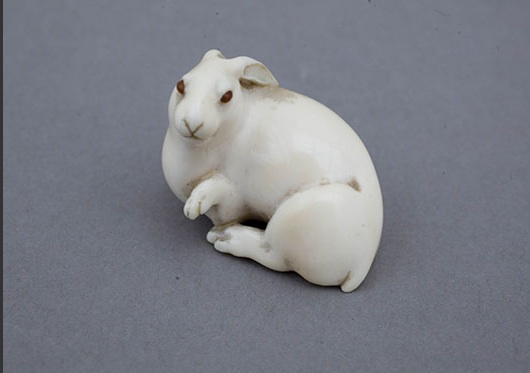
hare finallyAs I consider what to say about parts 3 and 4 of The Hare With Amber Eyes, I remember my daughter, Julia’s christening in early spring 1961. At the reception in our Don Mills apartment, her fraternal grandfather made a casual anti-Semitic joke. My objection was all but drowned out by laughter. What exactly he said, I have mercifully forgotten, but I have the satisfaction of knowing that the genes he handed down to my husband Blake and on to Julia got blended with Warsaw Jewish genes to produce a son, not strictly speaking Jewish since Julia is not, but good enough for Hitler. Even so, I mostly don’t let myself feel anything like the full force of what I could feel about the Holocaust which destroyed all but two members of that middle class Warsaw family. Until I read this part of The Hare With Amber Eyes. Oddly, it is the pillage and loss of beauty, which is irresistibly affecting to me, the netsuke sitting vulnerable in their glass cabinet while the mob breaks in and then the Nazis seize the palace and force Viktor to sign it over.

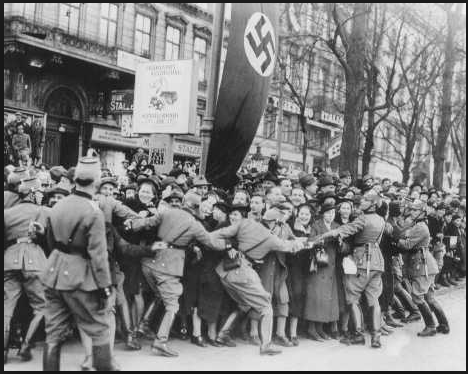
after anchluss palaisThis photograph was taken after the Anschluss. I imagine this crowd is waiting for a celebratory parade.

Unlike his children, Viktor does not have the instinct to flee. By the time, it is necessary, he has great difficulty doing so. It is true that none of the immediate family is deported to a camp, although one does not survive. On balance, the Ephrussis of Vienna, like my grandson’s Warsaw family, could be seen as lucky. Strange luck to survive in the face of such grief, of so much loss. The great advantage the Ephrussis have is Elizabeth, the lawyer and the author’s grandmother. Thus Viktor finds himself sitting by the kitchen stove in Tunbridge Wells, reading news of the war and Ovid’s poems of exile, while Elizabeth learns to cook. In December 1945, she goes back to the Palais Ephrussi, no longer a Nazi headquarters but an American one. Almost nothing is left, except Anna and, amazingly, the netsuke.

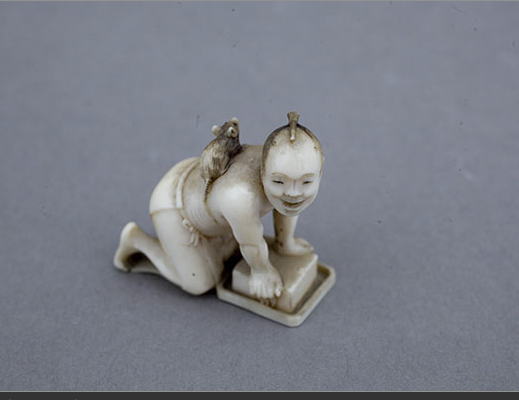
Then the story switches setting. Iggy, former fashion designer, and American Intelligence officer, returns to England from a year trading grain in the Congo and receives the collection from Elizabeth. It is as if the netsuke settle what he should do next. He takes the collection with him when he moves to war-torn Tokyo. Ironically, he will work as a banker there. “Iggy had a small attache case filled with ivory monks, craftsmen and beggars, but he knew nothing about the country.”

netsuke floor cleanerAbove, a floor cleaner has a surprise.

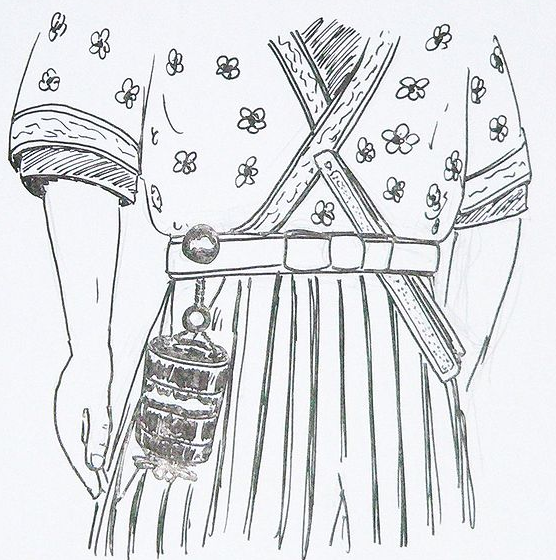
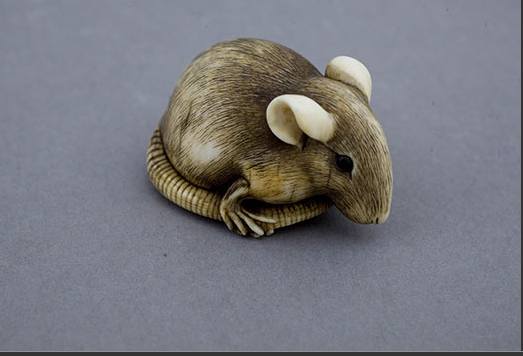
netsuke as wornThe netsuke is the bauble that is on the belt and attached by string to the purse or pocket below. It seems to be a rat pattern in this case.

Edmund De Waal gets to know his uncle when he goes to Japan as a teenager to study ceramics. By that time, Iggie has added Japanese to his German, Russian and English. He lives in a home with fewer objects, but nevertheless rare, Japanese antiques. He is successful and shares his life with a male friend, Jiro, some years younger. So there is beauty there and happiness, but this part feels elegaic. After Iggie’s death, De Waal stays with Jiro when he visits Japan.

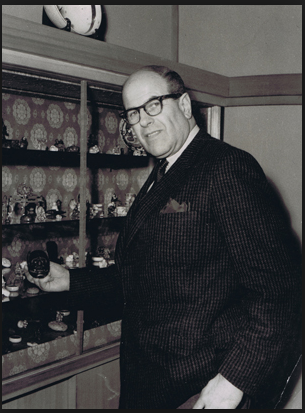
iggy with netsukeFinally, the author goes to Odessa where he joins his younger brother and they discover clues of the Ephrussi brothers presence there before 1870, not only in stories but also in a school and an orphanage they founded.

The netsuke are in London now in a vitrine where they can be taken out and played with by children.

netsuke rat

The Hare With Amber Eyes: Viktor and Emmy Ephrussi

ringstrasse above(The second in a series of posts about Edmund de Waal’s book The Hare With Amber Eyes)

In 1899 the collection of 264 netsuke (net-ski), tiny Japanese carvings, arrived along with their black lacquered vitrine at the Ringstrasse in VIenna, a gift from Charles Ephrussi to his cousin Viktor on the occasion of his wedding to Emmy. They were uncrated at the Palais Ephrussi and began life anew in Emmy’s dressing room.

palais ephrussi colourThey were destined to live in the Palais Ephrussi (above) for the next 48 years, although the Ephrussis did not.

The palace was built soon after the street itself, the Ringstrasse, in 1865, a boulevard made for imperial parades and stood near other magnificent homes of wealthy Jewish families – the Libens, Todescos, Wertheims, Gutmanns, Epsteins. By 1899, Freud had his office around the corner. The 145,000 Jews in Vienna had had civic equality since 1867, including the right to teach and own property. The Ephrussis, like many others, were secular Jews and did not attend synagogue. They were Viennese, citizens of the Austro-Hungarian Empire and loyal to the Emperor Franz Joseph, who had granted them their rights.

Baron Ignace von EphrussiThe great house was built by Ignace Ephrussi, who arrived in Vienna from Odessa in 1865 when his son Viktor was 3 years old. Eventually, Ignace was ennobled by the Emperor and became Baron von Ephrussi.

De Waal, the author and present owner of the netsuke is a renowned potter of simple modern forms and his reaction to the palace, now Casino Austria, is much like my own would be. He notes the gold trim on the exterior, the many half-clad Grecian maidens in the niches. He feels smothered by the smoothness of the omni-present marble, as if he can not get a purchase anywhere – on the shallow wide steps of staircases, on the slick floors.

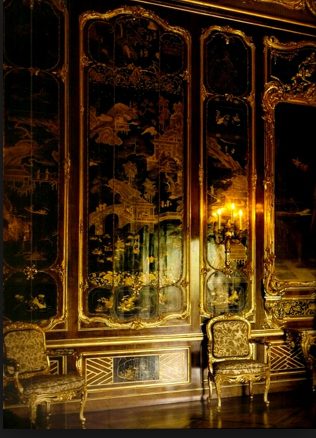
panneled wall palaisThe “implacably marble” interior was lavished with tapestry and ceiling murals.

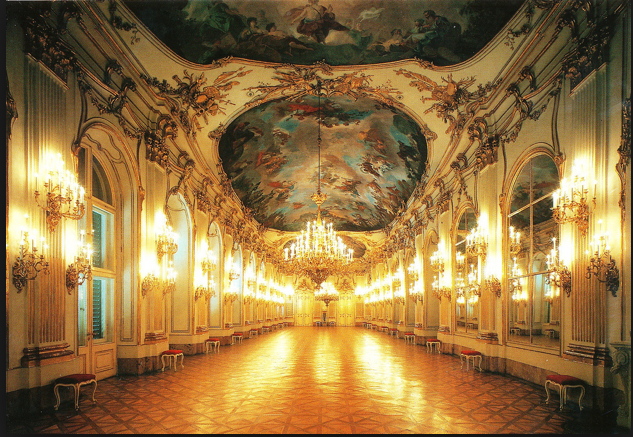
ballroom palais ephrussiMost of the paintings told classical stories, except oddly, the one on the ceiling of the ballroom, the only room that the Viennese, as opposed to Jews, would see. It told the story of Esther. De Waal says, “It is a long-lasting covert way of staking a claim for who you are.”

Viktor, like Charles in the Paris branch of the family was the spare son, so he too was spared bank training. Viktor preferred reading history and sitting in cafes with his friends – until, alas, his older brother Stefan, eloped with his father’s mistress and was disinherited. Suddenly the unprepared Viktor found himself working in the Bank Ephrussi, untrained, and, as it turned out, without a banker’s instincts.

Ignace died only 10 weeks after Viktor and Emmy’s wedding. They kept their apartment on the second floor, the Nobelstock, which Emmy had initially announced “looked like the foyer of the opera”. De Waal takes us into the palace where Ignace had had a a private staircase only he could use, servants’ rooms on a “secret” floor, one with no windows, tunnels to neigbouring houses, ways for naughty children to access the roof, and the glass-covered court yard where the carriages and horses and later the automobiles stood ready beside a statue of Apollo..

It was not a “cozy” place in the way that Charles’s home, opulent as it was, might have seemed. The netsuke vitrine evidently did not suit it except in the smaller more intimate surroundings of Emmy’s dressing room. Here her children gathered pre-dinner to watch her maid Anna dress her for dinner. Here Elizabeth, Iggy and Gisella were allowed to open the glass case and take the netsuke out to play with them.

But of course there was something secret and malignant, the worm in the rose, gnawing away beneath the surface beauty. Marble halls were not proof against it.

Even in Paris Charles was subject to anti-semiticism. Renoir turns against his patron when Charles buys paintings by Gustav Moreau.”It is ‘Jew art’ Renoir writes, galled to find his patron, the editor of the Gazette, with this gout Rothschild stuff on the walls..” Not only is Jewish artistic taste criticized, as bankers Jews are held to be exploitative and responsible for every economic setback. De Waal forces himself to read the newspapers, pamphets and books that target the Ephrussi family with hatred, and parody them as individuals, not only Charles, but others like Maurice, who has married Beatrice Rothschild. The Dreyfus scandal, in which the Jewish officer Alfred Dreyfus was accused of treason, effectively divided the nation into two parts, Semites with their few supporters and anti-semites. It was almost 10 years before he was exonerated and released from Devil’s Island.

But, if the French, in that era, were capable of anti-Semiticism, the German speakers had a positive gift for it. Elizabeth and Iggy, for example, found themselves shut out of a guest hut at the end of a long day’s mountain hike because they were Jews.

Franz Joseph knew a good thing when he saw it and courted the newly arrived Jews who brought wealth with them and soon made more. Viktor regarded himself as a loyal Austrian and, consequently did not follow the advice of his friends who spirited their money off to Switzerland when war was in the offing. In fact, he sunk his wealth into Austrian bonds. Just how reckless this was beame clear to me when I read Margaret MacMillan’s The War That Ended Peace. Austria-Hungary was a pasted together country, a collection of territory assembled by the Hapsbergs. Its soldiers spoke so many languages that units were divided accordingly and orders were sometimes issued in English. There were two parliaments and the Hungarian one erupted physical violence at one point. The heir to the throne was Franz Ferdinand, however, who had a sensible attitude that going to war was not a good idea. Then he and his wife were assassinated, the ostensible cause of the war’s outbreak.

By the end of the Great War in1918, Viktor’s branch of the Bank Ephrussi had to be bailed out. He still had the palais and personal money, but he had lost his fabulous wealth. And like every other family in Austria, his was almost starving because of food shortages. Emmy had just given birth to a fourth child, Rudolf, the Spanish flu was raging across Europe and it seemed as if mother and child might not survive.

They did survive as did their home, although there were half as many servants. Gradually, things improve. Elizabeth earns a doctor of law degree, marries and leaves the country. Iggie studies finance in Cologne. He is the only male Ephrussi in both branches of the family, but in 1933 wisely runs to Paris, giving banking up for a life in fashion eventually in New York City.

In 1938, there is the Anschluss. But this is part of the next section of the book, part 3, “Vienna, Kövecses, Tunbridge Wells, Vienna 1938-1947”.

To e-read or not to e-read: again

It was the First World War that made me realize the limitations of present day e-readers. I had loaded Margaret MacMillan’s The War That Ended Peace onto my Kindle before I went to Brussels for Christmas. Just the place to read about the causes of that war, I thought. Of course, the season and my brother’s open house policy prevented such serious reading. I was lucky to sneak in two John Grishams. The Michael Connelly, the Lee Child and the Margaret MacMillan had to wait until my return. I got through the first two of those fast enough and once I had read the new Ian Rankin and Louise Penny, I started some serious reading about the early twentieth century.

Immediately I knew I was in trouble.I had to read much more slowly. There was a large cast of characters, which I couldn’t keep track of. Who exactly was the “doomed Fredrich Wilhelm”? I knew MacMillan had told me already, butI couldn’t just look in the index without losing my place – at least not on my aging Kindle. I couldn’t flip back until the name jumped out at me. Finally, I went on-line and found out he was the father of Kaiser Wilhelm II who died less than a year after ascending the throne. Bad luck since he was liberal and pro-British unlike his Prussian-loving son. Fredrich was just the first of many puzzles. Plus the pictures were weird. Their descriptions turned up on the next page and I had to keep flipping back and forth, counting group photos, for example, to see which was Edward IV and which Tzar Nicholas. Turned out being cousins, they were all but identical. And the maps made me crazy.

So after yet another doctor appointment, I rewarded myself by stopping at one of our few remaining bookstores, a giant outfit called Chapters/Indigo, I forked over almost $40 for a hard copy, hard-covered and complete with dust cover. (The e-copy had cost about $15.) As I waited to pay for it, I chatted with the woman behind me and we agreed -you can’t read a serious book on an e-reader.

I try to indicate in my book reviews whether I read the book on my Kindle. I see that I have done that for a Lee Child novel, a Jo Nesbo, and a Ruth Rendall. Even so, I remember realizing that I had loaned the other Jo Nesbo books to a friend when I wrote the post on  The Police. I was thrown back on the internet for forgotten details. When I wrote about Kate Atkinson’s books, I actually went out and bought a hard copy of Behind the Scenes at the Museum when the on-line search didn’t work. Besides I couldn’t do without that book on my shelf.

What about the argument that a real reader wants to have a real book in hand for its sheer tactility. Well sure, but is that practical at a certain point? I am no longer a book collector. Once I had several thousand books, which required their own room and left barely enough space for a table and chair. It was twenty years ago, but I was able to hop on that earlier real estate meltdown and lose my house. The solution was to move in with my sister Georgia and while I would have a den of my own, I would have to downsize my library. I made several trips to a second hand book dealer. I didn’t get paid. In fact I would have paid him to find new homes for my beloveds. After that, I weeded as I went. Each book had to pass a stringent test in order to stick around: was I likely to use it as a reference or to want to reread it. Otherwise, it was off to a charity book sale. True, every so often, I discover I have exiled a book that I desperately need RIGHT NOW.

The Kindle is good for urgent book needs. You want a book and as often as not, you can download it in a few minutes. John Le Carré books were the exception last time I looked. Another great advantage of the e-reader is that it saves on luggage. Years ago when we travelled in Europe for the summer, our cases were so heavy with books that we spent a lot of time in laundromats. This year, I kept under the one bag, 23 kilo rule by taking my Kindle.

And e-readers are getting better. Georgia’s iPad is easier to read than my old e-reader, brighter, whiter, more like paper. Previously, she needed a little attachable lamp to read her old e-reader in the dark.

No doubt, it will soon be possible to search a downloaded e-book the way you can now search a document for a name. Perhaps it is already and I just don’t know it. What would be most helpful is a meaningful way of keeping track of page numbers. Knowing that I am at 85% or locations 1975-82 of Christopher Hitchen’s Thomas Jefferson, doesn’t work for me.

Pending these improvements, I will buy hard copies of difficult books.

Just One Evil Act: Elizabeth George’s latest

I searched in vain for newspaper reviews of Elizabeth George’s most recent novel, Just One Evil Act. There are plenty of reviews by readers on Goodreads, but the New York Times, the L.A. Times, the Toronto Star and the Globe and Mail not so much. And readers were less than kind.

Their main beef was the novel’s length – 719 pages, but they also go on at length about beloved characters, Lynley and Barbara Havers, acting uncharacteristically. Many of them recommended better editing, particularly with regard to the “excessive” detail of the Italian setting where the major crimes occur. In short, they felt the same irritation I did as I read it.

I began with gratitude. There was another Lynley mystery to occupy my imagination during a particularly cold and wintry season and I got it from my sister for Christmas. So thank you, Elizabeth George and Georgia, the latter of whom confessed that she had actually ready my copy, but she is such a tidy reader I couldn’t tell.

Now, it’s true that, of late, both Georgia and I have complained that George’s books are getting too long. It seems as if she actually enjoys -how to say this politely?- fooling with the reader’s brain. As she is reported to have said, she doesn’t take the reader’s feelings into account. She is capable  of killing off a beloved character even while said character is pregnant. She can then go on to devote her next book to a sympathetic examination of the murderer and then drag us through the husband’s resulting breakdown. Clearly, we do not own the characters. She does and as their creator, she is capable of dispassionate distance.

What are we to make of the fact that Inspector Thomas Lynley, 8th Earl of Asherton, opens the novel, as part of a shouting crowd of 200 in Brompton Hall, he and his man Denton, cheering on Kickarse Electra, one of Bristol’s Boedicia Broads, a roller derby team? Totally out of character, a chorus of reviewing readers say. Not so fast, say I. People fall in love unpredictably. Frankly, I can’t even remember Daidre Trahair, large animal vet and, evidently, the owner of a seaside cottage that Lynley broke into in the previous novel. Lynley can, and is willing to pass Denton off as a pal so as not to intimidate Daidre. Daidre who is tall, athletic and given to plain-speaking as well as roller-skating violence, is the antithesis of the well-bred, beautifully turned-out, shopaholic, Helen, Lynley’s late wife.

Which brings to mind Barbara Havers, Lynley’s partner in crime solving. Never well turned-out, given to wearing t-shirts with printed slogans such as “No Toads Need to Pucker Up’ and red, high-topped training shoes with white socks, Barbara lives in Chalk Farm. a district in London, in a converted carriage house behind an Edwardian Villa done into flats. In the first floor flat lives Taymullah Azar, a microbiologist, whom Barbara has loved from a distance for many years and many George novels. That love has been sublimated into his daughter, Haddiyah, now 9 years-old, who has been kidnapped by her mother, Angelina. Initially, Barbara is determined to find the child and return her to Azar, even though Azar was not married to Angelina, was not named as her father on her birth certificate and has no legal claim to her. To do this, Barbara enlists the help of a shady private detective, Dwayne Doughty and his side-kick, Em Cass.

At a certain point, Azar tells Barbara that Doughty has hit a dead end and that seems to be that. Suddenly, Angelina arrives back at the flat, a passionate Italian lover in tow, demanding that Azar return their daughter – who has been kidnapped in the Italian town of Lucca. Time for key characters to fly there, including Lynley, who falls victim to Barbara’s machinations and is assigned as a liaison officer. These machinations involve a tabloid reporter, Bryan Smythe, to whom Barbara feeds the story.

Is it believable that Barbara, who is a good detective but obviously a bit of a loose canon, would go so completely off the rails? The implication by several other characters is that she does it out of her love for Azar. I find it easier to believe initially that it was more out of concern for the child, but as things progress, it is harder to rationalize that. Whatever the motivation, the thing that bothered me was her profound stupidity. Reporters can’t be managed. Blatant disregard of police protocol is bound to come back to bite badly. Still, it is clear that she has weighed the loss of her career against the happiness of Haddiyah and her father and decided to risk all.

The initial kidnapping mystery is resolved in the first half of the book. More or less. This is thanks to a lovely new character, Chief Inspector Salvatore Lo Bianco, of the Lucca police department. Salvatore is separated from his wife and daughters and back living in a tower with his mother, where he escapes to the roof at sunset. His superior, Piero Fanucci, il Pubblico Ministero is stupid and corrupt and removes Salvatore, from the kidnapping case as soon as possible. But Salvatore is one of those detectives that doesn’t let a little thing like an official order stop him.

A second mystery develops in the latter half of the book while the details of the kidnapping are being wrapped up. By then, Lynley has returned to London, but Barbara jets off without authorization, the sleazy reporter in tow. While Lynley was fluent in Italian, having spent time there in his youth, Barbara is not and her interactions with Salvatore are puzzling to both of them. Irritating or amusing depending on your point of view. I was more amused and, for the most part, I enjoyed the local colour, detailed descriptions of the walled city of Lucca and the farm where Haddiyah and her mother live. I did get sick of the constant comments about Barbara’s lack of professionalism. Okay, I get it and now she’s doing something even worse. I can see that. You don’t have to tell me. Yet, she is instrumental in solving the second mystery, handicapped by language and attitude though she is.

The end of the book is a real surprise and has lead some to question its feasibility, but it’s just weird enough to appeal to me.

I hope that Barbara and I have seen the last of Taymullah Azar, frankly. I’m not sure how much more of Daidre I want to see either, although I reserve judgement there. I do know that, like most reader/reviewers I want to see Barbara and Lynley working as a team again and I would like more than the glimpse of Simon St James and his wife Deborah.

Doesn’t matter. Elizabeth George is not about to write to order. Given her ability to create well-rounded characters like Salvatore and genuinely mysterious plots, I will probably forget how she annoys me and buy the next book hot off the press.

How the Light Gets In: Louise Penny’s latest

At the beginning of her new novel, Louise Penny thanks Leonard Cohen for generously allowing her to use a line from his song “Anthem”. Cohen tells us in that song that “There is a crack in everything/ That’s how the light gets in.” I have read all nine of Penny’s novels, so, presumably, I must have enjoyed them. And those lines by Cohen struck me from the first time I heard them as a neat summation of how good comes out of bad. Why, then, do I dislike their use as the title of her ninth and latest Armand Gomache mystery, How the Light Gets In?

Reviews, including one in the New York Times ranged from very positive to rhapsodic. Fans told of staying up half the night, of being totally emotionally engaged, of how they had waited breathlessly since the dire conclusion of book 8, The Beautiful Mystery for the resolution of this book. My goodness, I thought, and here I’ve been sleeping soundly oblivious to Gomache’s terrible suffering. I was so cold-hearted that I plodded through the book in my usual three days, closing it up at my regular bedtime.

How the Light Gets In, unlike The Beautiful Mystery, is set once again in the village of Three Pines, a place that cannot be found on any map, hidden and sheltered by wooded mountains where cell phone towers and internet connections cannot penetrate. And, despite its high body count over the years, an idyllic place with its village green, its outdoor rink, its used bookstore, its gourmet bistro with two fireplaces and its eccentric but helpful villagers. When he isn’t solving the latest murder there, Gomache retreats to it for solace, something he greatly needs now that his department in Quebec’s Sureté has been dismantled, his reputation is in decline and his good friend Jean-Guy Beauvoir is a drug addict.

Three Pines is south-east of Montreal in Quebec’s Eastern Townships.  I am familiar with this area. More or less. I recently made a sentimental journey back there to my birthplace. (See https://115journals.com/2013/09/11/septuagenarians-on-the-road-3/) While I was there, I stayed at Auberge Ayres Cliff (https://115journals.com/2013/09/14/septuagenarians-on-the-road-5/ ),an excellent hotel, every bit as cozy as the one in Three Pines, although much more on the beaten path.

When it comes to the willing suspension of disbelief, I’m a hard case. I spent my first five years freezing and starving in the hills of the Eastern Townships, albeit in a place that couldn’t be found except by those who had been there. True we were on a hill farm which produced a bumper crop of stones every year. Over the hill and down the valley, there was rich land with fat herds of dairy cows. Presumably, the hilltop soil had been scraped off our high land and deposited there. One of those farmers held the mortgage on our place. In the end, it seemed better to move to town.

But okay, I’ll go along with this Brigadoon-like village. I’d even like to sit by one of those two fire places drinking hot chocolate and eating hot buttered croissants. (No wait I’m gluten intolerant.)

Something I won’t dispute is fear of the Champlain Bridge. Too long, too high, too confusing with those changeable lane markings and too prone to traffic jams. In the opening chapter, a woman driving across that bridge comes undone. Some time later, her body is discovered dashed against the rocks beneath. It used to be the bridge that took you from Montreal across the wide St. Lawrence to Auto Route 20 and so into Les Cantons Est. Imagine my delight when I discovered this past summer that a new bridge allowed me to cross the river without going near Montreal.

Another thing I won’t dispute is the corrupt reputation of Quebec’s construction industry and its bureaucrats or some of them at least. Whether it is believable that they could be quite so dastardly or that the dastardliness could reach quite so high is a stretch. (Whoops – I seem to have lifted “dastardly” from Marilyn Stasio’s New York Times review.)

Nevertheless, the mystery of why a 77 year-old visitor to Three Pines is murdered on her return home to Montreal is intriguing. What does her murder have to do with her siblings? And, of course, there is the ongoing question of whether Gomache is going down to defeat as some terrible act of terrorism befalls La Belle Province.

Why do I resent Penny’s appropriation of Leonard Cohen’s line? I think it’s because Cohen’s idea belongs to the real world, which, let’s face it, is fraught with suffering and hard-earned insight. Penny’s world, on the other hand, is a fantasy, an imagined place of cozy friendship and monstrous villainy. It is the dissonance that bothers me.

Jack Reacher Reaches Virginia: Never Go Back

Last year I posed the burning question -Will Jack Reacher ever get to Virginia? https://115journals.com/2012/11/04/jack-reacher-will-lee-child-let-him-get-to-virginia/ I can now answer that question. Yes.

It’s true that three of Lee Child’s Reacher novels – 61 Hours, Worth Dying For and A Wanted Man, describing his circuitous journey through South Dakota, Nebraska and Kansas, actually took only a matter of days Reacher time, but  it took several years in publishing time and, despite the thrills, seemed endless. In Never Go Back, he actually arrives there.

The novel begins: “Eventually they put Reacher in a car and drove him to a motel a mile away where the night clerk gave him a room, which had all the features Reacher expected, because he had seen such rooms a thousand times before.” The shower would be strangled, the towels thin, the television small and old. In short, he lives in such rooms. As faithful readers know he is in constant motion, travelling by bus and hitched rides across the United States. Earlier I called him a wandering Taoist, unattached to any notion of home. https://115journals.com/2012/06/08/jack-reacher-wandering-taoist/

Shortly after, he is dumped at the cheap motel, a plain dark sedan pulls up and two heavies attempt to persuade him to leave town. “They couldn’t find you before. They won’t find you now. The army doesn’t use skip tracers. And no skip tracer could find you anyway. Not the way you seem to live.” Now here’s a quandary. The guys in the first car have ordered him to stay. But of course, Reacher isn’t about to follow orders any more. He does follow his own rules one of which is “Get your retaliation in first” and soon there are dents to prove it. Such is his welcome to Virginia.

Why was he so intent on getting there? He was following the siren call of a woman’s voice. Not just any woman’s voice, but the competent, risk-taking woman’s voice that has helped him in his travels from South Dakota. His goal is the HQ of 110th MP Special Unit in Rock Creek, a place he knows well since he was its first commanding officer before he quit on principle in 1997, just short of being laterally transferred to the end of the earth. He announces that he is there to see the current CO, Susan Turner and sets the wheels in motion the mayhem that follows.

Turns out that Reacher is still a wanted man: he is wanted for the murder of a gunrunner in Los Angeles 15 years ago and for skipping out on a pregnant lover in Korea, who is now living in a car with her daughter and wants support. Fortunately, the litigant has the wisdom to be living in a car in L.A.

As for Susan Turner, she has vanished from sight and when Reacher tracks her down in a detention facility almost as secret as Gauntanamo, she has left word she doesn’t want to see him. That only encourages him of course.

Turns out her charges are even more serious.

Reacher doesn’t get a glimpse of Susan Turner until a quarter of the way through the book. “She was an inch or two above medium height. She was small-boned and slender, with dark hair pulled back, and tanned skin and deep brown eyes.” He concludes she was well worth the trip. Furthermore she can take care of herself.

It is not brawn but ingenuity that enables them to go on the lam with no papers of their own and a “borrowed” $30. They head for Los Angeles in an attempt to sort out Reacher’s problems before they tackle Turner’s. As they sort his out, they speculate about why they are being targeted and who has the power to pull such strings.

One of the delights of the story is the “daughter”, a 15 year-old who seems as if she should be Reacher’s child. She already has powers of observation well beyond the FBI agents, the Army MPs and the heavies who follow in Reacher’s wake.

The good news is that Reacher’s face doesn’t take on any more damage, but it’s not news at all that he ends up waiting for a bus.

(I read this book on my KIndle.)

Is this the End of Harry Hole#2: Police by Jo Nesbo

Spoilers for earlier Nesbo books and dark hints for Police.

Some months ago, I finished Jo Nesbo’s novel The Phantom in a panic and querried whether that was the end of Harry Hole (pronounced hooleh).  (See Is This the End of Harry Hole https://115journals.com/2013/03/27/jo-nesbos-the-phantom-is-this-the-end-of-harry-hole/  The appearance of a new book Police seemed to argue against it, but I got well into the new book -32% into it, my Kindle said- and Harry was still missing. It’s true there was a closely guarded coma patient in an otherwise empty locked ward in Oslo. That could be Harry, I thought. Last we knew, Harry’s “step-son” Oleg Fauke had gunned him down with a Russian Odessa – a copy of the better-known Stechkin – in a drug squat.

The first few pages of Police is told from that gun’s point of view, tracing its journey from Siberia to Norway in the hands of Rudolf Asayev and finally to Rakel Fauke’s house where it is now “sleeping” in a corner cupboard, smelling of old wood, powder residue and gun oil. Nesbo helpfully reminds us that two of its five bullets killed Gusto Hanssen who had pocketed Asayev’s money and dope, and that its next three bullets hit Harry Hole. Hitchcock said that if a gun is carried onto the stage in act one, it will sooner or later be an important plot device. There are 12 bullets left in the magazine.

As to the sleeping man in a hospital bed in a locked ward, a number of people hope never to see him again, including Mikael Bellman, the bent police chief, Harry’s nemesis.

After the glimpse of the hidden Odessa, Nesbo gives us a lovely picture of September in Norway and brings Erland Vennesla, a jogger and recently retired detective onto the scene. Poor Erland soon becomes the first victim in a series of carefully executed murders of police, mostly at the site of an unsolved murder that the victim investigated. As the bodies of police begin to pile up, Harry’s old boss Gunnar Hagen, head of Crime Squad, assembles a secret inside team consisting of Harry’s helpers: Katrine Bratt, the Bergen detective who spent time in a mental hospital, Beate Lonne, the head of Krimteknisk, who literally cannot forget a face, Stale Aune, Harry’s psychotherapist, and Rasta Hat, Bjorn Holm. Meeting in the Boiler Room as of old – so far beneath police headquarters that it’s almost in the prison next door- they bemoan the fact that Harry is totally unavailable. He was Norway’s only expert on serial murderers.

Long-standing bad guys are still on the scene, including Bellman, his lover Isabel Skoyen, a prominent city councilor, and Truls Bernsten, his erstwhile sidekick, temporarily suspended from the police department but still able to act the part of ‘burner’, destroyer of evidence. Bellman, of course, forbids Gunnar Hagen to split the investigation of the police murders between the regular police department and the four in the Boiler Room.

But who is the lecturer at the police college, the expert who has enthralled an attractive student, Silje Gravseng? And why are mysterious visitors waiting for him in his office? So his red-bearded colleague, Arnold, informs him? Surely this well-spoken, well-groomed person cannot be …..

As usual in Nesbo’s books, the murders are bizarre even grotesque, and in this case, duplications of old unsolved murders. And as usual Harry and his group leap to wrong conclusions. More than once. Harry is passionate about justice and committed to finding the bad guy, but bright? Not so much.

The trouble with Jo Nesbo as a writer is that he is capable of cold bloodedly killing off even the most beloved characters. He had Ellen Gjelten, Harry’s partner beaten to death just when she was about to tell Harry who the ‘Prince’ was. As a result, Oleg got kidnapped by the villain and narrowly escaped death, not for the last time. Then in the next book, Halvorsen, Harry’s new partner and father of Beate’s son, got gunned down. Moreover, Nesbo has said that Cockroaches due to be released soon is the last Harry Hole novel. (It is actually the second book after The Bat and before The Redbreast, translated only now.)

As the novel reaches its climax, Rakel and Oleg are menaced once again and surely this time, Harry cannot save them. Or himself.

Thus, this reader arrived near the end of the book at a solemn church service where the Boiler Room crew and the surviving cast members have assembled. Bellman is impatient for the organ to announce the ceremony. How inappropriate!

I may never forgive Nesbo for his tricky ways.