How I Developed ‘Low Tastes’ in Reading

For many years I was a reading snob. Certain kinds of books were just beneath my notice. What can I say? I couldn’t help it. I majored in English literature.

Initially, I just read everything I could get my hands on adventure, romance, historical fiction. As a teenager, I worked as a ‘page” in a library, ‘carding’ returned books and shelving them. (In those days, you could actually tell who had borrowed that book before you by their signatures on the card in the pocket inside the cover.) I carted home huge piles of books, the maximum allowable. I read all the 19th century British novels I could find and then 20th century Americans. I would choose an author like Bernard Shaw and just strip-mine his work and then I would move on to biographies about him. Clearly, there was either no television in those days or there was nothing good on.

Eventually, I was too busy balancing motherhood and teaching to read that much and anyway television got better. I still bought the latest work by Margaret Atwood or Margaret Lawrence or Robertson Davies and Alice Munroe. I was a great Can Lit supporter. (That’s Canadian Literature to the rest of the world.) Atwood had written a book called Survival in which she said that the central theme in all Canadian novels was survival. She could be right, I thought, and I was getting tired of that grimness. Anyway reading had become more of a special event than an obsession, mostly carried out in the half hour before I put my head down to sleep.

The ‘best’ novels began to pall, mainly because I was teaching them. Over and over and over. I knew 1984 and Tess of the D’Urbervilles and Lord of the Flies and Catcher in the Rye by heart. Reading David Copperfield or Jane Eyre or even beloved Wuthering Heights began to have as much appeal for me as water boarding. And so I took my first step down that slippery slope. I started reading fantasy.

I blame J.R.R. Tolkein. One summer when I commuted to a job marking exam papers, an exercise in brain torture if ever there was one, I buried myself in The Fellowship of the Ring before the train left the station and stayed mercifully oblivious until I got off. The really wonderful thing about this book was that it was the first book in a trilogy. Besides the best reviewers approved of Tolkein and his buddy, C.S. Lewis’s Space Trilogy, beginning with Out of the Silent Planet and the Narnia books.

Having given myself permission to read fantasy, I carried on. I read all the books by Carlos Castaneda who vowed that his teachings of don Juan were strictly factual. I entertained the idea that with the requisite spiritual training, I too could fly across canyons. It was a close as a person of my generation got to L.S.D. Eventually, I took up Ursula K. Le Guin who wrote several series and inevitably Harry Potter. I am tempted to blame that on grandchildren, but it wouldn’t be true. Then J.K. Rowland stopped writing.

For a time, I belonged to a book club, five women who met at each others’ houses once a month and talked about a given book. We read The Kiterunner and Saturday, Reading Lolita in Tehran and Ravelstein. We read Booker prize winners, spare, mannered tomes like On Chesil Beach, The Gathering and Banville’s The Sea.  Several members revolted and in response we read In the Company of a Courtesan. In the end, I didn’t want to have my reading assigned to me and I didn’t want to have to go back over the book to find points for discussion. Most of all, I hated the discussion questions that some books now included at the back. True I had taught English but I couldn’t come up with the first thing to say in response to such questions as “Does old age always harden beliefs?”

One day a friend told me she was reading a mystery set in Italy by Donna Leon. This friend was a notorious snob about reading, so I took this as permission granted. I had been reading reviews of mysteries for years, so I knew where to start: P.D. James, Ruth Rendall and Elizabeth George, so called cozy mysteries, set in England, a substantial body of work separately and several years of reading altogether. Then I moved on to Henning Mankell’s Swedish Detective Wallender and Ian Rankin’s Scots Detective Rebus. They were both heavy drinkers, divorced, the father of daughters and singularly morose. Must be the North  Sea influence. It turned out that there were other Swedish detectives – Edwardson’s Eric Winter and Steig Larsson’s computer whizz with the dragon tattoo, as well as Icelandic detectives (Arnaldur Indridason’s), Canadian detectives not to mention American detectives and pathologists.

At a certain point my sister joined me – actually at the cozy mystery stage- and we agree that some are better than others. I like Michael Connelly’s Harry Bosch books because they are set in Los Angeles and I recognize the settings, but we agree that his books are not as good as some. Such mysteries or police procedurals are written to formula, but it’s a good formula: a detailed and realistic setting that makes us feel as if we have been there, a puzzle to solve, and clues that make the final outcome believable. The reader can be confident of a certain kind of good read. Then from book to book in a detective series, we follow the detective’s character arc.

It was when we embarked on our current Lee Child marathon that I began to worry. Child’s hero is Jack Reacher, a former U.S. military policeman, in his own words, more of a brawler than a warrior, who travels across the country with nothing but a folding toothbrush, encountering dire situations and resolving them by his own means. Searching for a new Reacher book, I discovered they were not shelved in the mystery section and this was because they were classified as thrillers.

Oh, how the mighty have fallen! And I had to admit, not only that the average mystery caused a little uptick in adrenaline, but also that Lee Child’s books are so positively charged that they are addictive.

Right now I am nearing the end of his second last book, The Affair, set in Mississippi in 1997, earlier than all of the others but one. In it, we learn why he is no longer a serving major, be-medalled though he was.

Is there a reader’s hell supervised by an old-fashioned librarian with a pitchfork just waiting to catch me in my fall?
Why I Will Never Sleep Again: a noir police procedural

Connor was dead. I was the one who found his body. It was lodged at the bottom of a paper cup in what looked like latte foam. I knew he was dead when I poked him with a straw and he didn’t move.

Normally, Connor stood six feet tall, but lately he had been getting shorter. I was surprised a few days ago when I realized my eight year-old was looking down at him. Still discovering how tiny he had become was almost as bad as discovering he was dead. For a moment, I considered pretending that it was just an empty paper cup and tossing it in the garbage. But that wouldn’t be right.

The cup had been sitting beside his bed, his night-time drink, I supposed. How he had managed to fall into it, I could not imagine. Still I knew what I had to do: call the police for it was a sudden and unexplained death no matter how miniscule. I only hoped they would not think I had murdered him. After all I had poked his body with a straw and my finger prints were on it. I would just have to take my chances.

My call was transferred to female officer. I said someone had been found dead. I didn’t specify the size. She said she would be right over.

By now the household was stirring and I needed to inform the others. “Connor has died,” I said. Out of the corner of my eye I caught the horrified look on the face of my 8 year-old son. I turned my attention to him. It was some time later that I realized the officer was in the house talking to my daughter who had, apparently, provided her with coffee. I went to greet her, trepidation in my heart. How to explain?

“What lovely paintings you have,” she exclaimed and set about examining the artwork. “Did you paint these?” I could tell what she was doing, building background, which would be useful in case the death involved foul play.

“No,” I replied, indicating which of my family had painted each. “Well, I painted this one,” I admitted, “but I’m more of a writer.”

And then, as my creative writing students used to say where there should have been a climax, I woke up.


Septuagenarians on the Road: part 2

Checking in is simple when the room has been paid for since January. Now to find it. We are not on the fourth floor where the rest of our family is. We are on the ground floor in a wing that runs out to the back. Okay, down the stairs, whoa! seems like a dead end, turn right, turn left, ah, a corridor with rooms on either side. But a pattern has been established: for the entire weekend we will feel as if we are caught in a giant maze. Figuring out how to get to the right parking lot so that we can bring our bags in through the patio door takes all three of us, scouts and outriders.

And what have we bought for $200 a night? Let’s see. No terry cloth robe as Georgia hoped. No minibar fridge. No queen-sized beds but, yes, there is a ‘cot’ standing on end like an escaped Murphy bed and when it is wheeled over to the window and let down to horizontal, it proves to be at least as comfortable as the beds, if not more. Georgia pulls down the covers on it and discovers she can see the mattress through the sheet. She and I stare in wonder. I pull down the covers on my bed. Same diff, as we used to say. Well, at least the mattress looks clean and works fine. The three of us collapse as one. What a pleasure to feel circulation in our feet.

There is a certain amount of uncertainty, of the sort I would experience if I were at a house party in one of the great English houses. Where to go, what to do? There is no library to hang out in on the chance of meeting others, but there is a lobby and the breakfast tables there. Feeling a little rested, I go back up the byzantine route and find my daughter has arrived, having flown across the continent. General rejoicing. But she is to have dinner with the groom and his father’s family. So back to the room. My son had called in to ask us to eat with him and his girl. Blake has said we aren’t hungry yet.

“I’m starving,” I object. So we go to Applebys next door where my son said they were going. Can’t see him. Have to wait for half an hour in the bar. Finally get our table. Once we have ordered, look over at the people across the aisle who are inexplicably waving. It is them.

Georgia has in fact brought her own terry robe and pjs although she hates them, out of deference and modesty. Blake’s nightwear are his black skivvies, the size of a speedo. Fortunately, his body looks as lean and muscular as it did at 18. He does not notice her eyebrows disappear into her hairline.

Blake has cautioned us so often about how often he gets up in the night that we give him the bed next to the bathroom. Blake sleeps like a log, never stirring all night long. So does Georgia. I do not. After one trip with my tiny flashlight, I lie listening to them. Blake has worked up a snore that sounds on the out breath as if he is being murdered, a desperate cry from a cut throat. I listen to ten such expostulations. Enough!

“Blake, turn over,” I command, sotto voce. He stops. He stirs. He opens his eyes.

“Why,” he asks.

In the morning, we find each other in the lobby and consider the continental breakfast. My son and his wife partake and then take off on their bicycles. The rest of us go into town for real food. And we tour the Emily Dickinson house (see “A Poem a Day Keeps Blues Away”) Then my daughter hands me her iPhone which she has programed to lead us to Shutesbury and her son’s home that afternoon.

But first, we three septuagenarians (one only in training mind you) need to have a time out. The room looks pretty much as it had when we left. One bed is tucked in. The other two not so much. There is another blanket as I requested and extra bath towels, but all of the hand towels have vanished. The ice bucket needs to be refilled if we are to keep the chardonney cool and the desk, dresser and night tables need a bit of a tidy. I set about that chore, devising a sort of kitchen spot around the coffee maker. Georgia choses to believe housekeeping staff had been overwhelmed.

After a delicious lunch of rice crackers and peanut butter, we are on the road again. By now we have established a pattern. I give Blake more warning when he has to turn and he inevitably misses it. On the way back from the town centre, we had a tour of the country after we turned the wrong way on 116, but I take no credit for that since I was silently sulking. That turns out to be a good thing because the wedding is going to be out there.

So I pull out my daughter’s iPhone. No problem, this time.

There are apparently three basic ways to get from the Russel St Ho Jo’s to Shutesbury, two of the involve going back to the centre of Amherst. We go that way. Then something happens. Instead of seeing the map and hearing directions, I see only a green blip moving along a street. As I stare in wonder, all unaware, we pass our turn. I try in vain to enter a new search. It is the same phone as mine. Why can’t I get it to work. The others seem unconcerned. The scenery is green and beautiful, woods, rolling hills, fields. Leverett Rd turns into Cooleyville Rd. The green blip that is us bops along. Then somehow we are on Prescott Rd. I phone the groom. No answer. Their house is in a dead zone cell-tower-wise. They line up their cell phones on one window ledge to try to get a signal. I try again. No answer. I phone the land line.

“You’re where? he asks disbelieving. And well he might. It was a 20 minute trip and we had been on the road 45 minutes. “When you come down a steep hill to a T intersection turn right.”

But there are dozens of steep hills.

I recall Dickinson’s poem, “Because I could not stop for death”:  “We passed the school where children strove/At recess in a ring/We passed the Fields of Gazing Grain/We passed the setting sun.”  It has been over an hour. In my desperation, I imagine realizing that “The Horses’ Heads” really are turned toward eternity. And then, magically, we are there.

Slouching out of the car, and more or less ignoring a warm welcome, we fall into mutual recrimination. Georgia assumes all future navigational duties none of which will, according to her, involve technology. I am happy to retire.

She gets us back to the hotel with hand written instructions. Rehearsal dinner is just up the road, although I would have headed in the wrong direction. The wedding site, we have already found.

The return trip just means reversing the route we took to get there, so I have no role. As we near Buffalo, I begin to worry. How to get through the city to the bridge? I say nothing. Blake has driven and sailed everywhere and anywhere and never got lost. (Maybe confused as Davy Crockett would say, but not for 3 days.) Blake has an intuitive sense of direction. Let him be. Then we are off the highway onto city streets. Arrrrgh! I think, but I stay silent. Blake drives without comment, and drives and then, there it is the high ramp up onto the Peace Bridge.

Just one more slight snag – we head off the Queen Elizabeth Way following a sign to the Keg, a steakhouse of note. Can it be this far from the highway? A ship moves slowly through the Welland Canal blocking our path. Blake drives on. Fifteen minutes later, the Keg appears, a Canadian idea of a highway restaurant.

Septuagenarians On the Road: part 1

We had been on the road together at least once, fifty years ago, lithe, limber and quick. That time we had a five month old baby in tow and we slept in a tent. Now here we were  my ex-husband, Blake, my sister, Georgia and me, septuagenarians on the road again – to the wedding of that baby’s son.

Georgia insists she is not a septuagenarian and will not be until September (at which time she will no doubt celebrate her achievement). Well,okay kid, two septuagenarians and a sexagenarian, does that sound better?

First off, let me say, that we are active old codgers. Every day, Georgia swims, Blake hikes with his dog and I practise tai chi. So physically, we felt we were up to it.

Whether it was wise for the three of us to share a room was another question, but there was little room at the inn, it being graduation day in Amherst, and prices had risen accordingly. Two hundred dollars a night seemed sufficient. Two rooms at that price, a bit steep. I reasoned there would be two queen sized beds and ordered a cot, but I confess when I talked about it to non-participants, I implied there just weren’t two rooms available.

Georgia and I had, fairly recently, driven from Toronto to the Quebec/Vermont border, where we were born and that had gone well. We took turns driving her Corolla. Mostly, I remembered the way although I experienced the usual confusion getting through Montreal.

Blake and I had made many trips when we were married, to the east coast in the summer, to Myrtle Beach on spring break, through the Rockies to Vancouver and for two summers through England, France, Italy and Greece. Blake had always been a fearless driver even on the right- that is to say the wrong- side of the road. Plus he had with an unerring sense of direction.

And I had driven myself from Toronto to Los Angeles, a drive that surely qualified me for this day trip.

We made good time Friday morning, arriving at the Fort Erie border by 11 a.m. and clearing it twenty minutes later. Now we needed to stop for several reasons, some of them typically septuagenarian. Fortunately, the New York State Thruway had a service centre a few miles farther on and we piled out to stretch. It was hard for some of us to stand up when we got out of the car, but we soon shook that off. There was an Arby’s restaurant, but it was still before noon, so why not wait until the next service centre. We were back in the car twenty minutes later, armed with caffeine and rarin’ to go.

The next service centre sported a Mcdonalds. Okay, some of us were food snobs, but also starving, so I gathered my courage and ordered a grilled chicken sandwich. Later when asked how it was, I replied that chicken had not led a happy life.

This pattern repeated itself. We passed centres with Starbucks, for example, but when we needed sustenance, the nearest centre was sure to have only Mcdonalds. What changed was that, at every stop, it took longer for some of us to straighten up when we got out of the car.  We spent the first few seconds more or less doubled over as if we were searching the tarmac for a lost treasure.

It was a beautiful drive, through wooded flat land beside the Erie Canal and then through low hills. Suddenly, two roads diverged. “Go right”, I said, consulting  Google’s convoluted directions. Blake went left. Either I had to be quicker or he did.

That he even consulted me as navigator surprised me. What had happened to Blake the intuitive navigator? That he didn’t react to instruction faster amazed me. What was this lag time about? It hadn’t been there 35 years ago.

The directions the toll guy gave us were more confusing than Google’s but after 15 minutes and Blake repeatedly assuring us that east is east and the I-90 goes east, he proved to be right. Never trust a computer program to know a continuous route if its name changes.

By the time we arrived at Ho Jo’s at 6 p.m., I had decided that I’d rather drive than navigate and if I never sat down again, it would be too soon.

And there in the parking lot was my son whom I hadn’t seen for six months, unloading his baggage. “Legs, don’t fail me now,” I whispered and launched my bent-over body out of the car.

Hapless Human VS Pressure Cooker: if at first you don’t succeed, repeat

Image

Bright sunshine and the fragrance of spring drew me out of bed at 7 am on holiday Monday. (We Canucks like to get the jump on ‘mericans by having some of our holidays early.) How could this not be a great day!

I turned on the burner under the pressure cooker to high. In it, inside an Ohsawa pot, brown rice had been soaking overnight. (another story – hingeing on weak digestion). I walked away. And thus the saga began.

A violent hissing, like six angry adders drew me back to the kitchen. Six streams of steam were jetting out from under the front handle in every direction. Clearly pressure was not building.

Fine! I’m not afraid of a pressure cooker.  I have heard the story of a young woman who fled her exploding cooker across her loft, head down, in a brilliant display of broken field running. She escaped but the ceiling did not. Not me, boys! I’ve been handling one of these for 30 years. I grab the back handle, move it off the burner and turn off the heat.

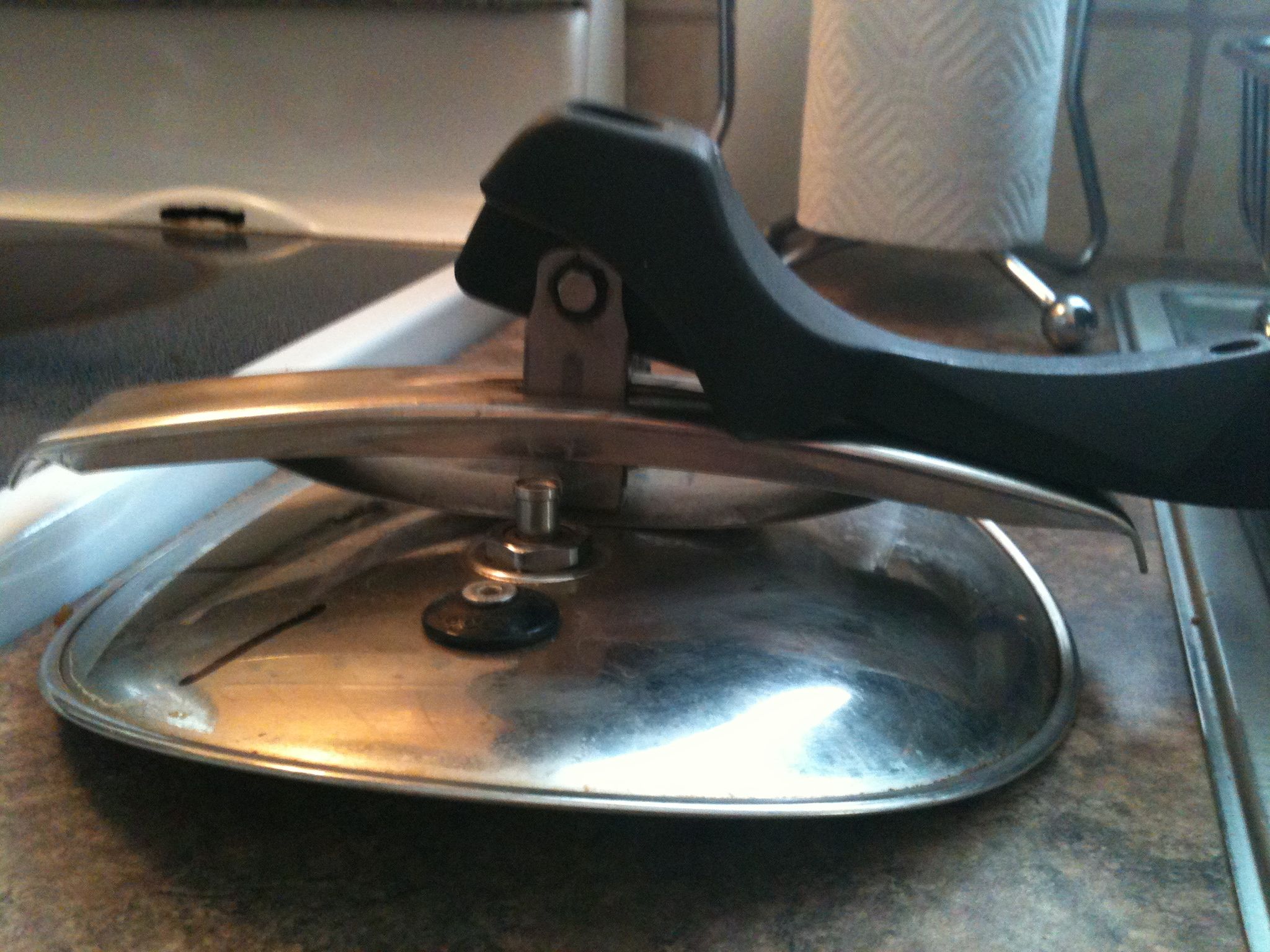
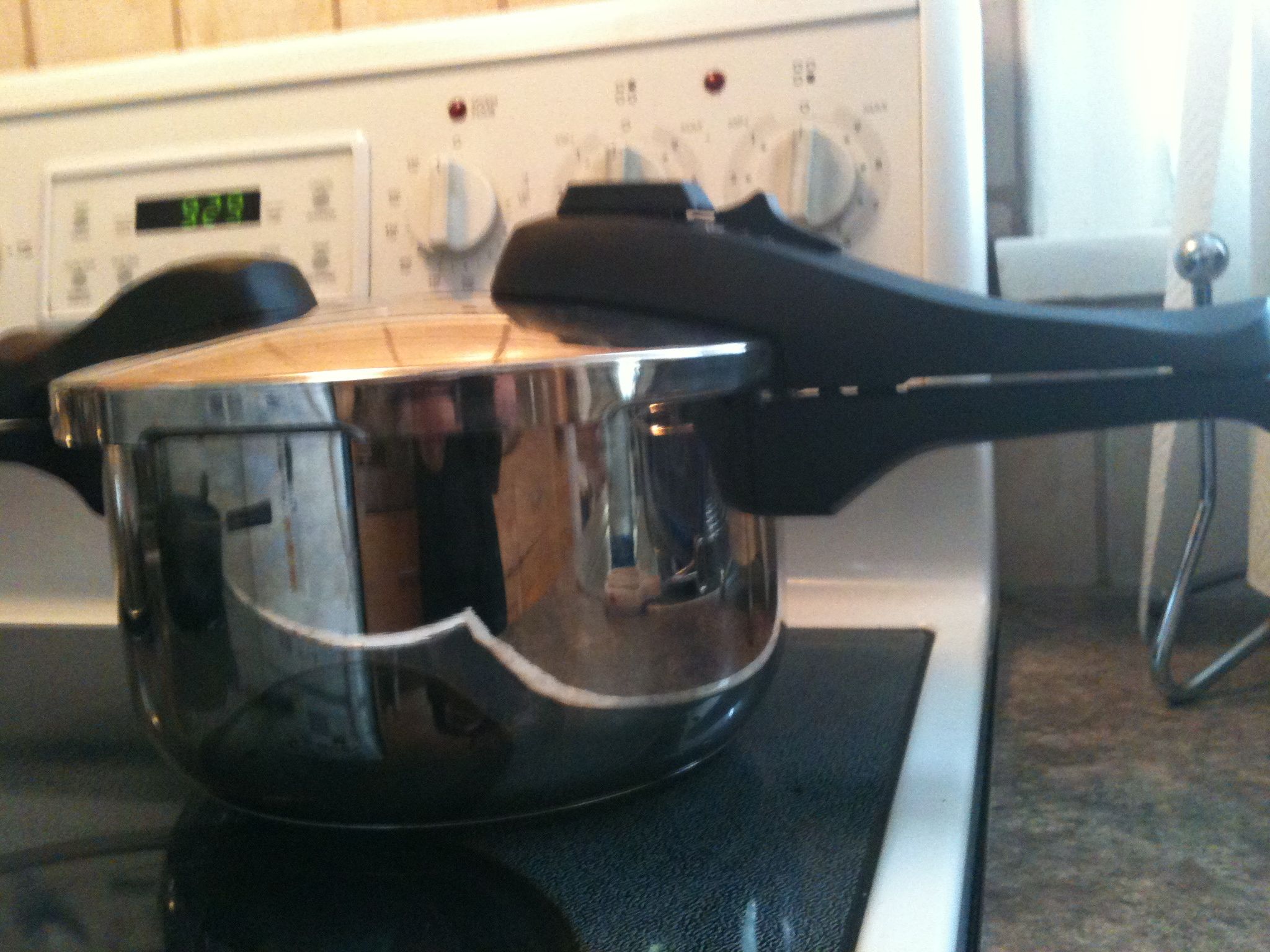
A little background: my old Lagostina pressure cooker, the one with the bendy lid that was such a pleasing puzzle to insert, served me uncomplaining and without maintenance for 30 years until last Feb 8th. I had a brief, unsatisfactory relationship with a model called Fresco. I say ‘brief’ but it felt interminable. Every morning was a new battle: the rice remained hard, the rice was swimming in water and half done, the lid wouldn’t go on, the lid wouldn’t come off. I grew crazed. I took it back for a  full credit. Then I looked up where to buy another Lagostina, but of course, it was not at all like the good old reliable bendy lid one. It was a new, improved model. In fact, it looked like the Fresco, but I had faith because it was a Lagostina.

Still I had a kind of residual post traumatic stress around the issue so I tackled the new problem warily but with confidence.

1. Removed lid, carefully aligned arrows, pressed down firmly with left hand, turned lid with right. Put pot on burner, turned heat on high, walked away.

Result: jets of steam, no pressure built.

2. Examined lid carefully, studied flanges of metal that were supposed to interlock, pressed yet more firmly, shut lid, turned heat on, walked away.

Same result.

3. Removed lid. Noted that the front handle seemed loose. Looked in vain for screws to tighten. Moved the Ohsawa pot more to the centre thinking it might be preventing a seal. Repeated #1.

Same result.

Vaguely remembered that human failing: if something doesn’t work, keep doing it, but try harder.

4. Maybe the inner pot was the problem. Removed Ohsawa pot, got out an old one, which isn’t as tall. Transferred rice, inserted in cooker and repeated #1.

Same result

Well, at least, I had eliminated one hypothesis.

5. Removed lid, took out gasket, studied situation, pressed it carefully back, repeated #1.

Same result.

6. Pulled out old bendy lid Lagostina, transferred rice pot. Glanced heavenward. Turned heat on.

Different result.  This time water bubbled out instead of steam. Well, what did I expect? The old thing was fatigued and told me so last Feb 8th.

7. Picked up the lid of the new cooker, shook it in admonition. It rattled. Took out the gasket. Ah, there they were -2 screws about half way out. Pulled out the heavy red tool box from under the sink, found the screwdriver with the star-shaped head, tightened those darned screws within a millimetre  of stripping them. Repeated #1. Leaned over the stove. Never mind the “watched pot” rule.

Result: a few seconds later, a soft sigh, the red-knobbed pressure indicator floated upward, I had 13 psi and in 50 minutes, I would have edible rice.

I also seemed to have fairly high blood pressure, but there was relief for that. I fired off an email missile-I mean missive- to Lagostina advising them to include a small screwdriver with their pressure cookers and clear instructions regarding loose screws.

Then, wouldn’t you know, turns out that other pressure cooker adherents of my acquaintance already knew that.

It’s Your Funeral

At a church funeral, the departed person’s first or ‘Christian’ name gets mentioned often. If it happens to be yours every mention is like the bell used in meditation or the little wooden gong struck while chanting. It wakes you up.

In this case, the shared name is unusual now, having dropped out of fashion and so, no doubt, both she and I regarded it as ours alone.

I did not really know her, although I had met her several times, but I knew her son. I see him several times a week and he reminds me of my own son whom I haven’t seen in too long. His mother and I were about the same age.

My initial reaction to her sudden and unexpected death was to rush home and put my own affairs in some better order. There I was nodding along in the fond expectation of another ten years or so when her death woke me up.

By the time, I had found parking and arrived at the church, it was jammed to the rafters. I know this because that is precisely where I sat, the high last row of the balcony where I had an excellent view of the wooden arches of the vaulted ceiling as well as the high stone- edged windows above the side aisles. The organ pipes were above my head and the audio control equipment was at the end of the row.

We rose as one as the processional music began. I was familiar with the order of progress: cross, clergy-four of them, choir, coffin and pallbearers. As a child, I had been part of the white robed choir. I recognized the rank of the clergy by their robes and I still remembered not only the melodies but also the words of the Anglican service. (Episcopalian, it would be called in the U.S.) And this church like the church where I sang was high Anglican.

“More Catholic than the Catholics,” my neighbour whispered.

It was an altogether beautiful experience musically and visually. The Bible readings were chosen to contradict death’s power and even included the well known line, “Death where is thy sting?” And the tribute was full of loving detail about my name sake’s life. Almost the entire congregation took communion, although I remained seated with two lapsed Catholics and a Jew.

I was struck by two things. One of them was that our lives had been very different. She had gone to the same church for probably her whole life and that meant that she had lived near it all her life. I had had over twenty addresses and I stopped going to church as a young mother. She had drawn hundreds of people to mourn her passing. Our family is given to memorials at a convenient date some time after cremation, modest gatherings, but someone is sure to bring a guitar.

The other thing that struck me was how my perspective had changed. When I was a church-goer and heard reference to God the Father, I accepted that a paternal eminence existed capable of granting protection and grace. Indeed He had graciously sent his only begotten son to ransom our souls. As I sat and listened, I was able to see this through the lens of the indwelling divinity I now understood. ‘Salvation’ has become more personal for me of late. That insight, which I cannot apparently articulate, made me happy.

I am very grateful to my name sake and wish her well on her journey. Through her, I got to have a funeral full of pomp and ceremony and exquisite beauty.

Blogging Makes Me Smart (and gets me a new Mac)

WordPress made me do it.  Well, strictly speaking it was Gravatar that gave me the final push. My WordPress dashboard urged me to upgrade Safari. I couldn’t. I had gone as far as I could go with the Snow Leopard, 10.5.8, operating system. Then Gravatar went into a loop when I tried to upload an image. I went off and sulked for a few days.

Blogging was way too hard for this old girl.

Anyway, I had actually published an ebook (my memoir, Never Tell, recovered memories…) on Kindle and Smashwords, so why complain about a few hitches? The Mac iBook G4 was just fine. All it needed was a better operating system. Hang on. Didn’t I buy a better operating system last year? Didn’t I buy a new battery last fall? Isn’t it time to stop sinking money into a 6 year-old computer?

You’re wondering why it took me so long. I could say thrift, but probably it would be more truthful to say fear. What was there to be afraid of, after all? These may be lean times but my bank is still unafraid. It longs to lend me money. And if I prorate what I spent buying the old computer, it works out to about $20 a month.

The Apple sales woman’s first response when I carried in the iBook, was, “Oh, that’s really old, but I’ve seen one before.”

Using her fine deductive skills, she spoke in terms of the Mac Book Air lasting me 5 years. I sought to establish a little more street cred by producing my iPhone and mentioning my iPod. What was less impressive was the fact that I couldn’t remember my Apple password.  I almost had it, but almost doesn’t make the grade.

So I came home with the beautiful slim laptop still in virgin condition and managed with my great nephew’s help to “migrate” all the stuff on the old computer. (Who knew “migrate” could be a transitive verb? Come to that, who knew what transitive is?)

The next day, I lost the dock, the Safari bar, every single page I tried to read and WordPress menu that runs down the left of this page on which I am writing this post. I could not scroll up or down by using 2 fingers on the trackpad or using the keyboard. (What happened to the up and down arrows on the right? What happened to the bar you could pull on?) Around dinner time, I lost it.

I raved on the phone to two sympathetic friends. Well, initially sympathetic. One kept saying, “why did they change it?” (She needs a new Mac Book.) The other one kept laughing at Apple and its overpriced products.

Before I opened the chardonnay, I phoned the store. Yes, I could still buy the 1 to 1 tutoring service and yes, they could probably squeeze in a few unbooked minutes of emergency help in just so I could finish this post.

What did I learn? Keep your fingers far away from the trackpad! Scroll by separating 2 fingers, holding the others aloft and pushing up or down and  put the cursor way up to the top to find the Safari bar-without clicking, good grief. And other good stuff that all you other Mac users already knew and all you young users were born knowing.

They say the brain forms new neural pathways when we challenge it. So I’ve worked it out, blogging makes me smart!