
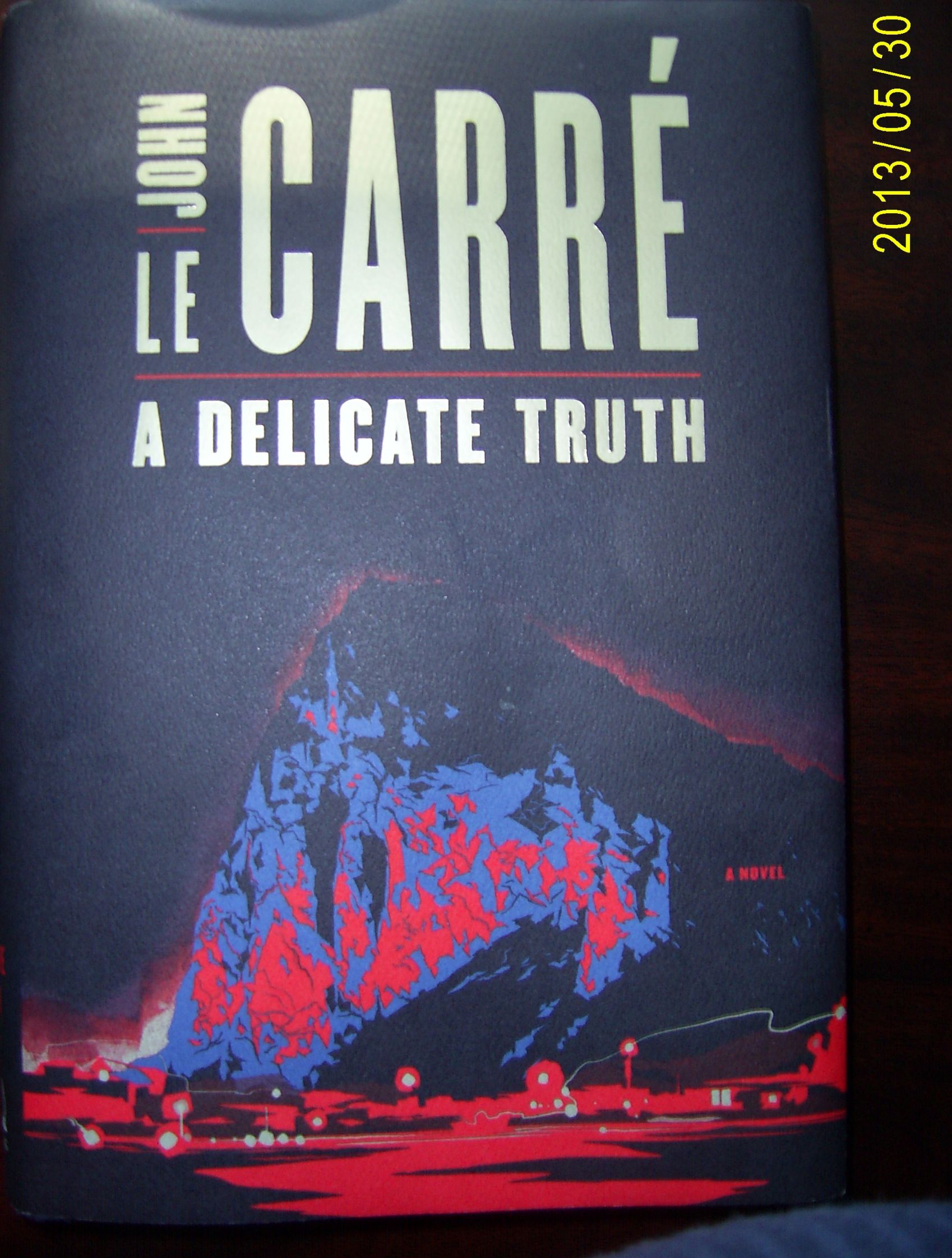
The Truth about Le Carré’s A Delicate Truth

SAMSUNG DIGITAL CAMERAOn Sunday May 26/13, I heard John Le Carré interviewed about his new novel A Delicate Truth. (free CBC app, Arts/Writers and Company podcast May, 26, 2013.) He agreed to do this interview because he had been interviewed by Eleanor Wachtel in 2010. He told her, once they were off the air that he would not be doing any more radio interviews. (This was a decision based on prior consideration and not a reaction to this interview, which he greatly enjoyed.)  So I consider myself fortunate to have chanced upon it as I drove home.

Indeed, I consider myself fortunate that he published this his twenty third novel, so fortunate that I tried to buy it several days before its release. Le Carré can be trusted to tell a good story and to do so with elegance and wit. But, looking over reviews of the novel, I found that not everyone agreed.

Most reviews began by referring to George Smiley, the protagonist of Le Carré’s breakthrough novel, The Spy Who Came in From the Cold as well as Tinker, Tailor, Soldier, Spy, the recent Gary Oldman movie. Once the Berlin Wall fell, readers wondered what Le Carré would write about. But, of course, there are always enemies, big pharma – The Constant Gardener, arms dealers – The Night Manager, unscrupulous bankers –Our Kind of Traitor. Spies were replaced by whistle blowers, but there was still intrigue enough for readers as well as plots that twisted and turned toward ambiguous endings. Yet some discontented reviewers lamented that these later novels lacked the subtlety and complexity of the earlier ones. The Globe and Mail reviewer of A Delicate Truth, Richard Poplac, declares that Le Carré “has reduced himself to writing a series of screeds”; he says about the writer’s recent protagonists, “not a word out of their mouths rings true” and calls the novel “a clunker”. Set against Poplac’s rant, were more positive comments; from the LA Times, “While some fans will miss the ambiguity of earlier books, A Delicate Truth delivers plentiful intelligence and thrills”.

George Smiley’s conundrum was whether or not he could preserve a modicum of humanity while serving his country or whether the compromises he would be forced to make in its service would make such inroads into his soul that he would be as bad as the enemy. Indeed those Cold War novels depicted the Western Intelligence Agencies as more or less morally equivalent to the KGB.

A Delicate Truth focuses on two men in the British Foreign Office who face the same challenge. We meet the first one in a hotel room in the British Crown Colony of Gibraltar under the name of Paul Anderson, going slowly mad as he awaits a phone call to tell him that the mission is underway.  “Paul” is a low flyer in the foreign office, a few years from retirement, “a violet by a rocky brook” sort of person: he has never attracted attention. The mission, once it gets underway, turns out to be the extraction of one code-named Punter who is about to buy missiles, “a jihadest equivalent of the Scarlet Pimpernel, an even wilier version of Osama Bin Laden” (National Post – 13/05/03). The land operatives are British soldiers, temporarily demobbed so as to be deniable, and the sea operatives are employees of an American private military outfit called Ethical Outcomes. Paul is there to act as “red telephone”, the eyes and ears of Fergus Quinn M.P. At the moment when the attack has to go or be called off, Paul heeds the advice of Jeb, the British soldier in charge, and refuses to give the go-ahead. Other, rasher heads prevail and, according to reports, the mission is a brilliant success. Punter, apparently, is spirited off to the American ship lying off-shore and suffers Rendition.

After that long first chapter, we find ourselves back in London witnessing the moral struggles of a younger foreign office minion named Toby Bell, who has bugged the office of his boss Fergus Quinn, and is about to retrieve the tape. Before we get there, though, we get Toby’s background. He is a thoroughly decent fellow who wanted to resign when Blair took the nation to war in Iraq under the false pretense of weapons of mass destruction. His mentor, Oakley, tells him, “Hyprocisy is the tribute that vice pays to virtue, dear boy. In an imperfect world, the best we can hope for.” Toby finds himself summarily shipped off to Madrid and the Cairo, rising with each step, until now fluent in Arabic, he returns to London to be Quinn’s private secretary, with a mandate from superiors to keep the Minister out of trouble.  Only thing is, Quinn never gives Toby a glimpse of what he is up to, hence the bugged office.

Of course Toby finds out something very troubling that has to do with a vaguely British operative named Jay Crispin and the American outfit, Ethical Outcomes.

Then we find ourselves years later in Cornwall, Le Carré’s home territory, watching Sir Christopher Probyn settle into his retirement as a benevolent lord of the manor personage. Wait a minute, isn’t this Paul! And doesn’t he magically run into Jeb, disgraced and reduced to “tinkering” and doesn’t Jeb have some awful here-to-for repressed information about what really happened in Gibraltar! What to do? Kit Probyn aka Sir Christopher aka Paul knows just the thing. Call that number he called before he met Fergus Quinn. The number belongs to Toby.

Thus the forces for good or at least for the truth begin to assemble. The third member of the group is Kit’s daughter, Emily, a doctor who treats the poor and needy in London’s east end. There we have the essence of the book: who will stand up for the individual who has been deemed unimportant, an acceptable loss in the face of the war on terror. And can the delicate truth be brought to light in the face of bureaucratic duplicity? Will the well-meaning opponents of officialdom find themselves declared traitors?

In a world where “War’s gone corporate” and intelligence is purchased from private spy agencies, truth becomes relative.

It is true that A Delicate Truth, like the other post-Cold War novels, lacks the irony of the Smiley books. Something changed so that Le Carré could no longer afford that detached point of view. Certainly 9/11 and the resulting War on Terror and the 2003 invasion of Iraq played a part in that. I find it hard to regret that.

A novelist is not a made-to-measure workman. He writes out of his soul and conscience. And I am very grateful to have yet another brilliant novel from Le Carré’s pen.

Blithe Spirit: frivolity in dark times

Starting on Sept 7, 1940, London was bombed for 57 consecutive nights. Between then and May 1941, it was blitzed 71 times, with a loss of 28,556 lives and a million buildings. Noel Coward’s office and home were destroyed. The actor, playwright and songwriter, who had worked in Intelligence for the war effort, went to Snowdonia in Wales in the spring of 1941 and wrote the play Blithe Spirit in 5 days. It premiered in Manchester in June 1941 and in London’s west end in July. First nighters walked across boards from a recently destroyed bomb shelter to get in the theatre door.

It seems outrageous that such a frivolous play could have emerged from such darkness, but that was Noel Coward for you, the man who sang “Let’s not be beastly to the Germans”, as you can hear if you Google his name and Blitz.

Phillip Hoare records in his biography of Coward that there was some feeling that it was not on to “make fun of death at the height of war” (Wikipedia), but black humour can salve the soul. Evidently, the play’s spiritualism and its assumption that, not only, is there life after death but that it is accessible won out.

And the play is very funny. I saw it performed at the Stratford Festival at Stratford, Ontario last Saturday and can attest to that.

The humour lies in the fact that the blithe spirit, the ghost of Charles Condomine’s deceased first wife, accidentally materialized by an inept medium, is visible and audible only to him. When he talks to her telling, for example, to shut up and get lost, his second wife naturally assumes, since there is apparently no one else in the room, that he is talking to her. Eventually, wife #2 begins to believe Charles’s protests that he is seeing a ghost and it seems as though they are settling in for a rather peculiar menage a trois, but the ghost wife has other plans. When we trooped back to our seats after the second break, the action took a darker turn until it arrived at an explosive end as Charles tiptoed off stage.

Coward’s snappy dialogue was declaimed in a suitably stagey manner by Ben Carlson, Seanna McKenna and Sara Topham. (Full disclosure – Ben is the son of a friend and Sara is his daughter in law.) The supporting characters added to the fun and the set was a beautiful country drawing room, capable of its own tricksy humour.

Coward drew his title from Shelley’s “Ode to A Skylark”, which I was pleased to discover is still part of the furniture of my mind, having been memorized at some point for credit – at least the first stanza and of course, stashed away in a remote dusty attic of that mind.

Hail to thee, blithe spirit,
Bird thou never wert
That from heaven or near it,
Pourest thy full heart in profuse strains of unpremeditated art.

Isn’t that just the way the world goes? Just when things feel grim as possible, some darned skylark or cardinal or robin or finch or red winged blackbird sets up a song that pulls us skyward.

The Great Gatsby: a personal response

Jay Gatsby and I go back a long way. No not to that hot summer of 1922, but to the hot summer of 1952. Having cycled to Burlington beach by myself, I lay in the sun reading Scott Fitzgerald’s The Great Gatsby for the first time. The 18 year-old boy I had given my heart to had, apparently, thrown me over, so I fell for Jay Gatsby instead. And got sunstroke. Next day, I was invalided home from my summer job on the ladies’ blouse counter and spent 3 days hallucinating lightshows, green and otherwise, and longing for a cool, blue pool.

That was just the beginning. Even after the boy came back into my life, became my husband and the father of my two children, Gatsby and I carried on and not clandestinely. I taught the novel to my grade 12 classes throughout most of my 35 year career as a high school English teacher. My husband and I began by believing Fitzgerald’s dictim that “living well was the best revenge” and ended by revising it to “eating well is the best revenge”. That was after the energy crisis and subsequent recession in the 70’s.

Meanwhile we lived in a house under a hill, where springs bubbled to the surface and pheasants called. We built rock gardens and planted bushes and trees for the birds. We planted a cedar hedge and built fences and dry stone walls. We sunk a pool beside the house. We bought a sailboat. We lived in a cul de sac and walked to work. We holidayed in Europe en famille.

Then Robert Redford’s Great Gatsby came out on film just in time for me to show it to my classes as my dream came apart.

It is many years later now, so many that I wasn’t sure I even had a copy of the novel. Not that I really need it since after so many repetitions I have virtually memorized it. But there it was beside Zelda’s novel Save Me the Waltz and Scott’s This Side of Paradise. I searched it out when I came home from watching Baz Luhrmann’s Gatsby.

In his Los Angeles Times review, Charles McNulty begins by remarking that from reading some reviews of Luhrmann’s Great Gatsby, “you’d think that the Australian… would be facing extradition for his crime against an American classic”. McNulty begins by calling the movie “relentlessly bouncy” and the CGI-enhanced opulence eye-tiring, but very soon, he concludes that it is a “diverting pop-culture riff that has as much to say about Fitzgerald’s novel as it does about the connection between two decadent eras, the Jazz Age and our own”. He goes on to illustrate how our perception of a classic, such as Hamlet, changes as we age and as the times we live in change.

I found myself an audience of one in a huge auditorium and absentmindedly wandered back out to pick up my 3D glasses. But no, this theatre was not equipped for 3D. Just as well, I got dizzy anyway. Yes, it was dazzling; yes, the party scenes were fantastic and overdone; yes, their effect was shallow and empty. (Wasn’t that the point?) True some of the music was Twenties -Gershwin’s ‘Rhapsody in Blue’- but much of it showed Jay Z’s hiphop influence, startlingly vital. For a brief moment I caught Beyonce singing Amy Winehouse’s ‘Black to Black’. And frankly, the window sequence at Myrtle’s Manhattan apartment was worth the price of admission.

Robert Redford in the 1974 movie was never my idea of Jay Gatsby. Too cool. Of course, Gatsby played cool but locked inside was James Gatz, the desperate poor boy and the bootlegger, the fellow rumoured to have killed a man. Di Caprio has more of that inner tension, so that when he strikes out at Tom Buchanan, it is not entirely unexpected. Daisy is hard to get wrong. Be beautiful and vulnerable and Carey Mulligan can do that. Indeed, Fitzgerald’s characters are not deep. Gatsby is mysterious, but not complex.

Christopher HItchens said that The Great Gatsby “remains great because it confronts the defeat of youth and beauty and idealism and finds the defeat unbearable and then turns to face it unflinchingly”.

Nick Carroway, the narrator, strengthened by his father’s midwestern upbringing, goes back to Chicago to work in finance, sobered but unbowed, Mr Luhrmann. He does not end up writing out his pain in a rehab centre. Just sayin’.

Spoiler alert: Gatsby and his creator died young. As indeed did Zelda Fitzgerald, Daisy’s prototype. At least Gatsby did not fall victim to alcohol, madness or fire. Having outlived his dream, that was probably for the best. But even to the last, Gatsby lived in hope, waiting for Daisy’s call. It was that hopefulness that made NIck call out, “You’re worth the whole damn bunch put together.”

Much to my surprise, I survived into old age in spite of opportunities not to. I survived loss and grief and illness that, each in its turn, felt unbearable. Gatsby has gone with me through the years, the real one in the book. Screen Gatsby’s are just for an afternoon.

Mother’s Day

95994044Here’s to all the women who are mothers but didn’t get celebrated (or not to their satisfaction).  Here’s to those who mother other people’s children. Here’s to bereft mothers. Here’s to those who want to be mothers but are not. Here’s to cat mothers and dog mothers. Here’s to all those of whatever gender who follow the Great Mothering principle of the world.

The crab apple blossoms made a fuchsia display of themselves next to the more demure apple blossoms this weekend in our town. Down by the river, the unselfconscious swans swam right to my feet.

swans

Once again Georgia loaned me her family, although I was chastised that, in fact, it was always my family and of course was and is. As it turned out all the men had to be elsewhere with other mothers or working and so we were seven women and a six month old baby girl at the round brunch table, one of us, very much a mother-in-training at 11. There was an almost-teenaged boy hiding out somewhere and two younger girls, who had written loving tributes to “the best mother in the world”. She needs that positive reinforcement. She is the only mother doing baby-duty.

One of the absent men had precooked most of brunch and a young aunt grilled the French toast. We had champagne.

trillium enlarged

Happy Mother’s Day!

Farewell to Old Filth: Jane Gardam’s Last Friends

SAMSUNG DIGITAL CAMERA

“You have to buy this, my friend said, thrusting Jane Gardam’s Old Filth at me.

We were standing at a table full of donated second-hand books, a fundraiser for our club.

“Why would I want to read a book called Filth”?

“Because it is very funny and a terrific read. Filth stands for “Failed in London Try Hong Kong. It’s about the Brits who went East to manage the British Empire.”

I read Old Filth and loved it. I searched out its sequel The Man in the Wooden Hat, and when the last of the trilogy, Last Friends, came out a few weeks ago, I devoured it. Then I started at the beginning and read them all again.

Sir Edward Feathers QC, a renowned judge by the end of his career, begins by “failing” in London and ends as a wealthy lawyer in Hong Kong. He is tall, good looking, always immaculately turned out – the first paragraph of the first book establishes this – and invariably called Filth, even to his face. He began life as a Raj orphan, a child of a Brit in the foreign service, sent home to England at 5 to live apart from his parents and to go to school. Like his cousins and the woman he eventually marries, Elizabeth Macintosh, and many other such children, his personality is shaped by that experience. Eddie and his cousins have a particularly bad start because their foster mother is such a sadist that the children wish her ill- with spectacular success.

These children know duty and loyalty but very little warmth and affection. The third main character, Terry Veneering, comes from a “lower” class, is brought up by loving if poor parents, is capable of love and spontaneity and is, of course, universally looked down upon as crass, despite the fact that he is every bit as successful as Filth both in Hong Kong and England. He is also Filth’s arch rival in love and law, but by a quirk of fate, ends up living next door to him in retirement. When he finds this out, Filth thinks to himself, “Well, thank God, Betty is gone.”

So it is not a spoiler to report that the novels end in death. Indeed they begin with death and only then go back to report the anarchic beginnings before World War II -Eddie’s childhood – and shortly after the war – his marriage to Betty in Hong Kong with a few glimpses of life at the height of his career and retirement to Donheads St Ague, in Dorset, southern England.

How can novels that begin with death be so entirely upbeat and genuinely funny? A secret known only to those of us like Gardam who have reached a certain age? (80 is the new 50!)

Gardam writes in episodes and flashbacks and uses incremental repetition. Some events like the wedding and Betty’s sudden death in her tulip bed are described more than once, sometimes in the same words but always with additional insight and variations on the initial telling. Old Filth tells Edward’s story, The Man in the Wooden Hat is more from Betty’s point of view and Last Friends is mostly Veneering’s although two peripheral characters, Dulcie and Fiscal-Smith, survive the other three and it is they from whom the novel takes its title. Or perhaps not. Perhaps in the end, even enemies are friends, at last.

The reviews for Last Friends are a mixed bag – some raves, some forgiving and some absolute pans – but personally, I wouldn’t take tea with those who panned it. Courtney Cook in the Los Angeles Review of Books (April 18, 2013) “Read Jane Gardam”, began by introducing readers to Gardam’s Queen of the Tambourine (1991), Crusoe’s Daughter (1985) and God on the Rocks (1978), before she gets to the trilogy. She calls Gardam’s books “a taxonomy of madness” by which she means “extreme confusion due to circumstances you can’t understand, can’t control and can’t possibly have foreseen”. Eddie Feathers, for example, is evacuated from wartime England to safety with his father who is serving in Shanghai. It takes months for his ship to near its destination just in time for the fall of the colony and, so, Eddie finds himself England-bound once more. Before he is carried off on a stretcher, he has spent the better part of a year on one ship or another. There are all sorts of dire happenings referred to – Japanese internment camps, bombing raids, ships torpedoed -if not actually depicted, but always with Gardam’s sure touch. Courtney Cook says one of the writer’s strengths is the way she handles death: “People die left and right in her books … and it’s horrible and it’s funny in that way that makes you feel badly and then all right again.”

Whenever I am reading a Jane Gardam novel, I feel optimistic and even happy about life.

I loved Last Friends because it gave me more of three characters I had come to like. I learned about Veneering’s early life in Herringfleet and the series of miraculous choices and interventions that kept him alive and prosperous into his old age, and, I suppose, because the trilogy muses on aging, an experience one finds oneself caught up in willy nilly despite the eternally youthful inner self.

Jane Gardam said, “What I don’t want is to be called an octogenarian. I saw ‘Octegenarian Jane Gardam’ and I thought ‘Blow me!’ I mean I am but that’s not the point.”