
The Voice in the Mirror

“I liked the voice,” she said. “I’ve never heard that voice before.”

She had read the manuscript of my memoir, which eventually became an ebook, Never Tell: recovered memories of a daughter of the Temple Mater and she meant the narrator’s voice.

Since it was my daughter speaking, it seemed likely that she had heard all my voices, so I kept my protest to myself. I did, however, ask myself how it was different and I came to an interesting conclusion.

It was a survivor’s voice, certainly, but not a grim survivor, nor even an exhausted one, more like a bouyant survivor bobbing to the surface.  When I thought of the events of my childhood, I might feel grim and exhausted as well self-pitying, sad and angry, but when I wrote, I spoke in a different voice. “Upbeat” doesn’t describe it, nor even “darkly humorous”. It was the voice of the child I was, striding forth, sailing through, undeterred. It wouldn’t even be right to say “determined”. There was more ease to it than that. It was more like a fixed assurance that in spite of everything, all would be well. In fact, it owed a great deal to my Aunt Mae, whose joyful optimism shaped it.

I was surprised to discover that it was not just the recitation of  past events, but finding that voice that had made writing the story such a healing experience.

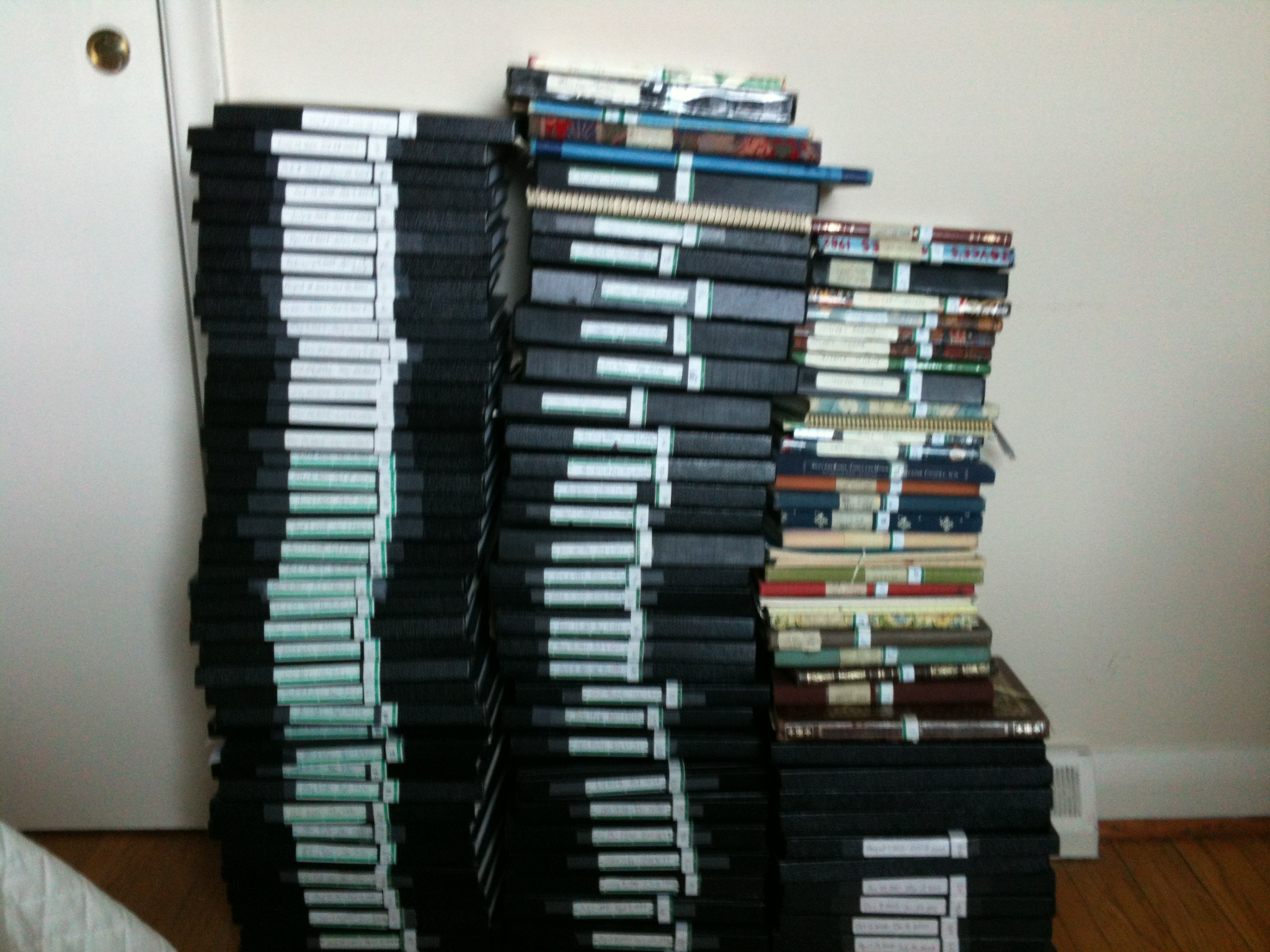
I speak with many voices in the 115 journals I have written so far, some familiar and some distinctly foreign. Who was the person? How could I have written that? On the other hand, where did this admirable, independent, confident self go to? That’s the great thing about writing consistently in a journal. You see yourself whole, developing and changing, in all your complexity and subtlety. You experiment with tone and attitude. One day’s entry is cutting wit, another a scathing rant and yet another a melancholy dirge.

A part of myself I discovered while writing the memoir was one that felt deep compassion for my little self. I wrote, “Ah, young Joyce, here we are again. Why have I ever feared you or sought to silence you? Let us sit together this night and tomorrow and as long as it takes, listening. When there are no words, we will listen to the feeling. Feelings are no less real because they are not named. We will be together. Steadily, steadily we will listen and gaze upon this pain and the sound of our listening and the light of our looking will mend us.”

Who are you ignoring? In that pantheon of personas (personae?) that make up you, which silenced voice, seeking expression, could help you hear yourself?

Free and frequent writing can discover such voices and they can lead us to self-discovery. A journal is a mirror that lets us see and hear what we are.

Why Keep a Journal #2: Journal as Mirror

King Lear retired from his job and came undone. “Who is it,” he cried in his anguish, “can tell me who I am?”

Good question and one we all come to eventually. The child starts school, the kid leaves for college, our lifelong love is gone, our home is lost, our career is over, the ground we stood on so solidly gives way like quicksand and we are left like Lear asking who am I?

Or it could just be a birthday with a number that boggles the mind. Having survived some of the former, I was ambushed by the latter a year ago. As I passed the hall mirror, it caught me unaware.  Whoa! Is that me? Not possible. I felt as if the last time I looked, I was about 35 years old,clear skinned, unlined, bright eyed. Who was this looking back at me? This was a woman with a high number of birthdays.

Ordinarily, I don’t put much stock in mirrors, using them mainly for check for tidiness and signs of dishevelment. A few years ago I fell out with them to the extent that I hung scarves over the few I had. There was such a disconnect between how I felt I looked and what they reported that I preferred to rely on my inner vision.

Now this hall mirror, had shaken my idea of what I was. Then photographs sitting here and there began to catch my eye: a kodachrome summer girl of eighteen, a black and white 22 year old in a scholar’s robe, a New Year’s mother with children, a fujicolored grandmother. I didn’t feel as if I were the woman in the mirror, but I was clearly none of these people either.  Who was I then?

In my pursuit of an answer, I avoided the mirror, put away the pictures and bought a new pair of jeans, before finally taking up a pen to explore the question. What I wrote turned itself into a poem, which ended with this stanza:

There is no pleasing mirror now

except this looking glass of words.

Here I may catch a fleeting glimpse

of clear bright core

of inner being.

Ah, so that’s why my perception of myself has not diminished with age. What I am seeing is the undying beauty of the real Self.

The answer to the question “who am I” is never a simple one: mother, wife, husband, father, teacher, tinker, tailor, spy, not even philanthropist or humanitarian. A human being is not one-dimensional. We are not just whatever role we are currently playing or find ourselves trapped in at the moment. Lear discovered that when he gave away his kingdom and lost his status. We are creations in progress, an epic novel we are still in the process of writing. Who can say what the theme of that novel is in a few words?

One of the ways to explore this complex question is to write, the more often the better. By writing we discover not only what we know but what we think and ultimately, what we are. Any creative process will give us insight, but if your inner artist, performer or composer isn’t ready to debut, write a journal as a beginning.

Why Keep a Journal

My creative writing students used to spend the first twenty minutes of class warming up by writing in their journals.  One of them attacked her journal angrily every morning, addressing her entry, “Dear Constance”. I didn’t actually read what they wrote, but I noticed the daily salutation when she presented her journal for page count. The implication I took was that I was a constant pain in the neck, but still I found it touching. Constance sounded like an ideal reader, patient, loyal and non-judgmental. If I envisaged a reader for my 115 journals, it would be Constance.

I don’t actually. I don’t expect they will ever be read except by me. I can imagine my survivors wondering what in the world to do with them, but I do not see them sitting down to read.

So why do I do it? What motivates me to spend the first half hour of every day writing to myself?

Possibly it’s pathological, a case of hypergraphia, in which case I am in the excellent company of van Gogh, Dostoevsky and Lewis Carroll. I don’t seem to suffer from damage to the cerebral cortex, but then neither did they. Let’s assume that the cause is more benign on the grounds that I could quit if I wanted to. (Honest.)

Like many people, I live alone. Statistics show that many more people do today; as many as 40% of American households are made up of one person and that rises to 50% for women over 75. Like many of these people, I’m used to it and I don’t feel lonely, but I miss having someone to talk to about my daily life. Talking helps me put things in perspective,  clarify my thoughts, make decisions, and enjoy myself. Talking was how I came to understand my life when I was living with others. Now I talk to my journal.

When I was 12, I was given a little diary with a padded faux leather cover and a metal clasp that I could lock against intruding eyes -siblings, mother- in which I recorded the weather for two weeks and not much else. I begin the same way now, checking the present and predicted temperature. (Is this just another obsession or the rational result of living in Toronto?) I review the day before and look over my plans for the day to come. I record my dreams if I remember them, but I don’t pretend to be as good at that as my sister who says she does that every day. (Yes, she also keeps a daily journal. Is it genetic?) I note my response to the day’s stresses, my physical and mental health, the causes thereof and strategies for coping. I examine relationships when necessary. Then to exercise my short term memory, which has never been very good, I record what I have read or watched on television.

There are practical results to having such a record.  What was that particular mystery by Lee Child about? When did I have a bone density test? How exactly did that diagnosis proceed? What was the date of that short-lived, registry office wedding? Apparently, the long delayed divorce cannot proceed until the date of the marriage is established.  Ah, yes, journal #18, August 1986. I am the family archive keeper.

But it didn’t begin that way. It began with a hard covered “Dominion blue line” record book which I bought for 2.75, the same day that I bought “Raindrops Keep Falling on My Head”. It contains sporadic entries, centered mostly on the angst of seeking job promotion, but there are lovely details of my children’s reading -Tales of Mother West Wind, riding home in the MG with the top down in the rain, the orange lilies in the rock garden, the mountain ash berries, until that dire event, when life in the house under the hill came to an end. I began the second journal 8 years after the first and it is entirely in poetry, yet a daily record of what I felt following my separation. By journal #5, I am back to prose, “a record, a scientific basis for discovery and judgment”. What can I say? I don’t actually recognize the person who wrote those early journals.  That is one of the miracles of journal writing.  I see how much I’ve changed. Of course, I’m way better now or at least my prose is not as wordy.

So the books began to accrue, small, brightly colored, easily carried into coffee shops at first, then at journal #33, black, 8 by 11, sketch books of acid free paper. Last Christmas my sister gave me a light blue sketch book (#114) and a lime green one (#115) saying it was time I swore off black. Now they make an untidy, hard to access pile, demanding their own bookcase.

I did use a computer for a number of years, although I prefer the tactile experience of an actual book. At the time, I printed entries as well and I’m glad I did because when my computer died without warning, I  lost several years of entries.

So here’s what I think: you should start a journal if you don’t already keep one.  (If you do, you should keep on.) You’ll get a confidante who can keep a secret, improve your memory and gain clarity. “The unexamined life,” Socrates said, “is not worth living.”